Chapter 9 — Eigen Decomposition
Linear Algebra and its Applications · IISc 2024 · typeset reproduction
The Spectral Theorem
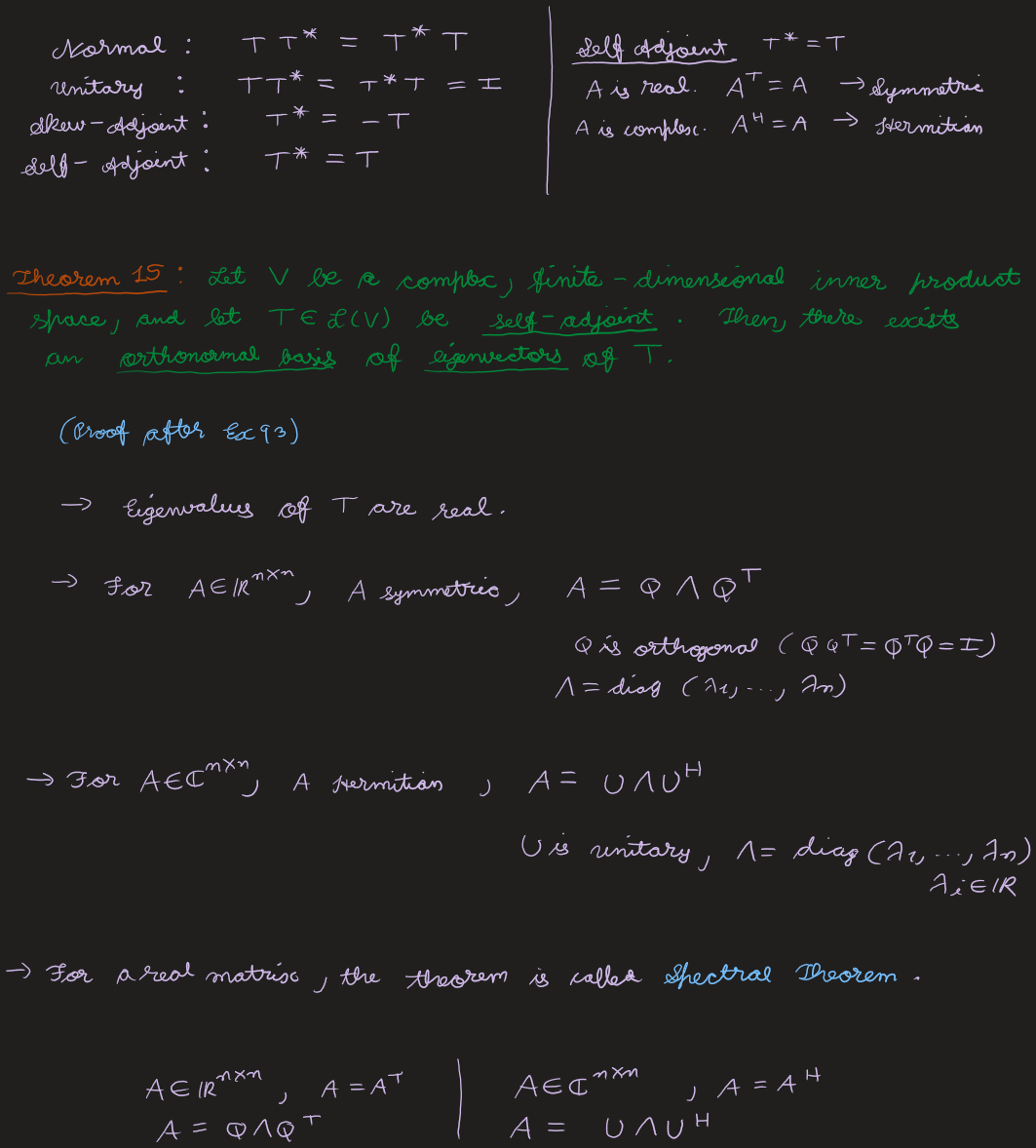
Recall the classes of operators:
- Normal: \( TT^* = T^*T \).
- Unitary: \( TT^* = T^*T = I \).
- Skew-adjoint: \( T^* = -T \).
- Self-adjoint: \( T^* = T \). For a matrix \(A\): if \(A\) is real, \( A\T = A \) (symmetric); if \(A\) is complex, \( A\herm = A \) (Hermitian).
Theorem 15 — Spectral Theorem
Let \(V\) be a complex, finite-dimensional inner product space, and let \( T \in \Lin(V) \) be self-adjoint. Then there exists an orthonormal basis of eigenvectors of \(T\). (Proof after Ex 93.) The eigenvalues of \(T\) are real.
- For \( A \in \R^{n\times n} \) symmetric, \( A = Q\Lambda Q\T \), where \(Q\) is orthogonal (\( QQ\T = Q\T Q = I \)) and \( \Lambda = \diag(\lambda_1, \dots, \lambda_n) \).
- For \( A \in \C^{n\times n} \) Hermitian, \( A = U\Lambda U\herm \), where \(U\) is unitary, \( \Lambda = \diag(\lambda_1, \dots, \lambda_n) \), \( \lambda_i \in \R \).
For a real matrix, the theorem is called the Spectral Theorem: \( A = A\T \Rightarrow A = Q\Lambda Q\T \), and \( A = A\herm \Rightarrow A = U\Lambda U\herm \).
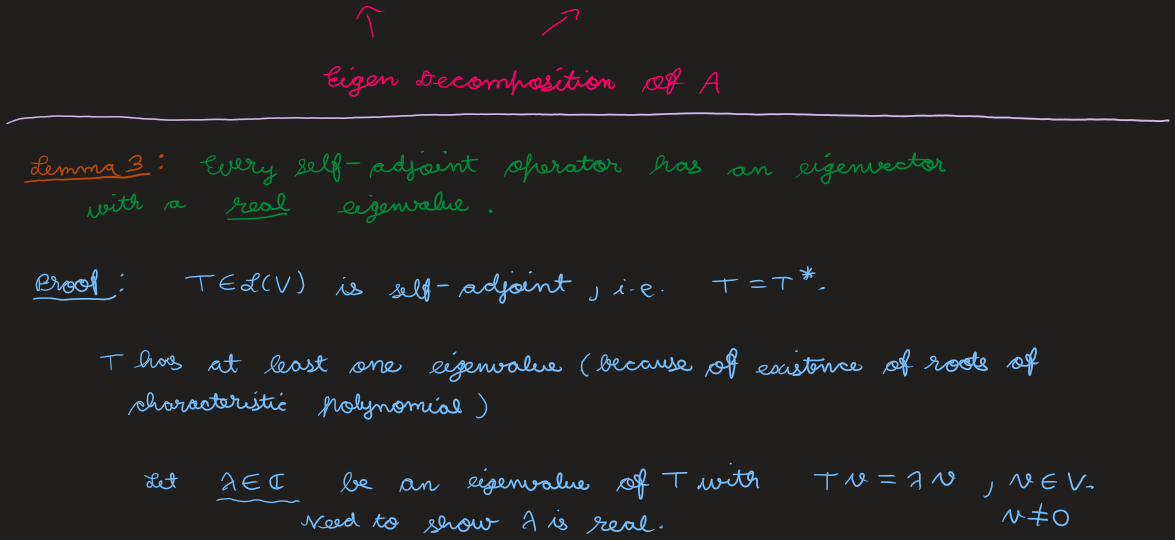
Lemma 3
Every self-adjoint operator has an eigenvector with a real eigenvalue.
Proof
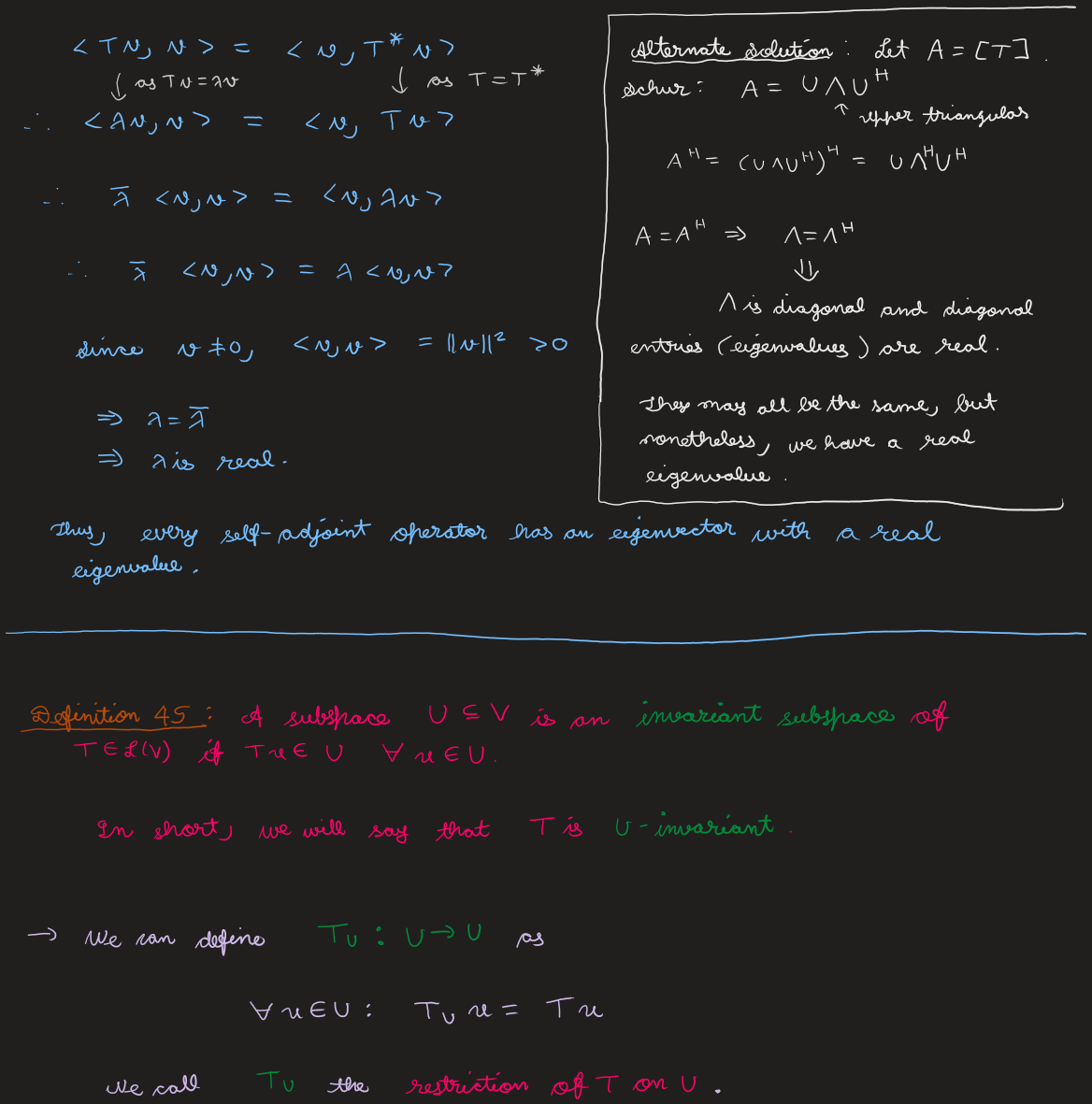
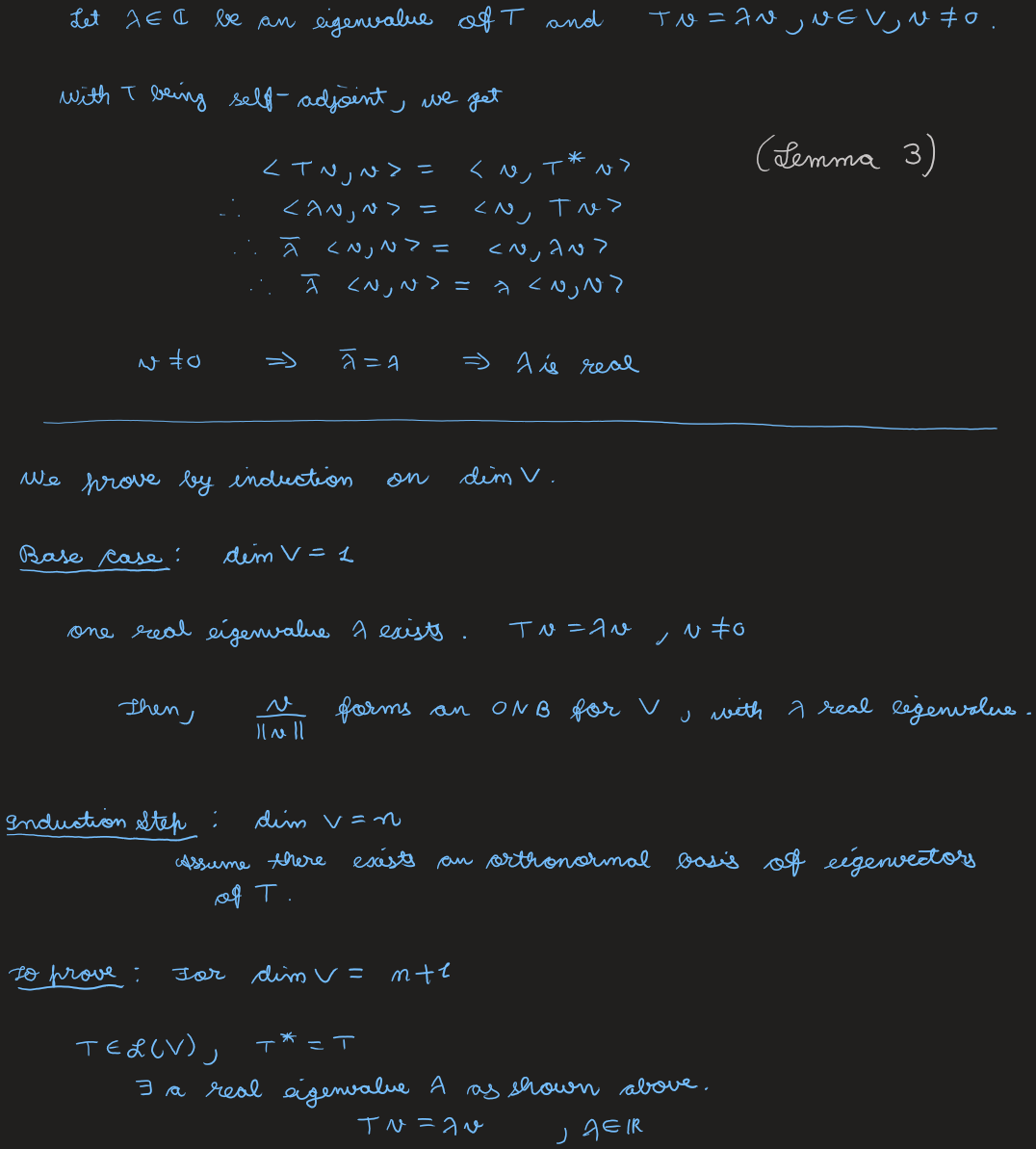
\( T \in \Lin(V) \) is self-adjoint, i.e. \( T = T^* \). \(T\) has at least one eigenvalue (by existence of roots of the characteristic polynomial). Let \( \lambda \in \C \) be an eigenvalue with \( Tv = \lambda v \), \( v \in V \), \( v \neq 0 \). We show \( \lambda \) is real: \[\begin{aligned} \langle Tv, v \rangle = \langle v, T^*v \rangle &\implies \langle \lambda v, v \rangle = \langle v, Tv \rangle \\ &\implies \overline{\lambda}\langle v,v\rangle = \langle v, \lambda v\rangle \\ &\implies \overline{\lambda}\langle v,v\rangle = \lambda\langle v,v\rangle. \end{aligned}\] Since \( v \neq 0 \), \( \langle v,v\rangle = \|v\|^2 > 0 \), so \( \overline{\lambda} = \lambda \), i.e. \( \lambda \) is real.
Alternate solution. Let \( A = [T] \). By Schur, \( A = U\Lambda U\herm \) with \( \Lambda \) upper triangular. Then \( A\herm = (U\Lambda U\herm)\herm = U\Lambda\herm U\herm \), and \( A = A\herm \Rightarrow \Lambda = \Lambda\herm \), so \( \Lambda \) is diagonal with real diagonal entries (the eigenvalues). They may all be the same, but nonetheless we have a real eigenvalue.
Definition 45 — Invariant subspace
A subspace \( U \subseteq V \) is an invariant subspace of \( T \in \Lin(V) \) if \( Tu \in U \ \forall\, u \in U \). In short, we say \(T\) is \(U\)-invariant. We can define \( T_U : U \to U \) by \( T_U u = Tu \ \forall\, u \in U \); we call \( T_U \) the restriction of \(T\) on \(U\).
Ex 92
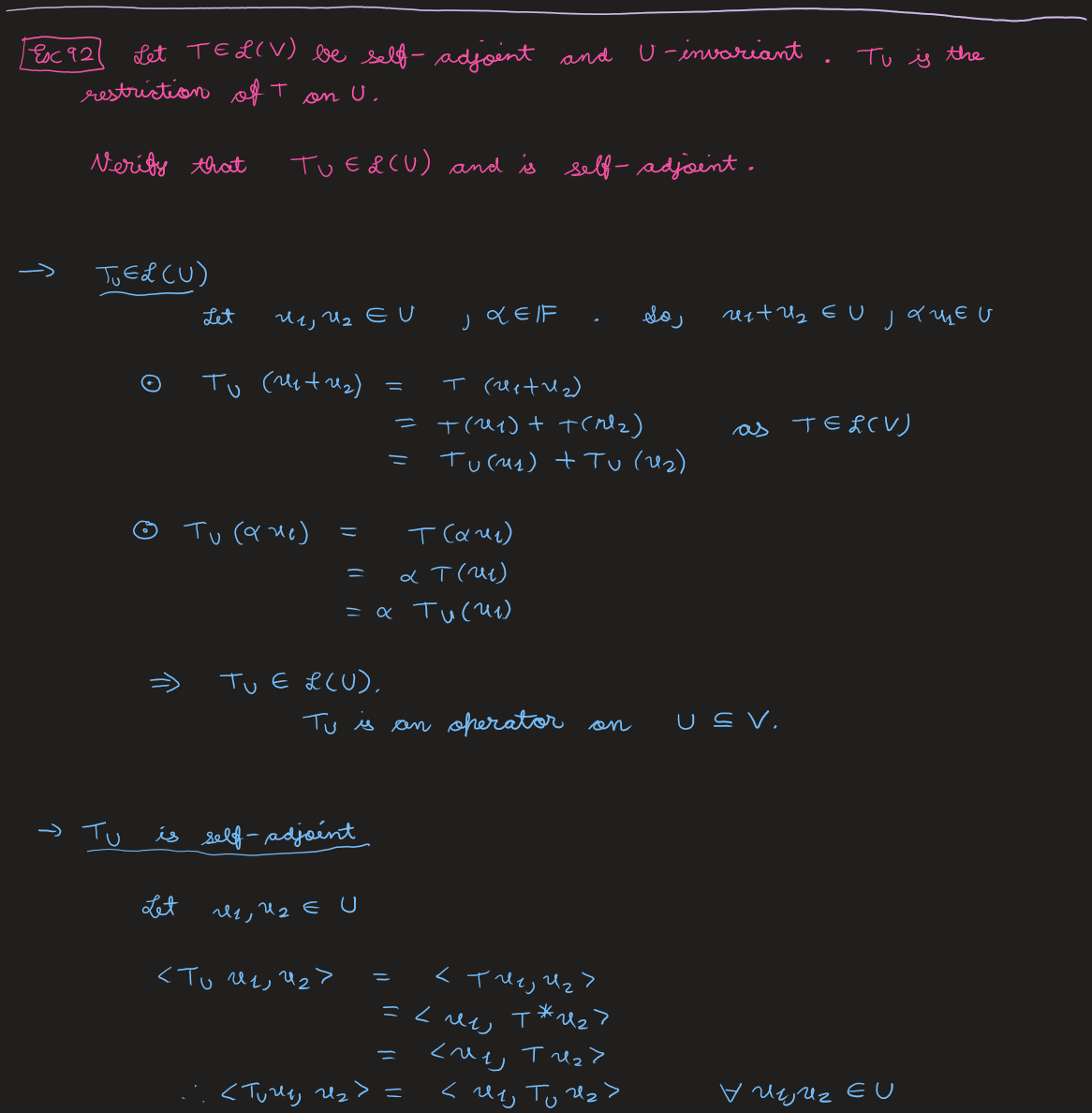
Let \( T \in \Lin(V) \) be self-adjoint and \(U\)-invariant, with \( T_U \) the restriction of \(T\) on \(U\). Verify that \( T_U \in \Lin(U) \) and is self-adjoint.
Solution
\( T_U \in \Lin(U) \). Let \( u_1, u_2 \in U \), \( \alpha \in \F \) (so \( u_1 + u_2 \in U \), \( \alpha u_1 \in U \)). \[\begin{aligned} T_U(u_1 + u_2) &= T(u_1 + u_2) = T(u_1) + T(u_2) = T_U(u_1) + T_U(u_2), \\ T_U(\alpha u_1) &= T(\alpha u_1) = \alpha T(u_1) = \alpha T_U(u_1). \end{aligned}\] So \( T_U \in \Lin(U) \) — an operator on \( U \subseteq V \).
\( T_U \) is self-adjoint. For \( u_1, u_2 \in U \), \[\begin{aligned} \langle T_U u_1, u_2 \rangle &= \langle T u_1, u_2 \rangle = \langle u_1, T^* u_2 \rangle \\ &= \langle u_1, T u_2 \rangle = \langle u_1, T_U u_2 \rangle \quad \forall\, u_1, u_2 \in U, \end{aligned}\] so \( T_U^* = T_U \).
Ex 93
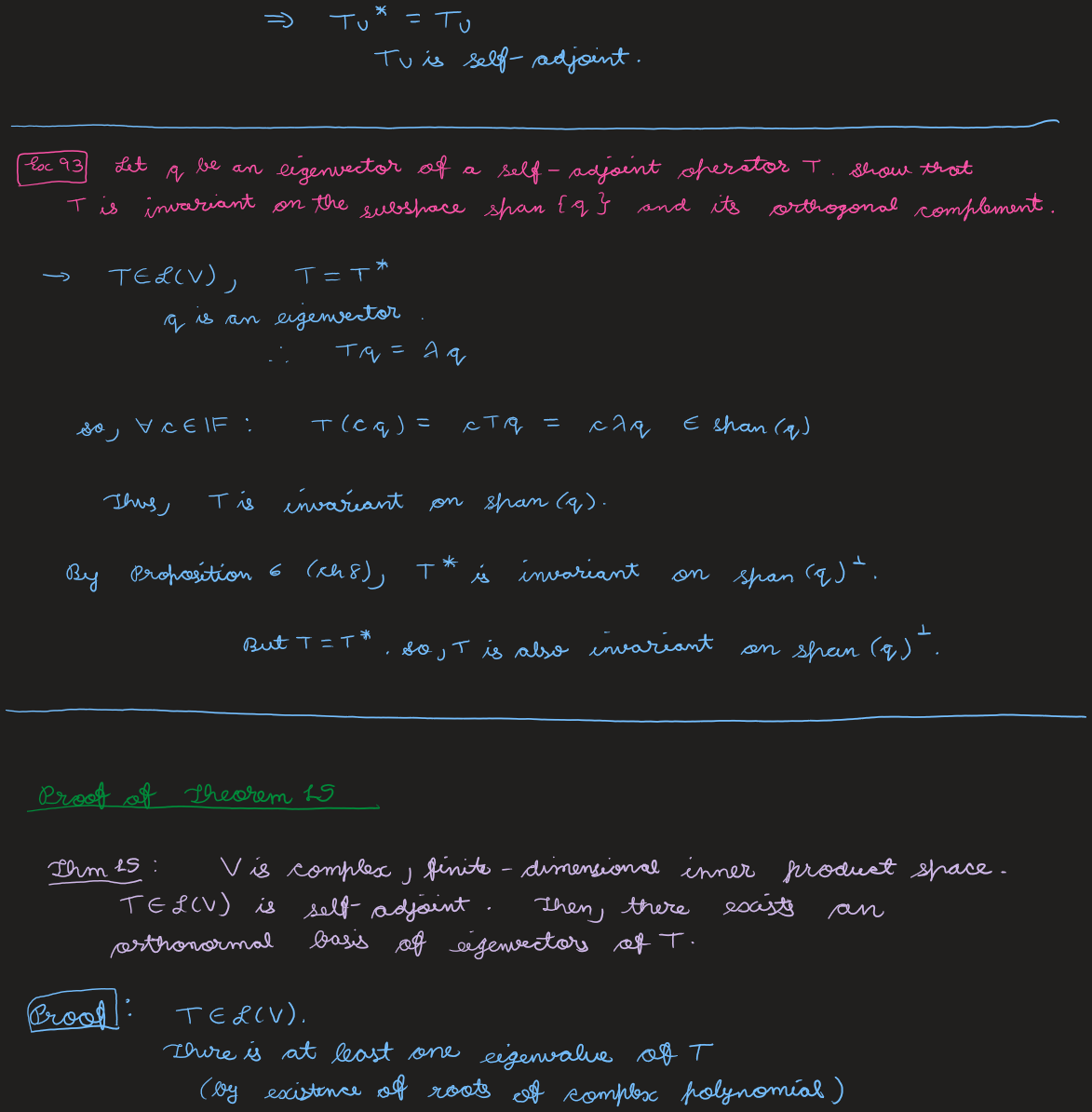
Let \(q\) be an eigenvector of a self-adjoint operator \(T\). Show that \(T\) is invariant on the subspace \( \operatorname{span}\{q\} \) and on its orthogonal complement.
Solution
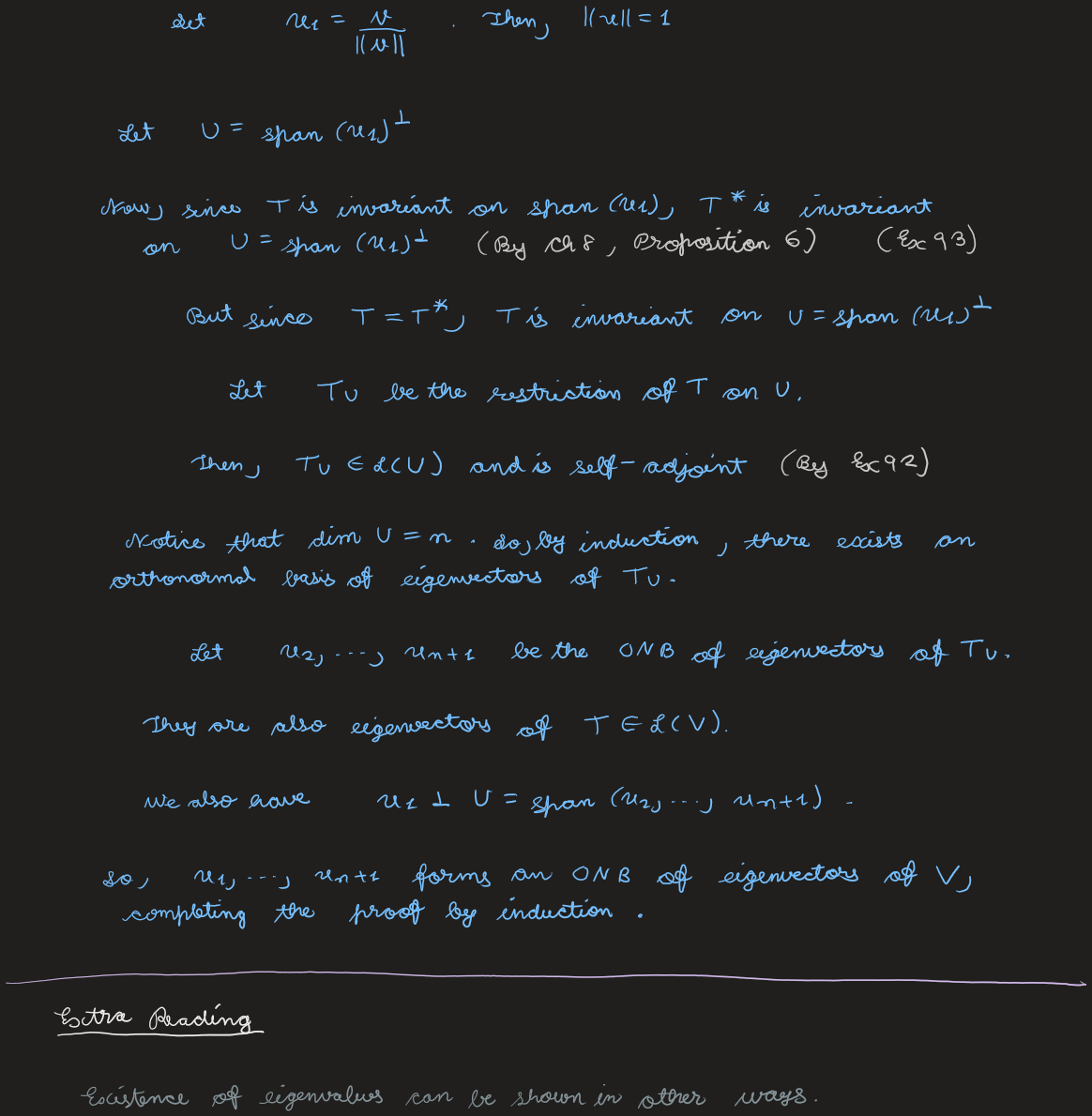
\( T \in \Lin(V) \), \( T = T^* \), \( q \) an eigenvector so \( Tq = \lambda q \). For any \( c \in \F \), \( T(cq) = cTq = c\lambda q \in \operatorname{span}(q) \), so \(T\) is invariant on \( \operatorname{span}(q) \). By Proposition 6 (Ch. 8), \( T^* \) is invariant on \( \operatorname{span}(q)^{\perp} \); but \( T = T^* \), so \(T\) is also invariant on \( \operatorname{span}(q)^{\perp} \).
Proof of Theorem 15
\( T \in \Lin(V) \) has at least one eigenvalue (existence of roots of the complex polynomial). Let \( \lambda \in \C \), \( Tv = \lambda v \), \( v \neq 0 \). By the argument of Lemma 3, \( \lambda \) is real. We prove the claim by induction on \( \dim V \).
Base case \( \dim V = 1 \): one real eigenvalue \( \lambda \) exists, \( Tv = \lambda v \), \( v \neq 0 \). Then \( \tfrac{v}{\|v\|} \) forms an ONB for \(V\), with \( \lambda \) real.
Inductive step. Assume the result for \( \dim V = n \). For \( \dim V = n+1 \): \( T \in \Lin(V) \), \( T^* = T \), with a real eigenvalue \( \lambda \) and \( Tv = \lambda v \). Let \( u_1 = \tfrac{v}{\|v\|} \) (so \( \|u_1\| = 1 \)) and \( U = \operatorname{span}(u_1)^{\perp} \). Since \(T\) is invariant on \( \operatorname{span}(u_1) \), \( T^* \) is invariant on \( U = \operatorname{span}(u_1)^{\perp} \) (Ch. 8, Proposition 6; Ex 93); and as \( T = T^* \), \(T\) is invariant on \(U\). Let \( T_U \) be the restriction of \(T\) on \(U\); then \( T_U \in \Lin(U) \) is self-adjoint (Ex 92). Now \( \dim U = n \), so by induction there is an ONB of eigenvectors of \( T_U \), say \( u_2, \dots, u_{n+1} \); these are also eigenvectors of \( T \in \Lin(V) \), and \( u_1 \perp U = \operatorname{span}(u_2, \dots, u_{n+1}) \). So \( u_1, \dots, u_{n+1} \) forms an ONB of eigenvectors of \(V\), completing the induction.
View original handwritten scans — Spectral Theorem, Lemma 3, Ex 92–93 & proof (pages 1–8)
Rayleigh Quotient
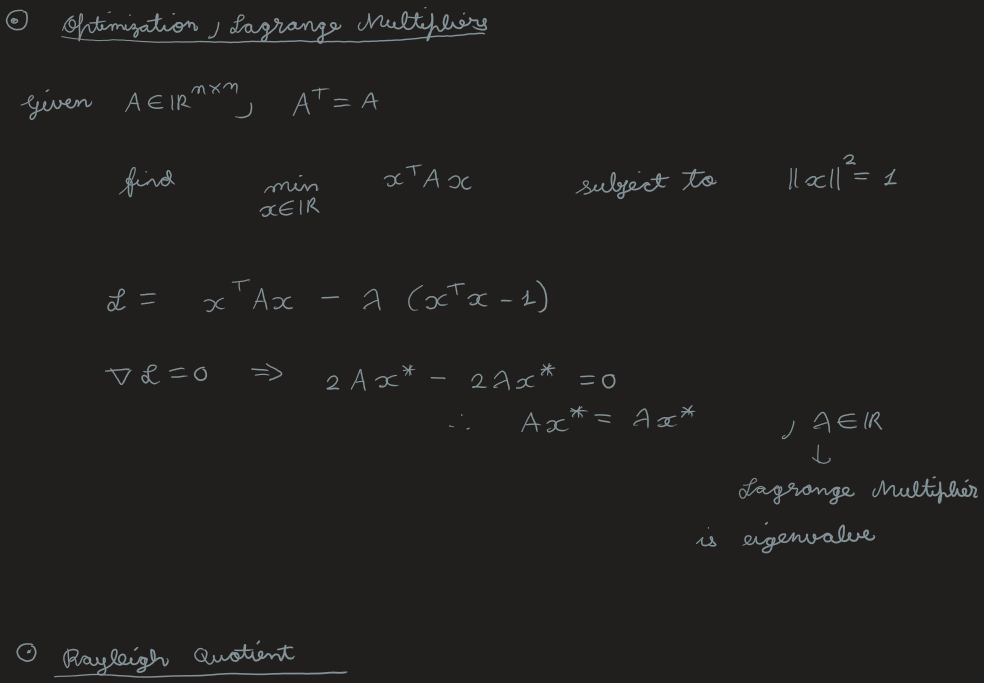
Optimization / Lagrange multipliers. Given \( A \in \R^{n\times n} \) with \( A\T = A \), find \[ \min_{x \in \R^n} x\T A x \quad\text{subject to}\quad \|x\|^2 = 1. \] The Lagrangian is \( \mathcal{L} = x\T A x - \lambda(x\T x - 1) \), and \( \nabla\mathcal{L} = 0 \Rightarrow 2Ax^* - 2\lambda x^* = 0 \), so \( Ax^* = \lambda x^* \) with \( \lambda \in \R \) — the Lagrange multiplier is an eigenvalue.
Rayleigh Quotient
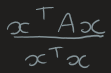
For a symmetric \( A \in \R^{n\times n} \) (\( A\T = A \)), the Rayleigh quotient is \[ R(x) = \frac{x\T A x}{x\T x}. \] Its extreme values over \( x \neq 0 \) are the extreme eigenvalues: \( \displaystyle\max_{x\neq 0} R(x) = \lambda_{\max} \) and \( \displaystyle\min_{x\neq 0} R(x) = \lambda_{\min} \), i.e. \( \lambda_{\min} \le R(x) \le \lambda_{\max} \).
View original handwritten scans — Rayleigh quotient (pages 9–18, laid out side-by-side in the export)




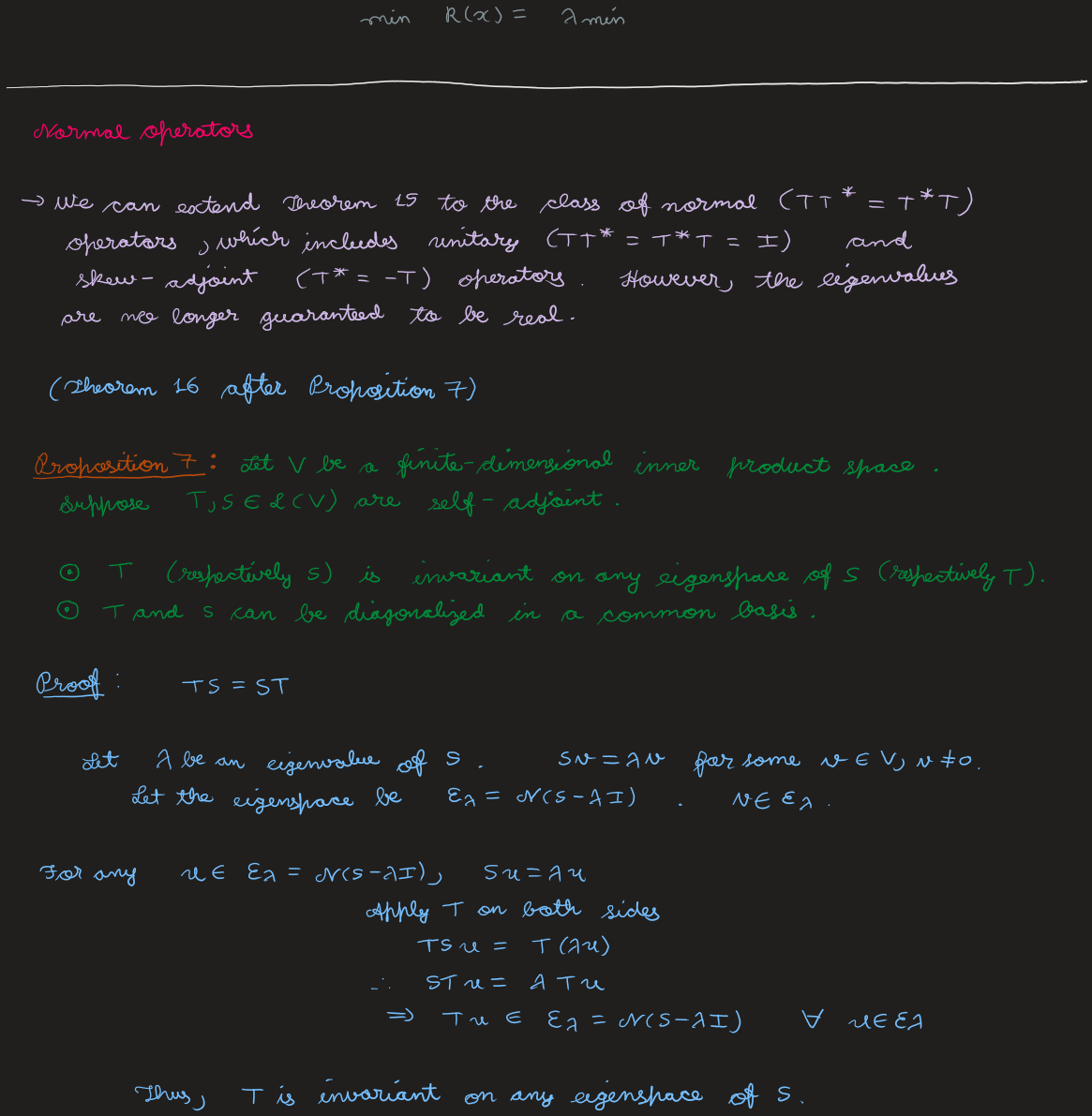
Normal Operators
We can extend Theorem 15 to the class of normal operators (\( TT^* = T^*T \)), which includes unitary (\( TT^* = T^*T = I \)) and skew-adjoint (\( T^* = -T \)) operators. However, the eigenvalues are no longer guaranteed to be real. (Theorem 16, after Proposition 7.)
Proposition 7
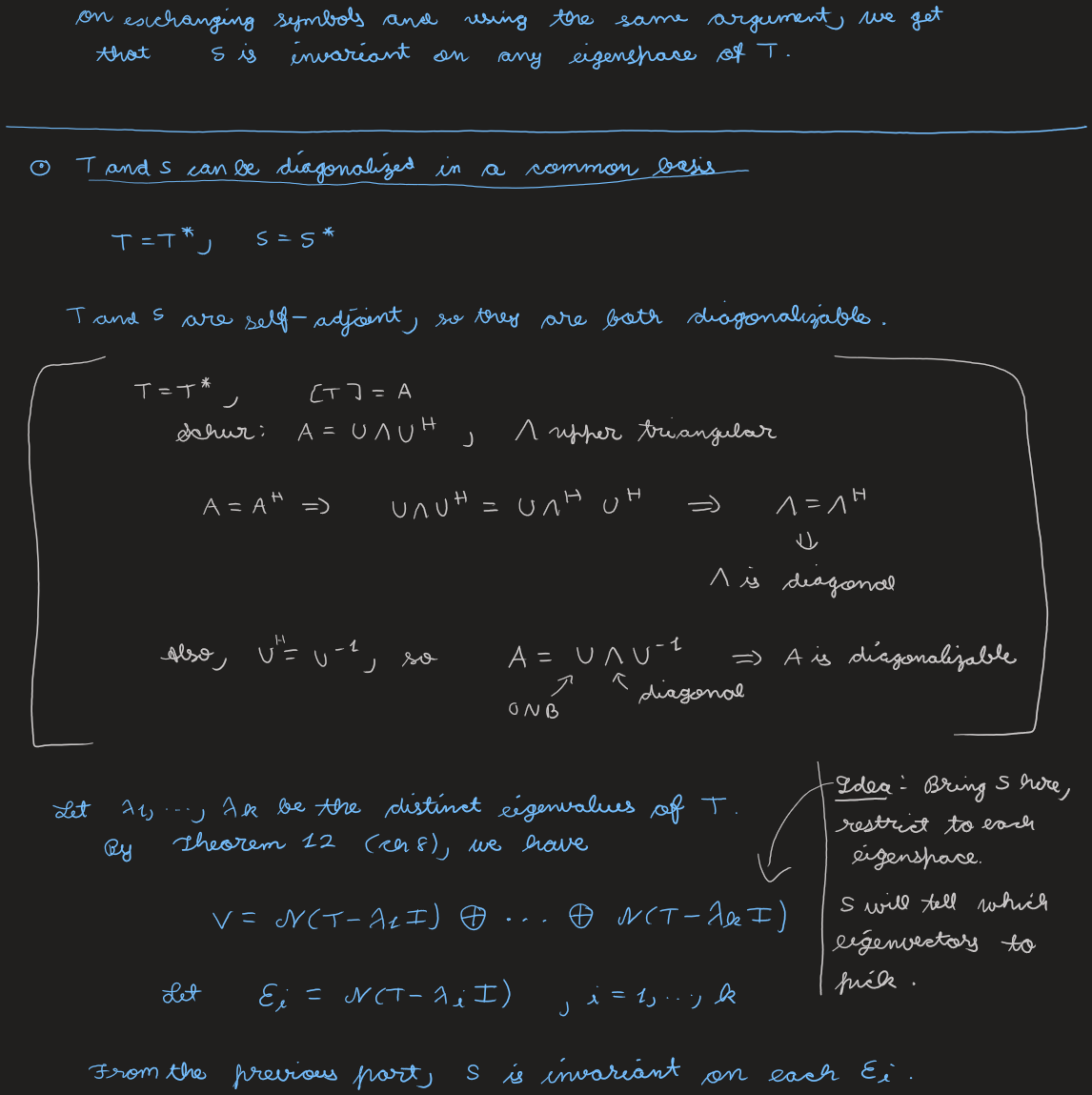
Let \(V\) be a finite-dimensional inner product space, and let \( S, T \in \Lin(V) \) be self-adjoint with \( TS = ST \). Then \(T\) is invariant on every eigenspace of \(S\) (and vice versa), and \(S\) and \(T\) can be diagonalized in a common basis.
Proof (sketch)
Suppose \( TS = ST \). Let \( \lambda \) be an eigenvalue of \(S\) with eigenspace \( E_\lambda = \Null(S - \lambda I) \). For \( v \in E_\lambda \), applying \(T\): \( TSv = T(\lambda v) = \lambda(Tv) \), and since \( TS = ST \), \( S(Tv) = \lambda(Tv) \), so \( Tv \in E_\lambda \). Hence \(T\) is invariant on every eigenspace of \(S\); exchanging the roles of \(S\) and \(T\) gives the converse.
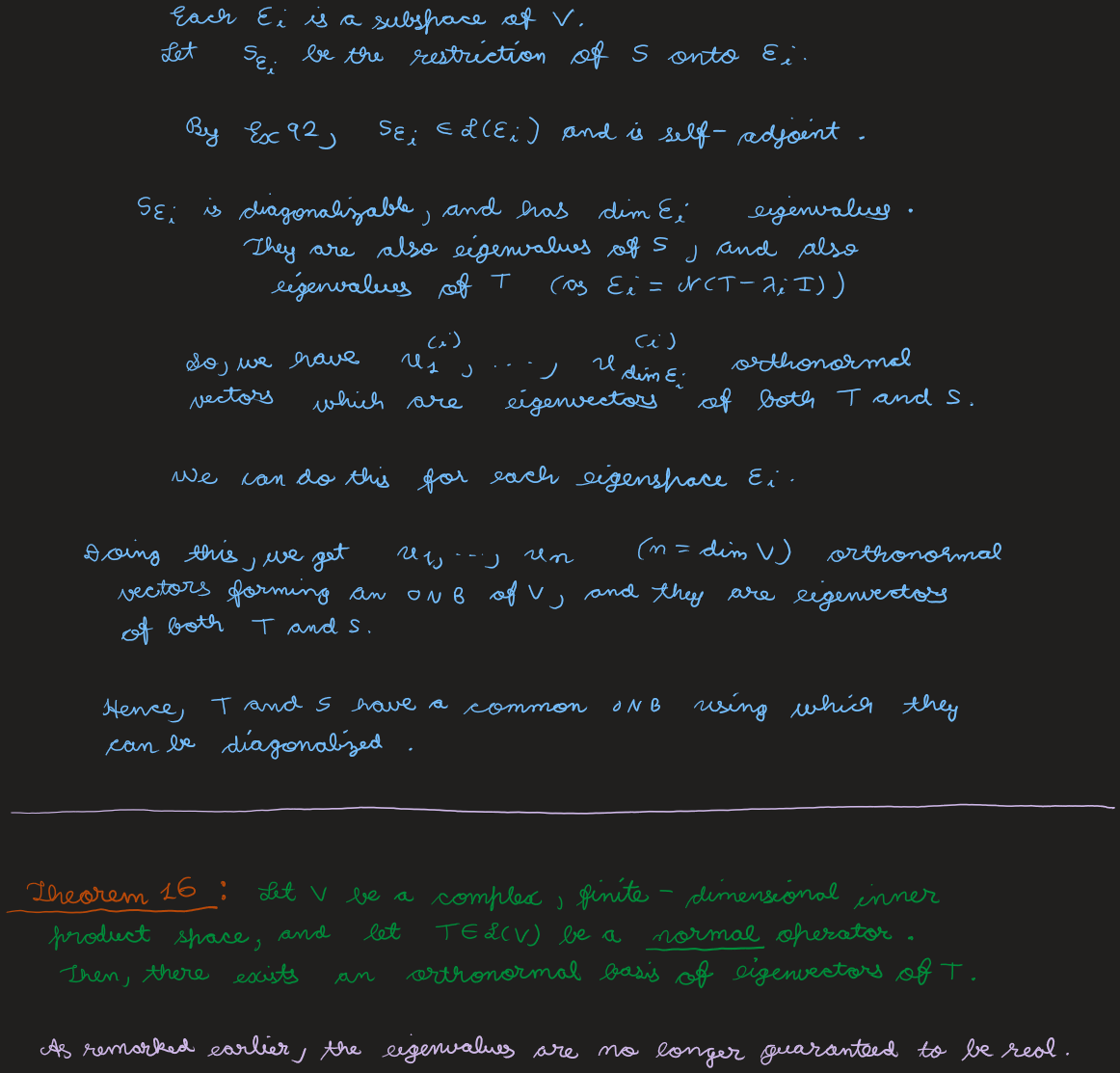
Since \(T\) and \(S\) are self-adjoint they are each diagonalizable. Decompose \( V = E_1 \oplus \dots \oplus E_k \) into eigenspaces \( E_i = \Null(T - \lambda_i I) \) of \(T\). By the above, \(S\) is invariant on each \( E_i \); let \( S_i \) be the restriction of \(S\) to \( E_i \). By Ex 92, \( S_i \in \Lin(E_i) \) is self-adjoint, hence diagonalizable, giving \( \dim E_i \) orthonormal eigenvectors that are eigenvectors of both \(T\) and \(S\). Doing this for each \( E_i \) yields \( \sum_i \dim E_i = n \) orthonormal vectors forming an ONB of \(V\) of common eigenvectors. Hence \(T\) and \(S\) share a common ONB in which they are diagonalized.
Theorem 16
Let \(V\) be a complex, finite-dimensional inner product space, and let \( T \in \Lin(V) \) be a normal operator. Then there exists an orthonormal basis of eigenvectors of \(T\) (though, unlike the self-adjoint case, the eigenvalues need not be real).
Proof
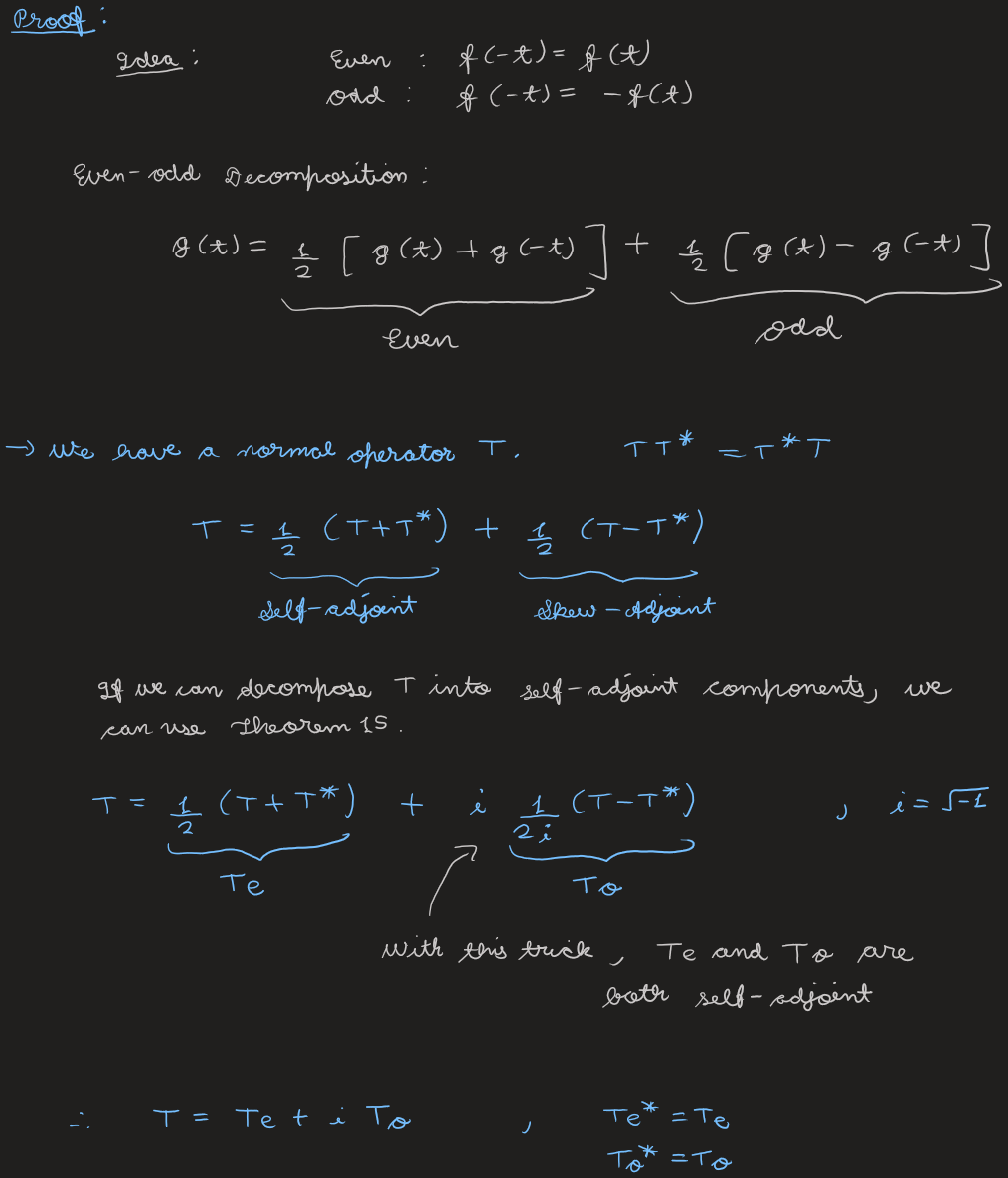
Idea (even–odd decomposition). For functions, even means \( f(-t) = f(t) \) and odd means \( f(-t) = -f(t) \); any \(g\) splits as \( g(t) = \tfrac12[g(t) + g(-t)] + \tfrac12[g(t) - g(-t)] \) (even + odd).
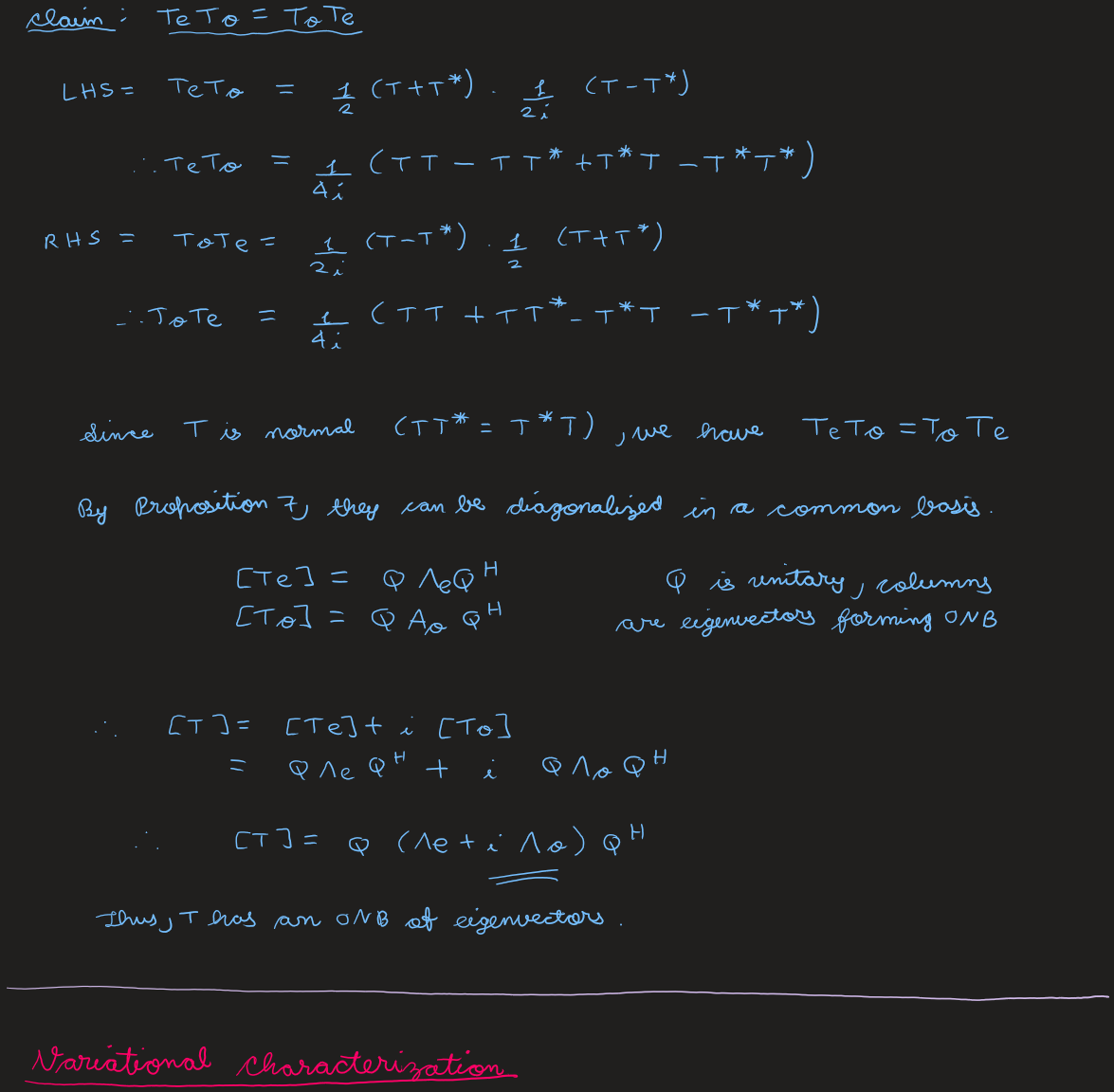
For a normal operator \(T\) (\( TT^* = T^*T \)), write \( T = \tfrac12(T + T^*) + \tfrac12(T - T^*) \) (self-adjoint + skew-adjoint). To use Theorem 15 we want self-adjoint components, so \[ T = \underbrace{\tfrac12(T + T^*)}_{T_e} + i\,\underbrace{\tfrac{1}{2i}(T - T^*)}_{T_o}, \qquad i = \sqrt{-1}, \] where \( T_e \) and \( T_o \) are both self-adjoint: \( T = T_e + iT_o \), \( T_e^* = T_e \), \( T_o^* = T_o \).
Claim: \( T_e T_o = T_o T_e \). \[ T_e T_o = \tfrac12(T + T^*)\cdot\tfrac{1}{2i}(T - T^*) = \tfrac{1}{4i}(TT - TT^* + T^*T - T^*T^*), \] \[ T_o T_e = \tfrac{1}{2i}(T - T^*)\cdot\tfrac12(T + T^*) = \tfrac{1}{4i}(TT + TT^* - T^*T - T^*T^*). \] Since \(T\) is normal (\( TT^* = T^*T \)), \( T_e T_o = T_o T_e \). By Proposition 7 they are diagonalized in a common basis: \[ [T_e] = Q\Lambda_e Q\herm, \quad [T_o] = Q\Lambda_o Q\herm \quad (Q \text{ unitary, columns an ONB of eigenvectors}). \] Therefore \( [T] = [T_e] + i[T_o] = Q\Lambda_e Q\herm + iQ\Lambda_o Q\herm = Q(\Lambda_e + i\Lambda_o)Q\herm \), so \(T\) has an ONB of eigenvectors.
Variational Characterization
Theorem 17 — Min–Max / Courant–Fischer
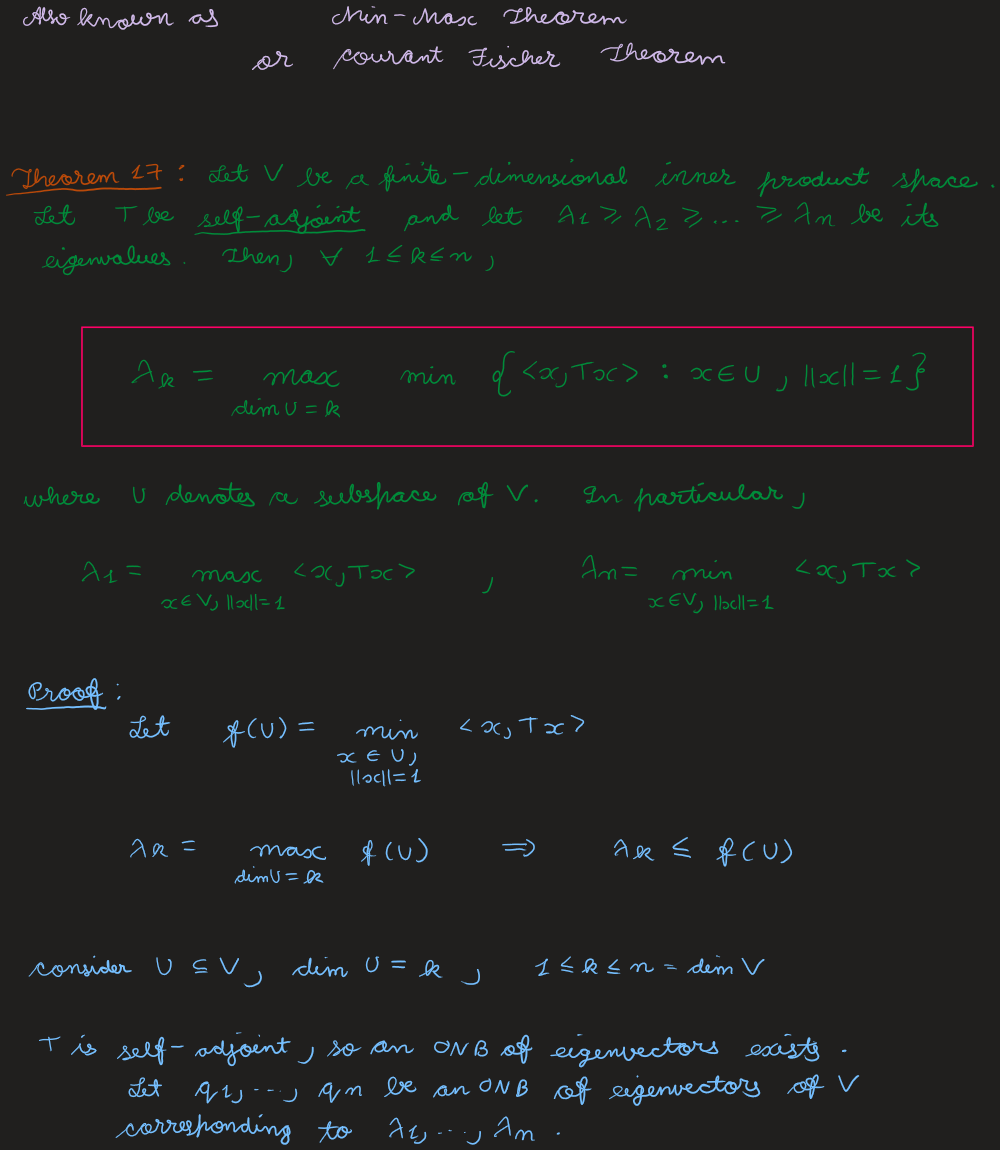
Let \(V\) be a finite-dimensional inner product space and \(T\) self-adjoint with eigenvalues \( \lambda_1 \ge \lambda_2 \ge \dots \ge \lambda_n \). Then for all \( 1 \le k \le n \), \[ \lambda_k = \max_{\dim U = k} \ \min\big\{ \langle x, Tx \rangle : x \in U,\ \|x\| = 1 \big\}, \] where \(U\) is a subspace of \(V\). In particular, \( \lambda_1 = \max_{x\in V,\ \|x\|=1}\langle x, Tx\rangle \) and \( \lambda_n = \min_{x\in V,\ \|x\|=1}\langle x, Tx\rangle \).
Proof
Let \( \varphi(U) = \min_{x\in U,\ \|x\|=1}\langle x, Tx\rangle \); we show \( \lambda_k = \max_{\dim U = k}\varphi(U) \). Take \( U \subseteq V \) with \( \dim U = k \), \( 1 \le k \le n = \dim V \). As \(T\) is self-adjoint, an ONB of eigenvectors \( q_1, \dots, q_n \) exists with \( Tq_i = \lambda_i q_i \).
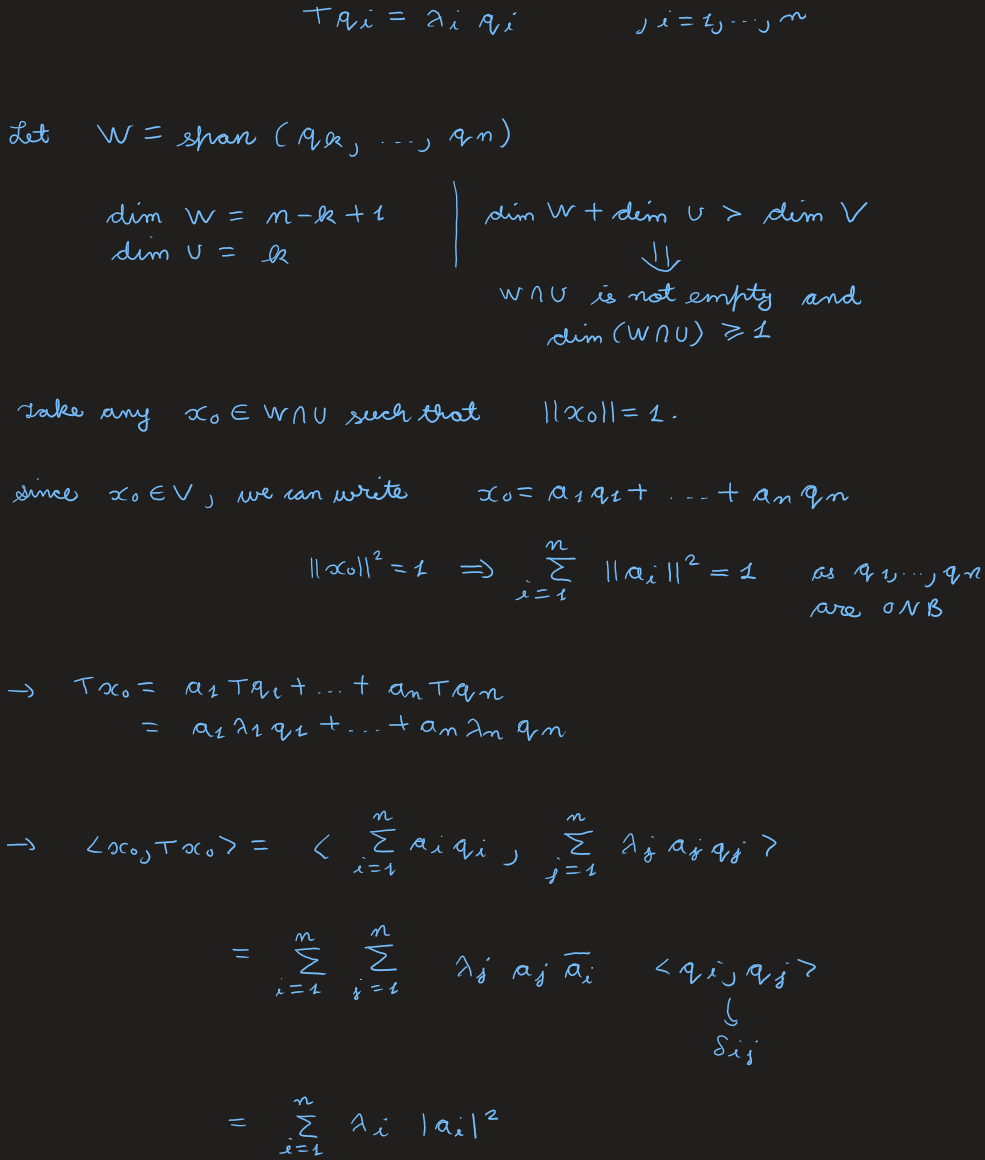
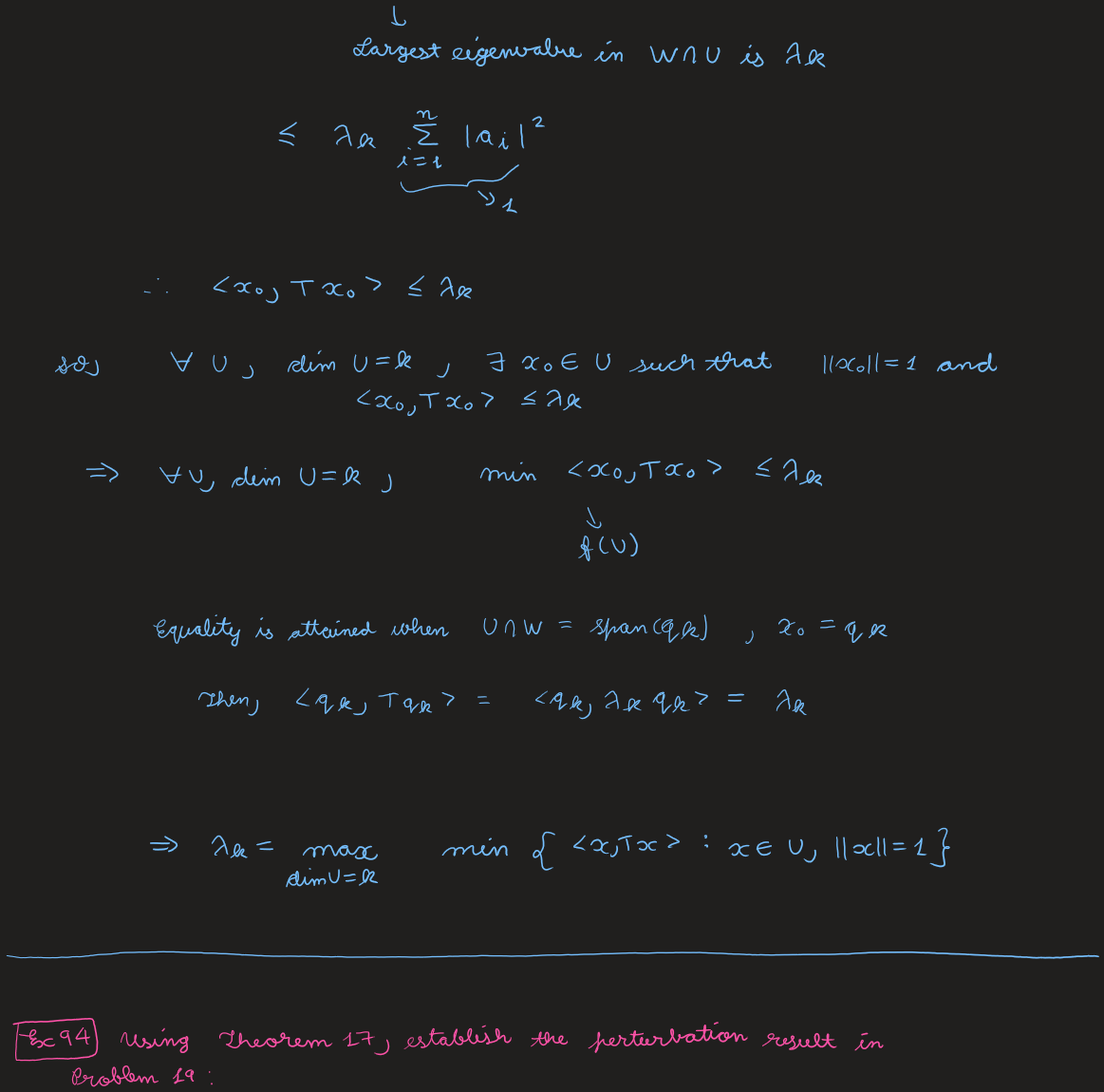
Let \( W = \operatorname{span}(q_k, \dots, q_n) \), so \( \dim W = n - k + 1 \). Since \( \dim W + \dim U > \dim V \), \( W \cap U \) is non-empty with \( \dim(W \cap U) \ge 1 \). Take \( x_0 \in W \cap U \), \( \|x_0\| = 1 \). Writing \( x_0 = a_1 q_1 + \dots + a_n q_n \) (with \( \sum_{i=1}^{n}|a_i|^2 = 1 \) as the \( q_i \) are an ONB), \[ Tx_0 = a_1\lambda_1 q_1 + \dots + a_n\lambda_n q_n, \qquad \langle x_0, Tx_0\rangle = \sum_{i=1}^{n}\sum_{j=1}^{n}\lambda_j a_j\overline{a_i}\underbrace{\langle q_i, q_j\rangle}_{\delta_{ij}} = \sum_{i=1}^{n}\lambda_i|a_i|^2. \] The largest eigenvalue appearing in \( W \cap U \) is \( \lambda_k \), so \( \langle x_0, Tx_0\rangle \le \lambda_k\sum_{i=1}^{n}|a_i|^2 = \lambda_k \). Hence for all \(U\) with \( \dim U = k \) there is \( x_0 \in U \), \( \|x_0\| = 1 \), with \( \langle x_0, Tx_0\rangle \le \lambda_k \), so \( \min_{x\in U,\|x\|=1}\langle x, Tx\rangle \le \lambda_k \), i.e. \( \varphi(U) \le \lambda_k \).
This bound is achieved: for \( U^* = \operatorname{span}(q_1, \dots, q_k) \) (\( \dim U^* = k \)), every unit \( x = a_1 q_1 + \dots + a_k q_k \in U^* \) has \( \langle x, Tx\rangle = \sum_{i=1}^{k}\lambda_i|a_i|^2 \ge \lambda_k\sum_{i=1}^{k}|a_i|^2 = \lambda_k \) (since \( \lambda_i \ge \lambda_k \) for \( i \le k \)), with equality at \( x = q_k \). So \( \varphi(U^*) = \lambda_k \); combined with \( \varphi(U) \le \lambda_k \) for every \(k\)-dimensional \(U\), \[ \lambda_k = \max_{\dim U = k}\ \min\big\{\langle x, Tx\rangle : x \in U,\ \|x\| = 1\big\}. \]
Ex 94
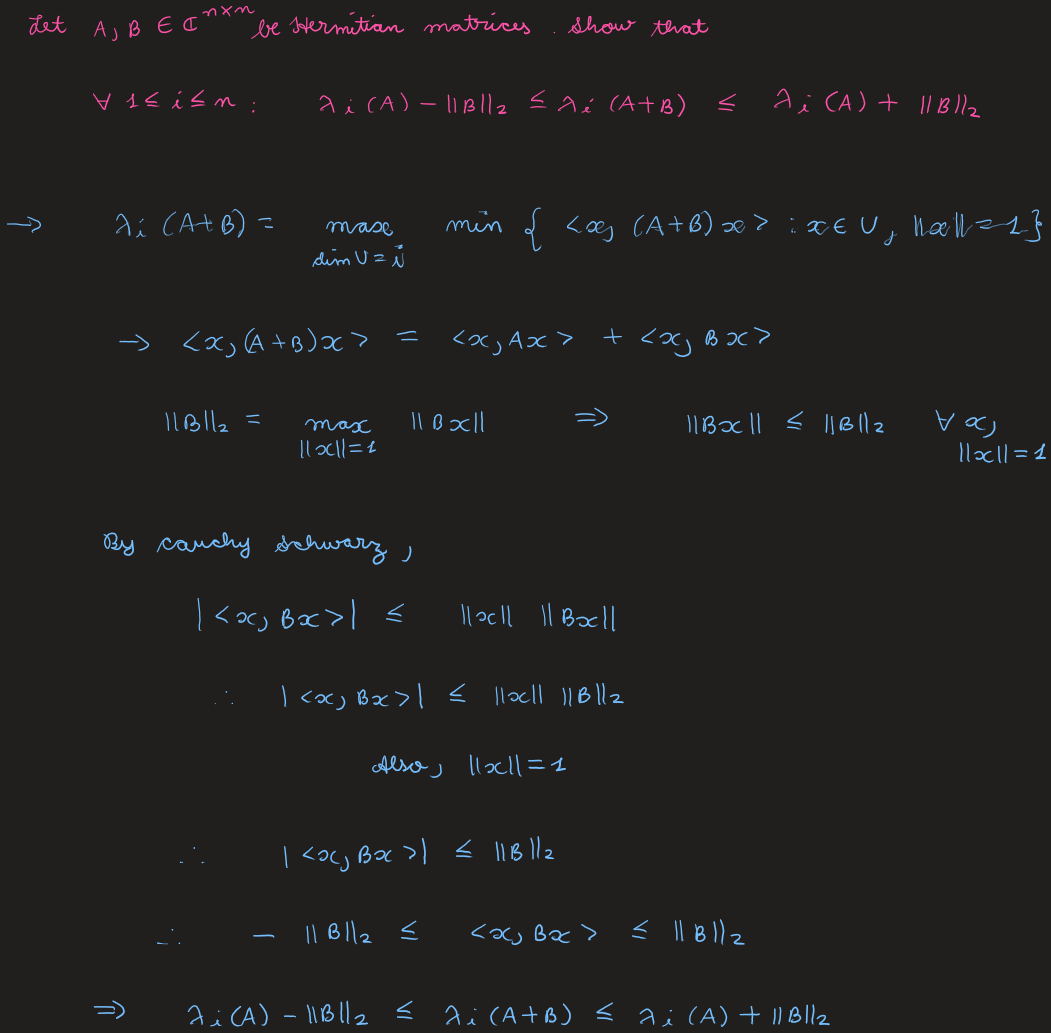
Using Theorem 17, establish the perturbation result of Problem 19: let \( A, B \in \C^{n\times n} \) be Hermitian. Show that \( \forall\, 1 \le i \le n \): \( \lambda_i(A) - \|B\|_2 \le \lambda_i(A+B) \le \lambda_i(A) + \|B\|_2 \).
Solution
\( \lambda_i(A+B) = \max_{\dim U = i}\min\{\langle x, (A+B)x\rangle : x \in U,\ \|x\| = 1\} \), and \( \langle x, (A+B)x\rangle = \langle x, Ax\rangle + \langle x, Bx\rangle \). Now \( \|B\|_2 = \max_{\|x\|=1}\|Bx\| \Rightarrow \|Bx\| \le \|B\|_2 \) for \( \|x\|=1 \). By Cauchy–Schwarz, \( |\langle x, Bx\rangle| \le \|x\|\,\|Bx\| \le \|x\|\,\|B\|_2 = \|B\|_2 \) (as \( \|x\|=1 \)), so \( -\|B\|_2 \le \langle x, Bx\rangle \le \|B\|_2 \). Therefore \[ \lambda_i(A) - \|B\|_2 \le \lambda_i(A+B) \le \lambda_i(A) + \|B\|_2. \]
View original handwritten scans — Normal operators & variational characterization (pages 19–27)
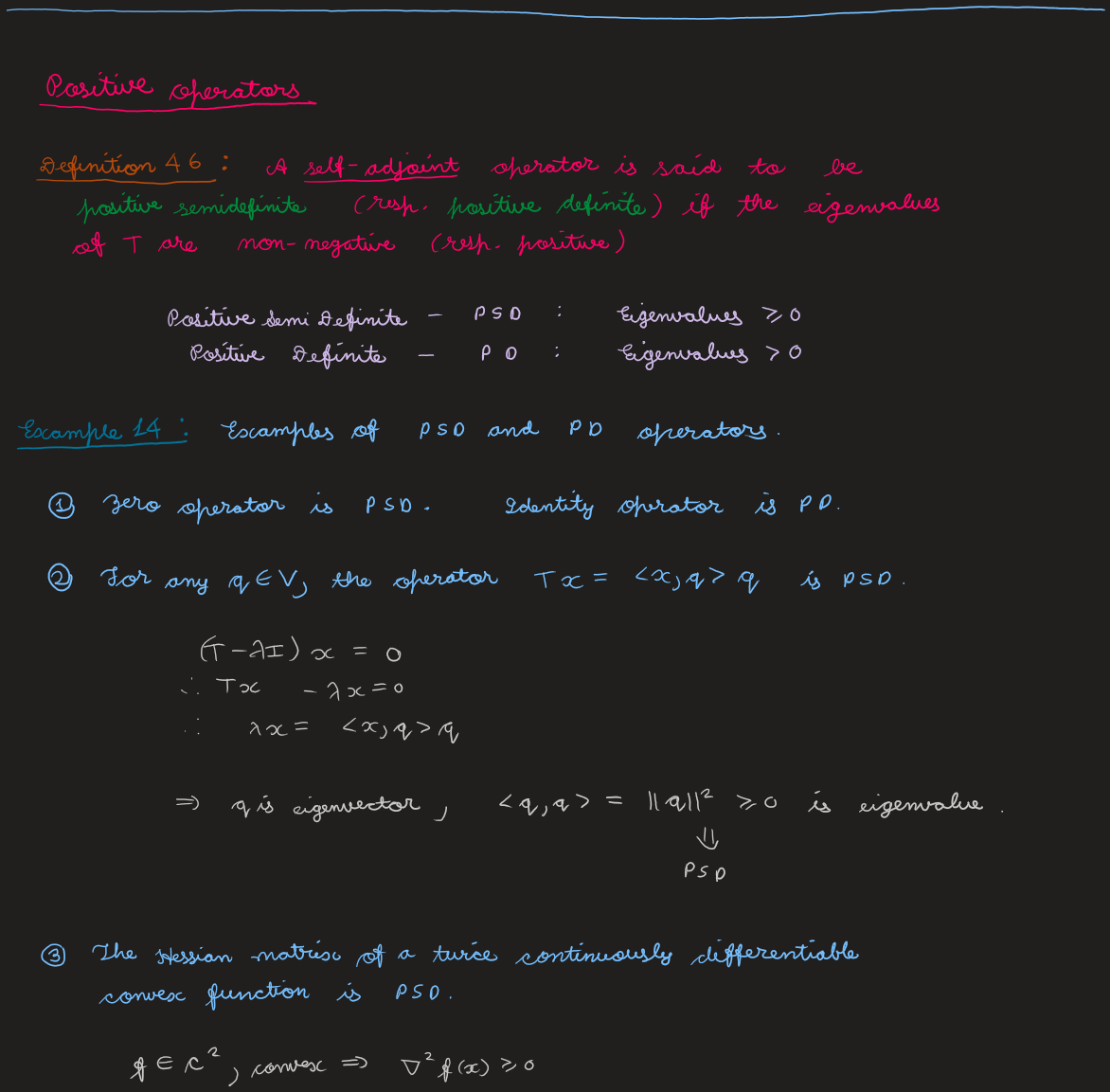
Positive Operators
Definition 46 — Positive (semi)definite
A self-adjoint operator is positive semidefinite (resp. positive definite) if the eigenvalues of \(T\) are non-negative (resp. positive).
- Positive semidefinite — PSD: eigenvalues \( \ge 0 \).
- Positive definite — PD: eigenvalues \( > 0 \).
Example 14 — PSD and PD operators
- The zero operator is PSD; the identity operator is PD.
- For any \( q \in V \), the operator \( Tx = \langle x, q\rangle q \) is PSD: from \( (T - \lambda I)x = 0 \), \( \lambda x = \langle x, q\rangle q \), so \(q\) is an eigenvector and \( \langle q, q\rangle = \|q\|^2 \ge 0 \) is the eigenvalue \( \Rightarrow \) PSD.
- The Hessian of a twice continuously differentiable convex function is PSD: \( f \in C^2 \) convex \( \Rightarrow \nabla^2 f(x) \succeq 0 \).
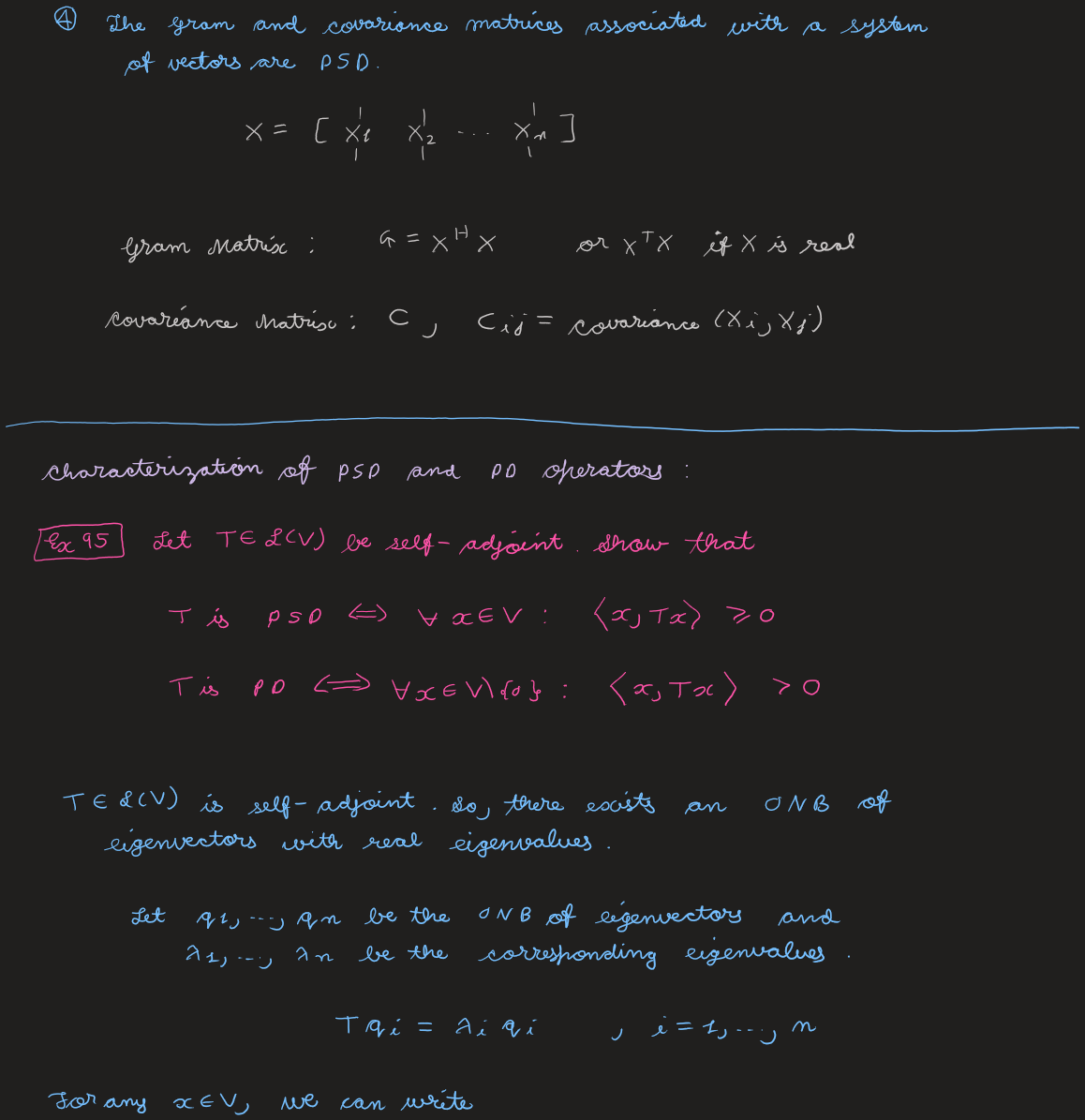
- The Gram and covariance matrices associated with a system of vectors are PSD. With \( X = [\,x_1\ x_2\ \cdots\ x_n\,] \): the Gram matrix is \( G = X\herm X \) (or \( X\T X \) if \(X\) is real); the covariance matrix \(C\) has \( C_{ij} = \operatorname{cov}(x_i, x_j) \).
Ex 95 — Characterization of PSD / PD
Let \( T \in \Lin(V) \) be self-adjoint. Show that \(T\) is PSD \( \iff \forall\, x \in V : \langle x, Tx\rangle \ge 0 \), and \(T\) is PD \( \iff \forall\, x \in V\setminus\{0\} : \langle x, Tx\rangle > 0 \).
Solution
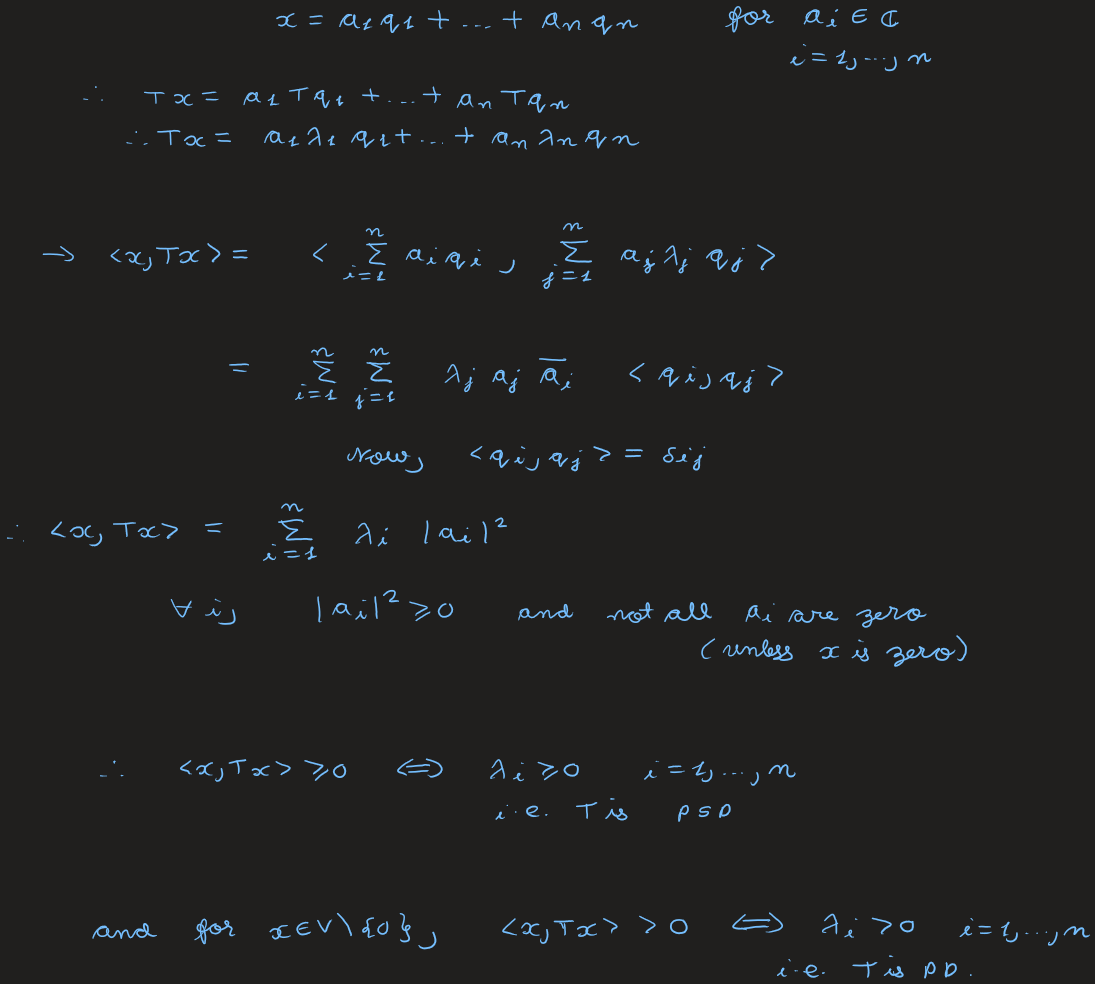
\( T \in \Lin(V) \) is self-adjoint, so there is an ONB of eigenvectors \( q_1, \dots, q_n \) with real eigenvalues \( \lambda_1, \dots, \lambda_n \), \( Tq_i = \lambda_i q_i \). For any \( x \in V \), write \( x = a_1 q_1 + \dots + a_n q_n \) (\( a_i \in \C \)). Then \( Tx = a_1\lambda_1 q_1 + \dots + a_n\lambda_n q_n \), and \[ \langle x, Tx\rangle = \sum_{i=1}^{n}\sum_{j=1}^{n}\lambda_j a_j\overline{a_i}\underbrace{\langle q_i, q_j\rangle}_{\delta_{ij}} = \sum_{i=1}^{n}\lambda_i|a_i|^2, \] where \( |a_i|^2 \ge 0 \) and not all \( a_i \) are zero (unless \( x = 0 \)). Hence \[ \langle x, Tx\rangle \ge 0 \iff \lambda_i \ge 0\ (i = 1, \dots, n) \quad\text{i.e. } T \text{ is PSD}, \] and for \( x \in V\setminus\{0\} \), \( \langle x, Tx\rangle > 0 \iff \lambda_i > 0\ (i = 1, \dots, n) \), i.e. \(T\) is PD.
View original handwritten scans — Positive operators (pages 28–30)