Chapter 6 — Operator and Matrix Norms
Linear Algebra and its Applications · IISc 2024 · typeset reproduction
Operator Norm
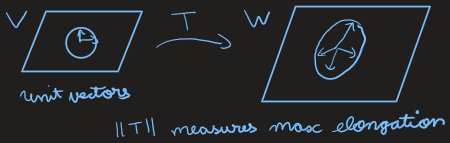
Definition 31 — Operator (induced) norm
Let \( (V, \|\cdot\|_V) \) and \( (W, \|\cdot\|_W) \) be two normed spaces. The operator (or induced) norm of \( T \in \Lin(V, W) \) is defined as \[ \|T\| = \max\big\{ \|Tx\|_W : x \in V,\ \|x\|_V = 1 \big\}. \]
Ex 67
Verify that the above operator norm is a valid norm on \( \Lin(V, W) \). Moreover, show that \( \forall\, T, S \in \Lin(V) \): \( \|TS\| \le \|T\|\,\|S\| \).
Solution
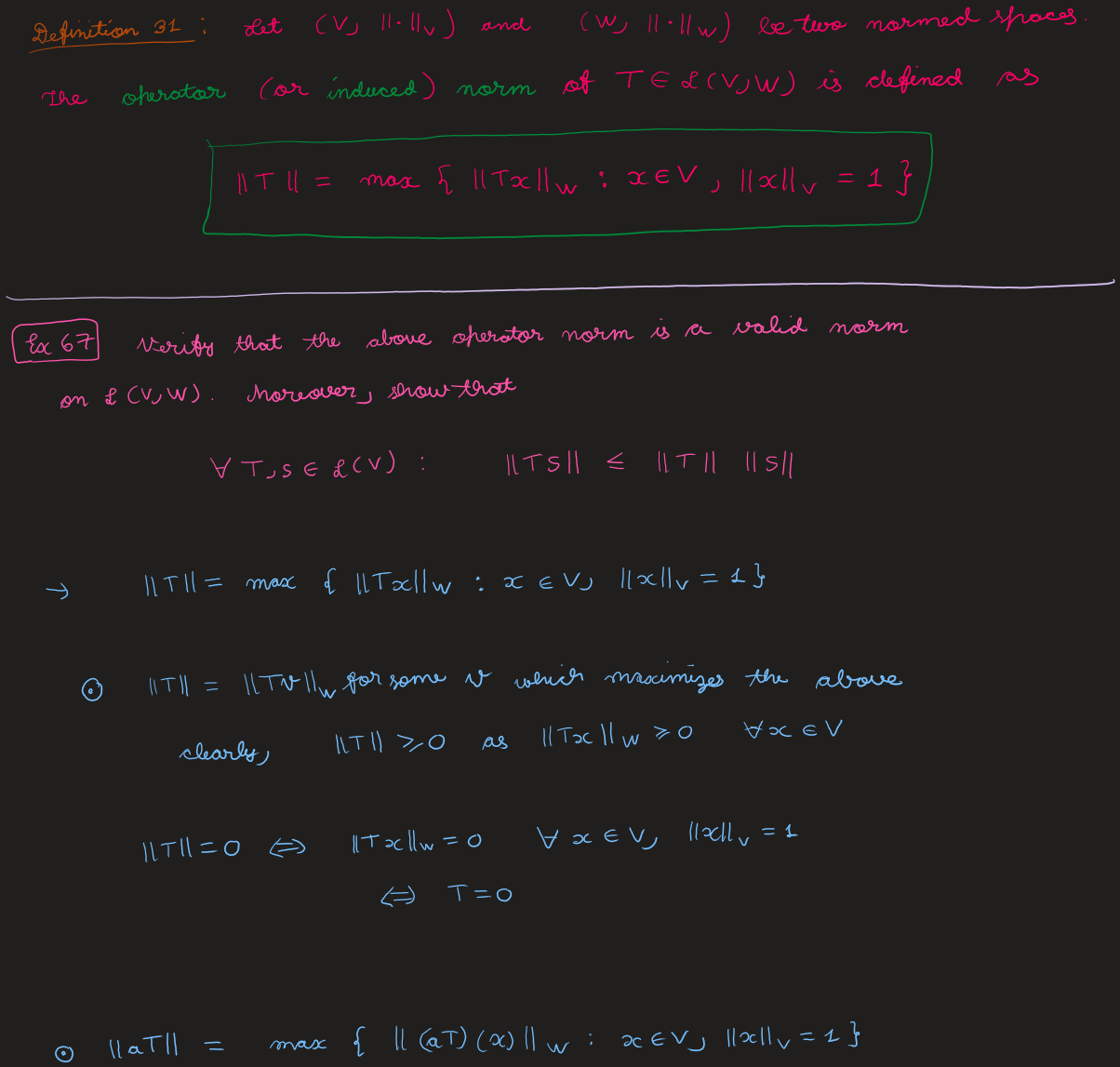
Write \( \|T\| = \max\{ \|Tx\|_W : x \in V,\ \|x\|_V = 1 \} = \|Tv\|_W \) for some \(v\) that maximizes it.
- Clearly \( \|T\| \ge 0 \), as \( \|Tx\|_W \ge 0 \ \forall\, x \in V \). And \( \|T\| = 0 \iff \|Tx\|_W = 0 \ \forall\, x \in V,\ \|x\|_V = 1 \iff T = 0 \).
- \( \|aT\| = \max\{ \|(aT)(x)\|_W : x \in V,\ \|x\|_V = 1 \} = \max\{ |a|\,\|Tx\|_W : x \in V,\ \|x\|_V = 1 \} = |a|\,\|T\| \ \forall\, a \in \F \).
- For \( T, S \in \Lin(V, W) \), \( \|T + S\| = \max\{ \|(T+S)x\|_W : \|x\|_V = 1\} = \max\{ \|Tx + Sx\|_W : \|x\|_V = 1\} \le \max\{ \|Tx\|_W + \|Sx\|_W : \|x\|_V = 1\} \), so \( \|T + S\| \le \|T\| + \|S\| \).
Thus the operator norm is a valid norm on \( \Lin(V, W) \).
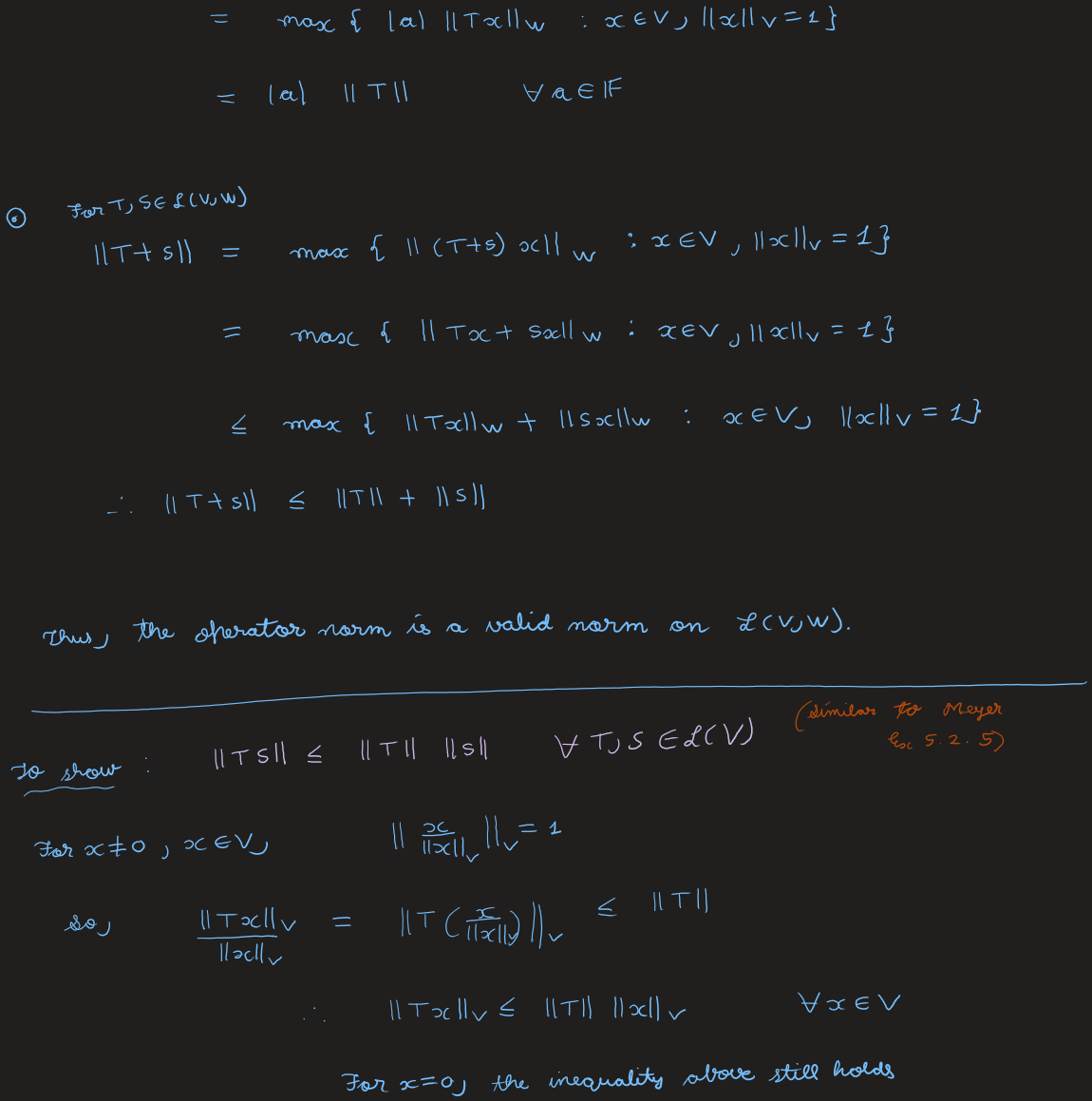
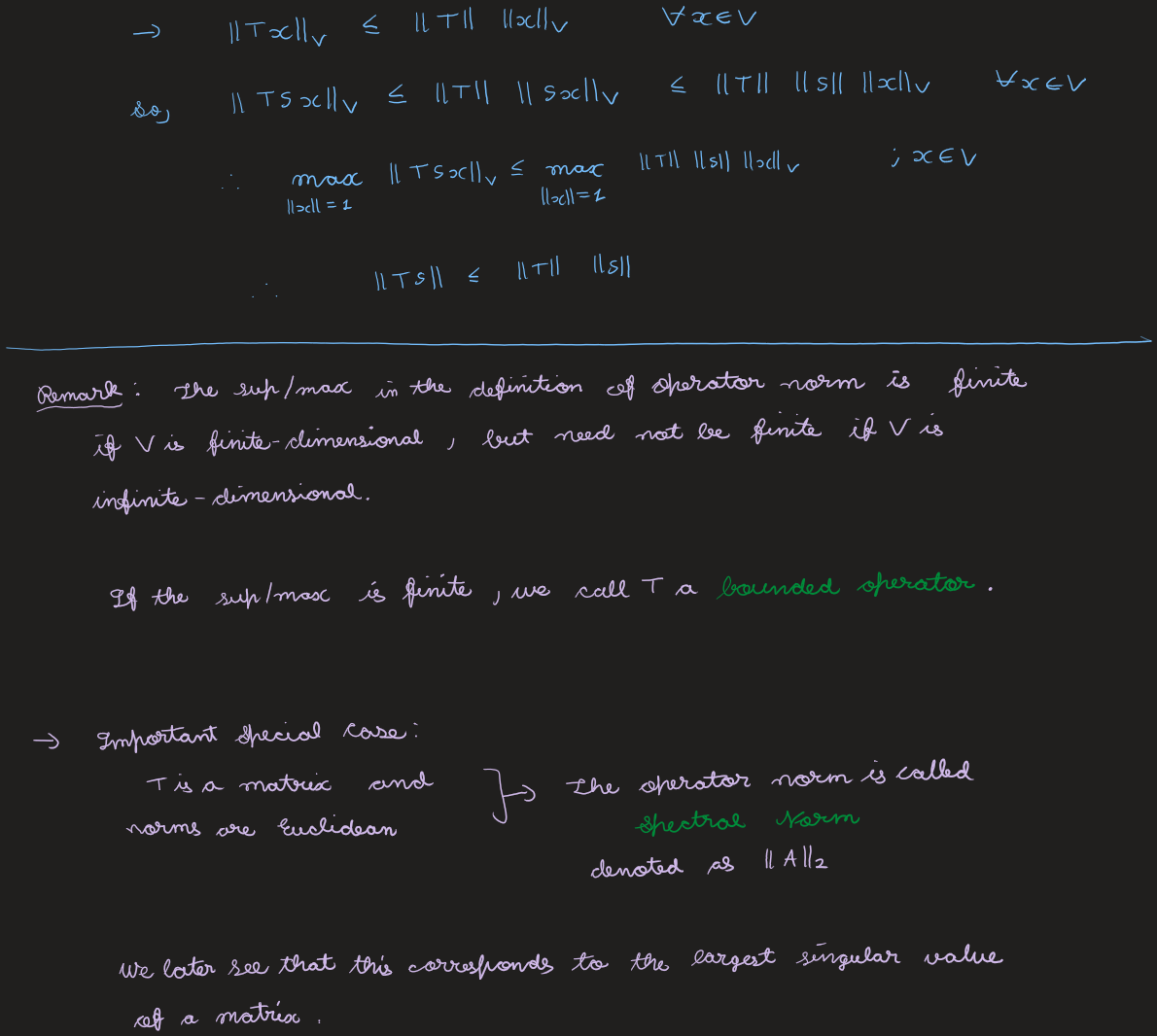
Submultiplicativity \( \|TS\| \le \|T\|\,\|S\| \ \forall\, T, S \in \Lin(V) \) (similar to Meyer, Ex 5.2.5). For \( x \neq 0 \), \( x \in V \), \( \big\|\tfrac{x}{\|x\|_V}\big\|_V = 1 \), so \( \dfrac{\|Tx\|_V}{\|x\|_V} = \big\|T\big(\tfrac{x}{\|x\|_V}\big)\big\|_V \le \|T\| \), giving \( \|Tx\|_V \le \|T\|\,\|x\|_V \ \forall\, x \in V \) (for \( x = 0 \) the inequality still holds). Then \[ \|TSx\|_V \le \|T\|\,\|Sx\|_V \le \|T\|\,\|S\|\,\|x\|_V \ \forall\, x \in V, \] so \( \max_{\|x\|=1}\|TSx\|_V \le \max_{\|x\|=1}\|T\|\,\|S\|\,\|x\|_V \), i.e. \( \|TS\| \le \|T\|\,\|S\| \).
Remark
The sup/max in the definition of the operator norm is finite if \(V\) is finite-dimensional, but need not be finite if \(V\) is infinite-dimensional. If the sup/max is finite, we call \(T\) a bounded operator.
Important special case: if \(T\) is a matrix and the norms are Euclidean, the operator norm is called the spectral norm, denoted \( \|A\|_2 \). We later see that this corresponds to the largest singular value of a matrix.
View original handwritten scans — Operator norm (pages 1–5)

Matrix Norms
Definition 32 — Matrix norm
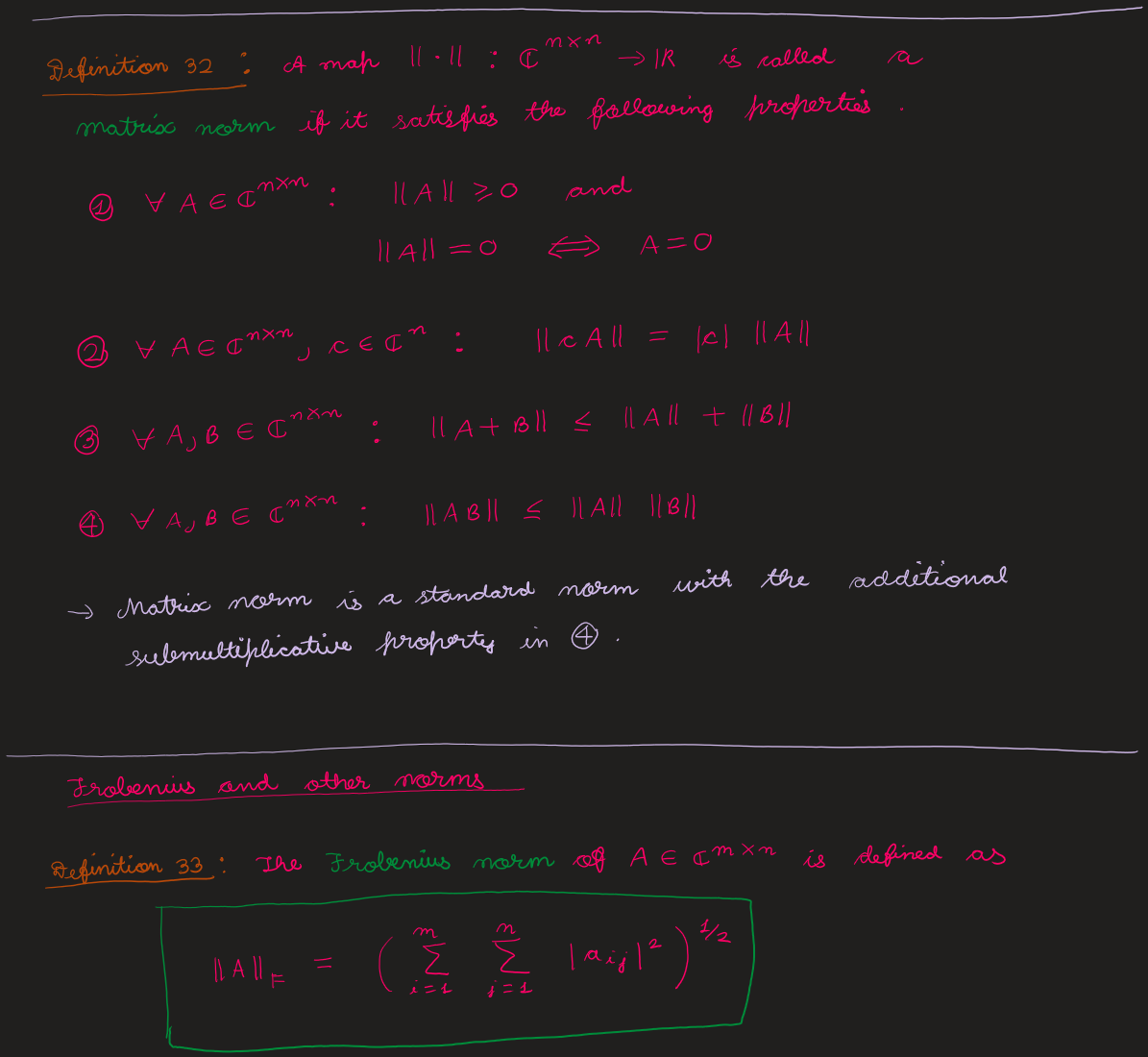
A map \( \|\cdot\| : \C^{n\times n} \to \R \) is called a matrix norm if it satisfies:
- \( \forall\, A \in \C^{n\times n} \): \( \|A\| \ge 0 \), and \( \|A\| = 0 \iff A = 0 \).
- \( \forall\, A \in \C^{n\times n},\ \)\( c \in \C \) (scan: c ∈ ℂⁿ): \( \|cA\| = |c|\,\|A\| \).
- \( \forall\, A, B \in \C^{n\times n} \): \( \|A + B\| \le \|A\| + \|B\| \).
- \( \forall\, A, B \in \C^{n\times n} \): \( \|AB\| \le \|A\|\,\|B\| \).
A matrix norm is a standard norm with the additional submultiplicative property (4).
Frobenius and Other Norms
Definition 33 — Frobenius norm
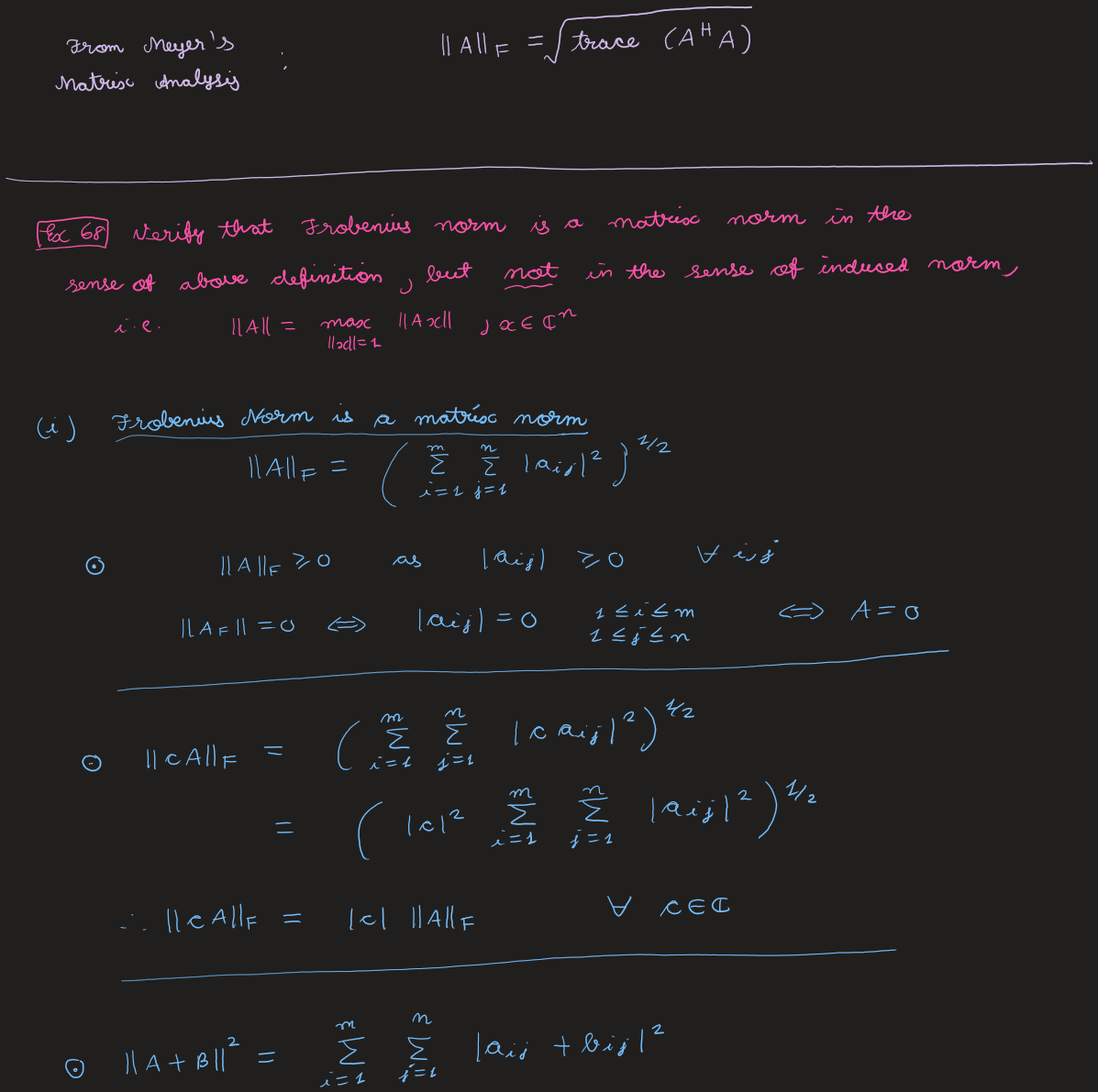
The Frobenius norm of \( A \in \C^{m\times n} \) is \[ \|A\|_F = \Big( \sum_{i=1}^{m}\sum_{j=1}^{n} |a_{ij}|^2 \Big)^{1/2}. \] From Meyer's Matrix Analysis, \( \|A\|_F = \sqrt{\operatorname{trace}(A\herm A)} \).
Ex 68
Verify that the Frobenius norm is a matrix norm in the sense of Definition 32, but not in the sense of an induced norm, i.e. \( \|A\| = \max_{\|x\|=1}\|Ax\| \), \( x \in \C^n \).
Solution — (i) Frobenius norm is a matrix norm
- \( \|A\|_F \ge 0 \) as \( |a_{ij}| \ge 0 \ \forall\, i,j \); \( \|A\|_F = 0 \iff |a_{ij}| = 0 \ (1\le i\le m,\ 1\le j\le n) \iff A = 0 \).
- \( \|cA\|_F = \big(\sum_i\sum_j |c\,a_{ij}|^2\big)^{1/2} = \big(|c|^2 \sum_i\sum_j |a_{ij}|^2\big)^{1/2} \), so \( \|cA\|_F = |c|\,\|A\|_F \ \forall\, c \in \C \).
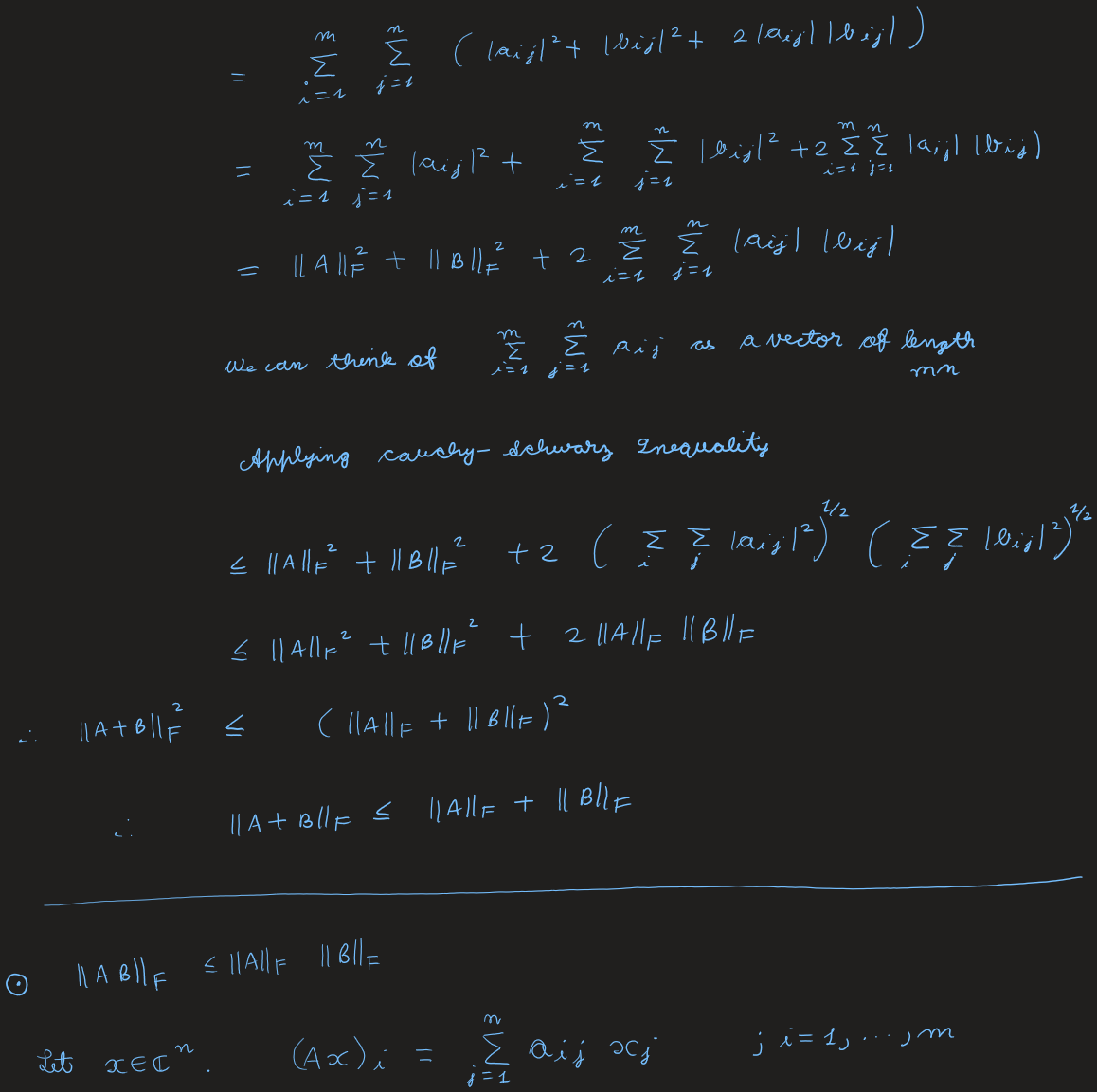
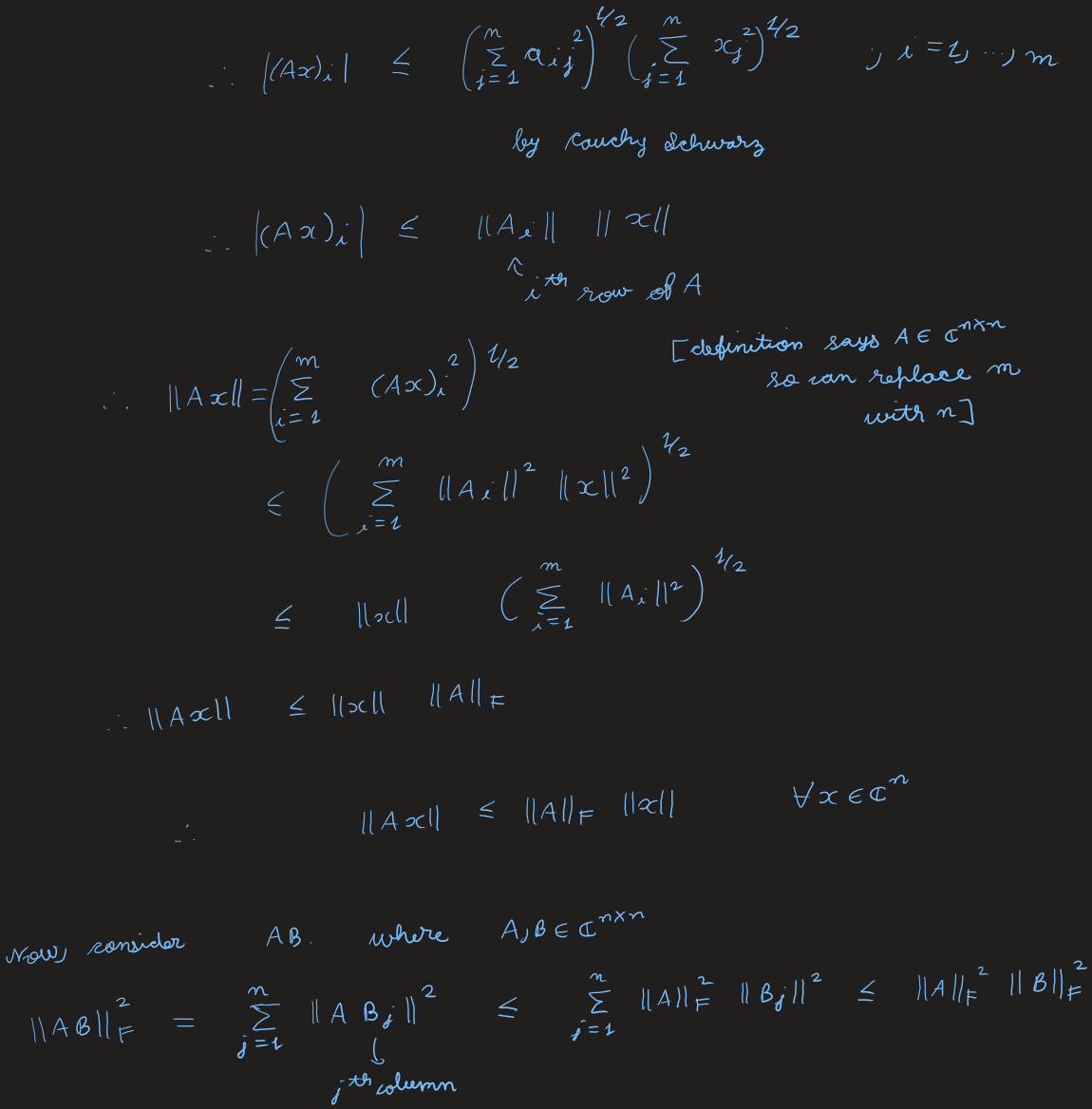
For the triangle inequality, \[\begin{aligned} \|A+B\|^2 &= \sum_{i=1}^{m}\sum_{j=1}^{n} |a_{ij} + b_{ij}|^2 \\ &= \sum_{i}\sum_{j}\big(|a_{ij}|^2 + |b_{ij}|^2 + 2|a_{ij}||b_{ij}|\big) \\ &= \|A\|_F^2 + \|B\|_F^2 + 2\sum_{i}\sum_{j}|a_{ij}||b_{ij}|. \end{aligned}\] Thinking of \( (a_{ij}) \) as a vector of length \( mn \) and applying the Cauchy–Schwarz inequality, \[\begin{aligned} &\le \|A\|_F^2 + \|B\|_F^2 + 2\Big(\sum_i\sum_j |a_{ij}|^2\Big)^{1/2}\Big(\sum_i\sum_j |b_{ij}|^2\Big)^{1/2} \\ &= \|A\|_F^2 + \|B\|_F^2 + 2\|A\|_F\|B\|_F = (\|A\|_F + \|B\|_F)^2, \end{aligned}\] so \( \|A+B\|_F \le \|A\|_F + \|B\|_F \).
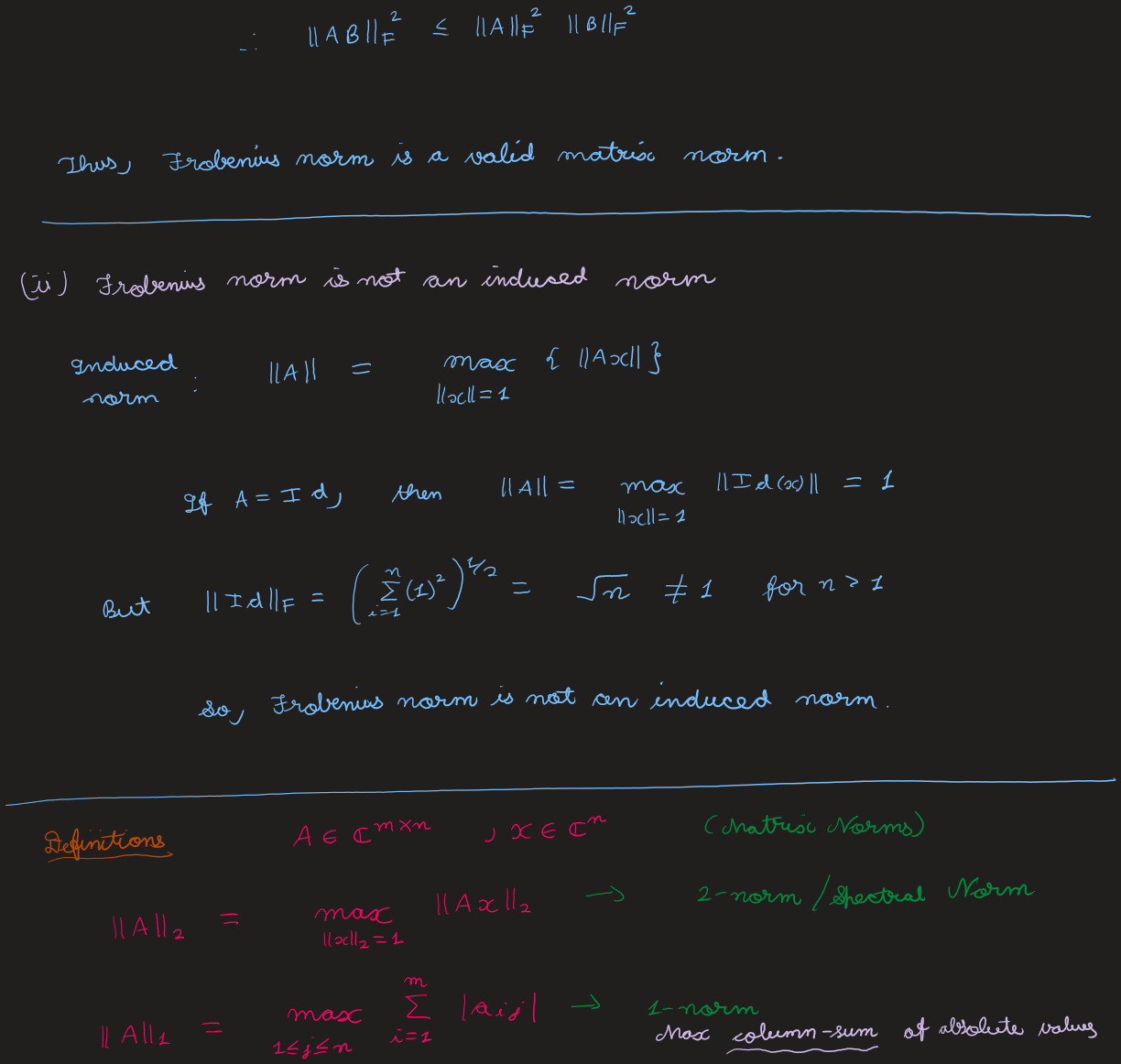
For submultiplicativity \( \|AB\|_F \le \|A\|_F\|B\|_F \): for \( x \in \C^n \), \( (Ax)_i = \sum_{j=1}^{n} a_{ij} x_j \), so by Cauchy–Schwarz \( |(Ax)_i| \le \big(\sum_j |a_{ij}|^2\big)^{1/2}\big(\sum_j |x_j|^2\big)^{1/2} = \|A_i\|\,\|x\| \) (where \(A_i\) is the \(i\)-th row of \(A\)). Then \[ \|Ax\| = \Big(\sum_{i=1}^{m}(Ax)_i^2\Big)^{1/2} \le \Big(\sum_{i=1}^{m}\|A_i\|^2\|x\|^2\Big)^{1/2} \le \|x\|\Big(\sum_{i=1}^{m}\|A_i\|^2\Big)^{1/2} = \|A\|_F\,\|x\| \quad \forall\, x \in \C^n. \] Now for \( A, B \in \C^{n\times n} \), with \(B_j\) the \(j\)-th column of \(B\), \[ \|AB\|_F^2 = \sum_{j=1}^{n}\|AB_j\|^2 \le \sum_{j=1}^{n}\|A\|_F^2\|B_j\|^2 \le \|A\|_F^2\|B\|_F^2, \] so \( \|AB\|_F \le \|A\|_F\|B\|_F \). Thus the Frobenius norm is a valid matrix norm.
Solution — (ii) Frobenius norm is not an induced norm
An induced norm satisfies \( \|A\| = \max_{\|x\|=1}\|Ax\| \). If \( A = \mathrm{Id} \), then \( \|A\| = \max_{\|x\|=1}\|\mathrm{Id}(x)\| = 1 \). But \[ \|\mathrm{Id}\|_F = \Big(\sum_{i=1}^{n}(1)^2\Big)^{1/2} = \sqrt{n} \neq 1 \quad\text{for } n > 1. \] So the Frobenius norm is not an induced norm.
Some matrix norms (with \( A \in \C^{m\times n} \), \( x \in \C^n \)):
- \( \|A\|_2 = \max_{\|x\|=1}\|Ax\|_2 \) — the 2-norm / spectral norm.
- \( \|A\|_1 = \max_{1\le j\le n}\sum_{i=1}^{m}|a_{ij}| \) — the 1-norm (max column-sum of absolute values).
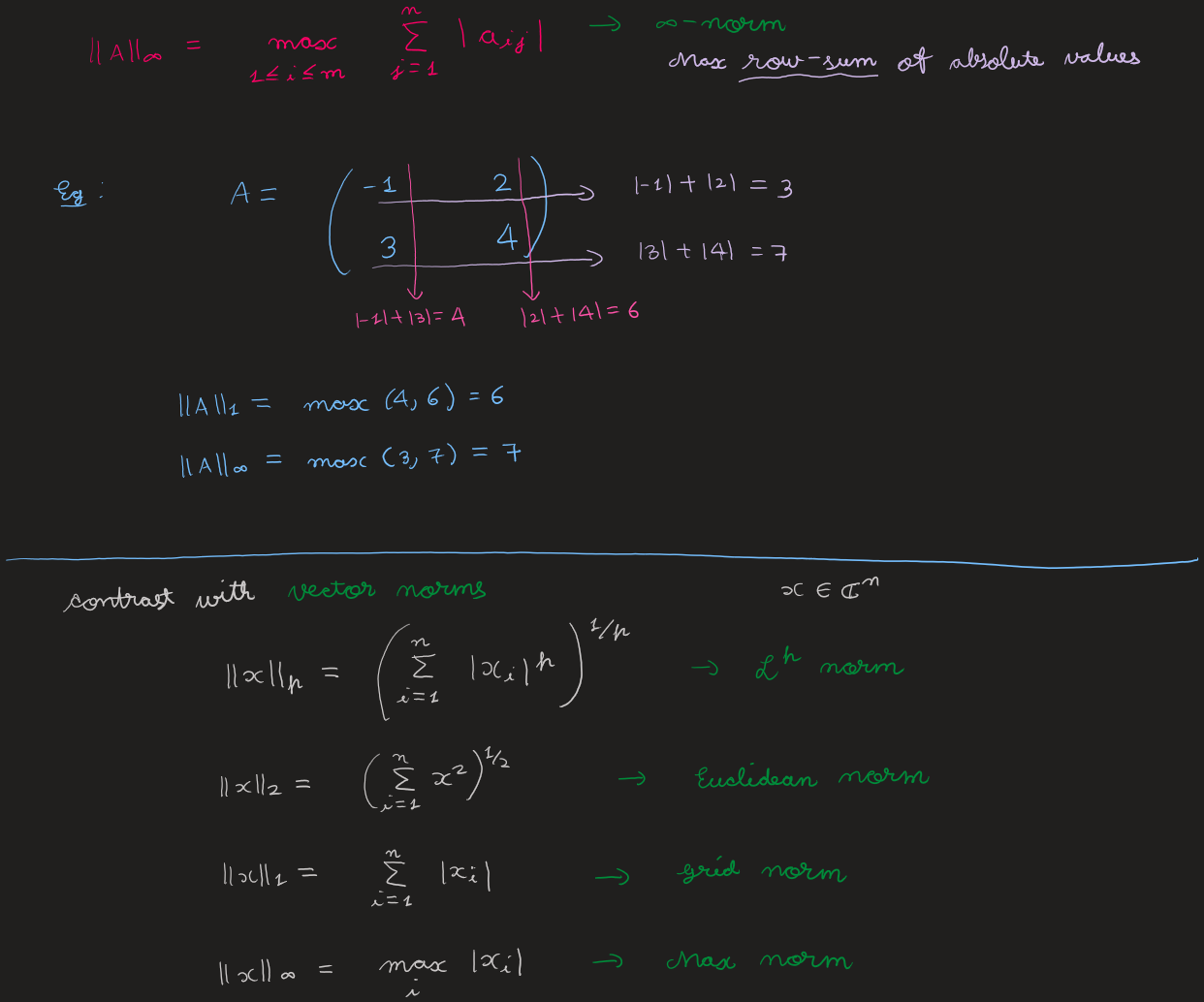
- \( \|A\|_\infty = \max_{1\le i\le m}\sum_{j=1}^{n}|a_{ij}| \) — the \( \infty \)-norm (max row-sum of absolute values).
Example
For \( A = \begin{bmatrix} -1 & 2 \\ 3 & 4 \end{bmatrix} \): the row sums are \( |{-1}| + |2| = 3 \) and \( |3| + |4| = 7 \); the column sums are \( |{-1}| + |3| = 4 \) and \( |2| + |4| = 6 \). Hence \[ \|A\|_1 = \max(4, 6) = 6, \qquad \|A\|_\infty = \max(3, 7) = 7. \]
Contrast with vector norms (\( x \in \C^n \)):
- \( \|x\|_p = \big(\sum_{i=1}^{n}|x_i|^p\big)^{1/p} \) — the \( \ell^p \) norm.
- \( \|x\|_2 = \big(\sum_{i=1}^{n}x_i^2\big)^{1/2} \) — the Euclidean norm.
- \( \|x\|_1 = \sum_{i=1}^{n}|x_i| \) — the grid (taxicab) norm.
- \( \|x\|_\infty = \max_i |x_i| \) — the max norm.
Remark
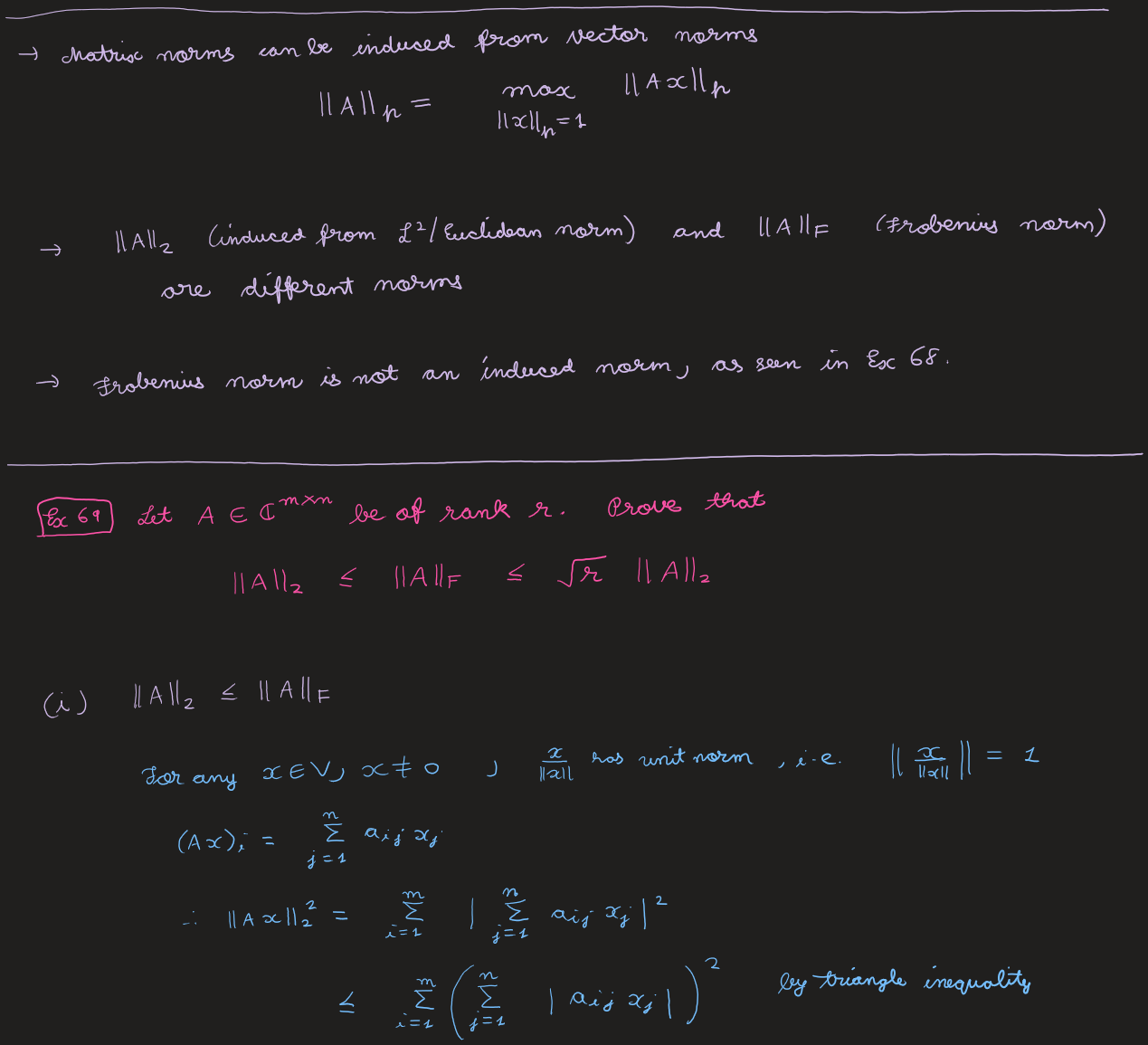
Matrix norms can be induced from vector norms: \( \|A\|_p = \max_{\|x\|_p = 1}\|Ax\|_p \). The norms \( \|A\|_2 \) (induced from the \( \ell^2 \)/Euclidean norm) and \( \|A\|_F \) (Frobenius) are different norms; the Frobenius norm is not an induced norm (Ex 68).
Ex 69
Let \( A \in \C^{m\times n} \) be of rank \(r\). Prove that \( \|A\|_2 \le \|A\|_F \le \sqrt{r}\,\|A\|_2 \).
Solution — (i) \( \|A\|_2 \le \|A\|_F \)
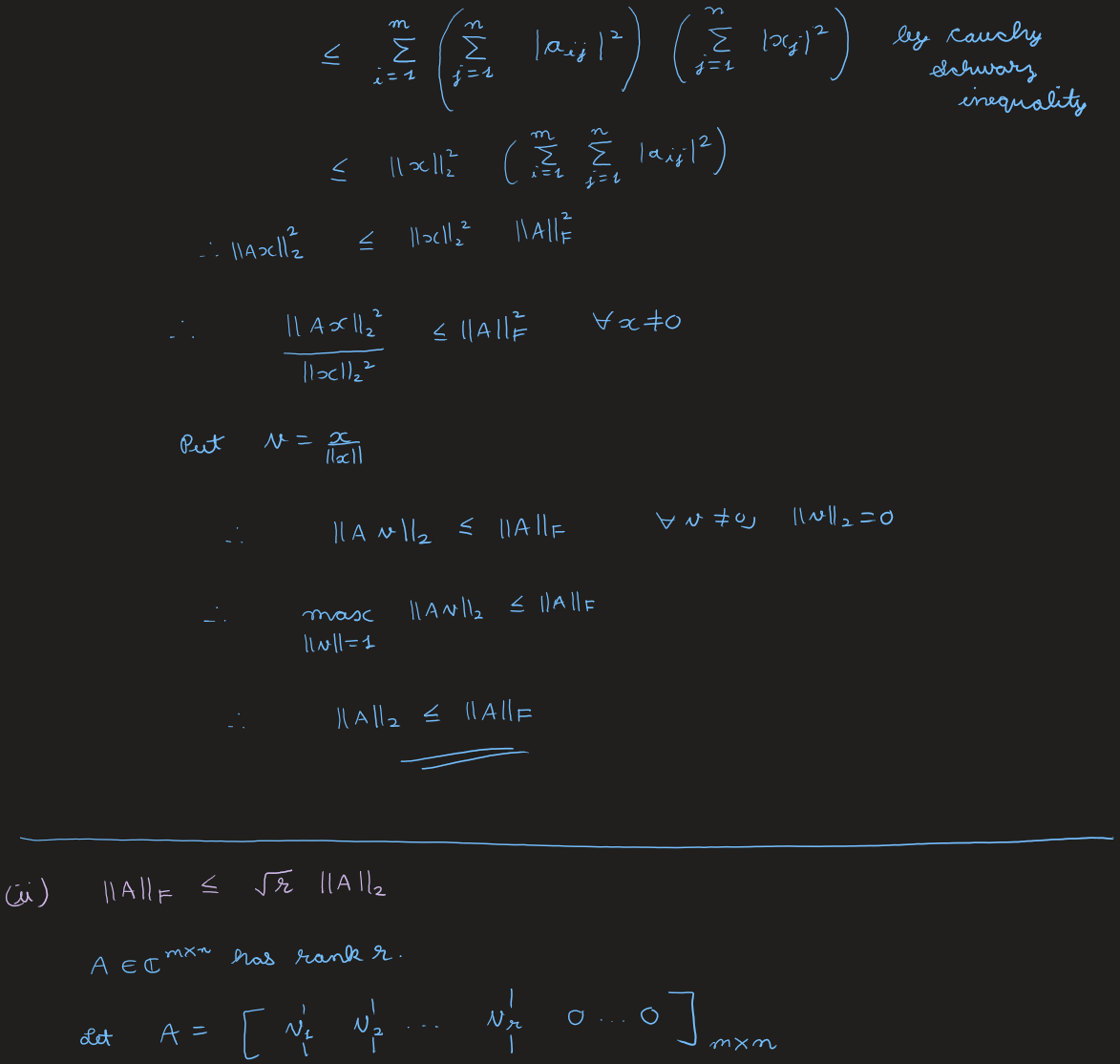
For any \( x \in V \), \( x \neq 0 \), \( \tfrac{x}{\|x\|} \) has unit norm. With \( (Ax)_i = \sum_{j=1}^{n} a_{ij}x_j \), \[\begin{aligned} \|Ax\|_2^2 &= \sum_{i=1}^{m}\Big|\sum_{j=1}^{n}a_{ij}x_j\Big|^2 \\ &\le \sum_{i=1}^{m}\Big(\sum_{j=1}^{n}|a_{ij}x_j|\Big)^2 \\ &\le \sum_{i=1}^{m}\Big(\sum_{j=1}^{n}|a_{ij}|^2\Big)\Big(\sum_{j=1}^{n}|x_j|^2\Big) \\ &\le \|x\|_2^2\Big(\sum_{i=1}^{m}\sum_{j=1}^{n}|a_{ij}|^2\Big), \end{aligned}\] by the triangle and Cauchy–Schwarz inequalities. So \( \|Ax\|_2^2 \le \|x\|_2^2\,\|A\|_F^2 \), i.e. \( \dfrac{\|Ax\|_2^2}{\|x\|_2^2} \le \|A\|_F^2 \ \forall\, x \neq 0 \). Putting \( v = \tfrac{x}{\|x\|} \), \( \|Av\|_2 \le \|A\|_F \ \forall\, v \neq 0,\ \|v\|_2 = 1 \), so \( \max_{\|v\|=1}\|Av\|_2 \le \|A\|_F \), giving \( \|A\|_2 \le \|A\|_F \).
Solution — (ii) \( \|A\|_F \le \sqrt{r}\,\|A\|_2 \)
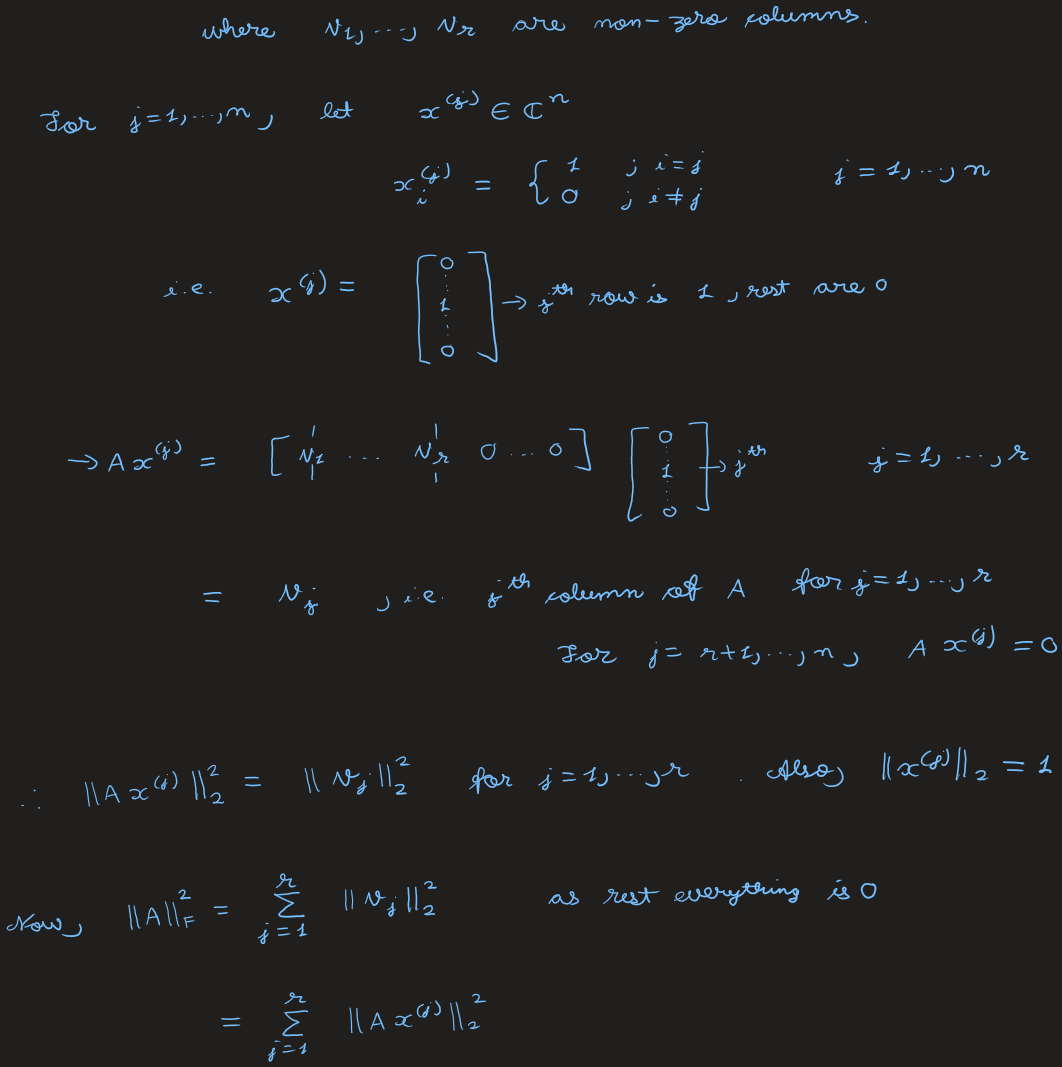
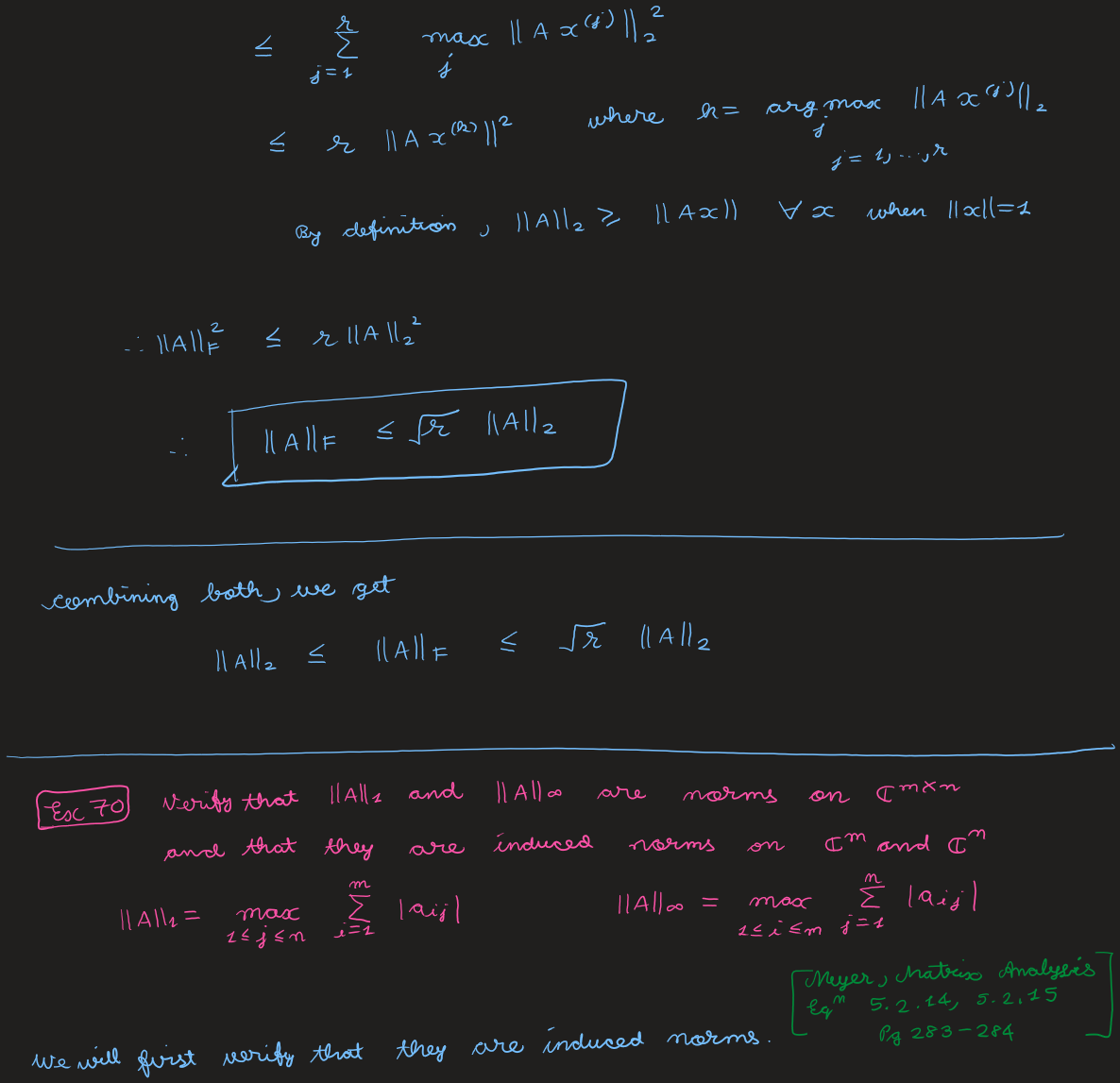
This bound is cleanest through the singular value decomposition (Chapter 10). Let \( A = \sum_{i=1}^{r} \sigma_i\, u_i v_i\herm \) be the SVD, where \( \sigma_1 \ge \sigma_2 \ge \dots \ge \sigma_r > 0 \) are the \( r = \operatorname{rank}(A) \) non-zero singular values. Then \[ \|A\|_F^2 = \operatorname{trace}(A\herm A) = \sum_{i=1}^{r}\sigma_i^2 \qquad\text{and}\qquad \|A\|_2 = \sigma_1 = \max_i \sigma_i. \] Since each \( \sigma_i^2 \le \sigma_1^2 \), \[ \|A\|_F^2 = \sum_{i=1}^{r}\sigma_i^2 \le r\,\sigma_1^2 = r\,\|A\|_2^2 \implies \|A\|_F \le \sqrt{r}\,\|A\|_2. \] Combining both, \( \|A\|_2 \le \|A\|_F \le \sqrt{r}\,\|A\|_2 \).
Correction — Ex 69(ii)
The original argument wrote a rank-\(r\) matrix as having exactly \(r\) non-zero columns, \( A = [\,v_1\,\cdots\,v_r\,0\,\cdots\,0\,] \), and summed \( \|A\|_F^2 = \sum_{j=1}^r\|v_j\|^2 \). That is not valid — a rank-\(r\) matrix can have many more than \(r\) non-zero columns (e.g. the all-ones \(3\times3\) matrix has rank \(1\) but three non-zero columns), so that sum undercounts \( \|A\|_F^2 \). The \( \sqrt r \) really comes from the \(r\) non-zero singular values, so the corrected proof uses the SVD.
Ex 70
Verify that \( \|A\|_1 \) and \( \|A\|_\infty \) are norms on \( \C^{m\times n} \), and that they are induced norms on \( \C^m \) and \( \C^n \). \( \|A\|_1 = \max_{1\le j\le n}\sum_{i=1}^{m}|a_{ij}| \), \( \|A\|_\infty = \max_{1\le i\le m}\sum_{j=1}^{n}|a_{ij}| \). (Meyer, Matrix Analysis, Eg 5.2.14–5.2.15, pp. 283–284.)
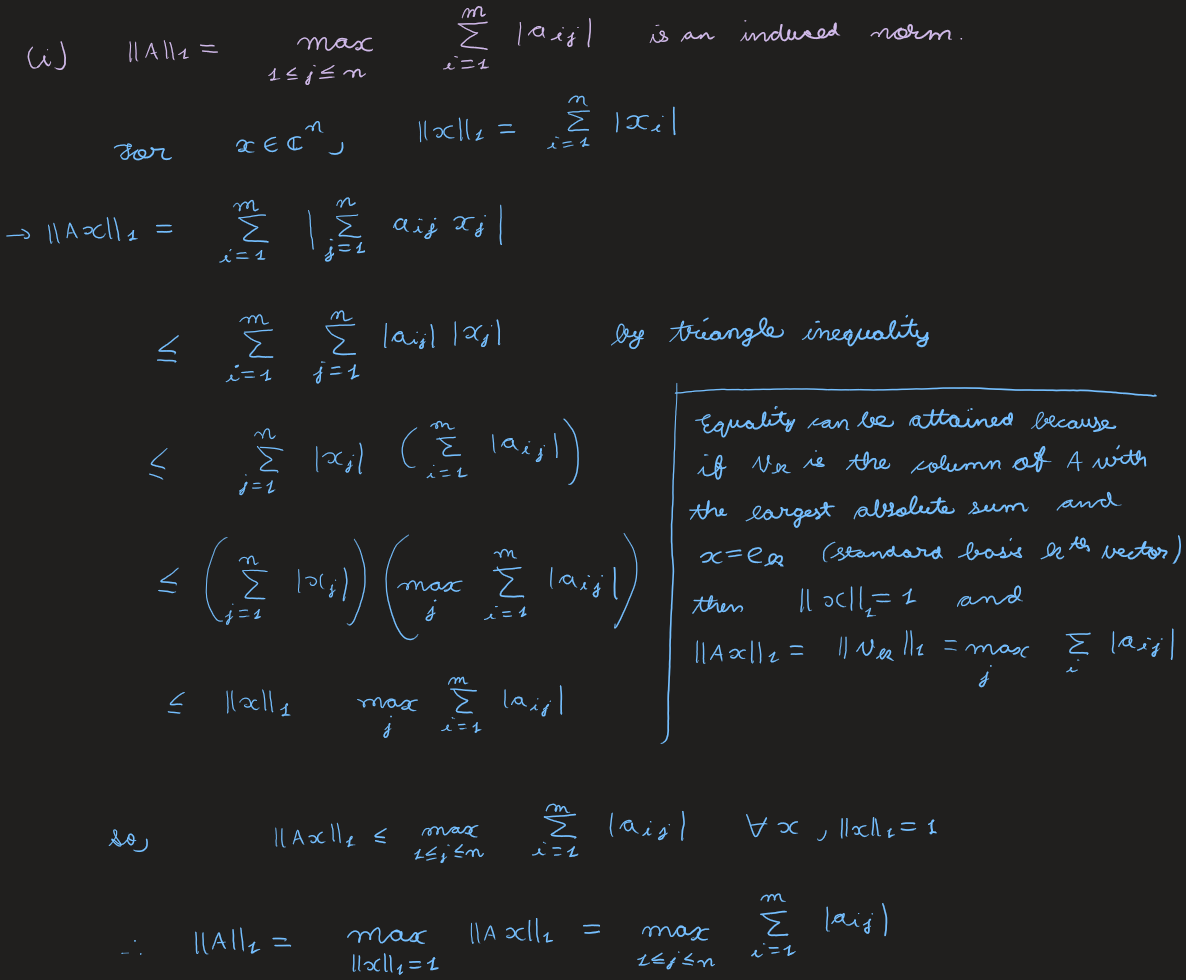
Solution — (i) \( \|A\|_1 \) is an induced norm
For \( x \in \C^n \), \( \|x\|_1 = \sum_{i=1}^{n}|x_i| \). Then \[\begin{aligned} \|Ax\|_1 &= \sum_{i=1}^{m}\Big|\sum_{j=1}^{n}a_{ij}x_j\Big| \\ &\le \sum_{i=1}^{m}\sum_{j=1}^{n}|a_{ij}||x_j| = \sum_{j=1}^{n}|x_j|\Big(\sum_{i=1}^{m}|a_{ij}|\Big) \\ &\le \Big(\sum_{j=1}^{n}|x_j|\Big)\max_j\sum_{i=1}^{m}|a_{ij}| \le \|x\|_1 \max_j\sum_{i=1}^{m}|a_{ij}|. \end{aligned}\] Equality is attained: if \( v_k \) is the column of \(A\) with the largest absolute sum and \( x = e_k \), then \( \|x\|_1 = 1 \) and \( \|Ax\|_1 = \|v_k\|_1 = \max_j\sum_i|a_{ij}| \). So \( \|A\|_1 = \max_{\|x\|_1 = 1}\|Ax\|_1 = \max_{1\le j\le n}\sum_{i=1}^{m}|a_{ij}| \).
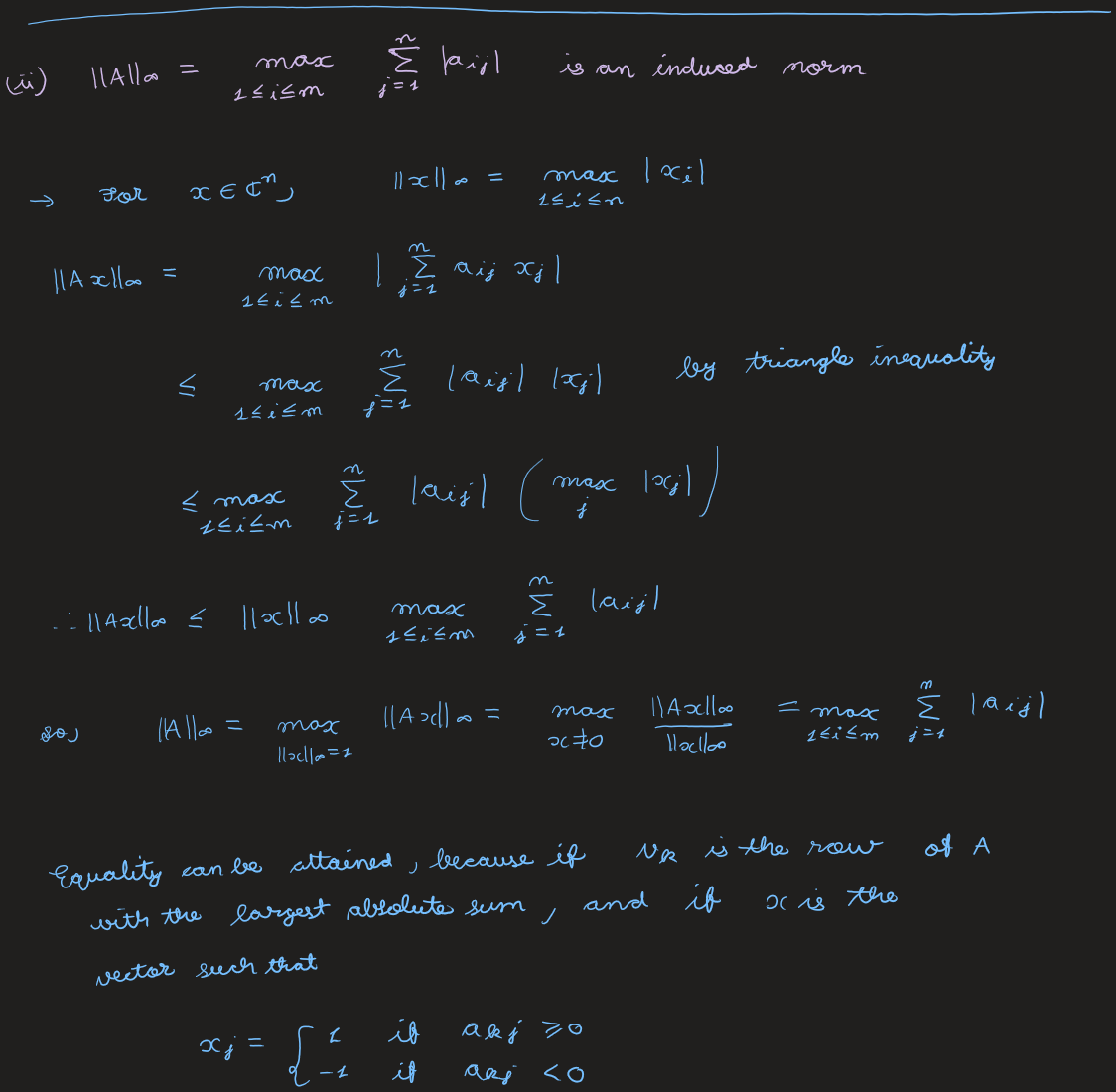
Solution — (ii) \( \|A\|_\infty \) is an induced norm
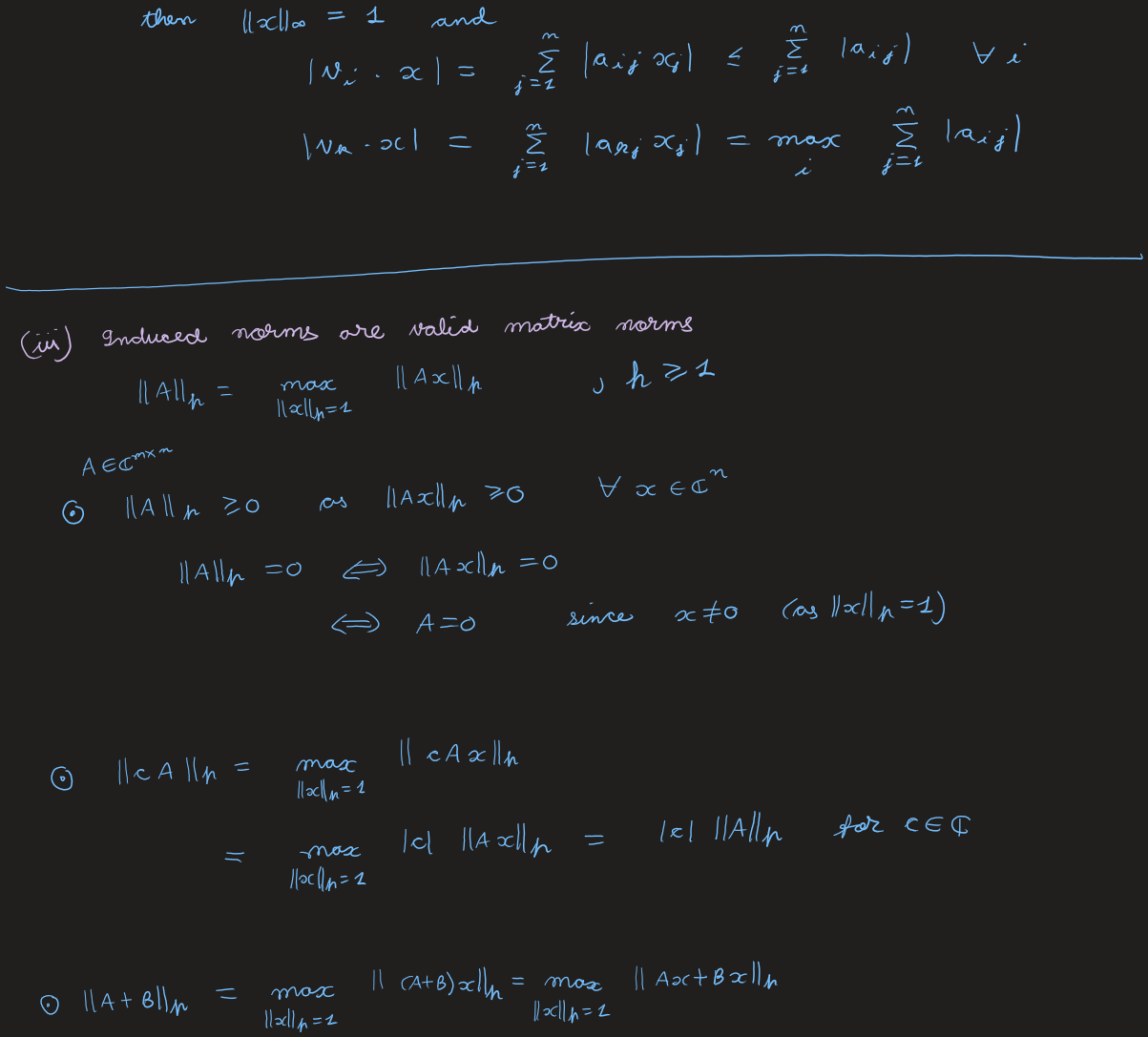
For \( x \in \C^n \), \( \|x\|_\infty = \max_{1\le i\le n}|x_i| \). Then \[\begin{aligned} \|Ax\|_\infty &= \max_{1\le i\le m}\Big|\sum_{j=1}^{n}a_{ij}x_j\Big| \\ &\le \max_{1\le i\le m}\sum_{j=1}^{n}|a_{ij}||x_j| \\ &\le \max_{1\le i\le m}\sum_{j=1}^{n}|a_{ij}|\,\big(\max_j|x_j|\big), \end{aligned}\] so \( \|Ax\|_\infty \le \|x\|_\infty \max_{1\le i\le m}\sum_{j=1}^{n}|a_{ij}| \). Equality is attained: if \( v_k \) is the row of \(A\) with the largest absolute sum, and \(x\) is such that \( x_j = \begin{cases} 1 & a_{kj} \ge 0 \\ -1 & a_{kj} < 0 \end{cases} \), then \( \|x\|_\infty = 1 \) and \( |v_k \cdot x| = \sum_{j=1}^{n}|a_{kj}x_j| = \max_i\sum_{j=1}^{n}|a_{ij}| \). So \( \|A\|_\infty = \max_{\|x\|=1}\|Ax\|_\infty = \max_{1\le i\le m}\sum_{j=1}^{n}|a_{ij}| \).
Solution — (iii) Induced norms are valid matrix norms
\( \|A\|_p = \max_{\|x\|_p = 1}\|Ax\|_p \), \( p \ge 1 \), \( A \in \C^{m\times n} \).
- \( \|A\|_p \ge 0 \) as \( \|Ax\|_p \ge 0 \ \forall\, x \in \C^n \); \( \|A\|_p = 0 \iff \|Ax\|_p = 0 \iff A = 0 \) (since \( x \neq 0 \), as \( \|x\|_p = 1 \)).
- \( \|cA\|_p = \max_{\|x\|_p = 1}\|cAx\|_p = \max_{\|x\|_p=1}|c|\,\|Ax\|_p = |c|\,\|A\|_p \) for \( c \in \C \).
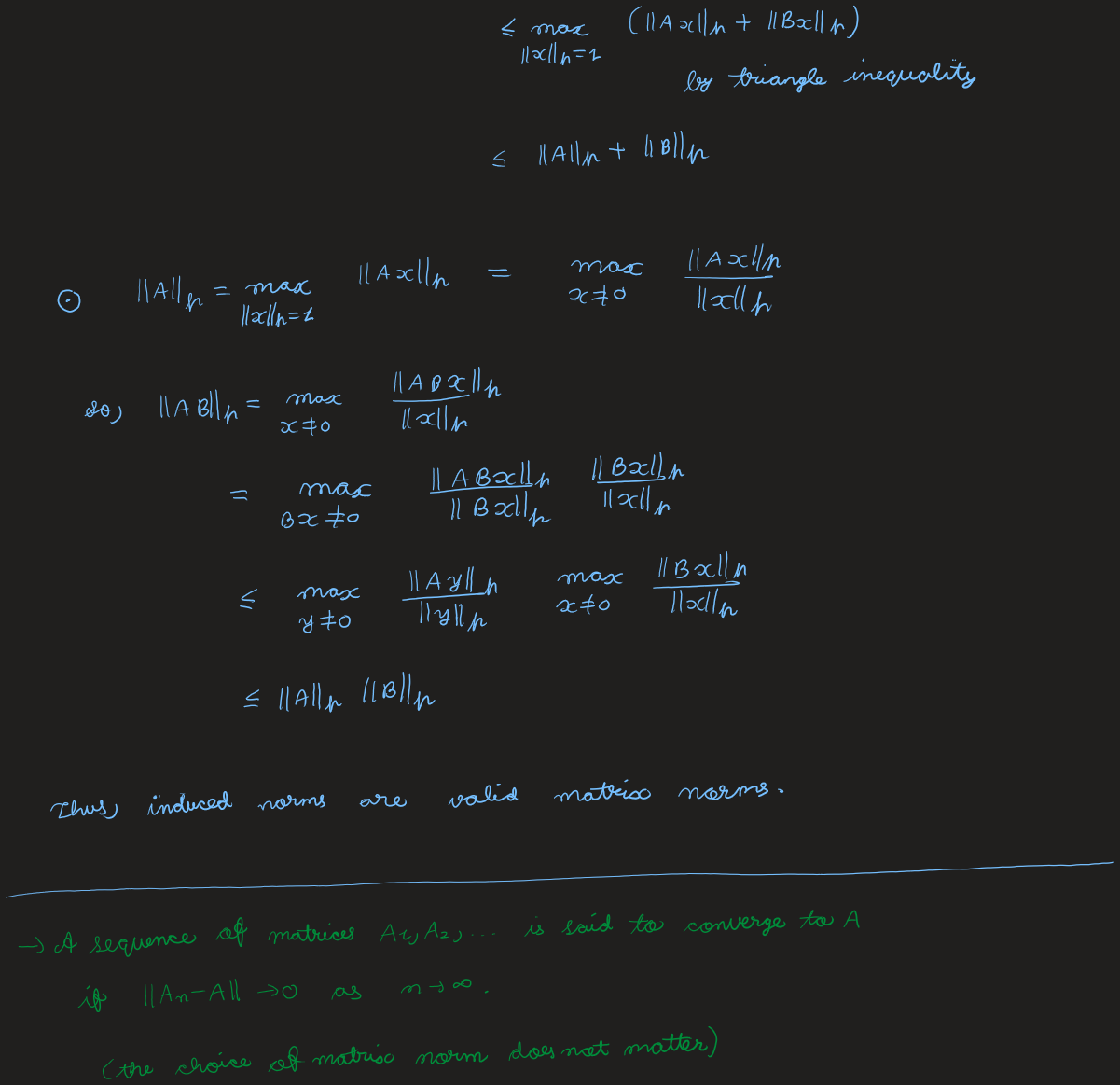
- \( \|A+B\|_p = \max_{\|x\|_p=1}\|(A+B)x\|_p \le \max_{\|x\|_p=1}\big(\|Ax\|_p + \|Bx\|_p\big) \le \|A\|_p + \|B\|_p \).
- With \( \|A\|_p = \max_{x\neq 0}\dfrac{\|Ax\|_p}{\|x\|_p} \), \( \|AB\|_p = \max_{x\neq 0}\dfrac{\|ABx\|_p}{\|x\|_p} = \max_{Bx\neq 0}\dfrac{\|ABx\|_p}{\|Bx\|_p}\dfrac{\|Bx\|_p}{\|x\|_p} \le \Big(\max_{y\neq 0}\dfrac{\|Ay\|_p}{\|y\|_p}\Big)\Big(\max_{x\neq 0}\dfrac{\|Bx\|_p}{\|x\|_p}\Big) \le \|A\|_p\|B\|_p \).
Thus induced norms are valid matrix norms.
View original handwritten scans — Matrix & Frobenius norms, Ex 68–70 (pages 6–19)
Sequences of Matrices & Invertibility
→ A sequence of matrices \( A_1, A_2, \dots \) is said to converge to \(A\) if \( \|A_n - A\| \to 0 \) as \( n \to \infty \) (the choice of matrix norm does not matter).
Ex 71
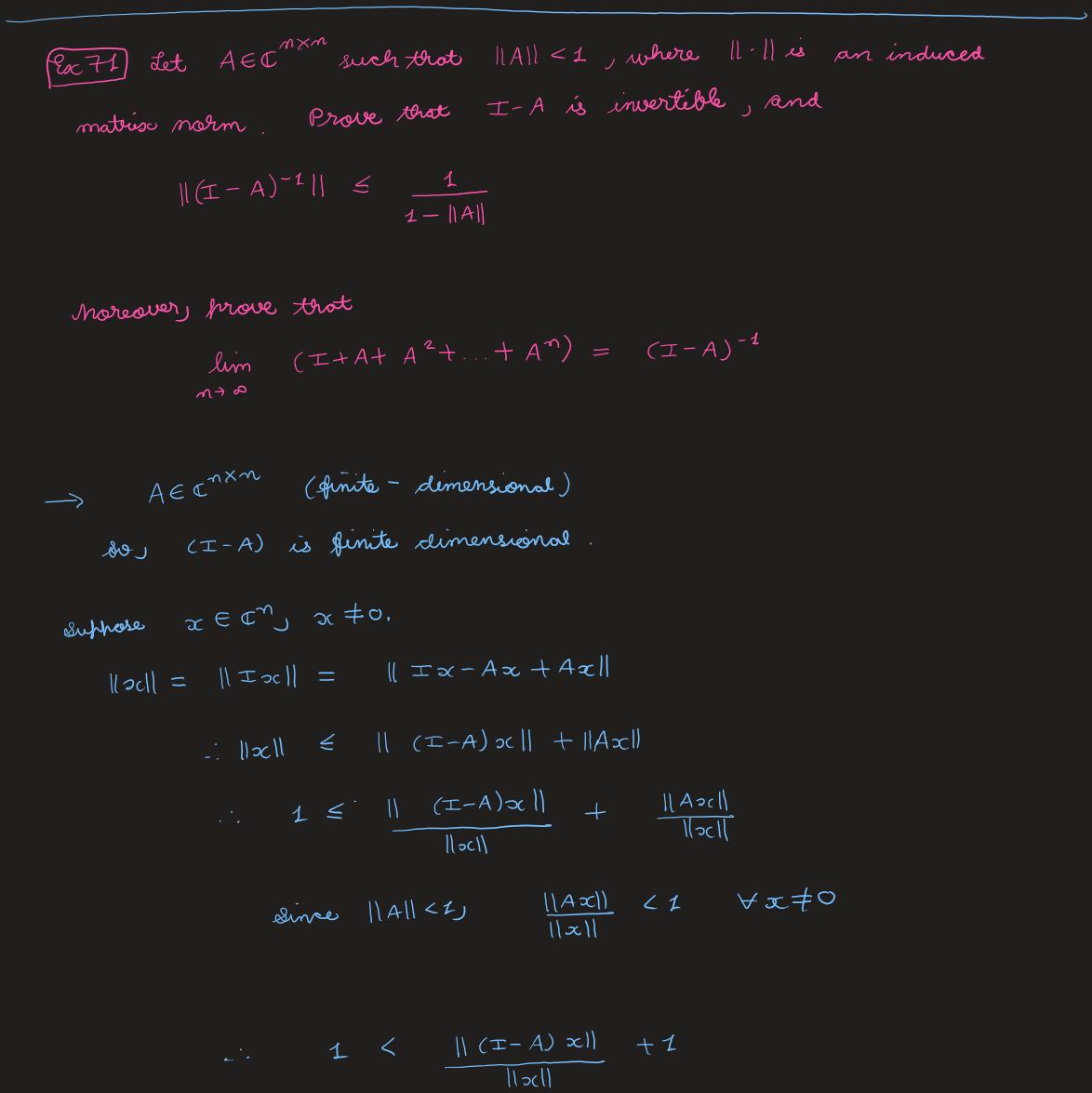
Let \( A \in \C^{n\times n} \) with \( \|A\| < 1 \), where \( \|\cdot\| \) is an induced matrix norm. Prove that \( I - A \) is invertible, and \( \|(I-A)^{-1}\| \le \dfrac{1}{1 - \|A\|} \). Moreover, prove that \( \displaystyle\lim_{n\to\infty}(I + A + A^2 + \dots + A^n) = (I - A)^{-1} \).
Solution — \( I - A \) is invertible
\( A \in \C^{n\times n} \) is finite-dimensional, so \( I - A \) is finite-dimensional. Suppose \( x \in \C^n \), \( x \neq 0 \). Then \( \|x\| = \|Ix\| = \|Ix - Ax + Ax\| \le \|(I-A)x\| + \|Ax\| \), so \( 1 \le \dfrac{\|(I-A)x\|}{\|x\|} + \dfrac{\|Ax\|}{\|x\|} \). Since \( \|A\| < 1 \), \( \dfrac{\|Ax\|}{\|x\|} < 1 \ \forall\, x \neq 0 \), so \( 1 < \dfrac{\|(I-A)x\|}{\|x\|} + 1 \), giving \( \dfrac{1}{\|x\|}\|(I-A)x\| > 0 \ \forall\, x \neq 0 \). Hence \( (I-A)x \neq 0 \ \forall\, x \neq 0 \Rightarrow \Null(I-A) = \{0\} \Rightarrow I - A \) is injective; being finite-dimensional, it is invertible.
Solution — the bound on \( \|(I-A)^{-1}\| \)
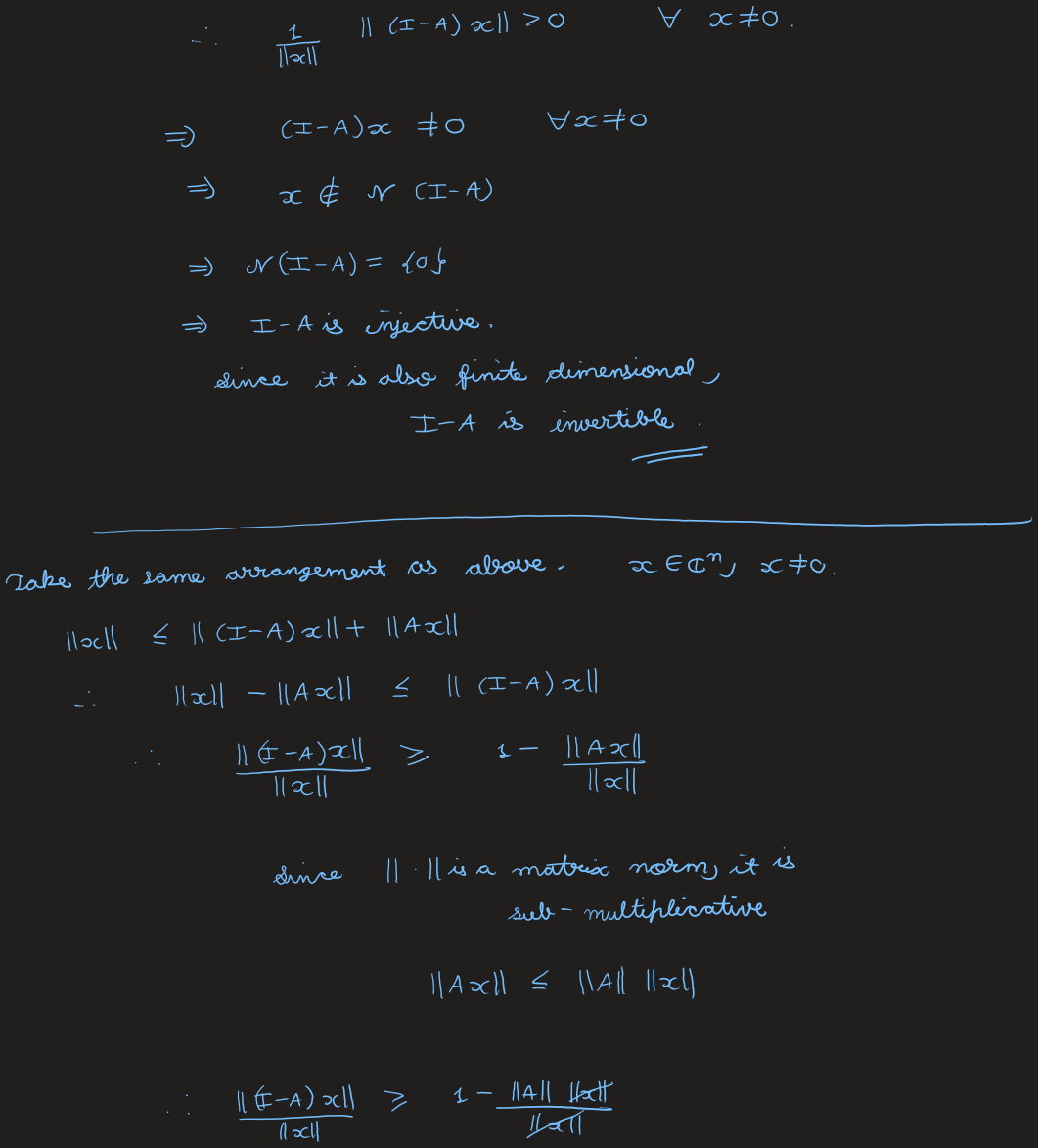
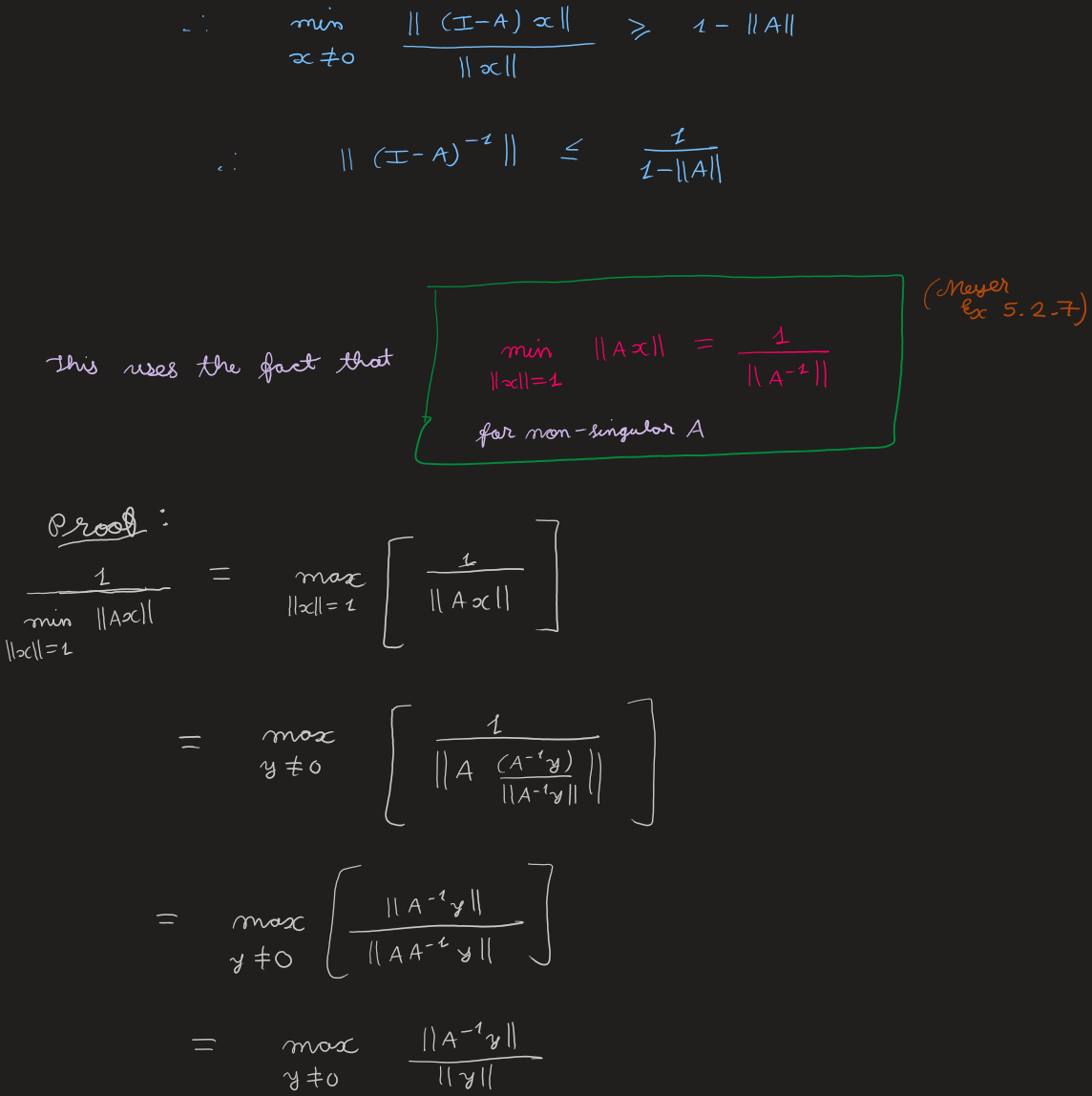
With \( x \in \C^n \), \( x \neq 0 \): \( \|x\| \le \|(I-A)x\| + \|Ax\| \), so \( \|x\| - \|Ax\| \le \|(I-A)x\| \), giving \( \dfrac{\|(I-A)x\|}{\|x\|} \ge 1 - \dfrac{\|Ax\|}{\|x\|} \). Since \( \|\cdot\| \) is submultiplicative, \( \|Ax\| \le \|A\|\|x\| \), so \( \dfrac{\|(I-A)x\|}{\|x\|} \ge 1 - \|A\| \). Hence \( \min_{x\neq 0}\dfrac{\|(I-A)x\|}{\|x\|} \ge 1 - \|A\| \), so \[ \|(I-A)^{-1}\| \le \frac{1}{1 - \|A\|}, \] using the fact that \( \min_{\|x\|=1}\|Ax\| = \dfrac{1}{\|A^{-1}\|} \) for non-singular \(A\) (Meyer, Ex 5.2.7), since \[\begin{aligned} \frac{1}{\min_{\|x\|=1}\|Ax\|} &= \max_{\|x\|=1}\frac{1}{\|Ax\|} \\ &= \max_{y\neq 0}\frac{1}{\big\|A\frac{A^{-1}y}{\|A^{-1}y\|}\big\|} \\ &= \max_{y\neq 0}\frac{\|A^{-1}y\|}{\|AA^{-1}y\|} = \max_{y\neq 0}\frac{\|A^{-1}y\|}{\|y\|} = \|A^{-1}\|. \end{aligned}\]
Solution — the Neumann series
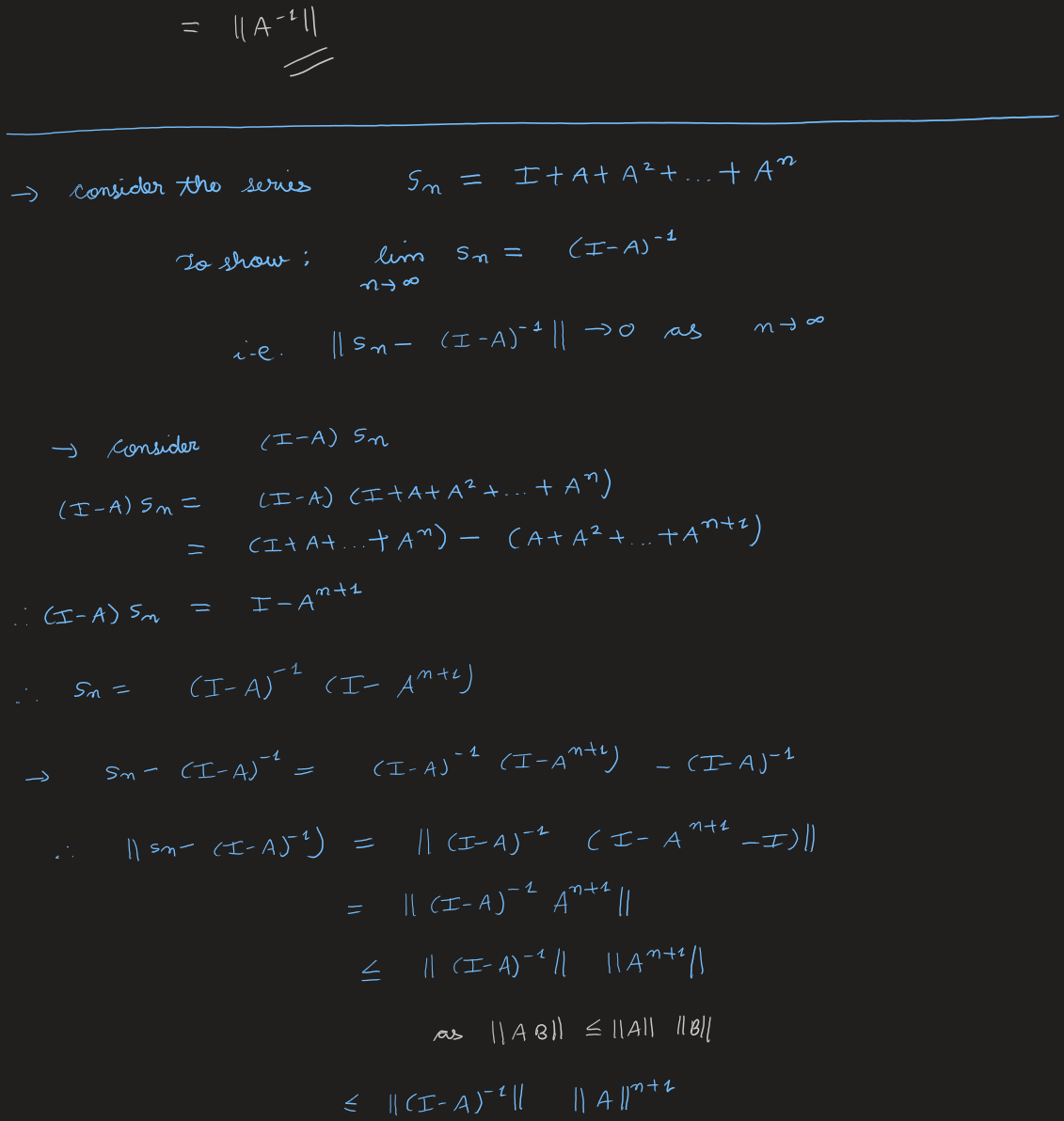
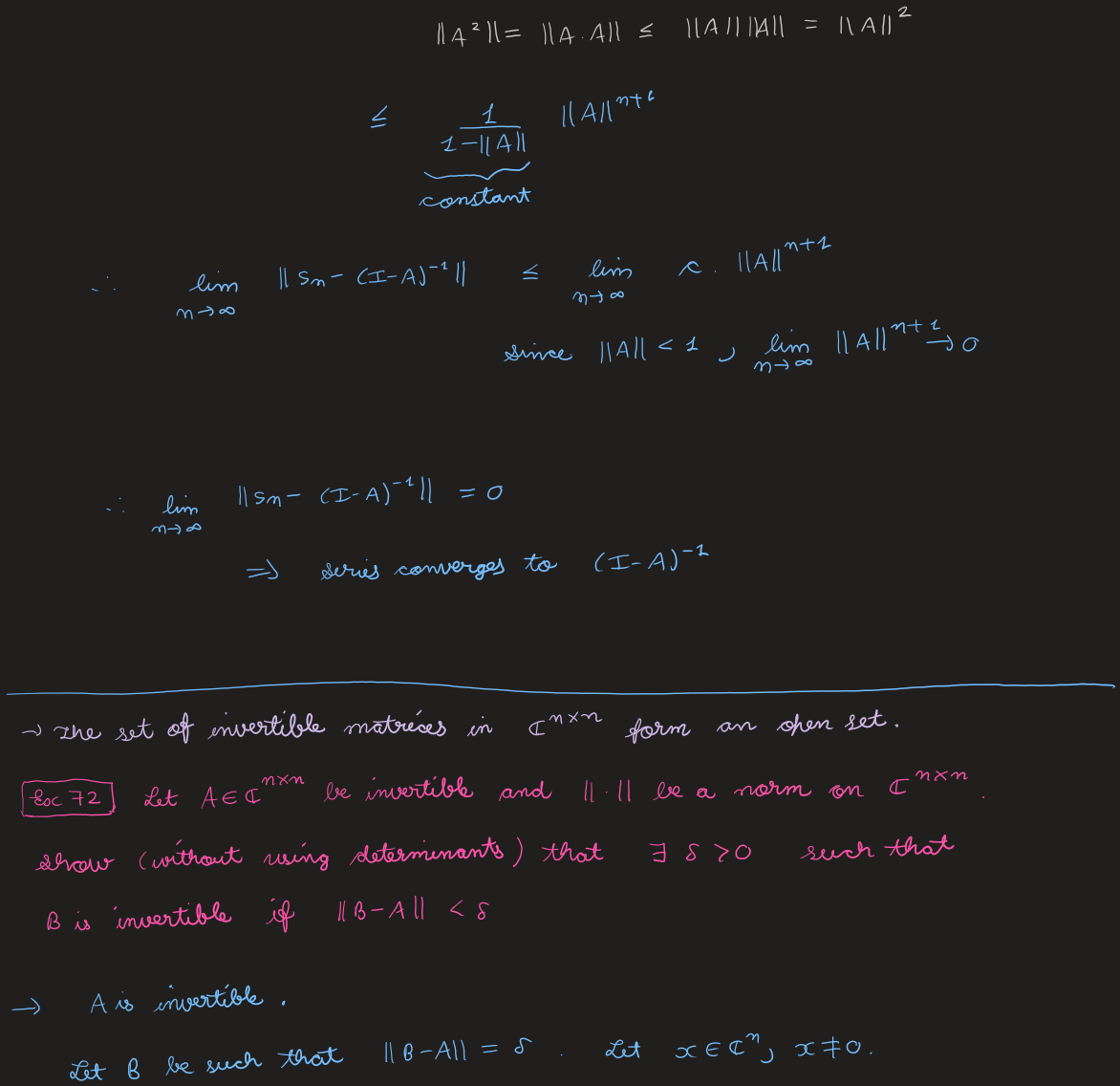
Consider \( S_n = I + A + A^2 + \dots + A^n \). We show \( \lim_{n\to\infty}S_n = (I-A)^{-1} \), i.e. \( \|S_n - (I-A)^{-1}\| \to 0 \). Since \[ (I-A)S_n = (I-A)(I + A + \dots + A^n) = (I + A + \dots + A^n) - (A + A^2 + \dots + A^{n+1}) = I - A^{n+1}, \] we get \( S_n = (I-A)^{-1}(I - A^{n+1}) \), so \( S_n - (I-A)^{-1} = (I-A)^{-1}(I - A^{n+1}) - (I-A)^{-1} \) and \[\begin{aligned} \|S_n - (I-A)^{-1}\| &= \|(I-A)^{-1}(I - A^{n+1} - I)\| \\ &= \|(I-A)^{-1}A^{n+1}\| \\ &\le \|(I-A)^{-1}\|\,\|A^{n+1}\| \le \frac{1}{1-\|A\|}\|A\|^{n+1}, \end{aligned}\] using \( \|A^{n+1}\| \le \|A\|^{n+1} \). Since \( \|A\| < 1 \), \( \lim_{n\to\infty}\|A\|^{n+1} = 0 \), so \( \lim_{n\to\infty}\|S_n - (I-A)^{-1}\| = 0 \). Hence the series converges to \( (I-A)^{-1} \).
→ The set of invertible matrices in \( \C^{n\times n} \) forms an open set.
Correction — exercise & theorem numbering
The instructor's Chapter 6 has exercises 67–72 — with Ex 72 the polynomial-continuity result below — and the equivalence result is Theorem 10; Chapter 7 then begins at Ex 73. The handwritten notes had inserted the "openness of the invertible matrices" result as an extra "Ex 72" (shifting the polynomial result to "73") and numbered the theorem "20". To keep the global numbering aligned with the instructor, that openness result is shown below as an unnumbered Additional Exercise, the polynomial-continuity result is renumbered to Ex 72, and the theorem to Theorem 10.
Additional Exercise — openness of the invertible matrices
Let \( A \in \C^{n\times n} \) be invertible and \( \|\cdot\| \) a norm on \( \C^{n\times n} \). Show (without using determinants) that \( \exists\, \delta > 0 \) such that \(B\) is invertible if \( \|B - A\| < \delta \). (Not in the instructor's numbered list; kept from the handwritten notes.)
Solution
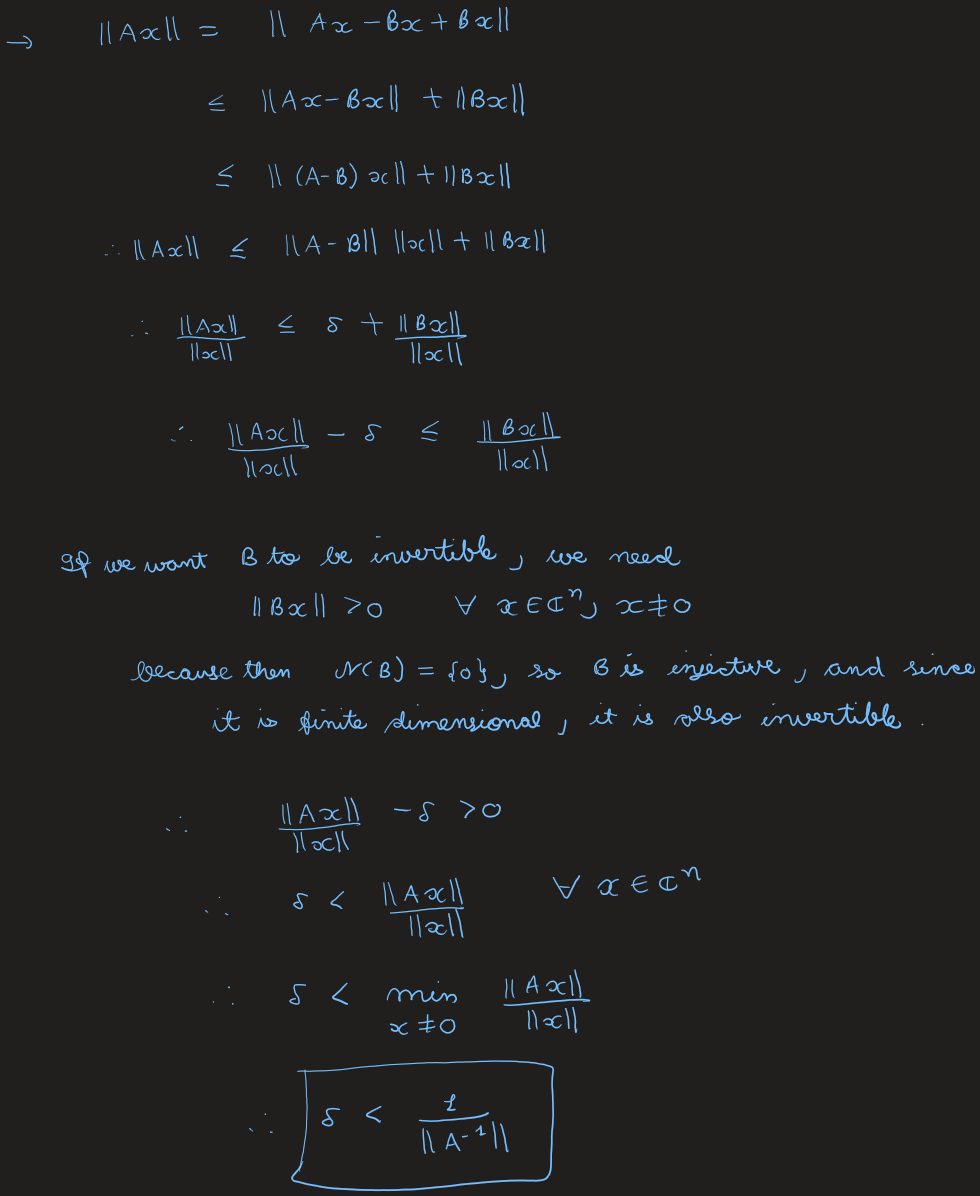
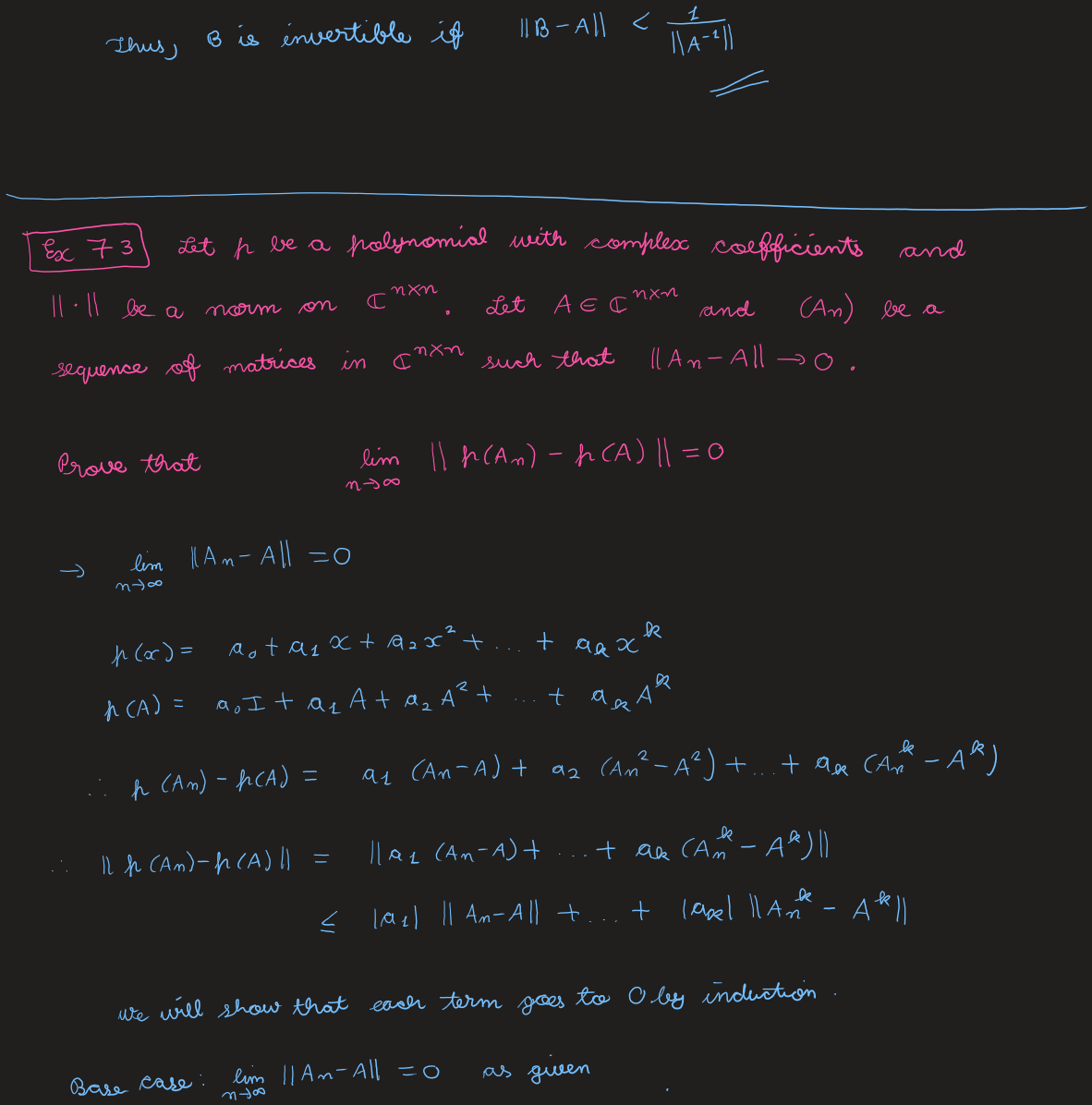
\(A\) is invertible. Let \(B\) be such that \( \|B - A\| = \delta \), and \( x \in \C^n \), \( x \neq 0 \). Then \[ \|Ax\| = \|Ax - Bx + Bx\| \le \|Ax - Bx\| + \|Bx\| \le \|(A-B)x\| + \|Bx\| \le \|A - B\|\,\|x\| + \|Bx\|, \] so \( \dfrac{\|Ax\|}{\|x\|} \le \delta + \dfrac{\|Bx\|}{\|x\|} \), i.e. \( \dfrac{\|Ax\|}{\|x\|} - \delta \le \dfrac{\|Bx\|}{\|x\|} \). For \(B\) to be invertible we need \( \|Bx\| > 0 \ \forall\, x \neq 0 \) (then \( \Null(B) = \{0\} \), so \(B\) is injective and, being finite-dimensional, invertible). So we need \( \dfrac{\|Ax\|}{\|x\|} - \delta > 0 \), i.e. \( \delta < \dfrac{\|Ax\|}{\|x\|} \ \forall\, x \neq 0 \), i.e. \( \delta < \min_{x\neq 0}\dfrac{\|Ax\|}{\|x\|} \). Therefore \[ \delta < \frac{1}{\|A^{-1}\|}. \] Thus \(B\) is invertible if \( \|B - A\| < \dfrac{1}{\|A^{-1}\|} \).
Ex 72
Let \(p\) be a polynomial with complex coefficients and \( \|\cdot\| \) a norm on \( \C^{n\times n} \). Let \( A \in \C^{n\times n} \) and \( (A_n) \) a sequence of matrices in \( \C^{n\times n} \) with \( \|A_n - A\| \to 0 \). Prove that \( \lim_{n\to\infty}\|p(A_n) - p(A)\| = 0 \).
Solution
With \( p(x) = a_0 + a_1 x + a_2 x^2 + \dots + a_k x^k \), \( p(A) = a_0 I + a_1 A + a_2 A^2 + \dots + a_k A^k \), so \[ p(A_n) - p(A) = a_1(A_n - A) + a_2(A_n^2 - A^2) + \dots + a_k(A_n^k - A^k), \] and \( \|p(A_n) - p(A)\| \le |a_1|\,\|A_n - A\| + \dots + |a_k|\,\|A_n^k - A^k\| \). We show each term \( \to 0 \) by induction.
Base case. \( \lim_{n\to\infty}\|A_n - A\| = 0 \) is given.
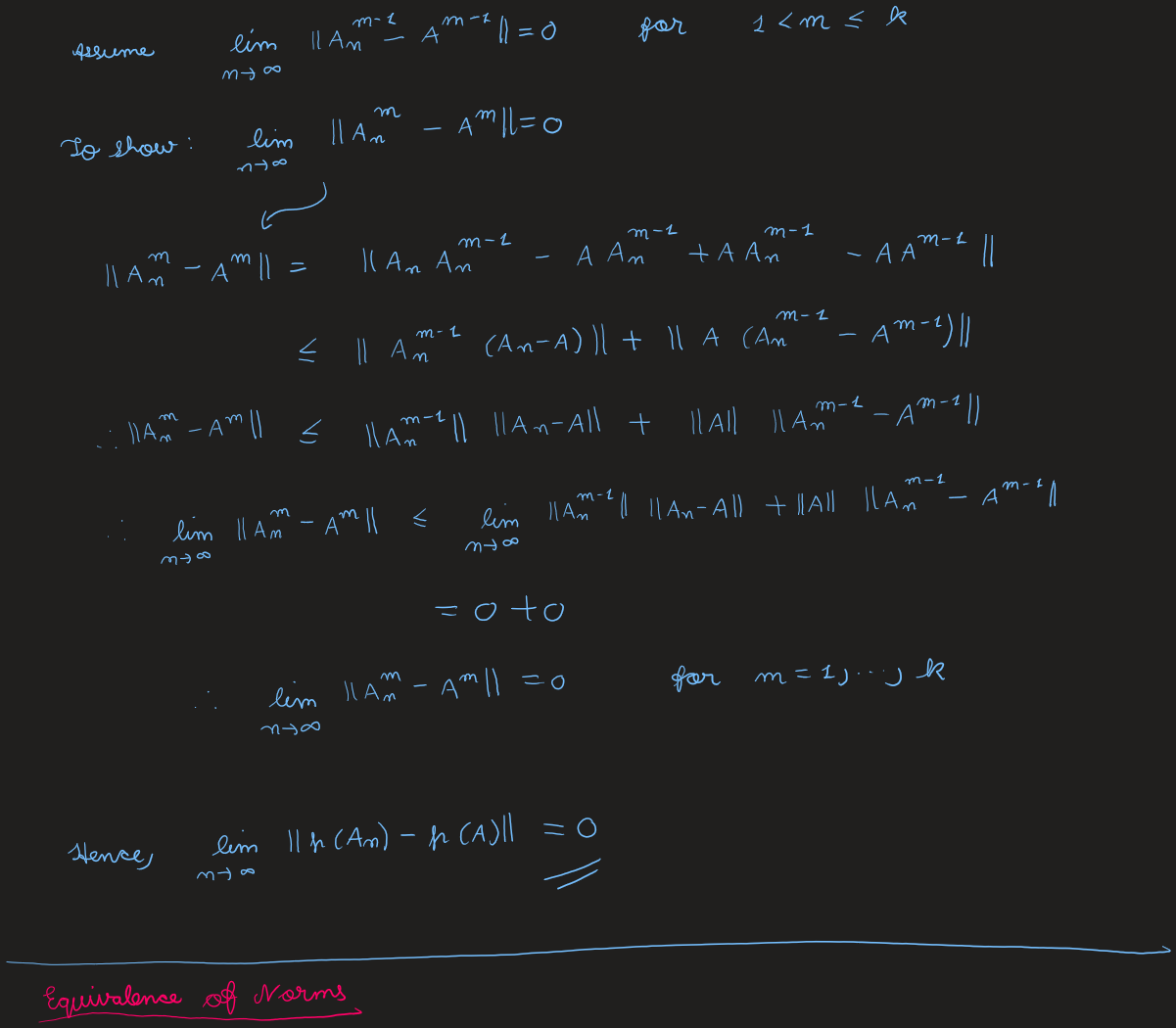
Inductive step. Assume \( \lim_{n\to\infty}\|A_n^{m-1} - A^{m-1}\| = 0 \) for \( 1 < m \le k \). Then \[ \|A_n^m - A^m\| = \|A_n A_n^{m-1} - A A_n^{m-1} + A A_n^{m-1} - A A^{m-1}\| \le \|A_n^{m-1}(A_n - A)\| + \|A(A_n^{m-1} - A^{m-1})\| \] \[ \le \|A_n^{m-1}\|\,\|A_n - A\| + \|A\|\,\|A_n^{m-1} - A^{m-1}\|, \] so \( \lim_{n\to\infty}\|A_n^m - A^m\| \le 0 + 0 = 0 \). Hence \( \lim_{n\to\infty}\|A_n^m - A^m\| = 0 \) for \( m = 1, \dots, k \), and therefore \( \lim_{n\to\infty}\|p(A_n) - p(A)\| = 0 \).
Equivalence of Norms
Theorem 10 — Equivalence of norms
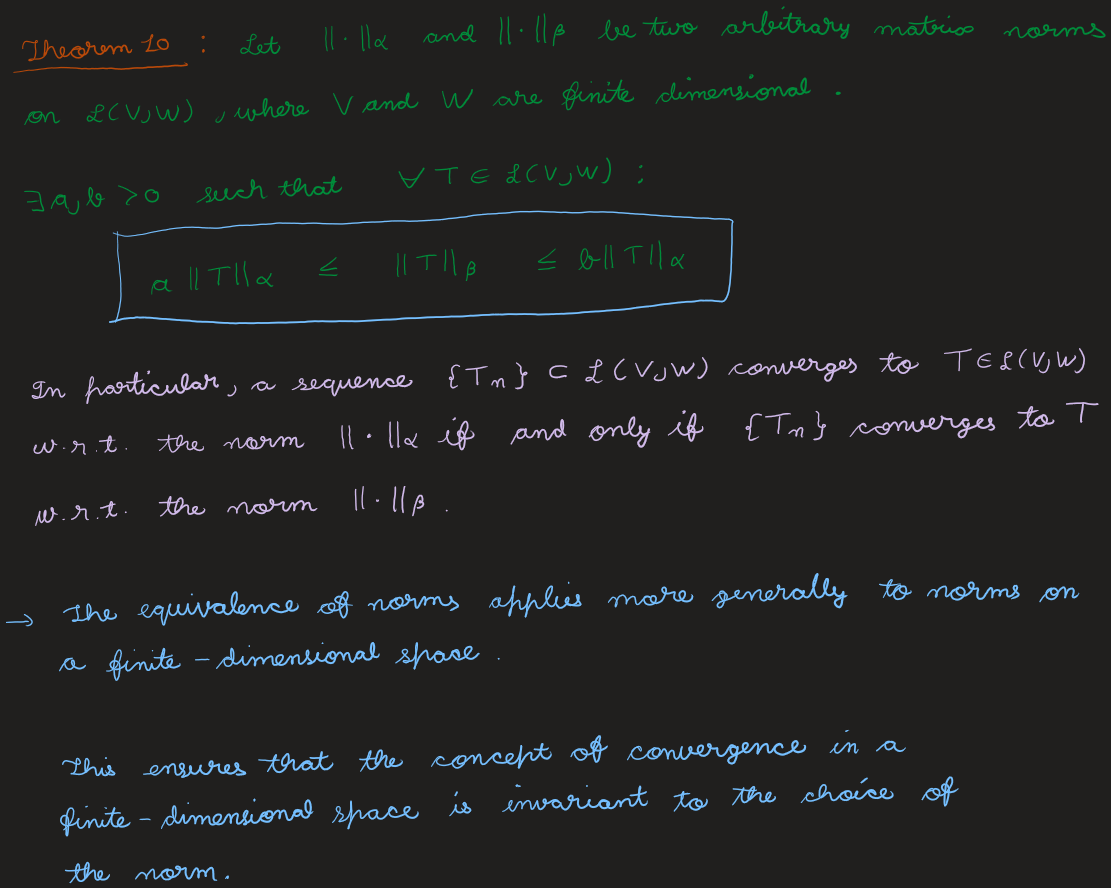
Let \( \|\cdot\|_\alpha \) and \( \|\cdot\|_\beta \) be two arbitrary matrix norms on \( \Lin(V, W) \), where \(V\) and \(W\) are finite-dimensional. Then \( \exists\, a, b > 0 \) such that \( \forall\, T \in \Lin(V, W) \): \[ a\,\|T\|_\alpha \le \|T\|_\beta \le b\,\|T\|_\alpha. \] In particular, a sequence \( \{T_n\} \subset \Lin(V, W) \) converges to \( T \in \Lin(V, W) \) w.r.t. \( \|\cdot\|_\alpha \) if and only if \( \{T_n\} \) converges to \(T\) w.r.t. \( \|\cdot\|_\beta \).
Remark
The equivalence of norms applies more generally to norms on a finite-dimensional space. This ensures that the concept of convergence in a finite-dimensional space is invariant to the choice of norm.
View original handwritten scans — Sequences, invertibility & equivalence, Ex 71–72 (+ an additional exercise) + Thm 10 (pages 20–28)