Chapter 4 — Inner-Product and Normed Spaces
Linear Algebra and its Applications · IISc 2024 · typeset reproduction
Recap: Complex Numbers
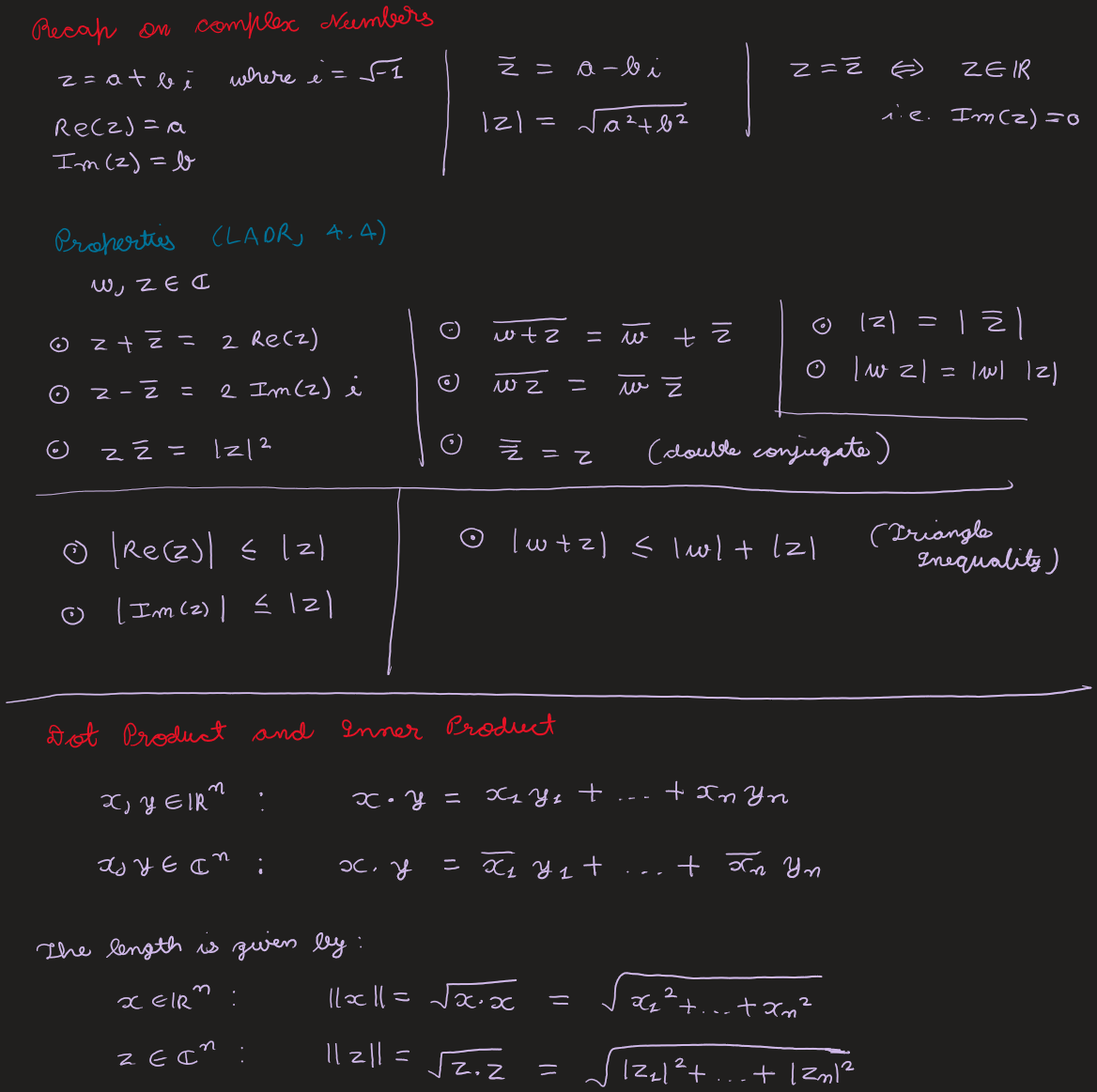
A complex number is \( z = a + bi \) where \( i = \sqrt{-1} \), with \( \operatorname{Re}(z) = a \) and \( \operatorname{Im}(z) = b \). Its conjugate is \( \bar z = a - bi \), its modulus \( |z| = \sqrt{a^2 + b^2} \), and \[ z = \bar z \iff z \in \R \quad(\text{i.e. } \operatorname{Im}(z) = 0). \]
Properties — LADR 4.4
For \( w, z \in \C \):
- \( z + \bar z = 2\operatorname{Re}(z) \)
- \( z - \bar z = 2\operatorname{Im}(z)\, i \)
- \( z\bar z = |z|^2 \)
- \( \overline{w + z} = \bar w + \bar z \)
- \( \overline{wz} = \bar w\, \bar z \)
- \( \overline{\bar z} = z \) (double conjugate)
- \( |z| = |\bar z| \)
- \( |wz| = |w|\,|z| \)
- \( |\operatorname{Re}(z)| \le |z| \)
- \( |\operatorname{Im}(z)| \le |z| \)
- \( |w + z| \le |w| + |z| \) (triangle inequality)
View original handwritten scan — complex-number recap & the dot product (page 1)
Inner Products
Dot product and length
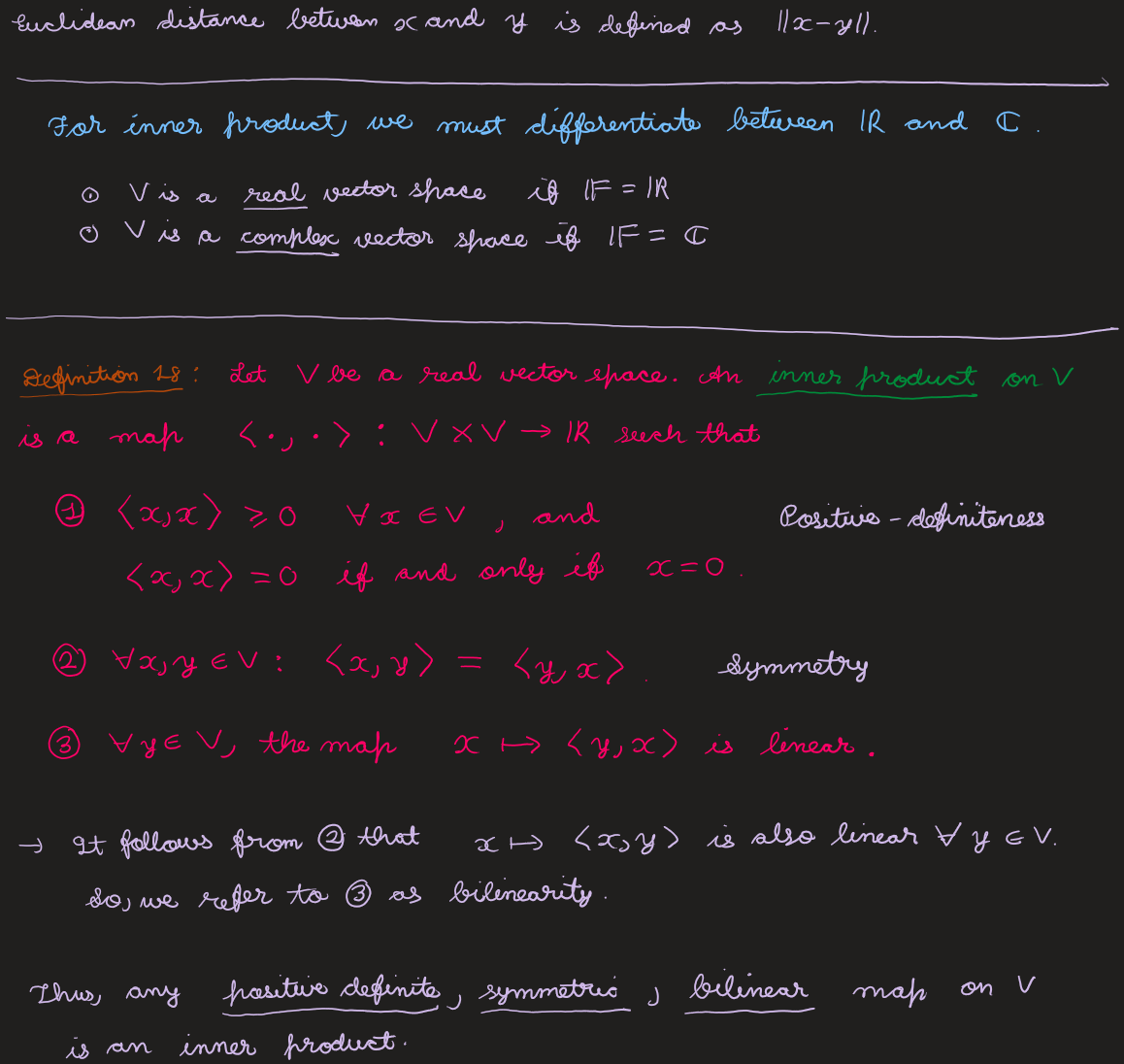
The dot product on \( \R^n \) and \( \C^n \): \[ x, y \in \R^n : \quad x \cdot y = x_1 y_1 + \dots + x_n y_n, \qquad x, y \in \C^n : \quad x \cdot y = \bar x_1 y_1 + \dots + \bar x_n y_n. \] The length of a vector is \[ x \in \R^n : \ \|x\| = \sqrt{x \cdot x} = \sqrt{x_1^2 + \dots + x_n^2}, \qquad z \in \C^n : \ \|z\| = \sqrt{z \cdot z} = \sqrt{|z_1|^2 + \dots + |z_n|^2}. \] The Euclidean distance between \( \alpha \) and \( \beta \) is \( |\alpha - \beta| \). For an inner product we must differentiate between \( \R \) and \( \C \): \( V \) is a real vector space if \( \F = \R \), and a complex vector space if \( \F = \C \).
Definition 18 — Inner product on a real vector space
Let \( V \) be a real vector space. An inner product on \( V \) is a map \( \langle\cdot,\cdot\rangle : V \times V \to \R \) such that
- \( \langle x, x\rangle \ge 0 \ \forall\, x \in V \), and \( \langle x, x\rangle = 0 \) if and only if \( x = 0 \) (positive-definiteness);
- \( \langle x, y\rangle = \langle y, x\rangle \ \forall\, x, y \in V \) (symmetry);
- \( \forall\, y \in V \), the map \( x \mapsto \langle y, x\rangle \) is linear.
It follows from (2) that \( x \mapsto \langle x, y\rangle \) is also linear \( \forall\, y \in V \) (bilinearity). Thus, any positive-definite, symmetric, bilinear map on \( V \) is an inner product.
Ex 39
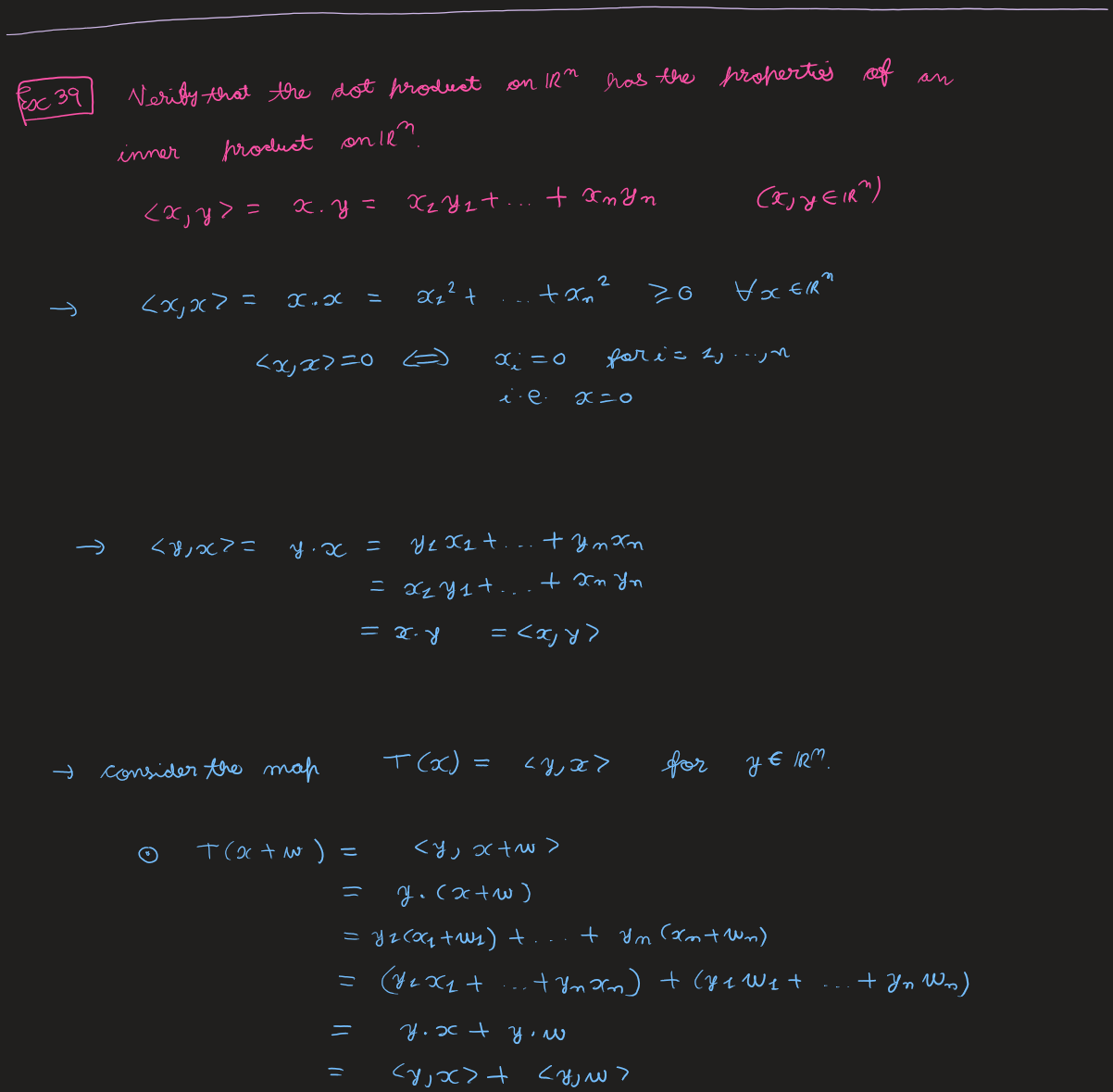
Verify that the dot product on \( \R^n \) has the properties of an inner product on \( \R^n \).
Solution
Here \( \langle x, y\rangle = x \cdot y = x_1 y_1 + \dots + x_n y_n \) for \( x, y \in \R^n \).
Positive-definiteness. \( \langle x, x\rangle = x \cdot x = x_1^2 + \dots + x_n^2 \ge 0 \ \forall\, x \in \R^n \), and \( \langle x, x\rangle = 0 \iff x_i = 0 \) for \( i = 1, \dots, n \), i.e. \( x = 0 \).
Symmetry. \( \langle y, x\rangle = y \cdot x = y_1 x_1 + \dots + y_n x_n = x_1 y_1 + \dots + x_n y_n = x \cdot y = \langle x, y\rangle \).
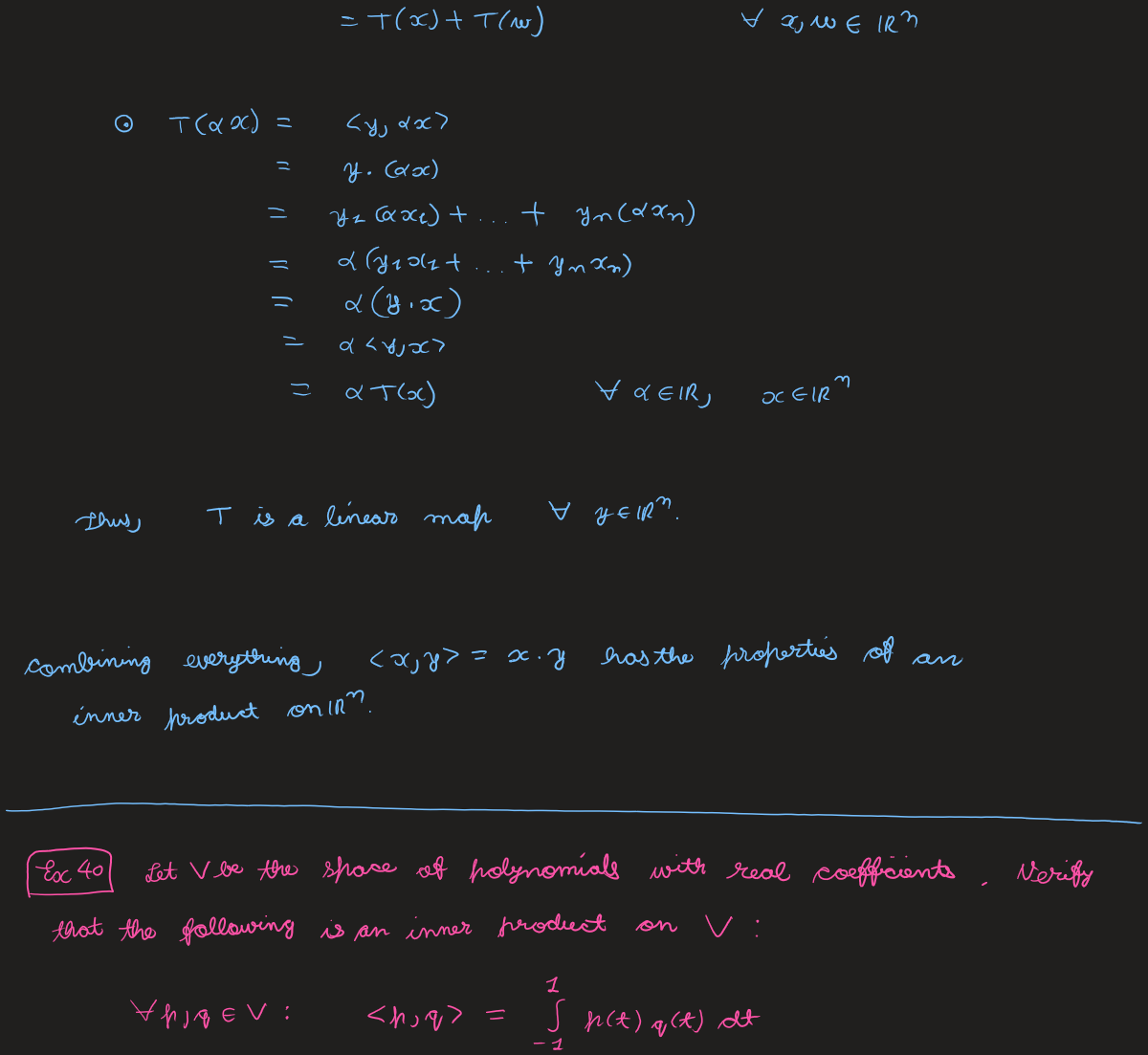
Linearity. Consider \( T(x) = \langle y, x\rangle \) for fixed \( y \in \R^n \). \[\begin{aligned} T(x + w) &= \langle y, x + w\rangle = y \cdot (x + w) \\ &= (y_1 x_1 + \dots + y_n x_n) + (y_1 w_1 + \dots + y_n w_n) \\ &= \langle y, x\rangle + \langle y, w\rangle = T(x) + T(w), \end{aligned}\] \[\begin{aligned} T(\alpha x) &= \langle y, \alpha x\rangle = y \cdot (\alpha x) \\ &= \alpha(y_1 x_1 + \dots + y_n x_n) \\ &= \alpha\langle y, x\rangle = \alpha T(x) \quad \forall\, \alpha \in \R,\ x \in \R^n. \end{aligned}\] So \( T \) is linear \( \forall\, y \in \R^n \). Combining everything, \( \langle x, y\rangle = x \cdot y \) has the properties of an inner product on \( \R^n \).
Ex 40
Let \( V \) be the space of polynomials with real coefficients. Verify that the following is an inner product on \( V \): \[ \forall\, h, q \in V : \quad \langle h, q\rangle = \int_{-1}^{1} h(t)\, q(t)\, dt. \]
Solution
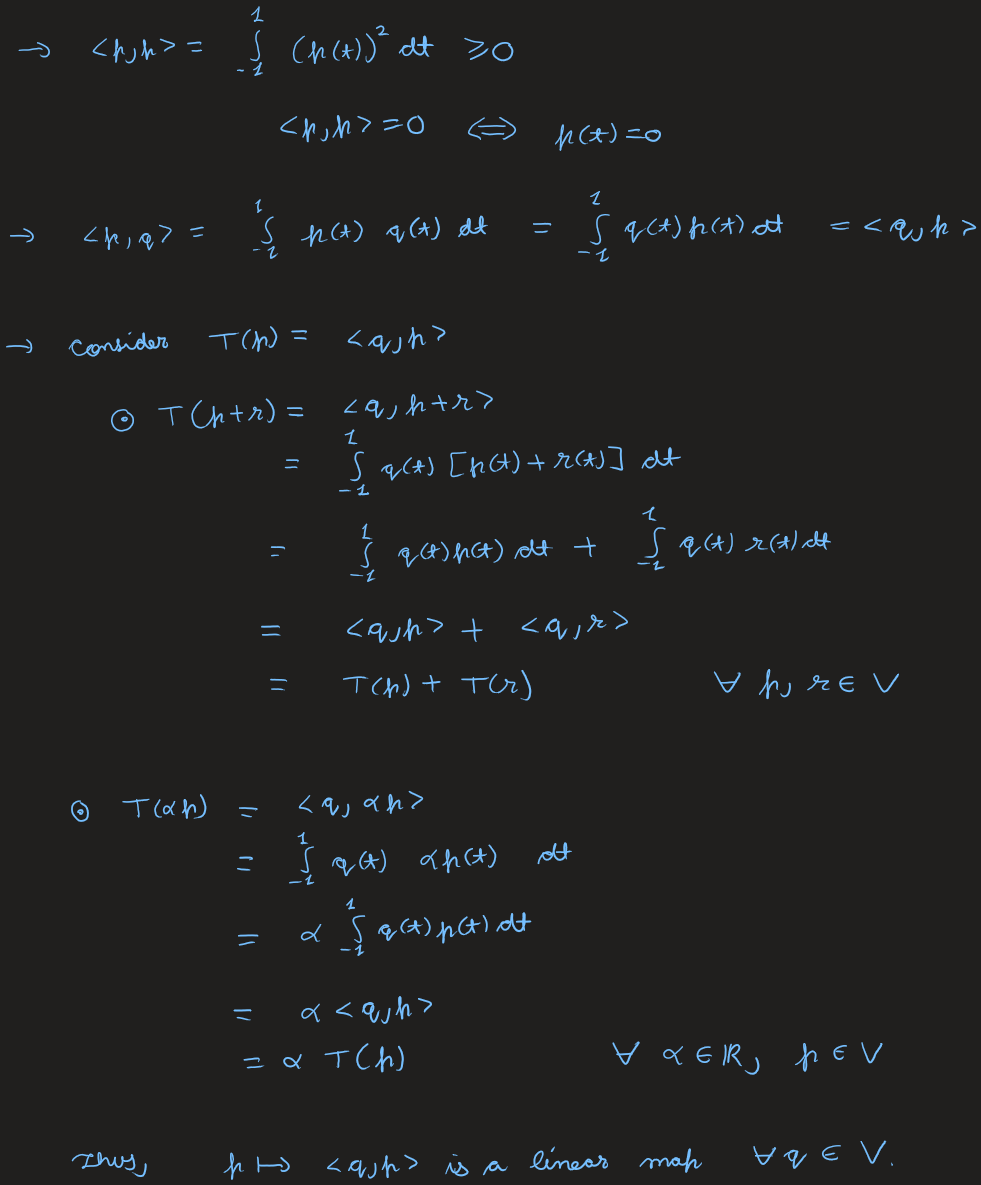
Positive-definiteness. \( \langle h, h\rangle = \int_{-1}^{1} \big(h(t)\big)^2\, dt \ge 0 \), and \( \langle h, h\rangle = 0 \iff h(t) = 0 \).
Symmetry. \( \langle h, q\rangle = \int_{-1}^{1} h(t)\, q(t)\, dt = \int_{-1}^{1} q(t)\, h(t)\, dt = \langle q, h\rangle \).
Linearity. Consider \( T(h) = \langle q, h\rangle \). \[\begin{aligned} T(h + r) &= \langle q, h + r\rangle = \int_{-1}^{1} q(t)\big[h(t) + r(t)\big]\, dt \\ &= \int_{-1}^{1} q(t)h(t)\, dt + \int_{-1}^{1} q(t)r(t)\, dt \\ &= \langle q, h\rangle + \langle q, r\rangle = T(h) + T(r), \end{aligned}\] \[\begin{aligned} T(\alpha h) &= \langle q, \alpha h\rangle = \int_{-1}^{1} q(t)\,\alpha h(t)\, dt \\ &= \alpha \int_{-1}^{1} q(t) h(t)\, dt \\ &= \alpha\langle q, h\rangle = \alpha T(h) \quad \forall\, \alpha \in \R,\ h \in V. \end{aligned}\] So \( h \mapsto \langle q, h\rangle \) is linear \( \forall\, q \in V \). Combining all the above, \( \langle h, q\rangle = \int_{-1}^{1} h(t) q(t)\, dt \) is an inner product on \( V \).
Ex 41
Let \( V = \R^n \) and fix \( w_1, \dots, w_n > 0 \). Verify that the following is an inner product on \( V \): \[ \forall\, x, y \in V : \quad \langle x, y\rangle = w_1 x_1 y_1 + \dots + w_n x_n y_n. \]
Solution
Positive-definiteness. \( \langle x, x\rangle = w_1 x_1^2 + \dots + w_n x_n^2 \ge 0 \) as \( w_1, \dots, w_n > 0 \); and \( \langle x, x\rangle = 0 \iff x_i = 0 \) for \( i = 1, \dots, n \) (as all \( w_i > 0 \)), i.e. \( x = 0 \).
Symmetry. \( \langle y, x\rangle = w_1 y_1 x_1 + \dots + w_n y_n x_n = w_1 x_1 y_1 + \dots + w_n x_n y_n = \langle x, y\rangle \).
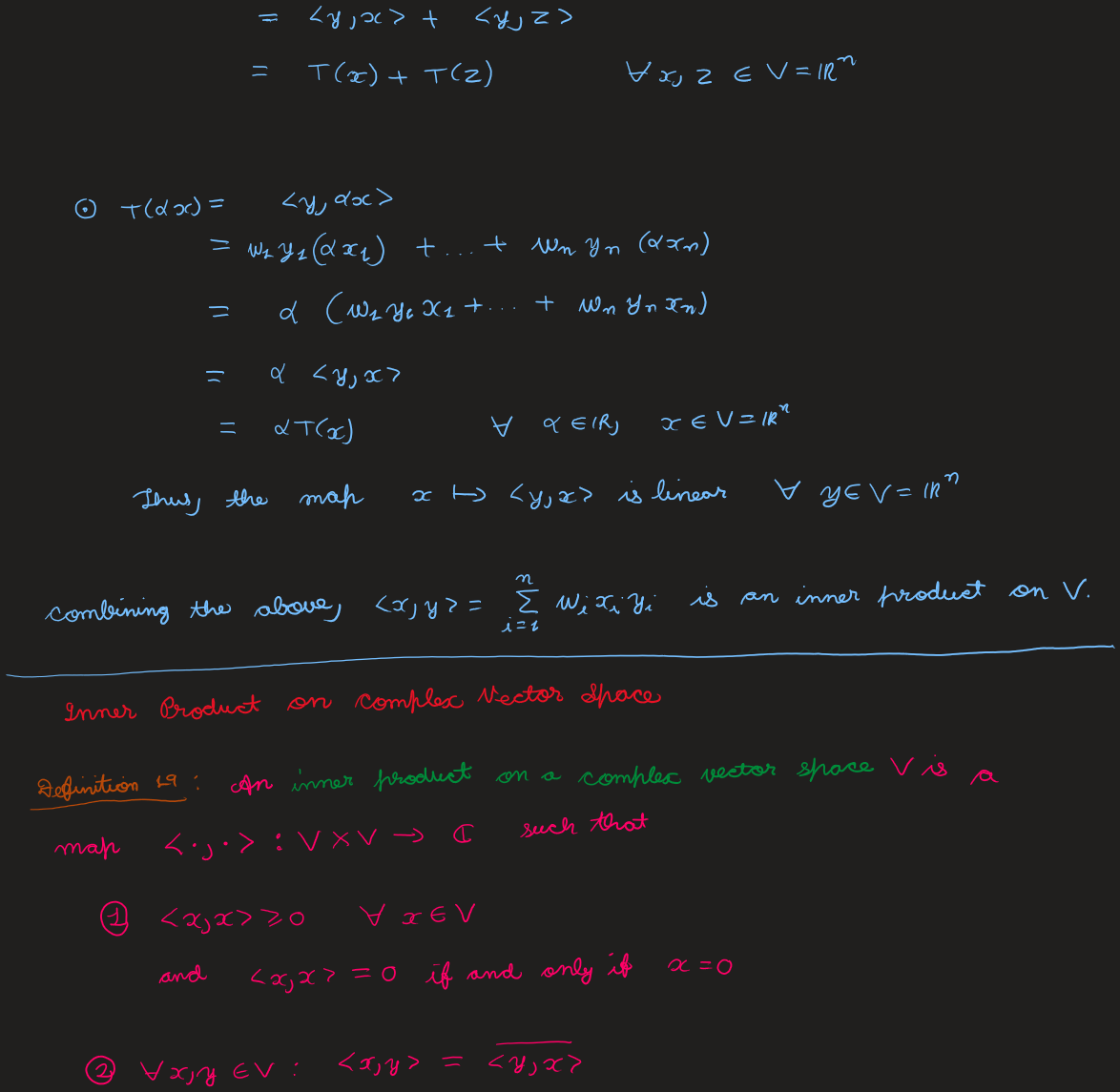
Linearity. With \( T(x) = \langle y, x\rangle \), \[\begin{aligned} T(x + z) &= \langle y, x + z\rangle \\ &= (w_1 y_1 x_1 + \dots + w_n y_n x_n) + (w_1 y_1 z_1 + \dots + w_n y_n z_n) \\ &= \langle y, x\rangle + \langle y, z\rangle = T(x) + T(z), \end{aligned}\] \[\begin{aligned} T(\alpha x) &= \langle y, \alpha x\rangle \\ &= w_1 y_1(\alpha x_1) + \dots + w_n y_n(\alpha x_n) \\ &= \alpha(w_1 y_1 x_1 + \dots + w_n y_n x_n) \\ &= \alpha\langle y, x\rangle = \alpha T(x) \quad \forall\, \alpha \in \R,\ x \in V. \end{aligned}\] So \( x \mapsto \langle y, x\rangle \) is linear \( \forall\, y \in V \). Combining the above, \( \langle x, y\rangle = \sum_{i=1}^{n} w_i x_i y_i \) is an inner product on \( V \).
Inner product on a complex vector space
Definition 19 — Inner product on a complex vector space
An inner product on a complex vector space \( V \) is a map \( \langle\cdot,\cdot\rangle : V \times V \to \C \) such that
- \( \langle x, x\rangle \ge 0 \ \forall\, x \in V \), and \( \langle x, x\rangle = 0 \) if and only if \( x = 0 \);
- \( \langle x, y\rangle = \overline{\langle y, x\rangle} \ \forall\, x, y \in V \) (conjugate symmetry);
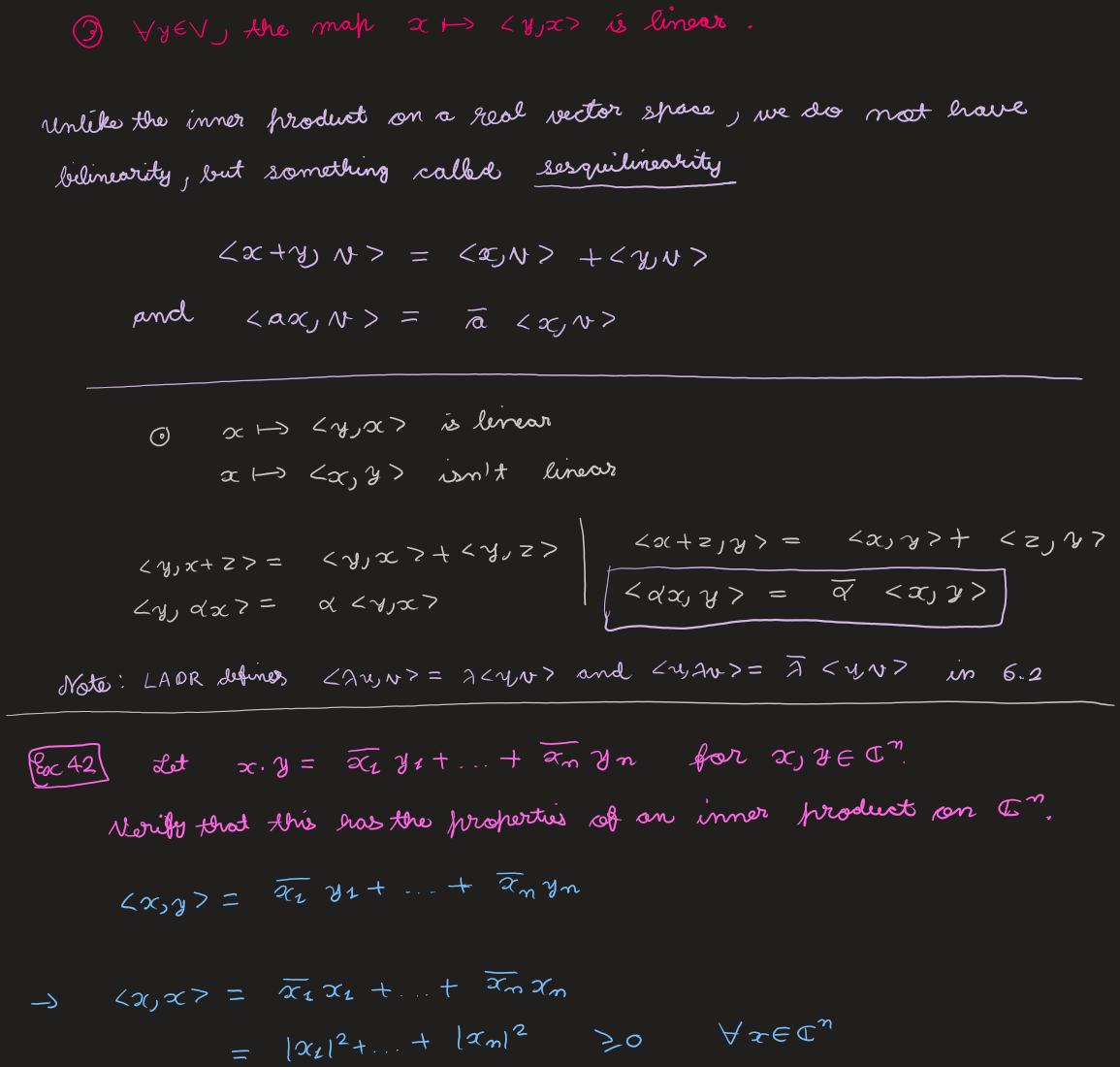
- \( \forall\, y \in V \), the map \( x \mapsto \langle y, x\rangle \) is linear.
Unlike the inner product on a real vector space, we do not have bilinearity, but something called sesquilinearity: \[ \langle x + y, v\rangle = \langle x, v\rangle + \langle y, v\rangle, \qquad \langle \alpha x, v\rangle = \bar\alpha\,\langle x, v\rangle. \] So \( x \mapsto \langle y, x\rangle \) is linear, but \( x \mapsto \langle x, y\rangle \) is not: \[ \langle y, x + z\rangle = \langle y, x\rangle + \langle y, z\rangle, \qquad \langle y, \alpha x\rangle = \alpha\langle y, x\rangle, \] \[ \langle x + z, y\rangle = \langle x, y\rangle + \langle z, y\rangle, \qquad \boxed{\ \langle \alpha x, y\rangle = \bar\alpha\,\langle x, y\rangle\ }. \]
Note: LADR defines \( \langle \alpha u, v\rangle = \alpha\langle u, v\rangle \) and \( \langle u, \alpha v\rangle = \bar\alpha\langle u, v\rangle \) in 6.2 — i.e. LADR puts the linearity in the first slot, whereas these notes put it in the second.
Ex 42
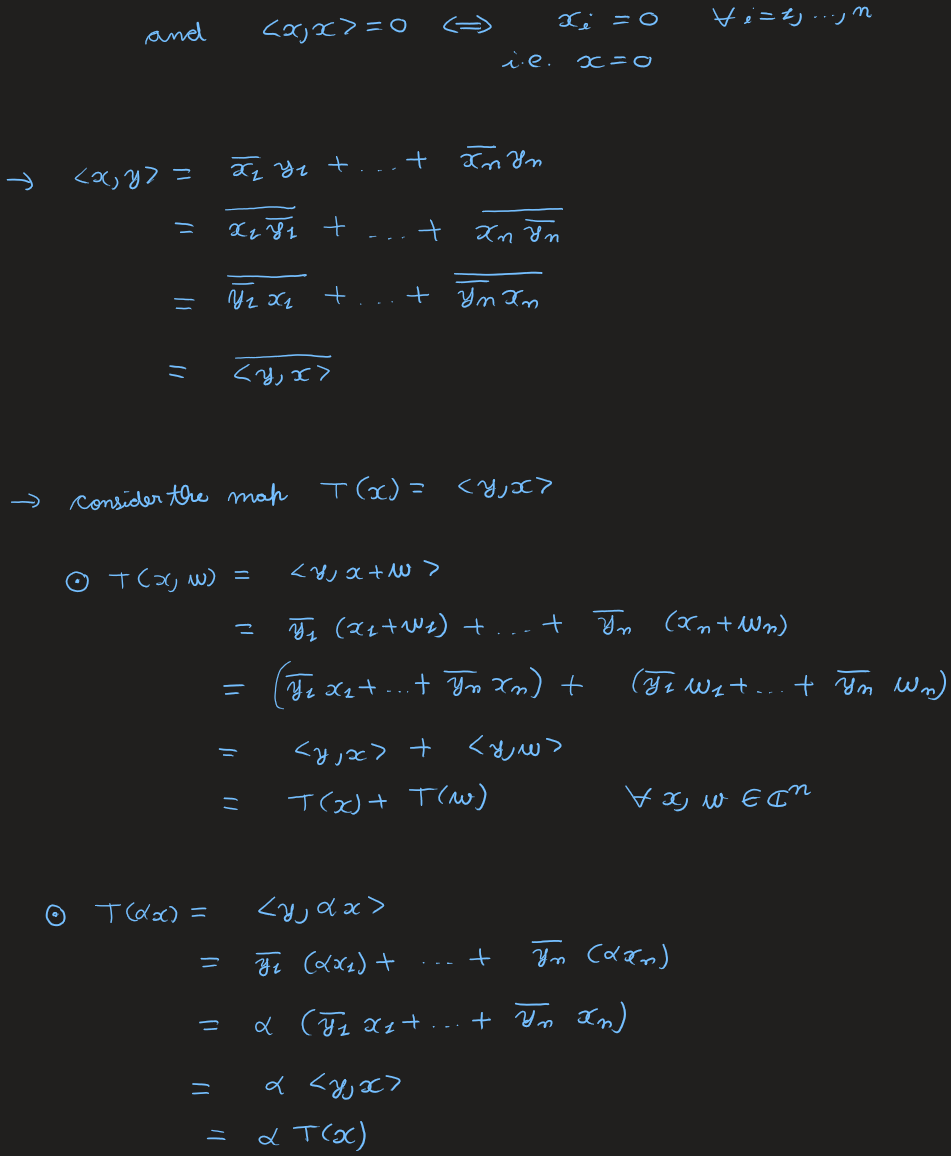
Let \( x \cdot y = \bar x_1 y_1 + \dots + \bar x_n y_n \) for \( x, y \in \C^n \). Verify that this has the properties of an inner product on \( \C^n \).
Solution
Here \( \langle x, y\rangle = \bar x_1 y_1 + \dots + \bar x_n y_n \).
Positive-definiteness. \( \langle x, x\rangle = \bar x_1 x_1 + \dots + \bar x_n x_n = |x_1|^2 + \dots + |x_n|^2 \ge 0 \ \forall\, x \in \C^n \), and \( \langle x, x\rangle = 0 \iff x_i = 0 \ \forall\, i = 1, \dots, n \), i.e. \( x = 0 \).
Conjugate symmetry. \[\begin{aligned} \langle x, y\rangle &= \bar x_1 y_1 + \dots + \bar x_n y_n \\ &= \overline{x_1 \bar y_1} + \dots + \overline{x_n \bar y_n} \\ &= \overline{\bar y_1 x_1} + \dots + \overline{\bar y_n x_n} = \overline{\langle y, x\rangle}. \end{aligned}\]
Linearity. With \( T(x) = \langle y, x\rangle \), \[\begin{aligned} T(x + w) &= \langle y, x + w\rangle \\ &= \bar y_1(x_1 + w_1) + \dots + \bar y_n(x_n + w_n) \\ &= \langle y, x\rangle + \langle y, w\rangle = T(x) + T(w), \end{aligned}\] \[\begin{aligned} T(\alpha x) &= \langle y, \alpha x\rangle \\ &= \bar y_1(\alpha x_1) + \dots + \bar y_n(\alpha x_n) \\ &= \alpha\langle y, x\rangle = \alpha T(x). \end{aligned}\] Thus \( x \mapsto \langle y, x\rangle \) is linear, and \( x \cdot y = \sum_{i=1}^{n} \bar x_i y_i \) has the properties of an inner product on \( \C^n \).
View original handwritten scans — dot product, Def 18–19 & Ex 39–42 (pages 2–9)

Inner Product Spaces
Definition 20 — Inner product space
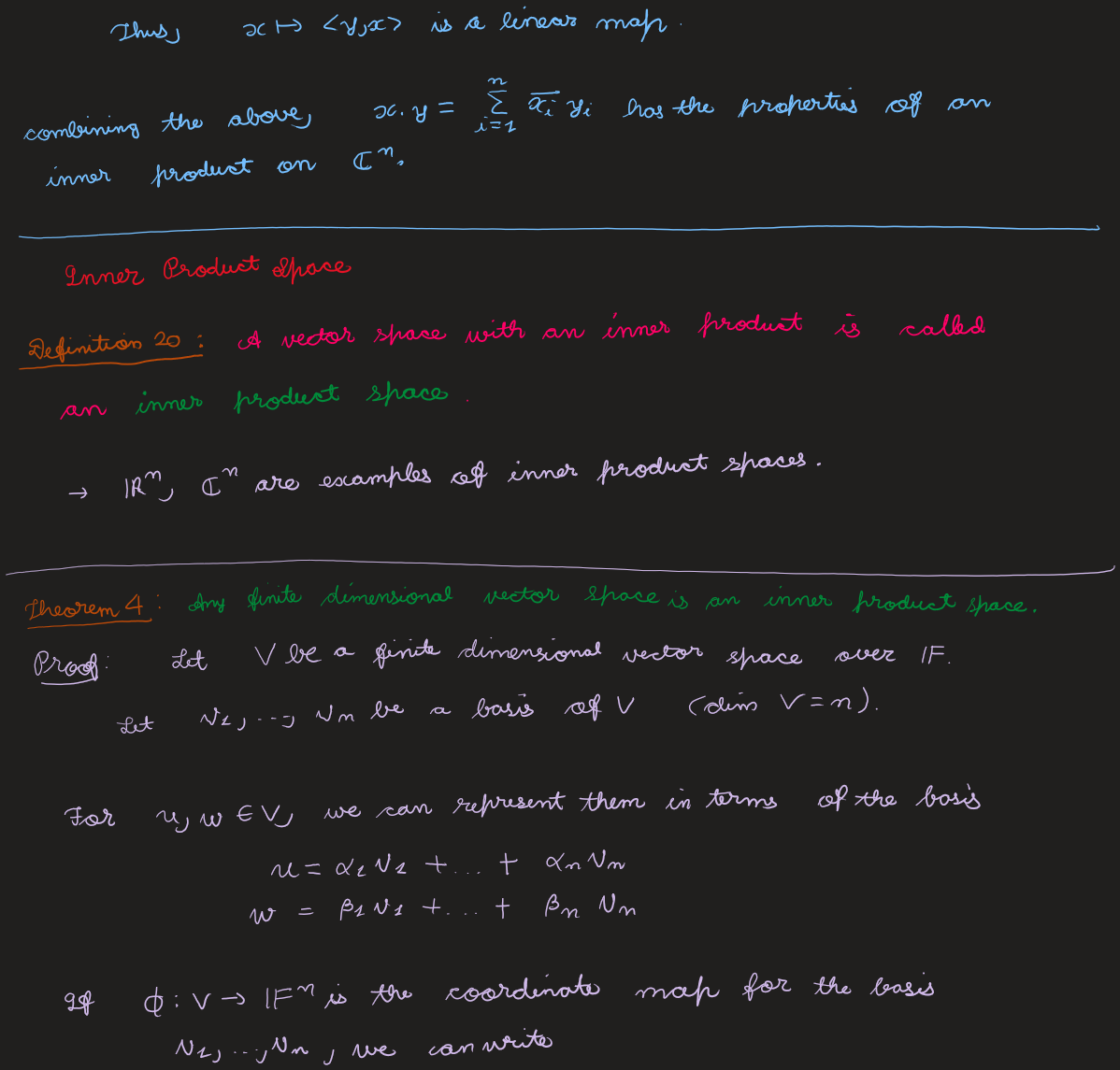
A vector space with an inner product is called an inner product space. \( \R^n \) and \( \C^n \) are examples of inner product spaces.
Theorem 4
Any finite-dimensional vector space is an inner product space.
Proof
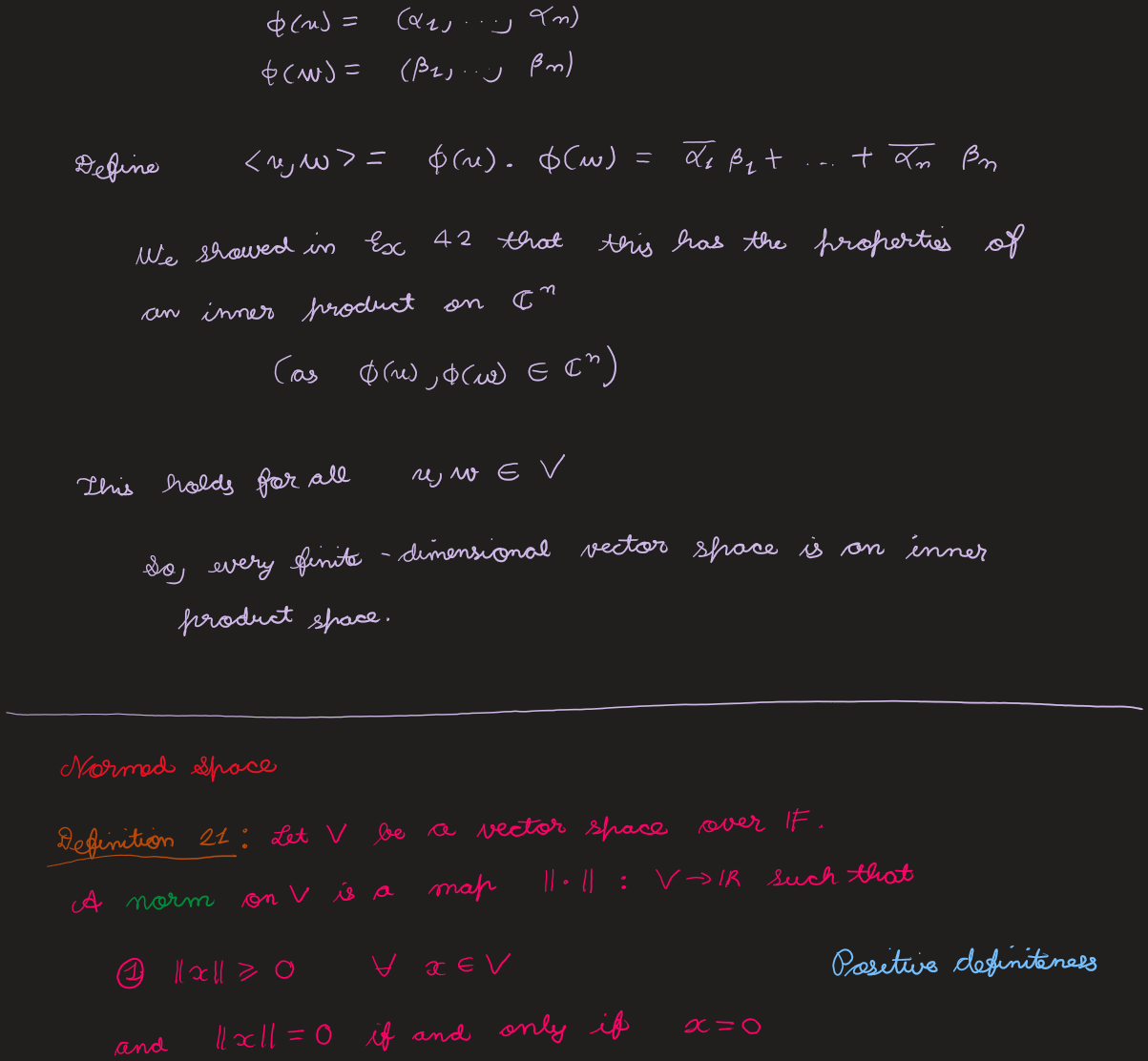
Let \( V \) be a finite-dimensional vector space over \( \F \), and let \( v_1, \dots, v_n \) be a basis of \( V \) (\( \dim V = n \)). For \( u, w \in V \), represent them in the basis: \[ u = \alpha_1 v_1 + \dots + \alpha_n v_n, \qquad w = \beta_1 v_1 + \dots + \beta_n v_n. \] If \( \phi : V \to \F^n \) is the coordinate map for the basis \( v_1, \dots, v_n \), we can write \( \phi(u) = (\alpha_1, \dots, \alpha_n) \) and \( \phi(w) = (\beta_1, \dots, \beta_n) \) (scan: subscripts written as m). Define \[ \langle u, w\rangle = \phi(u) \cdot \phi(w) = \bar\alpha_1 \beta_1 + \dots + \bar\alpha_n \beta_n. \] We showed in Ex 42 that this has the properties of an inner product on \( \C^n \) (as \( \phi(u), \phi(w) \in \C^n \)). This holds for all \( u, w \in V \). So, every finite-dimensional vector space is an inner product space.
View original handwritten scans — Def 20 & Theorem 4 (pages 10–11)
Normed Spaces
Definition 21 — Norm
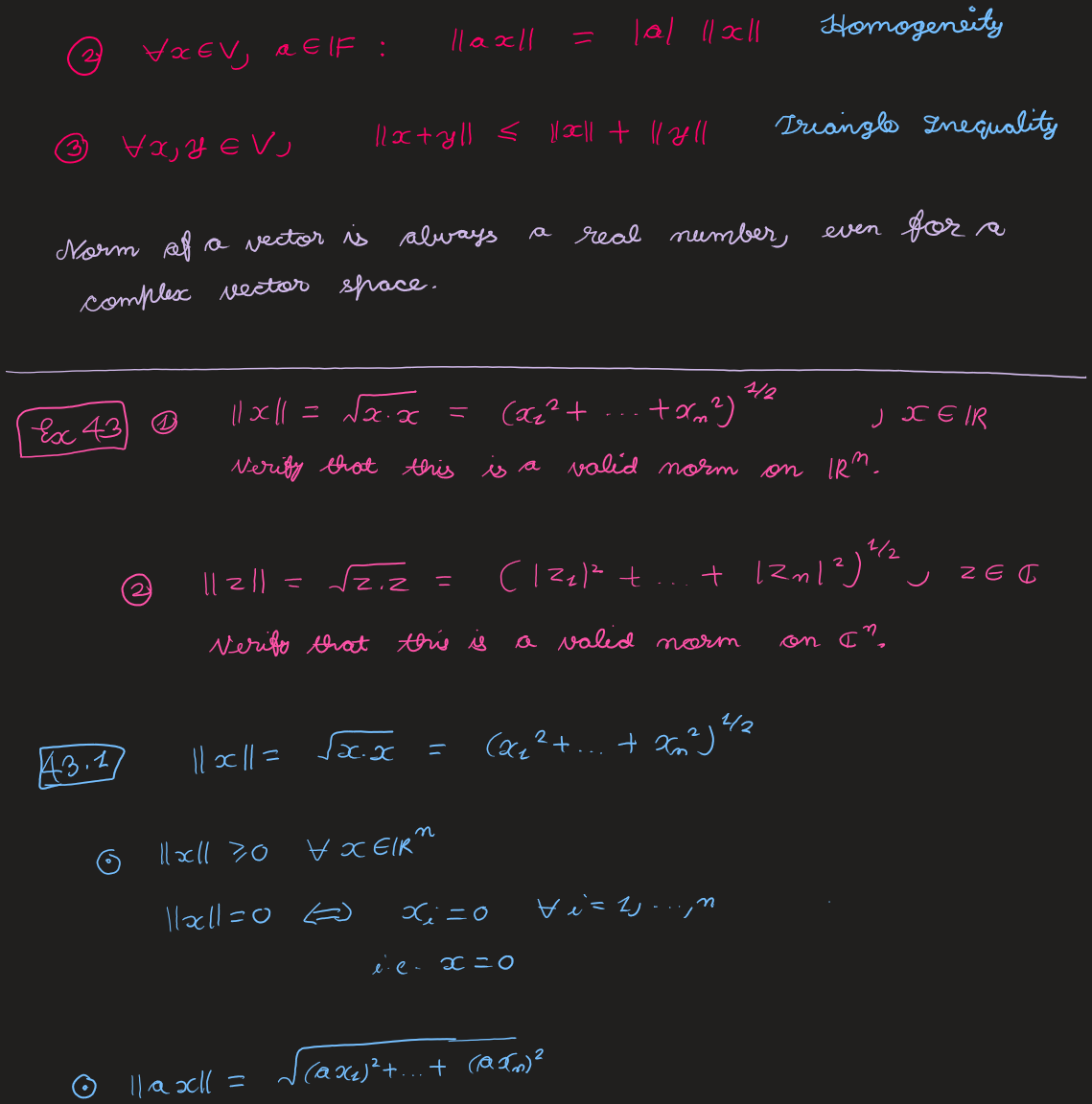
Let \( V \) be a vector space over \( \F \). A norm on \( V \) is a map \( \|\cdot\| : V \to \R \) such that
- \( \|x\| \ge 0 \ \forall\, x \in V \), and \( \|x\| = 0 \) if and only if \( x = 0 \) (positive-definiteness);
- \( \|ax\| = |a|\,\|x\| \ \forall\, x \in V,\ a \in \F \) (homogeneity);
- \( \|x + y\| \le \|x\| + \|y\| \ \forall\, x, y \in V \) (triangle inequality).
The norm of a vector is always a real number, even for a complex vector space.
Ex 43
- \( \|x\| = \sqrt{x \cdot x} = \big(x_1^2 + \dots + x_n^2\big)^{1/2} \), \( x \in \R^n \). Verify that this is a valid norm on \( \R^n \).
- \( \|z\| = \sqrt{z \cdot z} = \big(|z_1|^2 + \dots + |z_n|^2\big)^{1/2} \), \( z \in \C^n \). Verify that this is a valid norm on \( \C^n \).
Solution 43.1 — Euclidean norm on \( \R^n \)
\( \|x\| = \sqrt{x \cdot x} = (x_1^2 + \dots + x_n^2)^{1/2} \).
Positive-definiteness. \( \|x\| \ge 0 \ \forall\, x \in \R^n \), and \( \|x\| = 0 \iff x_i = 0 \ \forall\, i = 1, \dots, n \), i.e. \( x = 0 \).
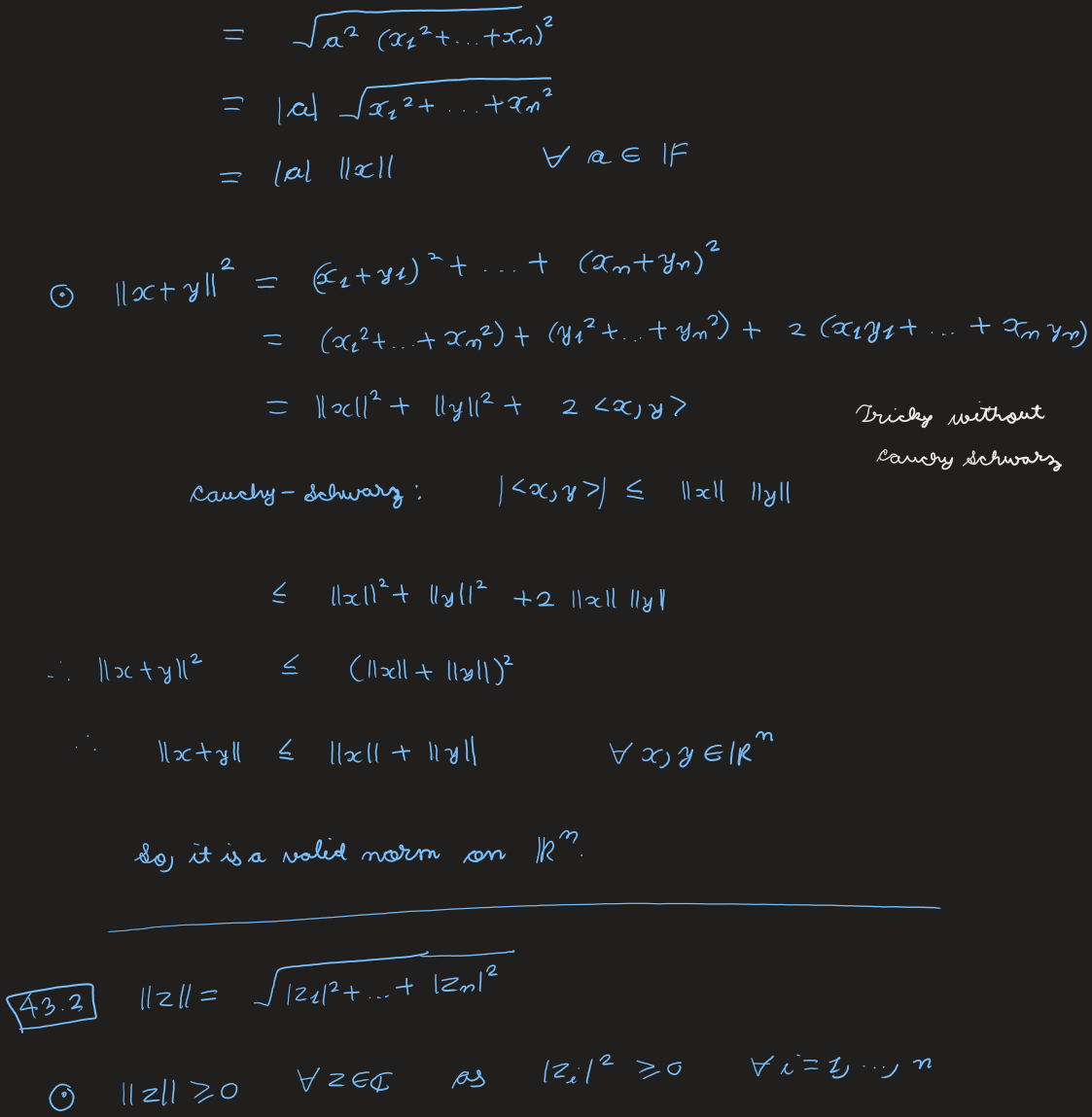
Homogeneity. \( \|ax\| = \sqrt{(ax_1)^2 + \dots + (ax_n)^2} = \sqrt{a^2(x_1^2 + \dots + x_n^2)} = |a|\sqrt{x_1^2 + \dots + x_n^2} = |a|\,\|x\| \ \forall\, a \in \F \).
Triangle inequality. \[\begin{aligned} \|x + y\|^2 &= (x_1 + y_1)^2 + \dots + (x_n + y_n)^2 \\ &= (x_1^2 + \dots + x_n^2) + (y_1^2 + \dots + y_n^2) + 2(x_1 y_1 + \dots + x_n y_n) \\ &= \|x\|^2 + \|y\|^2 + 2\langle x, y\rangle. \end{aligned}\] By Cauchy–Schwarz, \( |\langle x, y\rangle| \le \|x\|\,\|y\| \), so \[\begin{aligned} \|x + y\|^2 &\le \|x\|^2 + \|y\|^2 + 2\|x\|\,\|y\| = (\|x\| + \|y\|)^2 \\ &\implies \|x + y\| \le \|x\| + \|y\| \quad \forall\, x, y \in \R^n. \end{aligned}\] So it is a valid norm on \( \R^n \). (Tricky without Cauchy–Schwarz.)
Solution 43.2 — Euclidean norm on \( \C^n \)
\( \|z\| = \sqrt{|z_1|^2 + \dots + |z_n|^2} \).
Positive-definiteness. \( \|z\| \ge 0 \ \forall\, z \in \C^n \) as \( |z_i|^2 \ge 0 \ \forall\, i = 1, \dots, n \); and \( \|z\| = 0 \iff |z_i| = 0 \), i.e. \( z = 0 \).
Homogeneity. \( \|\alpha z\| = \sqrt{(\alpha z) \cdot (\alpha z)} = \sqrt{|\alpha|^2 |z_1|^2 + \dots + |\alpha|^2 |z_n|^2} = |\alpha|\,\|z\| \ \forall\, \alpha \in \C \).
Triangle inequality. \[\begin{aligned} \|x + y\|^2 &= \langle x + y, x + y\rangle \\ &= \langle x, x\rangle + \langle y, y\rangle + \langle x, y\rangle + \langle y, x\rangle \\ &= \|x\|^2 + \|y\|^2 + \langle x, y\rangle + \overline{\langle x, y\rangle} \\ &= \|x\|^2 + \|y\|^2 + 2\operatorname{Re}\langle x, y\rangle. \end{aligned}\] Using \( |\operatorname{Re}(z)| \le |z| \) and Cauchy–Schwarz \( |\langle u, v\rangle| \le \|u\|\,\|v\| \), \[\begin{aligned} \|x + y\|^2 &\le \|x\|^2 + \|y\|^2 + 2\|x\|\,\|y\| = (\|x\| + \|y\|)^2 \\ &\implies \|x + y\| \le \|x\| + \|y\| \quad \forall\, x, y \in \C^n. \end{aligned}\] So it is a valid norm on \( \C^n \).
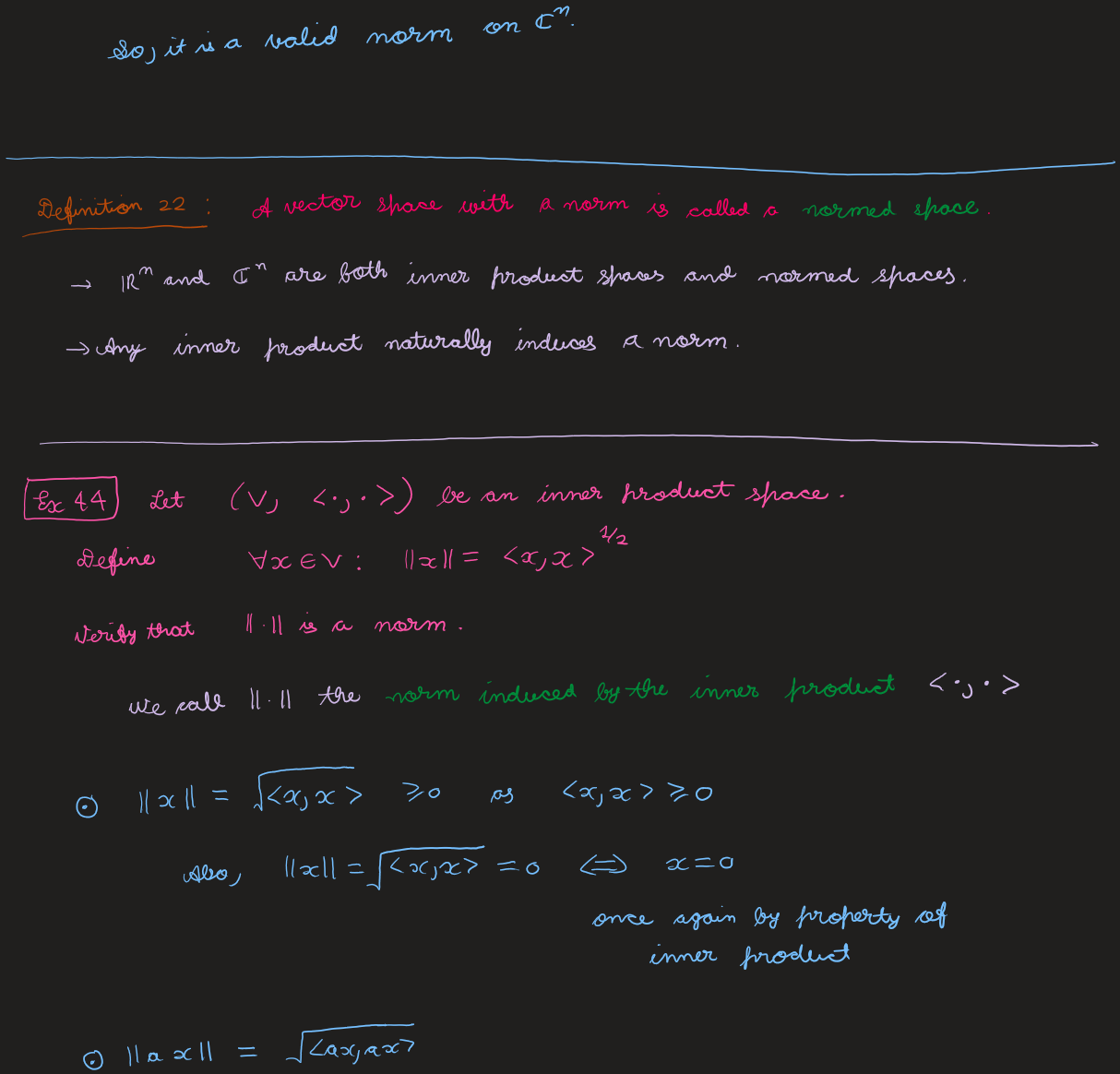
Definition 22 — Normed space
A vector space with a norm is called a normed space. \( \R^n \) and \( \C^n \) are both inner product spaces and normed spaces. Any inner product naturally induces a norm.
Ex 44
Let \( (V, \langle\cdot,\cdot\rangle) \) be an inner product space. Define \( \forall\, x \in V : \|x\| = \langle x, x\rangle^{1/2} \). Verify that \( \|\cdot\| \) is a norm. (We call \( \|\cdot\| \) the norm induced by the inner product \( \langle\cdot,\cdot\rangle \).)
Solution
Positive-definiteness. \( \|x\| = \sqrt{\langle x, x\rangle} \ge 0 \) as \( \langle x, x\rangle \ge 0 \); also \( \|x\| = \sqrt{\langle x, x\rangle} = 0 \iff x = 0 \) (again by the properties of the inner product).
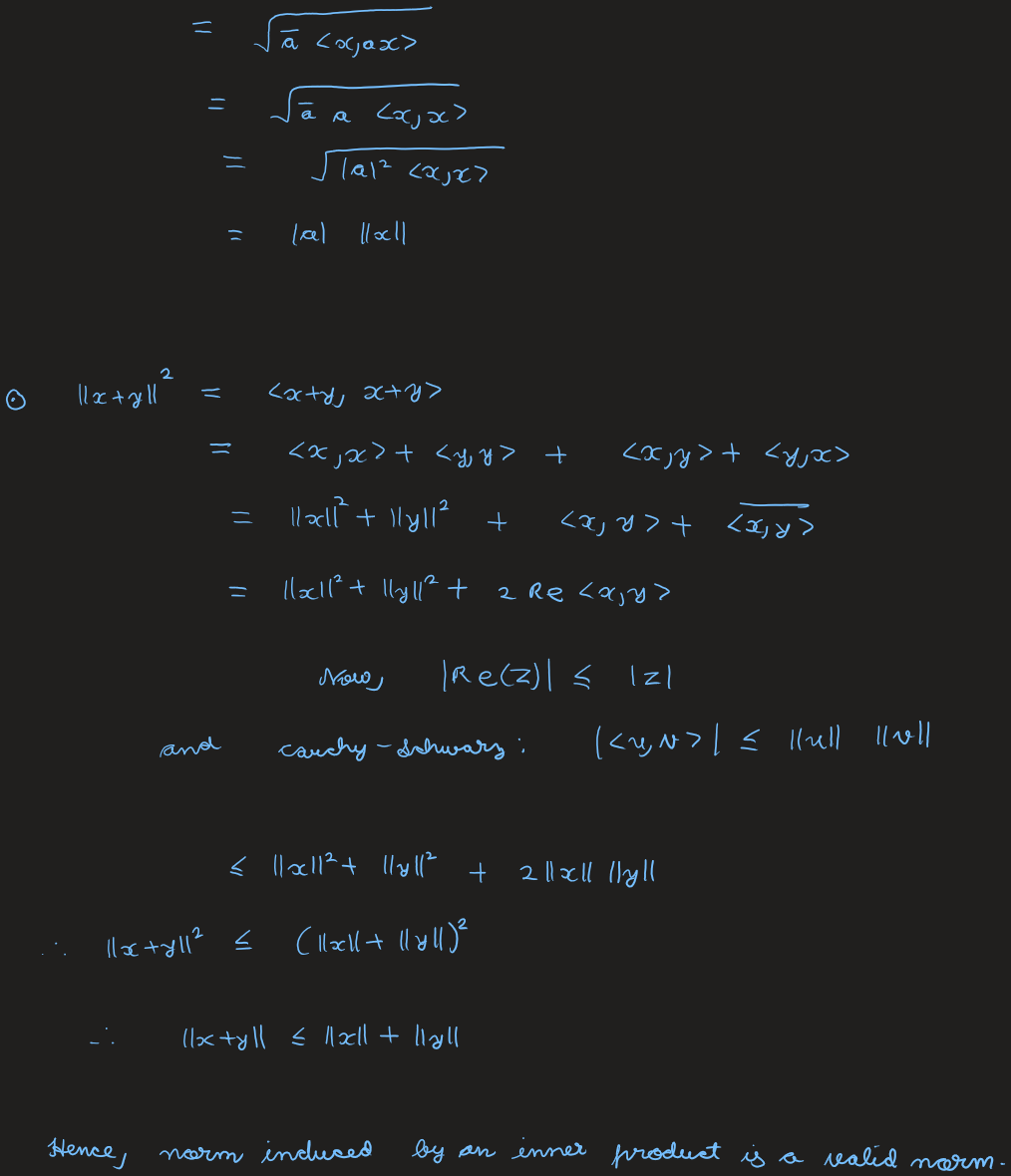
Homogeneity. \( \|ax\| = \sqrt{\langle ax, ax\rangle} = \sqrt{\bar a\langle x, ax\rangle} = \sqrt{\bar a\, a\langle x, x\rangle} = \sqrt{|a|^2\langle x, x\rangle} = |a|\,\|x\| \).
Triangle inequality. \[\begin{aligned} \|x + y\|^2 &= \langle x + y, x + y\rangle \\ &= \|x\|^2 + \|y\|^2 + \langle x, y\rangle + \overline{\langle x, y\rangle} \\ &= \|x\|^2 + \|y\|^2 + 2\operatorname{Re}\langle x, y\rangle. \end{aligned}\] Using \( |\operatorname{Re}(z)| \le |z| \) and Cauchy–Schwarz \( |\langle u, v\rangle| \le \|u\|\,\|v\| \), \[\begin{aligned} \|x + y\|^2 &\le \|x\|^2 + \|y\|^2 + 2\|x\|\,\|y\| = (\|x\| + \|y\|)^2 \\ &\implies \|x + y\| \le \|x\| + \|y\|. \end{aligned}\] Hence the norm induced by an inner product is a valid norm.
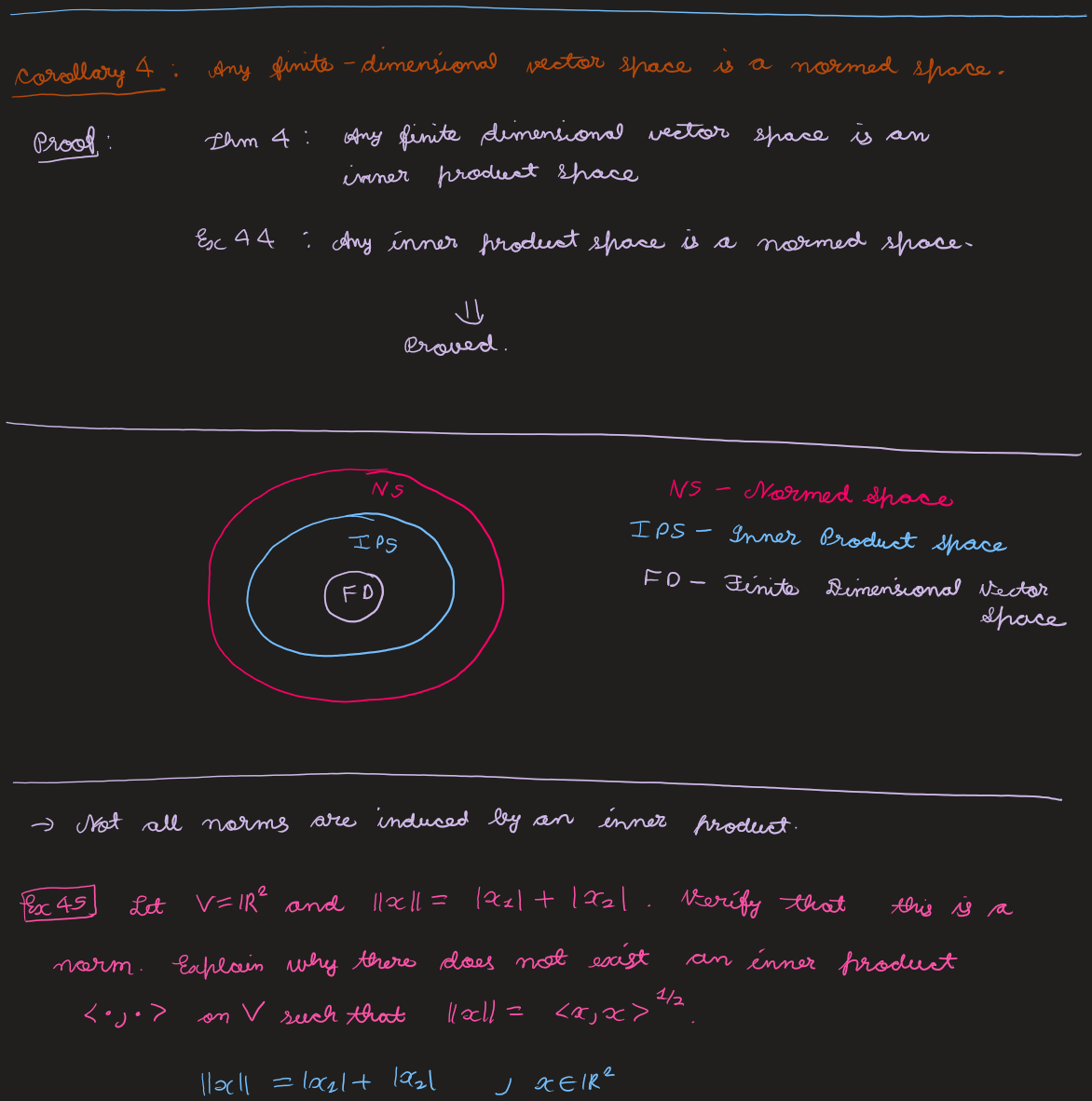
Corollary 4
Any finite-dimensional vector space is a normed space.
Proof
By Theorem 4, any finite-dimensional vector space is an inner product space; by Ex 44, any inner product space is a normed space. Combining the two proves the claim.
Not all norms are induced by an inner product.
Ex 45
Let \( V = \R^2 \) and \( \|x\| = |x_1| + |x_2| \). Verify that this is a norm. Explain why there does not exist an inner product \( \langle\cdot,\cdot\rangle \) on \( V \) such that \( \|x\| = \langle x, x\rangle^{1/2} \).
Solution
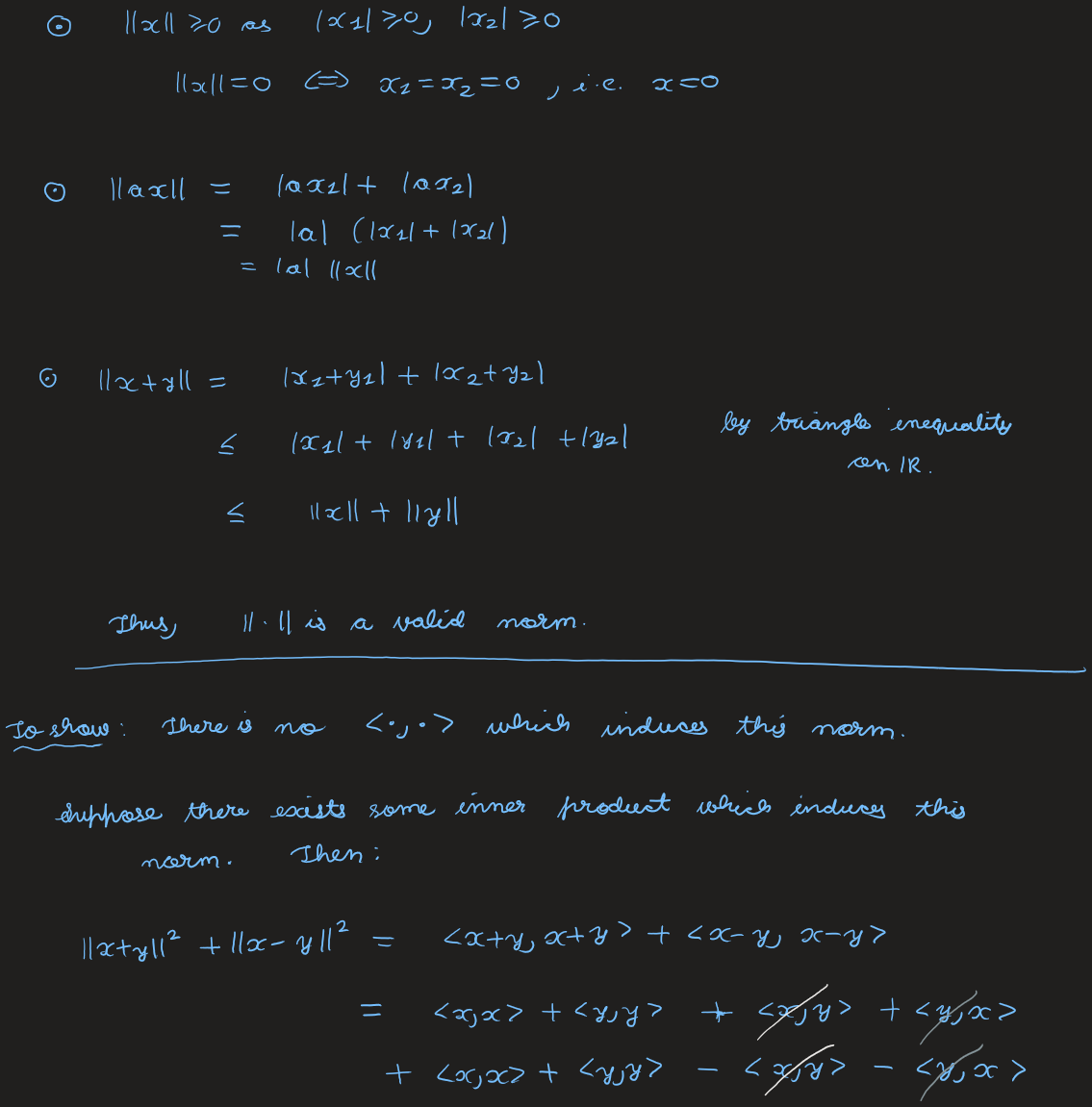
It is a norm. With \( \|x\| = |x_1| + |x_2| \):
- \( \|x\| \ge 0 \) as \( |x_1| \ge 0,\ |x_2| \ge 0 \); and \( \|x\| = 0 \iff x_1 = x_2 = 0 \), i.e. \( x = 0 \).
- \( \|ax\| = |ax_1| + |ax_2| = |a|(|x_1| + |x_2|) = |a|\,\|x\| \).
- \( \|x + y\| = |x_1 + y_1| + |x_2 + y_2| \le |x_1| + |y_1| + |x_2| + |y_2| = \|x\| + \|y\| \) (by the triangle inequality on \( \R \)).
Thus \( \|\cdot\| \) is a valid norm.
No inner product induces it. Suppose some inner product induced this norm. Then \[ \|x + y\|^2 + \|x - y\|^2 = \langle x + y, x + y\rangle + \langle x - y, x - y\rangle = 2\big(\|x\|^2 + \|y\|^2\big), \] the parallelogram law (the cross terms \( \langle x, y\rangle \) and \( \langle y, x\rangle \) cancel). So: \[ \text{an inner product induces the norm} \implies \text{the norm satisfies the parallelogram law,} \] equivalently, if the norm violates the parallelogram law, no inner product can induce it. Take \( x = (1, 0) \) and \( y = (0, 1) \): \[ \|x\|^2 = (|1| + |0|)^2 = 1, \quad \|y\|^2 = (|0| + |1|)^2 = 1, \] \[ x + y = (1, 1) \Rightarrow \|x + y\|^2 = (|1| + |1|)^2 = 4, \quad x - y = (1, -1) \Rightarrow \|x - y\|^2 = (|1| + |{-1}|)^2 = 4. \] So \( \|x + y\|^2 + \|x - y\|^2 = 8 \), but \( 2(\|x\|^2 + \|y\|^2) = 4 \), and \( 4 \neq 8 \). The norm violates the parallelogram law, so there is no inner product which induces it.
Remark — not part of the course
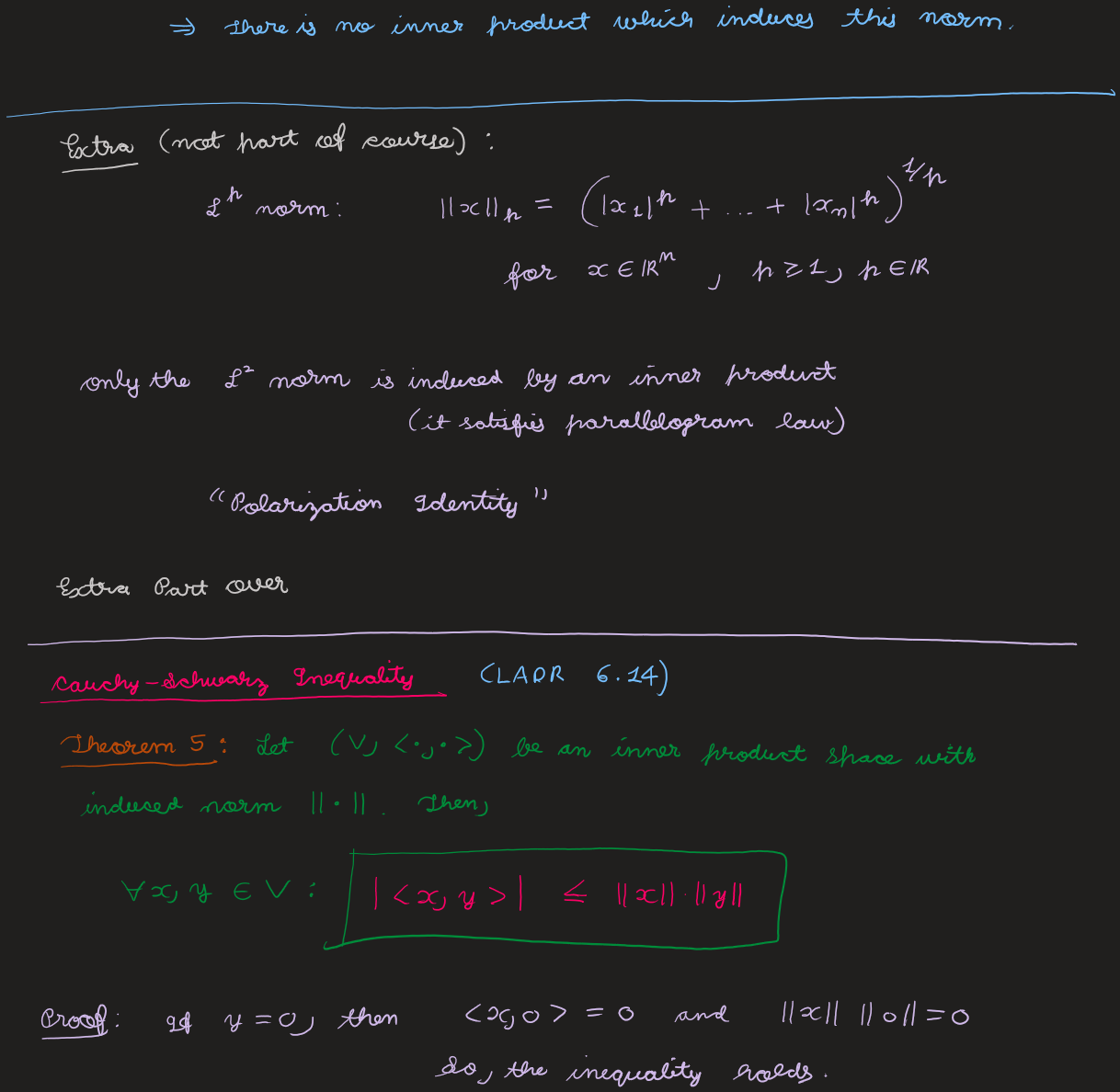
The \( \ell^p \) norm is \( \|x\|_p = \big(|x_1|^p + \dots + |x_n|^p\big)^{1/p} \) for \( x \in \R^n \), \( p \ge 1 \), \( p \in \R \). Only the \( \ell^2 \) norm is induced by an inner product (it satisfies the parallelogram law); the recovery of the inner product from such a norm is the polarization identity.
View original handwritten scans — norms, Def 21–22, Ex 43–45 & the parallelogram counterexample (pages 11–19)


Cauchy–Schwarz Inequality
Theorem 5 — Cauchy–Schwarz (LADR 6.14)
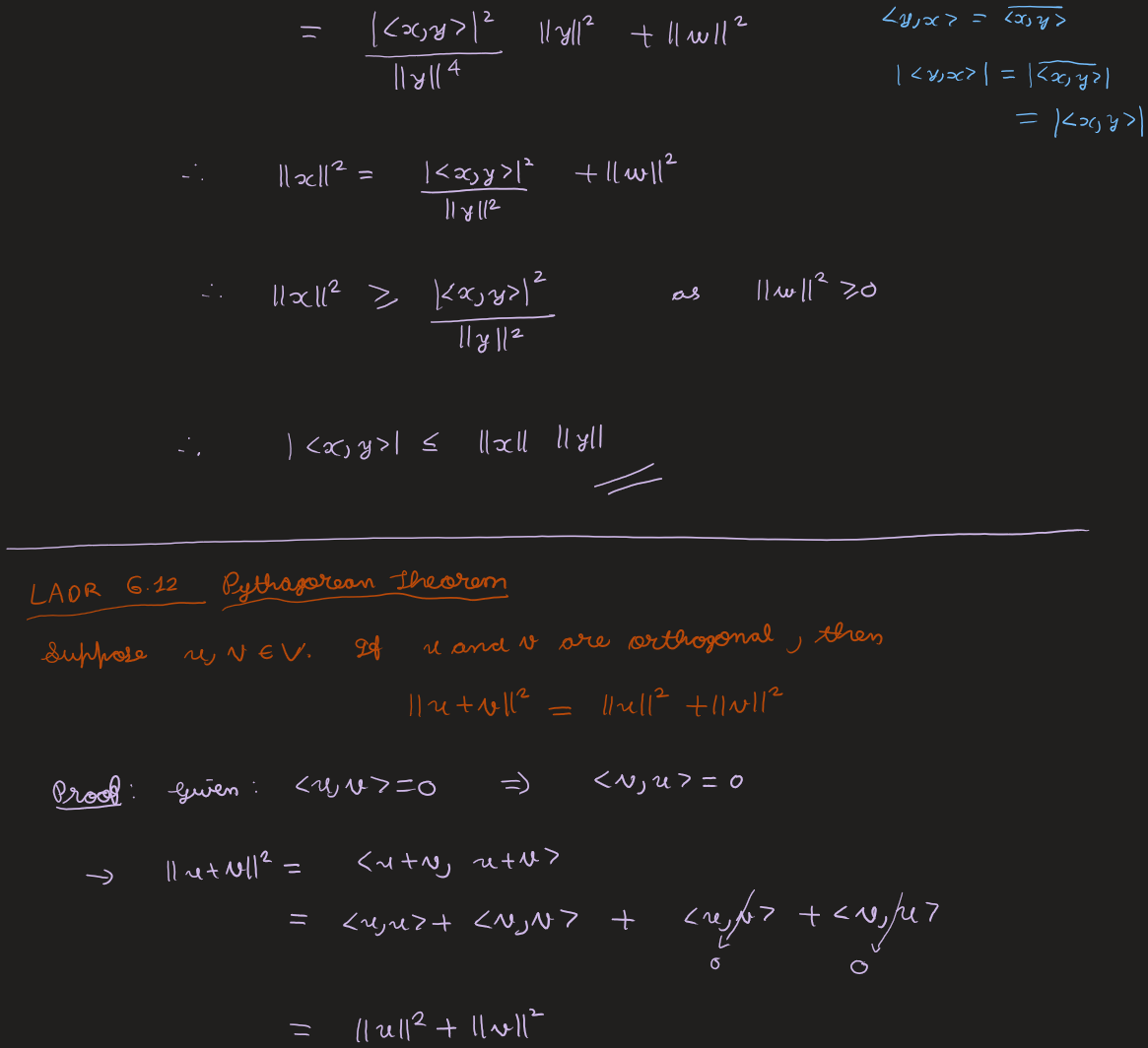
Let \( (V, \langle\cdot,\cdot\rangle) \) be an inner product space with induced norm \( \|\cdot\| \). Then \[ \forall\, x, y \in V : \quad |\langle x, y\rangle| \le \|x\|\,\|y\|. \]
Proof
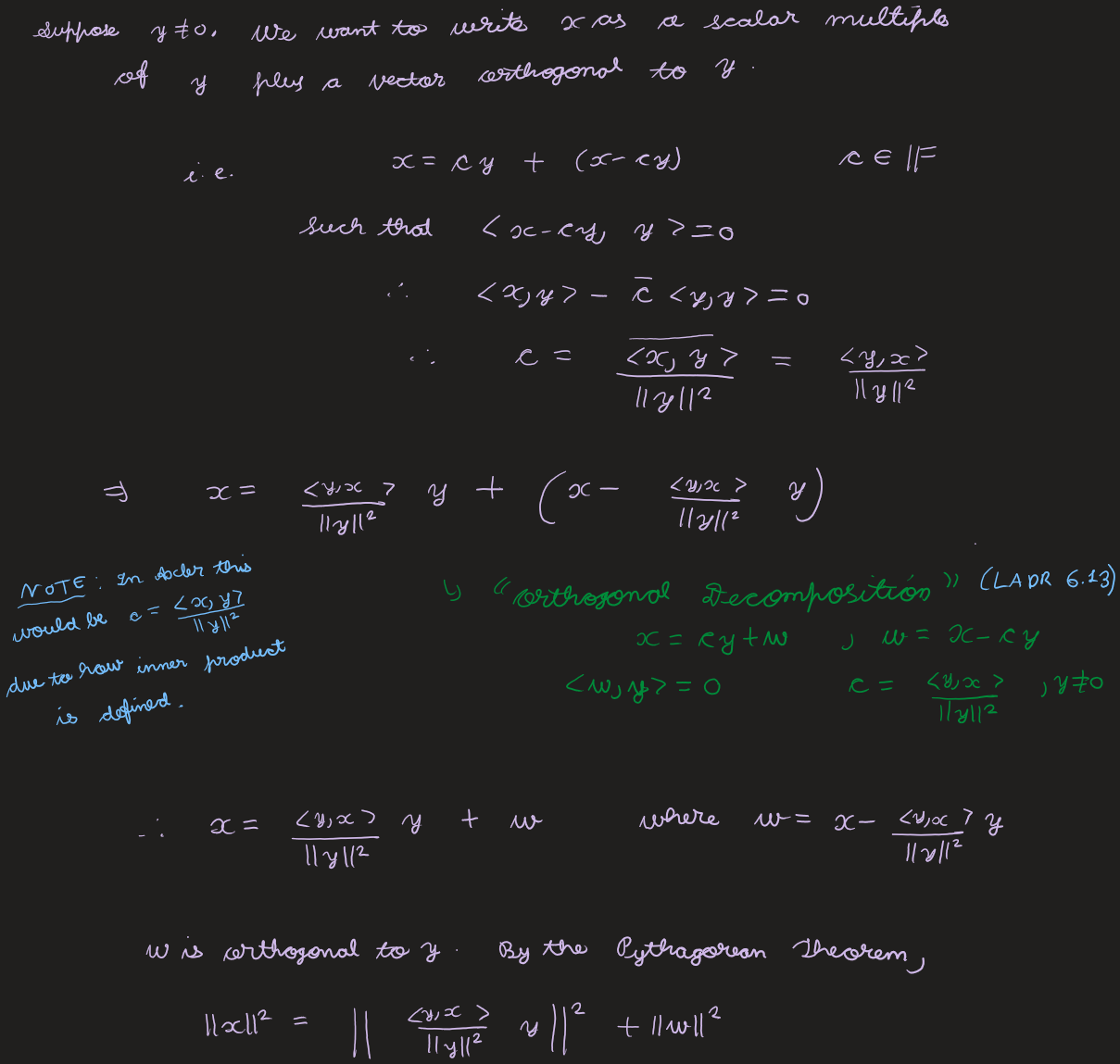
If \( y = 0 \), then \( \langle x, 0\rangle = 0 \) and \( \|x\|\,\|0\| = 0 \), so the inequality holds. Suppose \( y \neq 0 \). We write \( x \) as a scalar multiple of \( y \) plus a vector orthogonal to \( y \): \( x = cy + (x - cy) \) with \( c \in \F \) such that \( \langle x - cy, y\rangle = 0 \). Then \[ \langle x, y\rangle - \bar c\langle y, y\rangle = 0 \implies \bar c = \frac{\langle x, y\rangle}{\|y\|^2} \implies c = \frac{\langle y, x\rangle}{\|y\|^2}. \]
Note: in LADR this would be \( c = \dfrac{\langle x, y\rangle}{\|y\|^2} \), due to how the inner product is defined there.
This is the orthogonal decomposition (LADR 6.13): \( x = cy + w \) with \( w = x - cy = x - \dfrac{\langle y, x\rangle}{\|y\|^2}\, y \), \( \langle w, y\rangle = 0 \), \( y \neq 0 \). Since \( w \perp y \), by the Pythagorean theorem, \[\begin{aligned} \|x\|^2 &= \left\| \frac{\langle y, x\rangle}{\|y\|^2}\, y \right\|^2 + \|w\|^2 \\ &= \frac{|\langle x, y\rangle|^2}{\|y\|^4}\,\|y\|^2 + \|w\|^2 \\ &= \frac{|\langle x, y\rangle|^2}{\|y\|^2} + \|w\|^2, \end{aligned}\] using \( \langle y, x\rangle = \overline{\langle x, y\rangle} \) so \( |\langle y, x\rangle| = |\langle x, y\rangle| \). Therefore \[ \|x\|^2 \ge \frac{|\langle x, y\rangle|^2}{\|y\|^2} \quad (\text{as } \|w\|^2 \ge 0) \implies |\langle x, y\rangle| \le \|x\|\,\|y\|. \]
Pythagorean Theorem — LADR 6.12
Suppose \( u, v \in V \). If \( u \) and \( v \) are orthogonal, then \( \|u + v\|^2 = \|u\|^2 + \|v\|^2 \).
Proof
Given \( \langle u, v\rangle = 0 \Rightarrow \langle v, u\rangle = 0 \). Then \[ \|u + v\|^2 = \langle u + v, u + v\rangle = \langle u, u\rangle + \langle v, v\rangle + \underbrace{\langle u, v\rangle}_{0} + \underbrace{\langle v, u\rangle}_{0} = \|u\|^2 + \|v\|^2. \]
View original handwritten scans — Cauchy–Schwarz, orthogonal decomposition & Pythagoras (pages 20–22)
Orthogonality
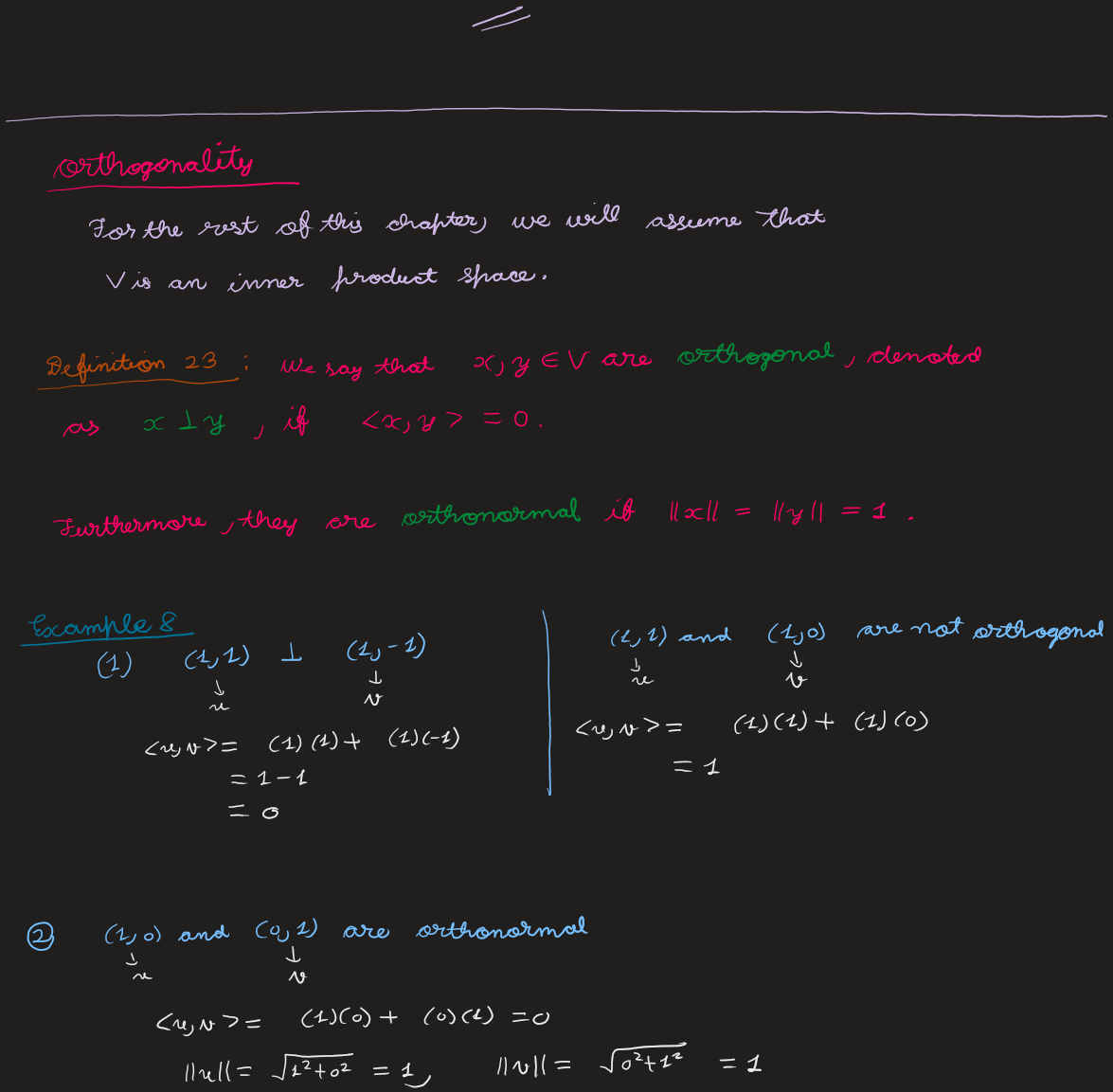
For the rest of this chapter, we assume that \( V \) is an inner product space.
Definition 23 — Orthogonal / orthonormal
We say that \( x, y \in V \) are orthogonal, denoted \( x \perp y \), if \( \langle x, y\rangle = 0 \). Furthermore, they are orthonormal if \( \|x\| = \|y\| = 1 \).
Example 8
- \( (1, 1) \perp (1, -1) \): \( \langle u, v\rangle = (1)(1) + (1)(-1) = 1 - 1 = 0 \). But \( (1, 1) \) and \( (1, 0) \) are not orthogonal: \( \langle u, v\rangle = (1)(1) + (1)(0) = 1 \).
- \( (1, 0) \) and \( (0, 1) \) are orthonormal: \( \langle u, v\rangle = (1)(0) + (0)(1) = 0 \), \( \|u\| = \sqrt{1^2 + 0^2} = 1 \), \( \|v\| = \sqrt{0^2 + 1^2} = 1 \).
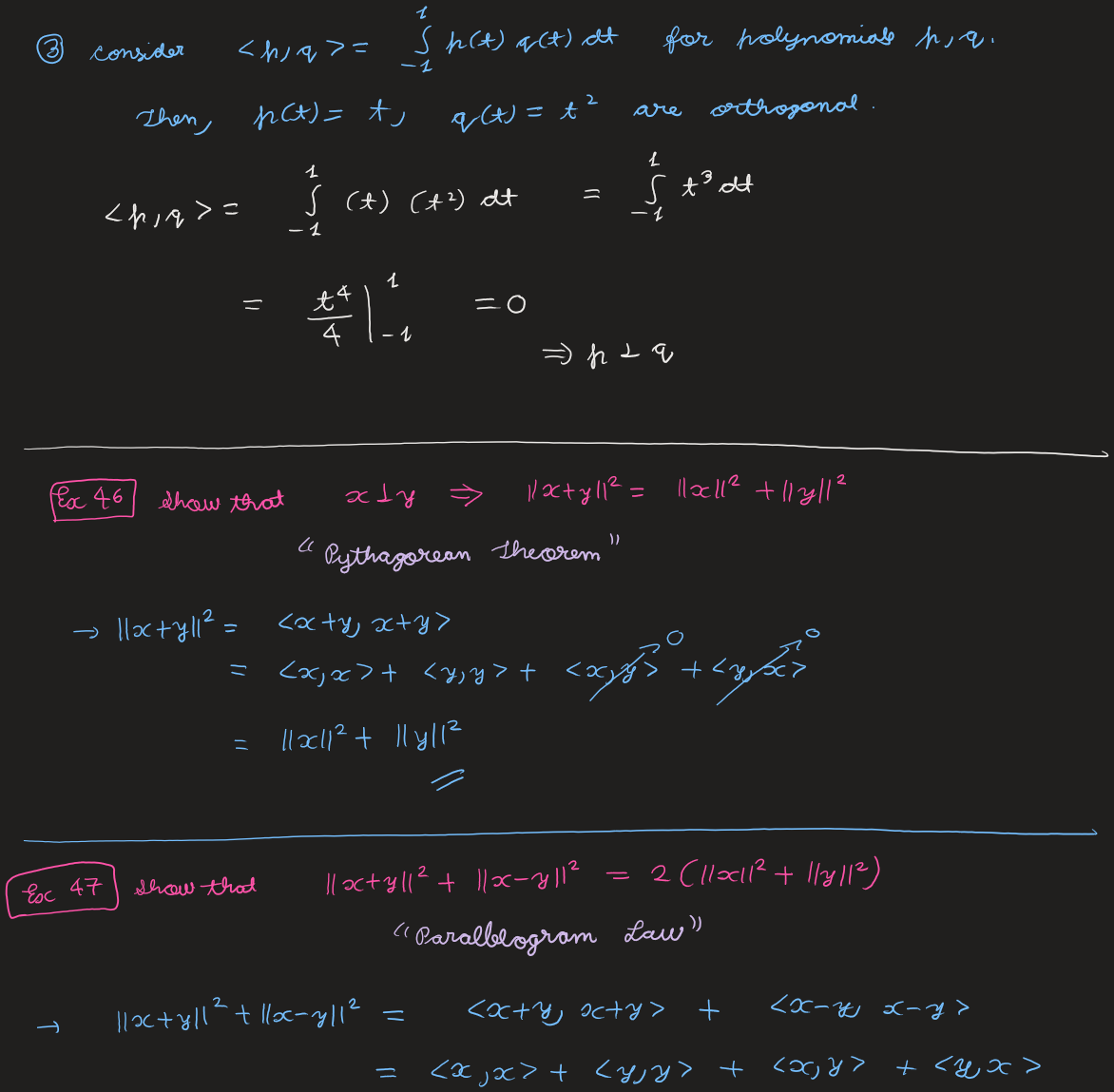
- With \( \langle h, q\rangle = \int_{-1}^{1} h(t)q(t)\, dt \), the polynomials \( h(t) = t \) and \( q(t) = t^2 \) are orthogonal: \( \langle h, q\rangle = \int_{-1}^{1} t \cdot t^2\, dt = \int_{-1}^{1} t^3\, dt = \big[\tfrac{t^4}{4}\big]_{-1}^{1} = 0 \Rightarrow h \perp q \).
Ex 46 — Pythagorean theorem
Show that \( x \perp y \implies \|x + y\|^2 = \|x\|^2 + \|y\|^2 \).
Solution
\( \|x + y\|^2 = \langle x + y, x + y\rangle = \langle x, x\rangle + \langle y, y\rangle + \underbrace{\langle x, y\rangle}_{0} + \underbrace{\langle y, x\rangle}_{0} = \|x\|^2 + \|y\|^2 \).
Ex 47 — Parallelogram law
Show that \( \|x + y\|^2 + \|x - y\|^2 = 2\big(\|x\|^2 + \|y\|^2\big) \).
Solution
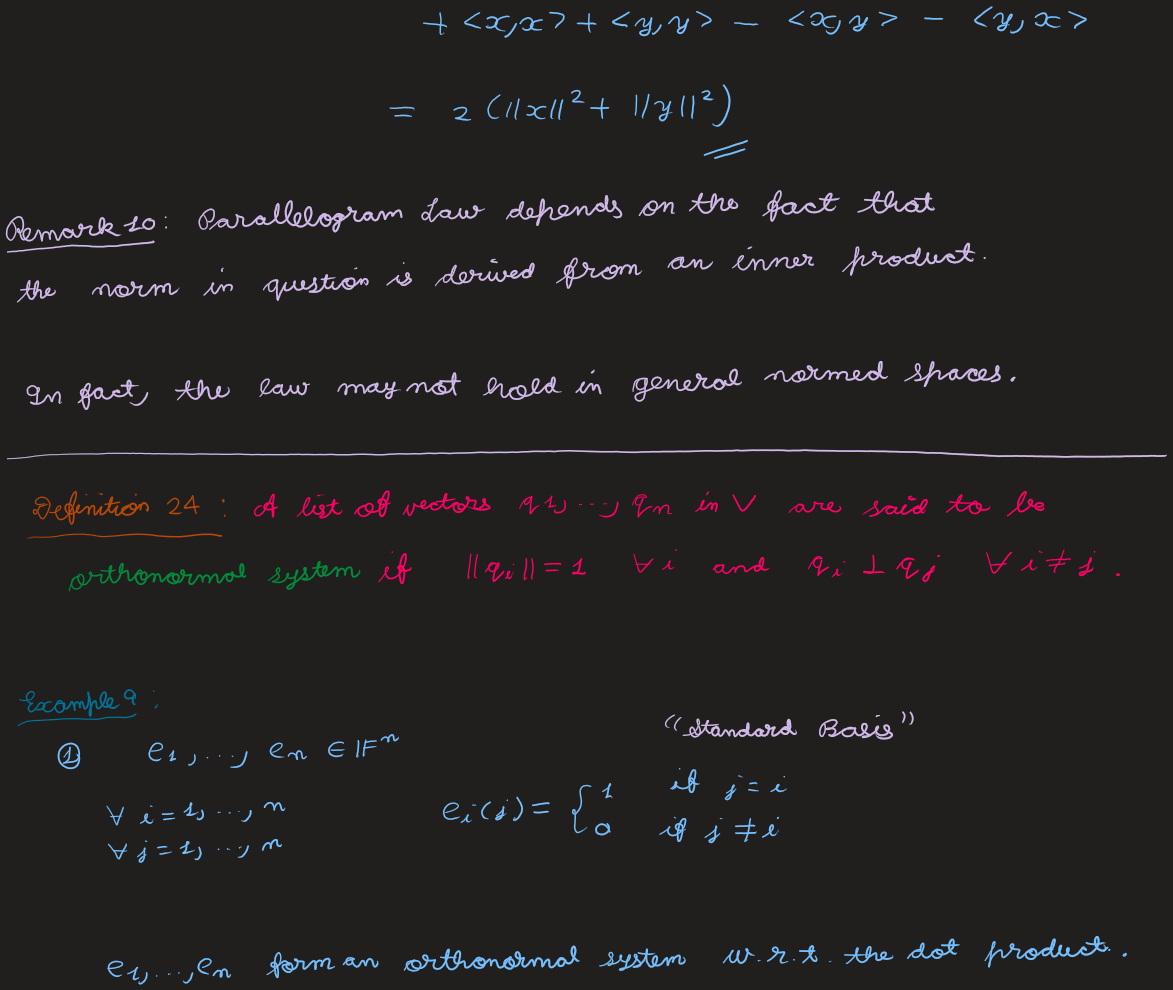
\[\begin{aligned} \|x + y\|^2 + \|x - y\|^2 &= \langle x + y, x + y\rangle + \langle x - y, x - y\rangle \\ &= \langle x, x\rangle + \langle y, y\rangle + \langle x, y\rangle + \langle y, x\rangle \\ &\quad + \langle x, x\rangle + \langle y, y\rangle - \langle x, y\rangle - \langle y, x\rangle \\ &= 2\big(\|x\|^2 + \|y\|^2\big). \end{aligned}\]
Remark 10
The parallelogram law depends on the fact that the norm in question is derived from an inner product. In fact, the law may not hold in general normed spaces.
Definition 24 — Orthonormal system
A list of vectors \( q_1, \dots, q_n \) in \( V \) is said to be an orthonormal system if \( \|q_i\| = 1 \ \forall\, i \) and \( q_i \perp q_j \ \forall\, i \neq j \).
Example 9
- Standard basis. \( e_1, \dots, e_n \in \F^n \) with \( e_i(j) = \begin{cases} 1 & \text{if } j = i \\ 0 & \text{if } j \neq i \end{cases} \) for \( i, j = 1, \dots, n \) (scan: 1,…,m). The \( e_1, \dots, e_n \) form an orthonormal system w.r.t. the dot product.
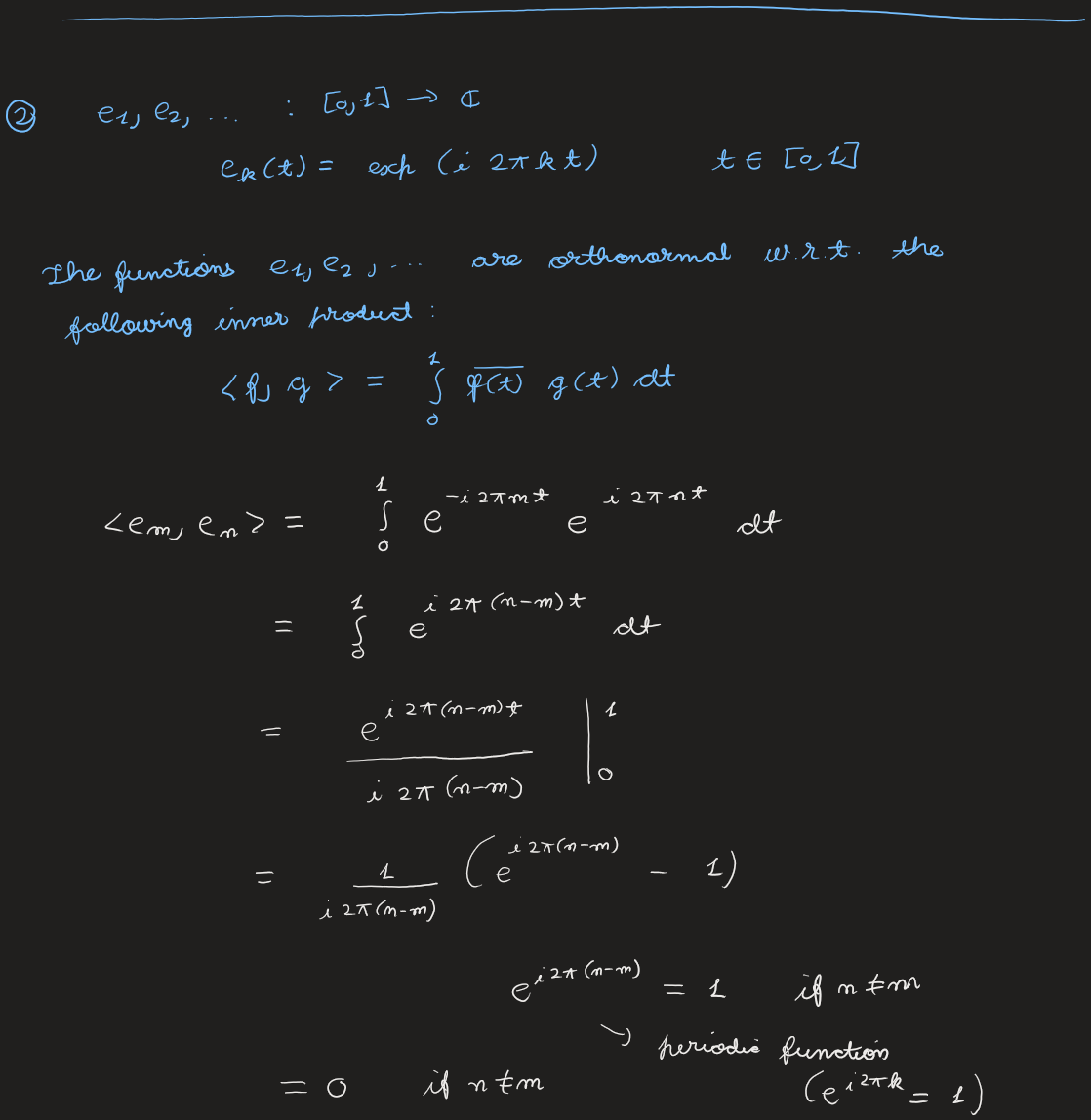
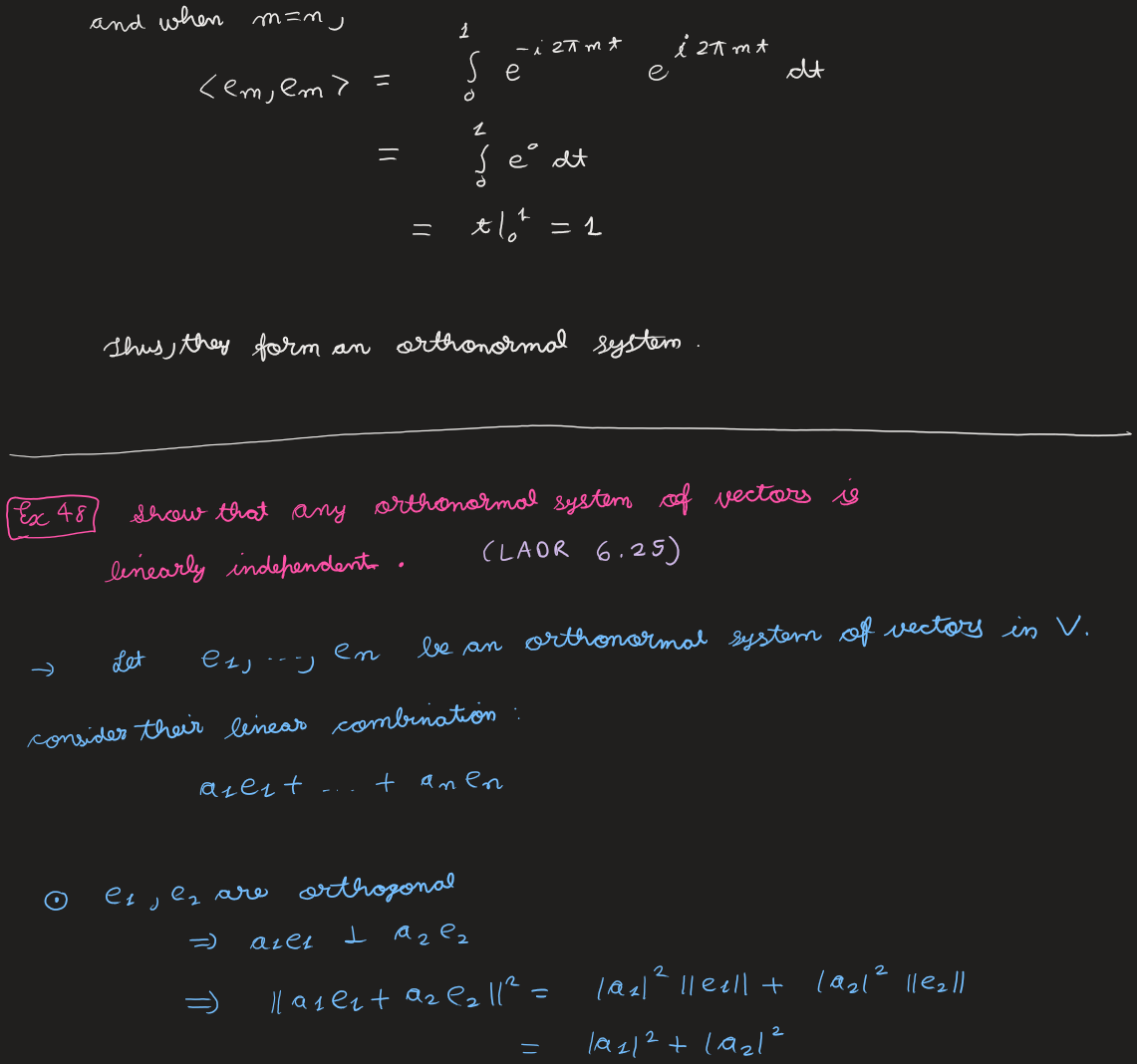
- Fourier exponentials. \( e_1, e_2, \dots : [0, 1] \to \C \), \( e_k(t) = \exp(i\,2\pi k t) \), \( t \in [0, 1] \). The functions \( e_1, e_2, \dots \) are orthonormal w.r.t. the inner product \( \langle f, g\rangle = \int_{0}^{1} \overline{f(t)}\, g(t)\, dt \): \[ \langle e_m, e_n\rangle = \int_{0}^{1} e^{-i 2\pi m t}\, e^{i 2\pi n t}\, dt = \int_{0}^{1} e^{i 2\pi (n - m) t}\, dt = \frac{1}{i\,2\pi(n - m)}\Big(e^{i 2\pi(n - m)} - 1\Big) = 0 \quad (n \neq m), \] since \( e^{i 2\pi(n - m)} = 1 \) (periodicity, \( e^{i 2\pi k} = 1 \)); and when \( m = n \), \[ \langle e_m, e_m\rangle = \int_{0}^{1} e^{-i 2\pi m t}\, e^{i 2\pi m t}\, dt = \int_{0}^{1} e^{0}\, dt = \big[t\big]_{0}^{1} = 1. \] Thus they form an orthonormal system.
Ex 48 — LADR 6.25
Show that any orthonormal system of vectors is linearly independent.
Solution
Let \( e_1, \dots, e_n \) be an orthonormal system of vectors in \( V \), and consider their linear combination \( a_1 e_1 + \dots + a_n e_n \).
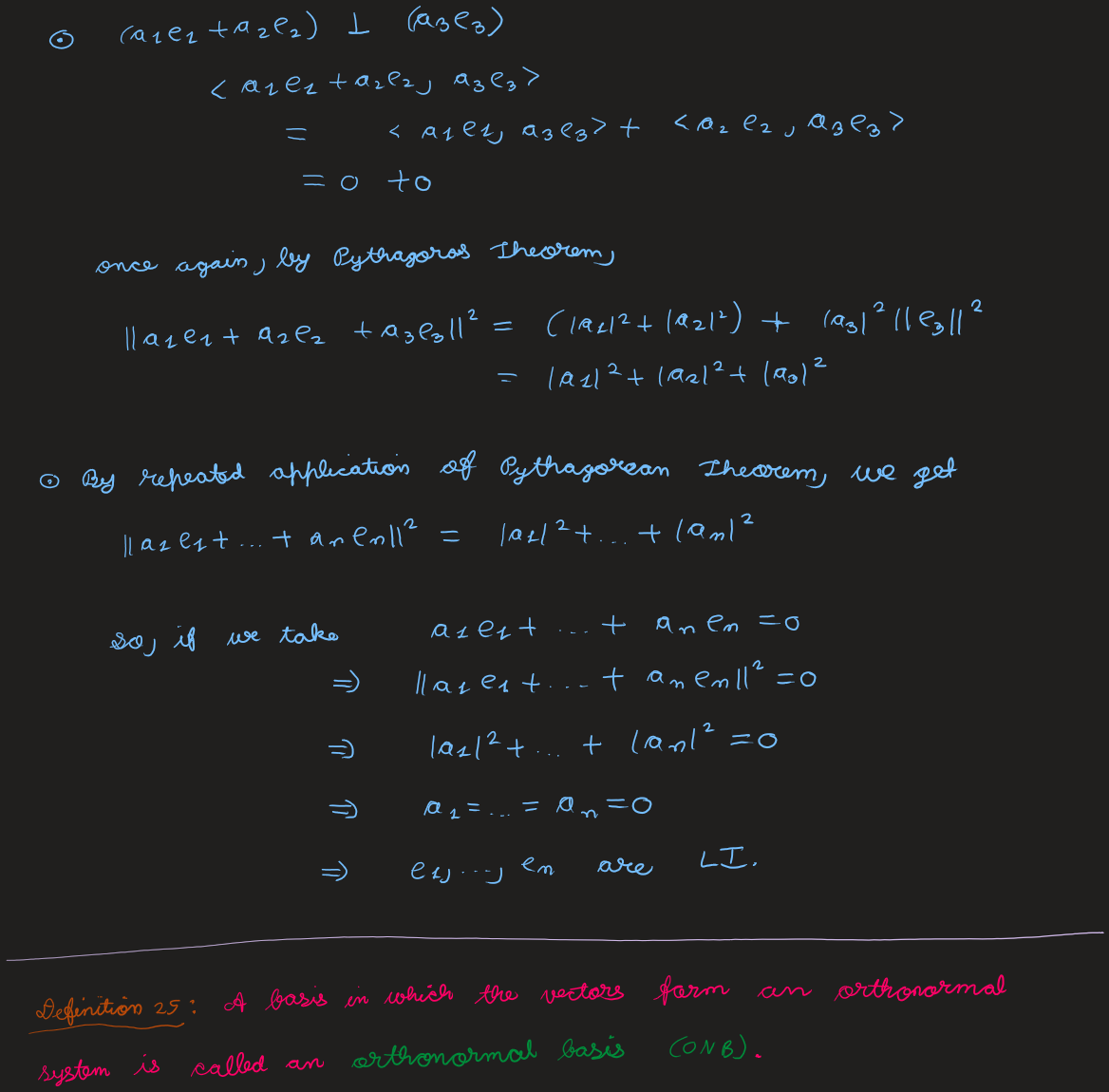
Since \( e_1, e_2 \) are orthogonal, \( a_1 e_1 \perp a_2 e_2 \), so by the Pythagorean theorem \( \|a_1 e_1 + a_2 e_2\|^2 = |a_1|^2\|e_1\|^2 + |a_2|^2\|e_2\|^2 = |a_1|^2 + |a_2|^2 \). Next, \( (a_1 e_1 + a_2 e_2) \perp a_3 e_3 \) because \( \langle a_1 e_1 + a_2 e_2, a_3 e_3\rangle = \langle a_1 e_1, a_3 e_3\rangle + \langle a_2 e_2, a_3 e_3\rangle = 0 + 0 \), so again by Pythagoras \( \|a_1 e_1 + a_2 e_2 + a_3 e_3\|^2 = |a_1|^2 + |a_2|^2 + |a_3|^2 \). By repeated application, \[ \|a_1 e_1 + \dots + a_n e_n\|^2 = |a_1|^2 + \dots + |a_n|^2. \] So if \( a_1 e_1 + \dots + a_n e_n = 0 \), then \( |a_1|^2 + \dots + |a_n|^2 = 0 \Rightarrow a_1 = \dots = a_n = 0 \Rightarrow e_1, \dots, e_n \) are linearly independent.
Definition 25 — Orthonormal basis (ONB)
A basis in which the vectors form an orthonormal system is called an orthonormal basis (ONB).
Ex 49
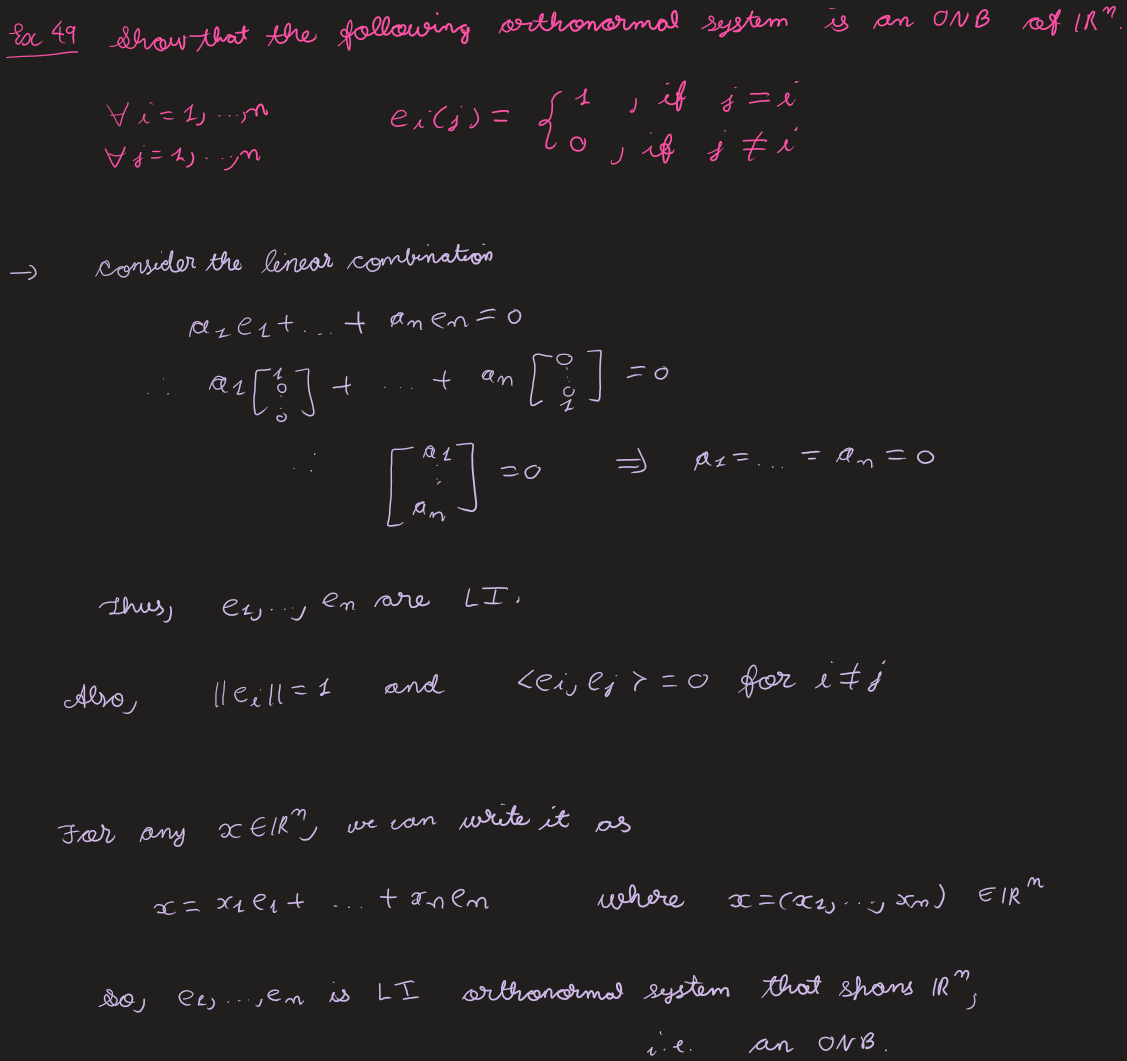
Show that the standard orthonormal system \( e_i(j) = \begin{cases} 1 & j = i \\ 0 & j \neq i \end{cases} \) (\( i, j = 1, \dots, n \)) is an ONB of \( \R^n \).
Solution
Consider the linear combination \( a_1 e_1 + \dots + a_n e_n = 0 \): \[ a_1 \begin{bmatrix} 1 \\ 0 \\ \vdots \\ 0 \end{bmatrix} + \dots + a_n \begin{bmatrix} 0 \\ \vdots \\ 0 \\ 1 \end{bmatrix} = 0 \implies \begin{bmatrix} a_1 \\ \vdots \\ a_n \end{bmatrix} = 0 \implies a_1 = \dots = a_n = 0, \] so \( e_1, \dots, e_n \) are linearly independent. Also \( \|e_i\| = 1 \) and \( \langle e_i, e_j\rangle = 0 \) for \( i \neq j \). For any \( x \in \R^n \) we can write \( x = x_1 e_1 + \dots + x_n e_n \) where \( x = (x_1, \dots, x_n) \in \R^n \). So \( e_1, \dots, e_n \) is a linearly independent orthonormal system that spans \( \R^n \), i.e. an ONB.
View original handwritten scans — orthogonality, Def 23–25, Examples 8–9 & Ex 46–49 (pages 23–29)
Gram–Schmidt Orthogonalization
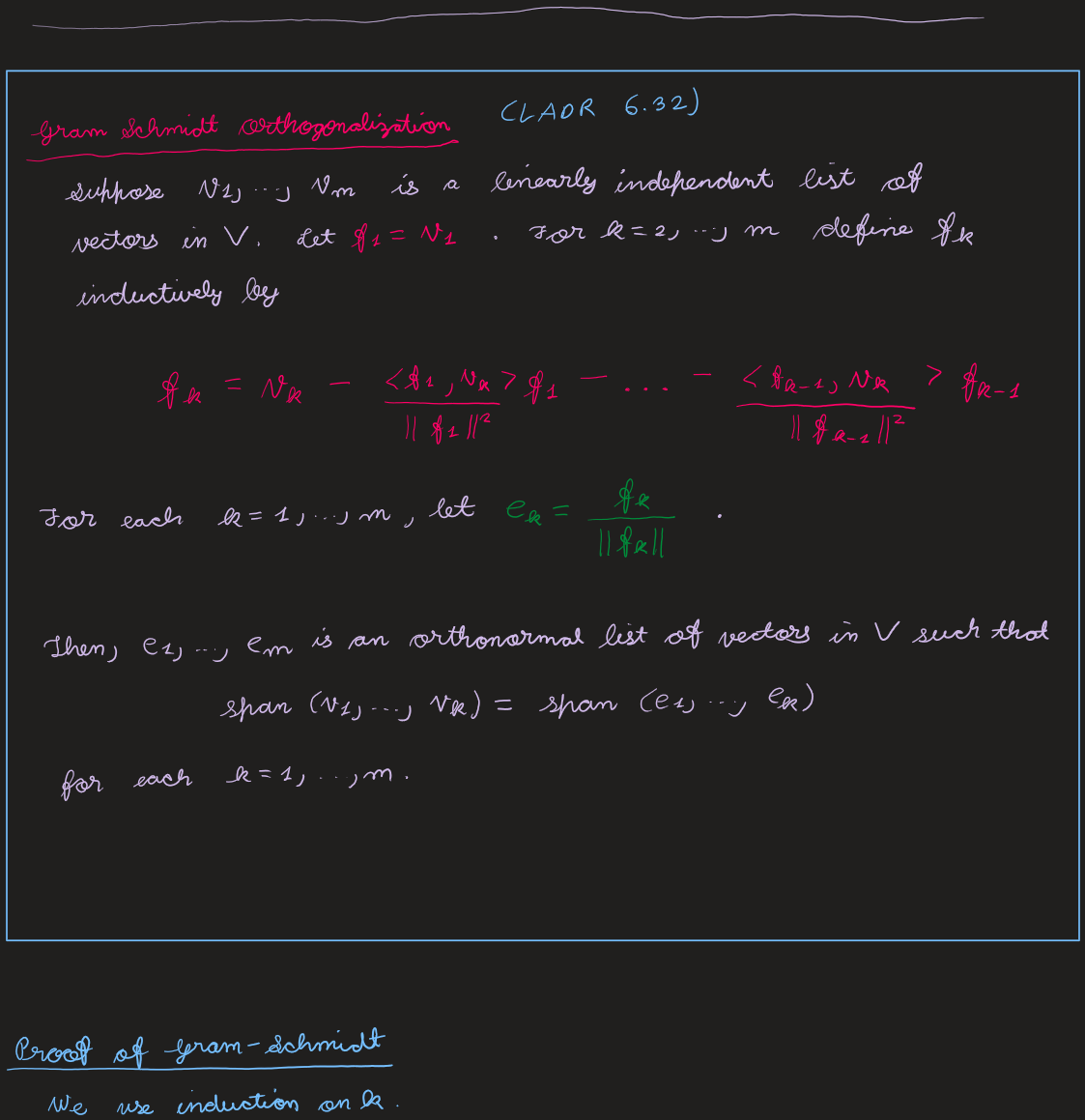
Gram–Schmidt — LADR 6.32
Suppose \( v_1, \dots, v_m \) is a linearly independent list of vectors in \( V \). Let \( f_1 = v_1 \). For \( k = 2, \dots, m \), define \( f_k \) inductively by \[ f_k = v_k - \frac{\langle f_1, v_k\rangle}{\|f_1\|^2}\, f_1 - \dots - \frac{\langle f_{k-1}, v_k\rangle}{\|f_{k-1}\|^2}\, f_{k-1}. \] For each \( k = 1, \dots, m \), let \( e_k = \dfrac{f_k}{\|f_k\|} \). Then \( e_1, \dots, e_m \) is an orthonormal list of vectors in \( V \) such that \( \operatorname{span}(v_1, \dots, v_k) = \operatorname{span}(e_1, \dots, e_k) \) for each \( k = 1, \dots, m \).
Proof of Gram–Schmidt
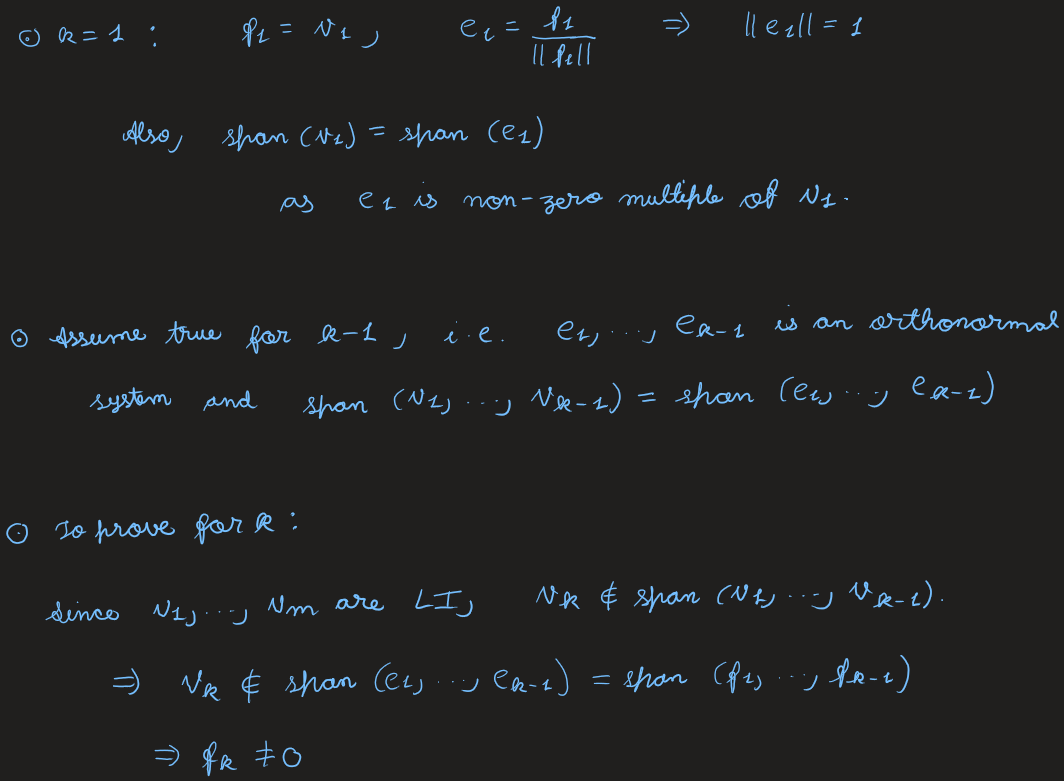
We use induction on \( k \).
Base case \( k = 1 \): \( f_1 = v_1 \), \( e_1 = \dfrac{f_1}{\|f_1\|} \Rightarrow \|e_1\| = 1 \). Also \( \operatorname{span}(v_1) = \operatorname{span}(e_1) \), as \( e_1 \) is a non-zero multiple of \( v_1 \).
Inductive hypothesis. Assume true for \( k - 1 \): \( e_1, \dots, e_{k-1} \) is an orthonormal system and \( \operatorname{span}(v_1, \dots, v_{k-1}) = \operatorname{span}(e_1, \dots, e_{k-1}) \).
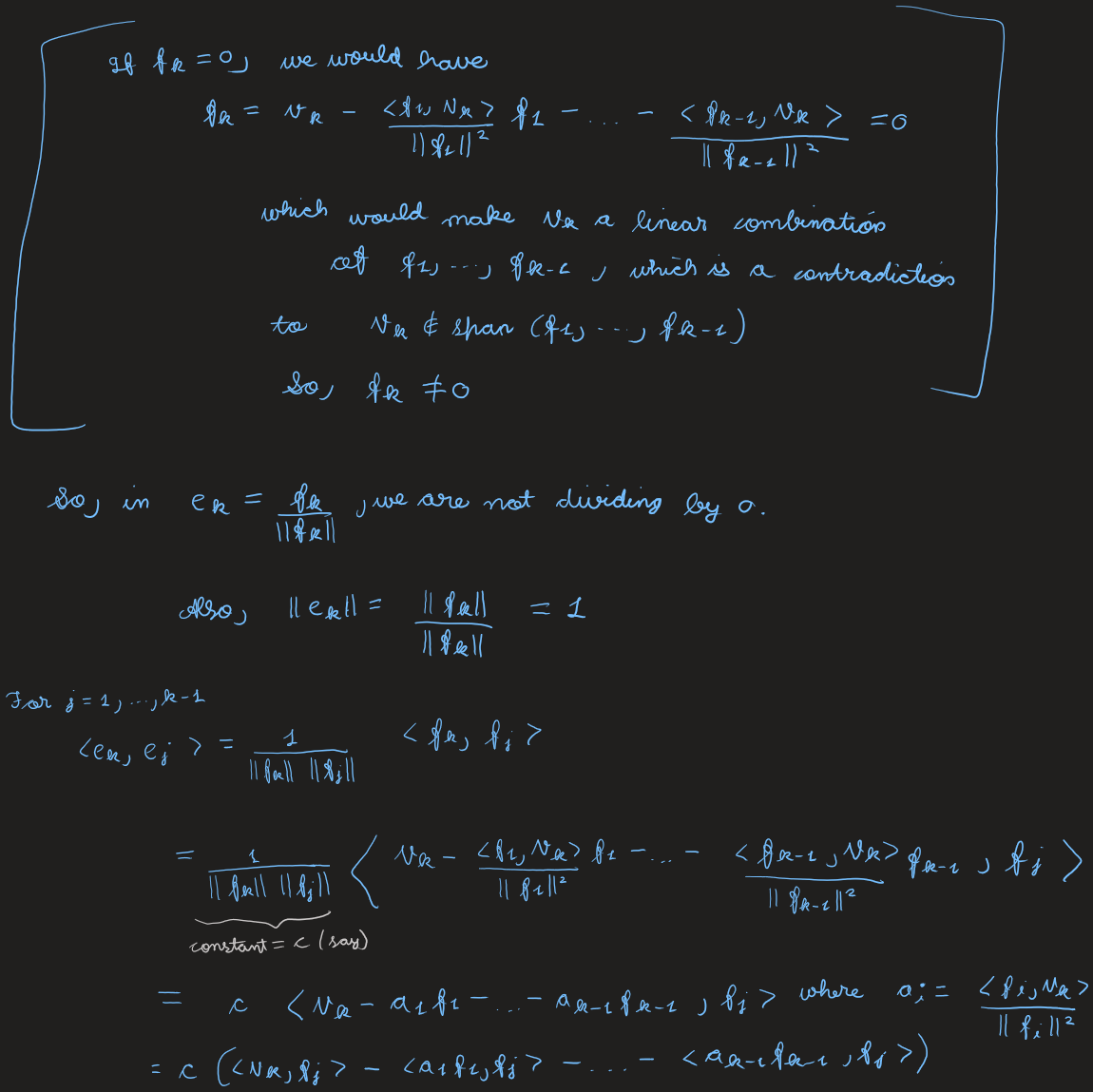
Inductive step. Since \( v_1, \dots, v_m \) are linearly independent, \( v_k \notin \operatorname{span}(v_1, \dots, v_{k-1}) \Rightarrow v_k \notin \operatorname{span}(e_1, \dots, e_{k-1}) = \operatorname{span}(f_1, \dots, f_{k-1}) \Rightarrow f_k \neq 0 \). (If \( f_k = 0 \), the defining relation would make \( v_k \) a linear combination of \( f_1, \dots, f_{k-1} \), contradicting \( v_k \notin \operatorname{span}(f_1, \dots, f_{k-1}) \).) So in \( e_k = \dfrac{f_k}{\|f_k\|} \) we are not dividing by \( 0 \), and \( \|e_k\| = \dfrac{\|f_k\|}{\|f_k\|} = 1 \).
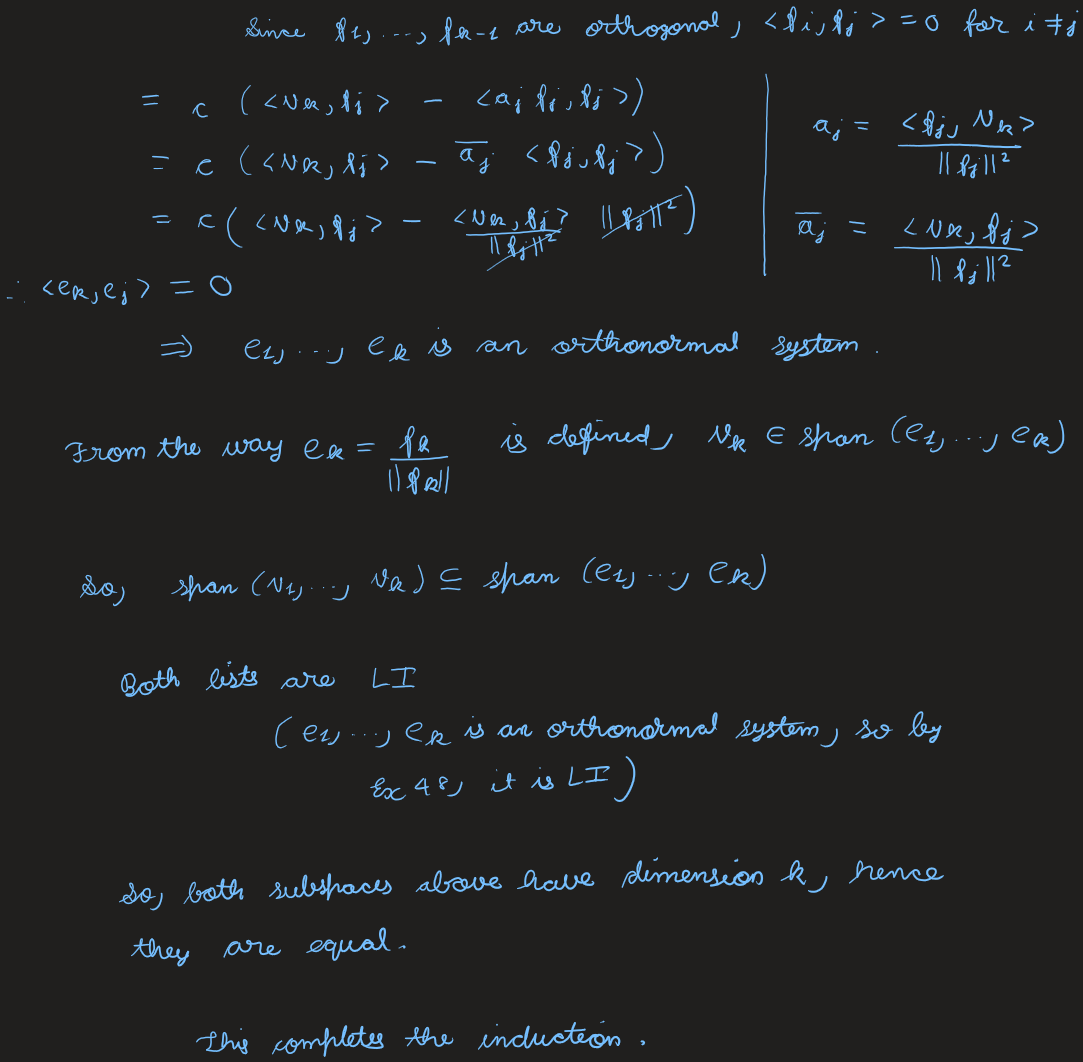
For \( j = 1, \dots, k-1 \), write \( c = \dfrac{1}{\|f_k\|\,\|f_j\|} \) and \( a_j := \dfrac{\langle f_j, v_k\rangle}{\|f_j\|^2} \) (so \( \bar a_j = \dfrac{\langle v_k, f_j\rangle}{\|f_j\|^2} \)). Then \[ \langle e_k, e_j\rangle = c\,\langle f_k, f_j\rangle = c\,\Big\langle v_k - a_1 f_1 - \dots - a_{k-1} f_{k-1},\ f_j \Big\rangle = c\big(\langle v_k, f_j\rangle - \langle a_1 f_1, f_j\rangle - \dots - \langle a_{k-1} f_{k-1}, f_j\rangle\big). \] Since \( f_1, \dots, f_{k-1} \) are orthogonal, \( \langle f_i, f_j\rangle = 0 \) for \( i \neq j \), so only the \( j \)-th term survives: \[ \langle e_k, e_j\rangle = c\big(\langle v_k, f_j\rangle - \bar a_j\langle f_j, f_j\rangle\big) = c\Big(\langle v_k, f_j\rangle - \frac{\langle v_k, f_j\rangle}{\|f_j\|^2}\,\|f_j\|^2\Big) = 0. \] Hence \( e_1, \dots, e_k \) is an orthonormal system. From the way \( e_k = \dfrac{f_k}{\|f_k\|} \) is defined, \( v_k \in \operatorname{span}(e_1, \dots, e_k) \), so \( \operatorname{span}(v_1, \dots, v_k) \subseteq \operatorname{span}(e_1, \dots, e_k) \). Both lists are linearly independent (\( e_1, \dots, e_k \) is an orthonormal system, so LI by Ex 48), so both subspaces have dimension \( k \) and are therefore equal. This completes the induction.
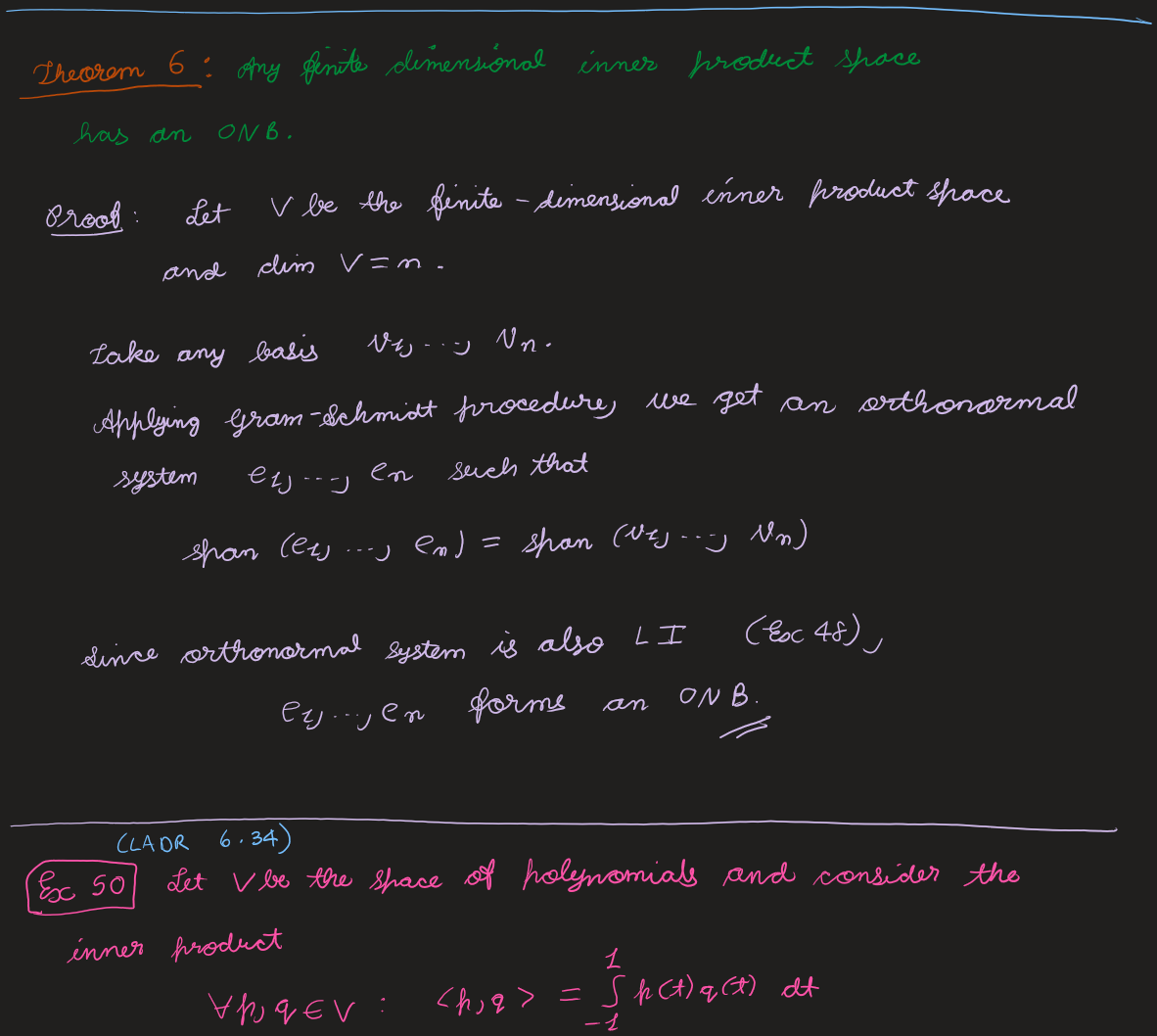
Theorem 6 — LADR 6.34
Any finite-dimensional inner product space has an ONB.
Proof
Let \( V \) be the finite-dimensional inner product space with \( \dim V = n \). Take any basis \( v_1, \dots, v_n \). Applying the Gram–Schmidt procedure, we get an orthonormal system \( e_1, \dots, e_n \) such that \( \operatorname{span}(e_1, \dots, e_n) = \operatorname{span}(v_1, \dots, v_n) \). Since an orthonormal system is also linearly independent (Ex 48), \( e_1, \dots, e_n \) forms an ONB.
Ex 50
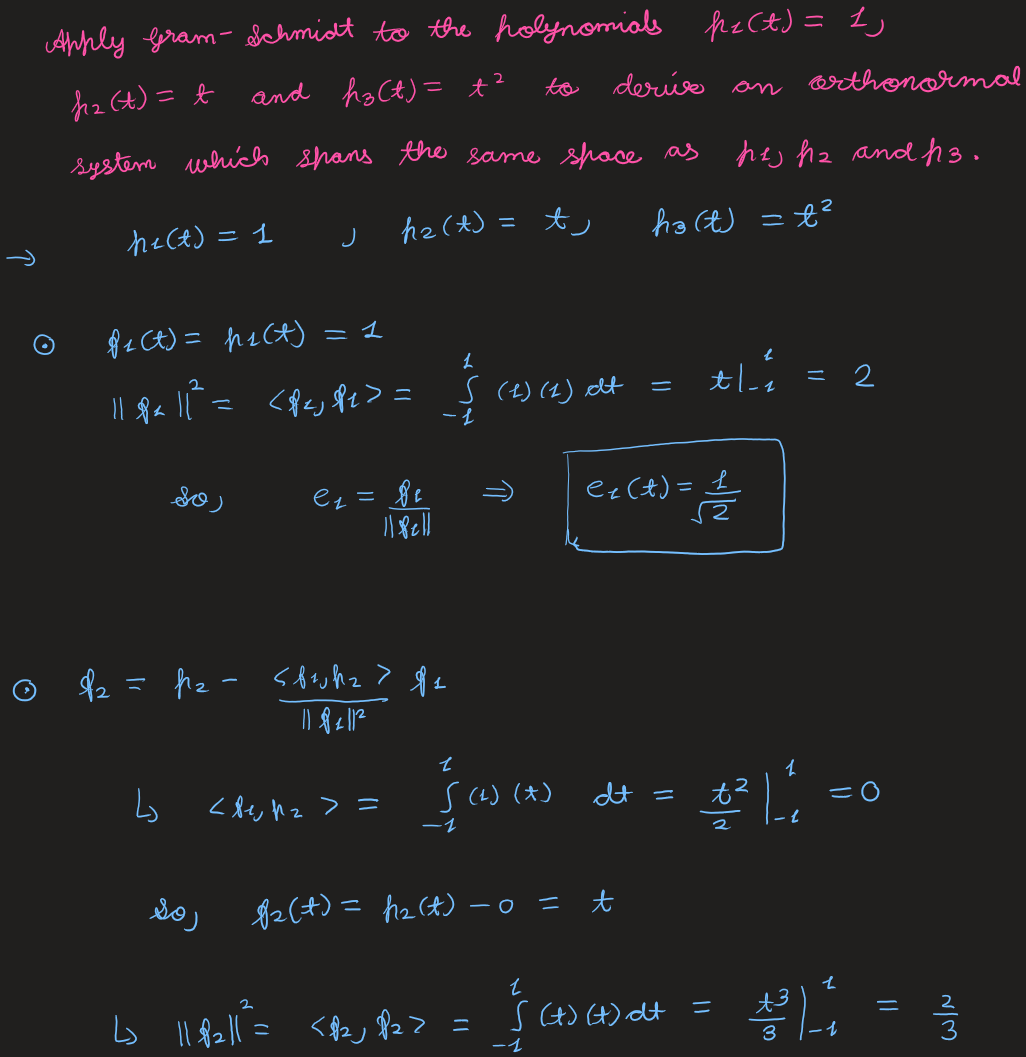
Let \( V \) be the space of polynomials with inner product \( \langle h, q\rangle = \int_{-1}^{1} h(t)q(t)\, dt \). Apply Gram–Schmidt to \( h_1(t) = 1 \), \( h_2(t) = t \), \( h_3(t) = t^2 \) to derive an orthonormal system that spans the same space.
Solution
\( f_1 \). \( f_1(t) = h_1(t) = 1 \), \( \|f_1\|^2 = \langle f_1, f_1\rangle = \int_{-1}^{1} (1)(1)\, dt = [t]_{-1}^{1} = 2 \). So \( e_1 = \dfrac{f_1}{\|f_1\|} \Rightarrow \boxed{\, e_1(t) = \tfrac{1}{\sqrt 2} \,} \).
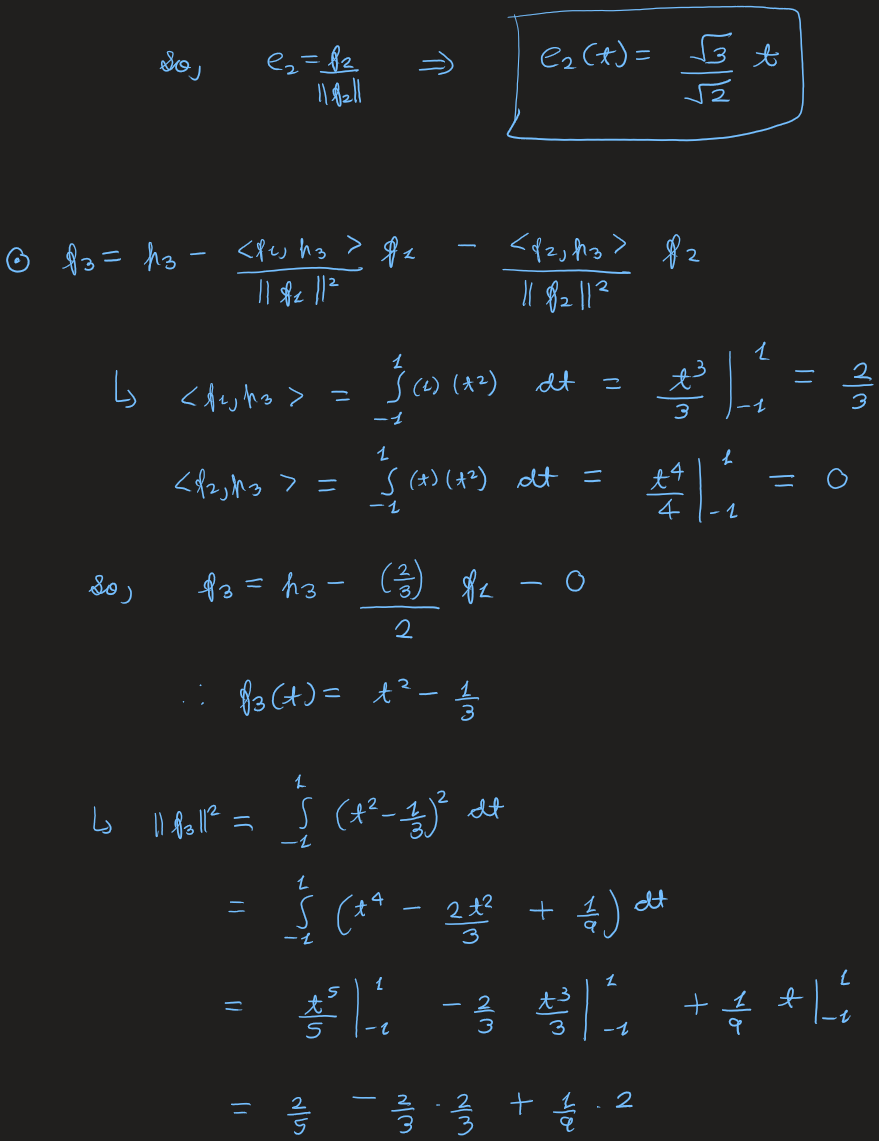
\( f_2 \). \( f_2 = h_2 - \dfrac{\langle f_1, h_2\rangle}{\|f_1\|^2}\, f_1 \). Now \( \langle f_1, h_2\rangle = \int_{-1}^{1} (1)(t)\, dt = \big[\tfrac{t^2}{2}\big]_{-1}^{1} = 0 \), so \( f_2(t) = h_2(t) - 0 = t \), and \( \|f_2\|^2 = \int_{-1}^{1} (t)(t)\, dt = \big[\tfrac{t^3}{3}\big]_{-1}^{1} = \tfrac{2}{3} \). So \( e_2 = \dfrac{f_2}{\|f_2\|} \Rightarrow \boxed{\, e_2(t) = \tfrac{\sqrt 3}{\sqrt 2}\, t \,} \).
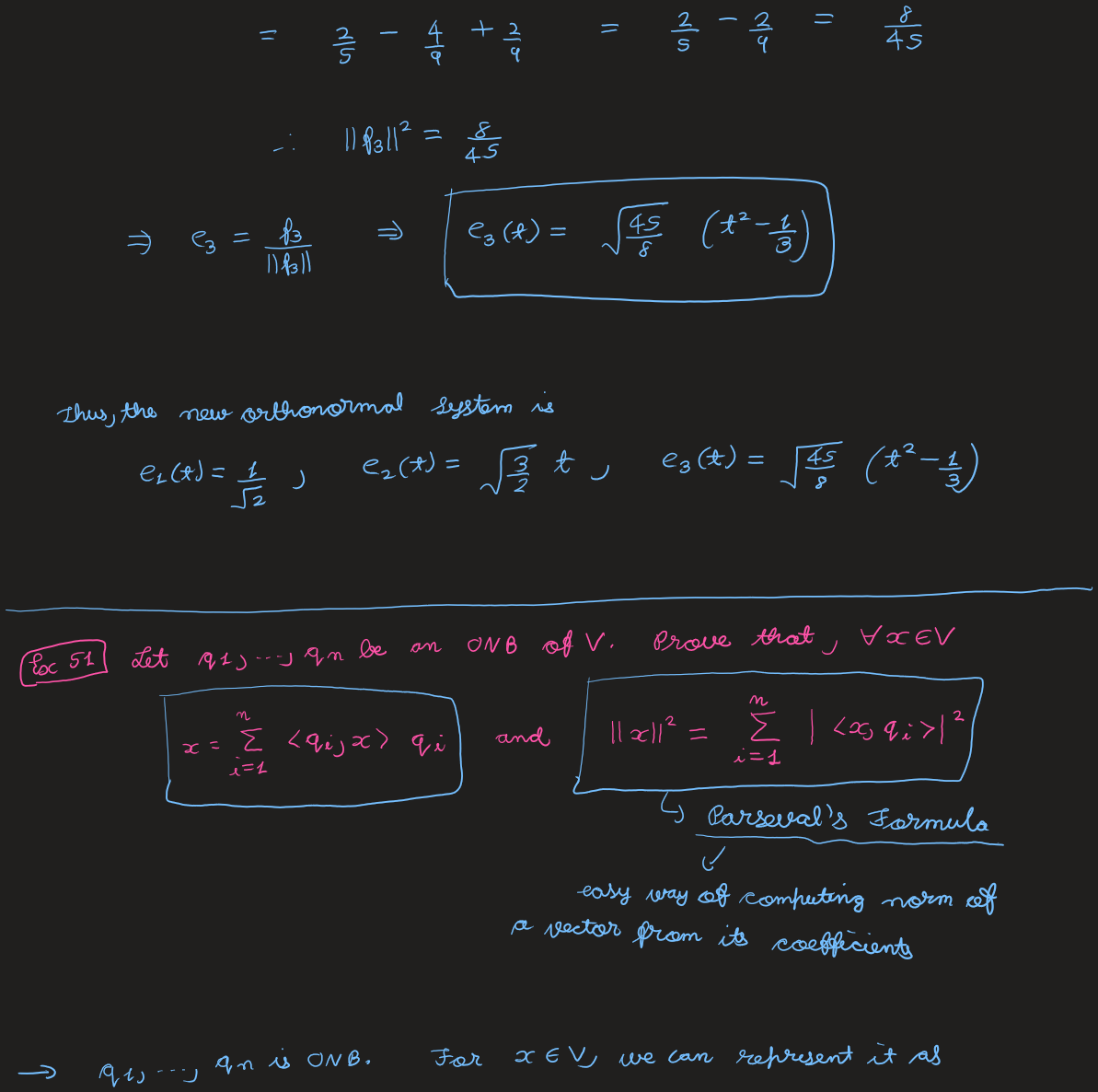
\( f_3 \). \( f_3 = h_3 - \dfrac{\langle f_1, h_3\rangle}{\|f_1\|^2}\, f_1 - \dfrac{\langle f_2, h_3\rangle}{\|f_2\|^2}\, f_2 \). Here \( \langle f_1, h_3\rangle = \int_{-1}^{1} (1)(t^2)\, dt = \big[\tfrac{t^3}{3}\big]_{-1}^{1} = \tfrac{2}{3} \) and \( \langle f_2, h_3\rangle = \int_{-1}^{1} (t)(t^2)\, dt = \big[\tfrac{t^4}{4}\big]_{-1}^{1} = 0 \). So \[ f_3 = h_3 - \frac{2/3}{2}\, f_1 - 0 \implies f_3(t) = t^2 - \tfrac{1}{3}. \] Then \[ \|f_3\|^2 = \int_{-1}^{1} \Big(t^2 - \tfrac{1}{3}\Big)^2 dt = \int_{-1}^{1} \Big(t^4 - \tfrac{2t^2}{3} + \tfrac{1}{9}\Big) dt = \Big[\tfrac{t^5}{5}\Big]_{-1}^{1} - \tfrac{2}{3}\Big[\tfrac{t^3}{3}\Big]_{-1}^{1} + \tfrac{1}{9}\big[t\big]_{-1}^{1} = \tfrac{2}{5} - \tfrac{2}{3}\cdot\tfrac{2}{3} + \tfrac{1}{9}\cdot 2 = \tfrac{2}{5} - \tfrac{4}{9} + \tfrac{2}{9} = \tfrac{2}{5} - \tfrac{2}{9} = \tfrac{8}{45}. \] So \( e_3 = \dfrac{f_3}{\|f_3\|} \Rightarrow \boxed{\, e_3(t) = \sqrt{\tfrac{45}{8}}\,\Big(t^2 - \tfrac{1}{3}\Big) \,} \).
Thus the new orthonormal system is \[ e_1(t) = \tfrac{1}{\sqrt 2}, \qquad e_2(t) = \sqrt{\tfrac{3}{2}}\, t, \qquad e_3(t) = \sqrt{\tfrac{45}{8}}\,\Big(t^2 - \tfrac{1}{3}\Big). \]
Ex 51 — Parseval's formula
Let \( q_1, \dots, q_n \) be an ONB of \( V \). Prove that \( \forall\, x \in V \), \[ x = \sum_{i=1}^{n} \langle q_i, x\rangle\, q_i \qquad\text{and}\qquad \|x\|^2 = \sum_{i=1}^{n} |\langle x, q_i\rangle|^2. \] (An easy way of computing the norm of a vector from its coefficients.)
Solution
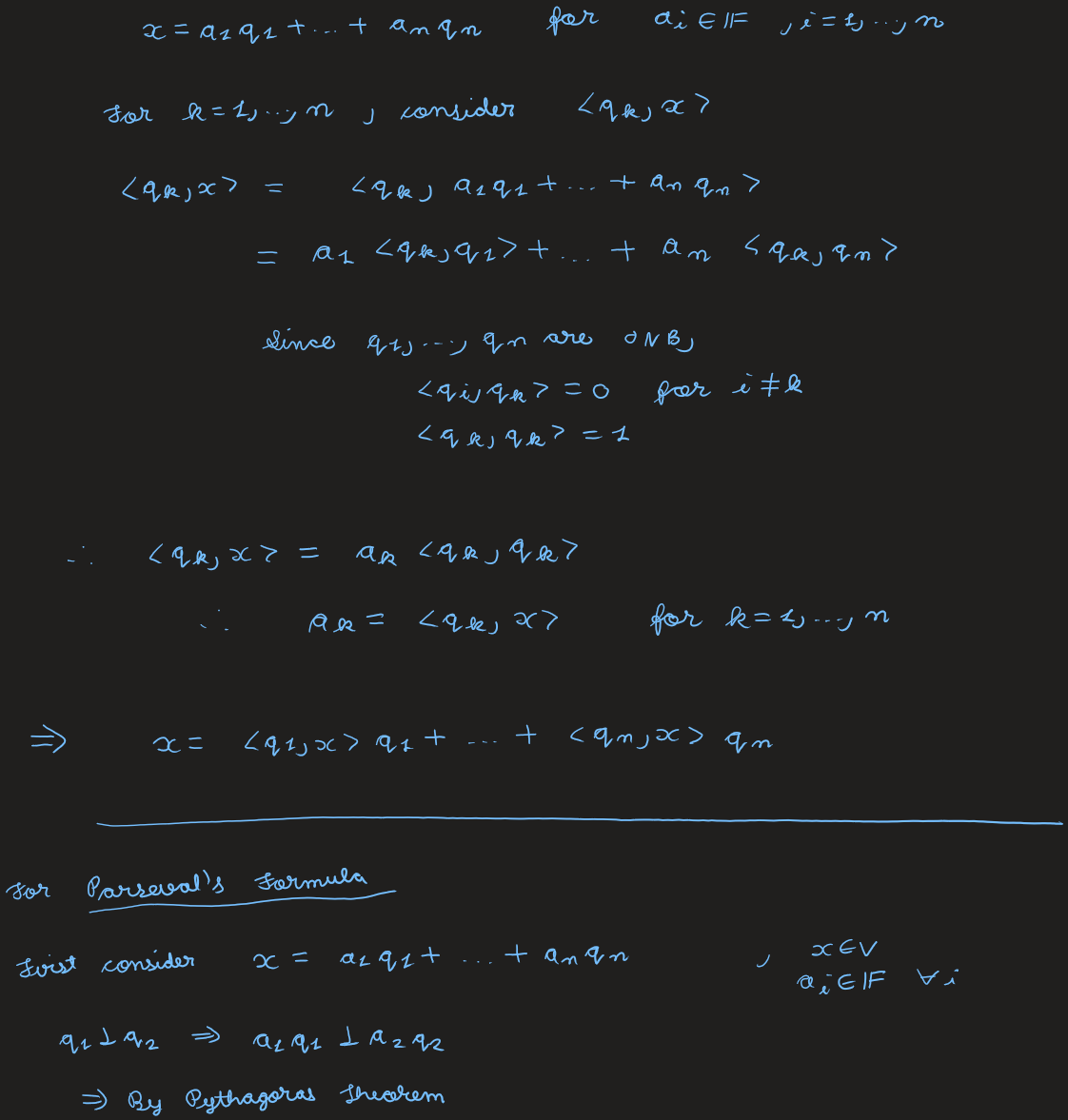
Expansion. Since \( q_1, \dots, q_n \) is an ONB, for \( x \in V \) write \( x = a_1 q_1 + \dots + a_n q_n \), \( a_i \in \F \). For \( k = 1, \dots, n \), \[ \langle q_k, x\rangle = \langle q_k, a_1 q_1 + \dots + a_n q_n\rangle = a_1\langle q_k, q_1\rangle + \dots + a_n\langle q_k, q_n\rangle = a_k \] because \( \langle q_i, q_k\rangle = 0 \) for \( i \neq k \) and \( \langle q_k, q_k\rangle = 1 \). Hence \( a_k = \langle q_k, x\rangle \), giving \( x = \langle q_1, x\rangle q_1 + \dots + \langle q_n, x\rangle q_n \).
Parseval. First, with \( x = a_1 q_1 + \dots + a_n q_n \): \( q_1 \perp q_2 \Rightarrow a_1 q_1 \perp a_2 q_2 \), so by the Pythagorean theorem \( \|a_1 q_1 + a_2 q_2\|^2 = |a_1|^2\|q_1\|^2 + |a_2|^2\|q_2\|^2 = |a_1|^2 + |a_2|^2 \) (as \( \|q_i\| = 1 \)). Repeatedly applying Pythagoras, \[ \|x\|^2 = \|a_1 q_1 + \dots + a_n q_n\|^2 = |a_1|^2 + \dots + |a_n|^2. \] From the previous part \( a_i = \langle q_i, x\rangle \), so \( \|x\|^2 = \sum_{i=1}^{n} |\langle q_i, x\rangle|^2 \).
View original handwritten scans — Gram–Schmidt, Theorem 6, Ex 50 (Legendre) & Ex 51 (Parseval) (pages 30–39)

Linear Functionals & the Dual Space
Definition — Linear functional (LADR 6.39)
A linear functional on \( V \) is a linear map from \( V \) to \( \F \). The dual space of \( V \), denoted \( V' \), is the vector space of all linear functionals on \( V \): \[ V' = \Lin(V, \F). \]
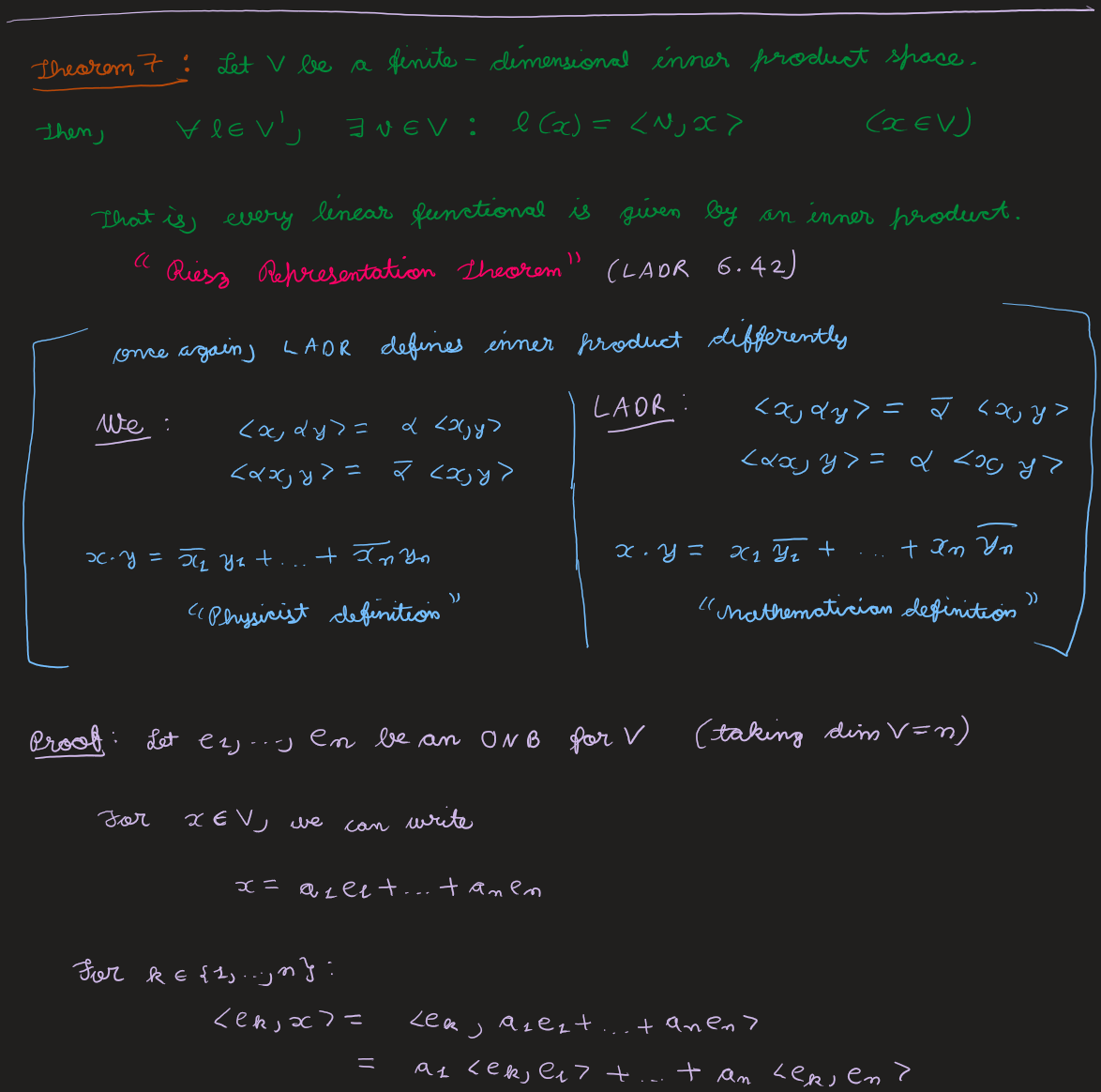
Theorem 7 — Riesz Representation (LADR 6.42)
Let \( V \) be a finite-dimensional inner product space. Then \( \forall\, \ell \in V' \), \( \exists\, v \in V \) such that \[ \ell(x) = \langle v, x\rangle \quad (x \in V). \] That is, every linear functional is given by an inner product.
Aside — convention
Once again, LADR defines the inner product differently:
- These notes: \( \langle x, \alpha y\rangle = \alpha\langle x, y\rangle \), \( \langle \alpha x, y\rangle = \bar\alpha\langle x, y\rangle \), \( x \cdot y = \bar x_1 y_1 + \dots + \bar x_n y_n \) (the "physicist" convention).
- LADR: \( \langle x, \alpha y\rangle = \bar\alpha\langle x, y\rangle \), \( \langle \alpha x, y\rangle = \alpha\langle x, y\rangle \), \( x \cdot y = x_1 \bar y_1 + \dots + x_n \bar y_n \) (the "mathematician" convention).
Proof
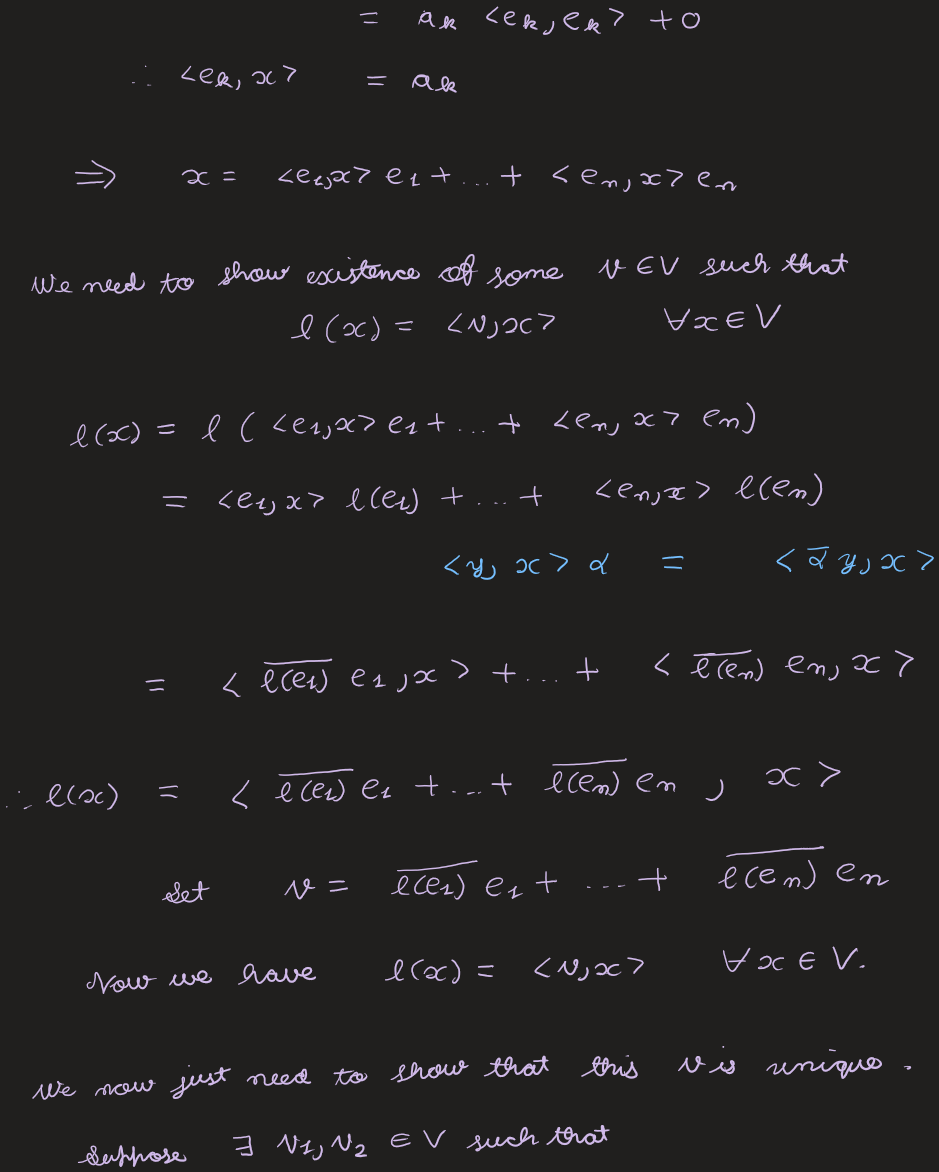
Let \( e_1, \dots, e_n \) be an ONB for \( V \) (\( \dim V = n \)). For \( x \in V \), write \( x = a_1 e_1 + \dots + a_n e_n \). For \( k \in \{1, \dots, n\} \), \( \langle e_k, x\rangle = a_1\langle e_k, e_1\rangle + \dots + a_n\langle e_k, e_n\rangle = a_k \), so \( x = \langle e_1, x\rangle e_1 + \dots + \langle e_n, x\rangle e_n \).
We need some \( v \in V \) with \( \ell(x) = \langle v, x\rangle \ \forall\, x \in V \). Using linearity of \( \ell \) and \( \alpha\langle y, x\rangle = \langle \bar\alpha y, x\rangle \), \[\begin{aligned} \ell(x) &= \ell\big(\langle e_1, x\rangle e_1 + \dots + \langle e_n, x\rangle e_n\big) \\ &= \langle e_1, x\rangle\,\ell(e_1) + \dots + \langle e_n, x\rangle\,\ell(e_n) \\ &= \big\langle \overline{\ell(e_1)}\, e_1, x\big\rangle + \dots + \big\langle \overline{\ell(e_n)}\, e_n, x\big\rangle. \end{aligned}\] So \( \ell(x) = \big\langle \overline{\ell(e_1)}\, e_1 + \dots + \overline{\ell(e_n)}\, e_n,\ x\big\rangle \). Set \( v = \overline{\ell(e_1)}\, e_1 + \dots + \overline{\ell(e_n)}\, e_n \); then \( \ell(x) = \langle v, x\rangle \ \forall\, x \in V \).
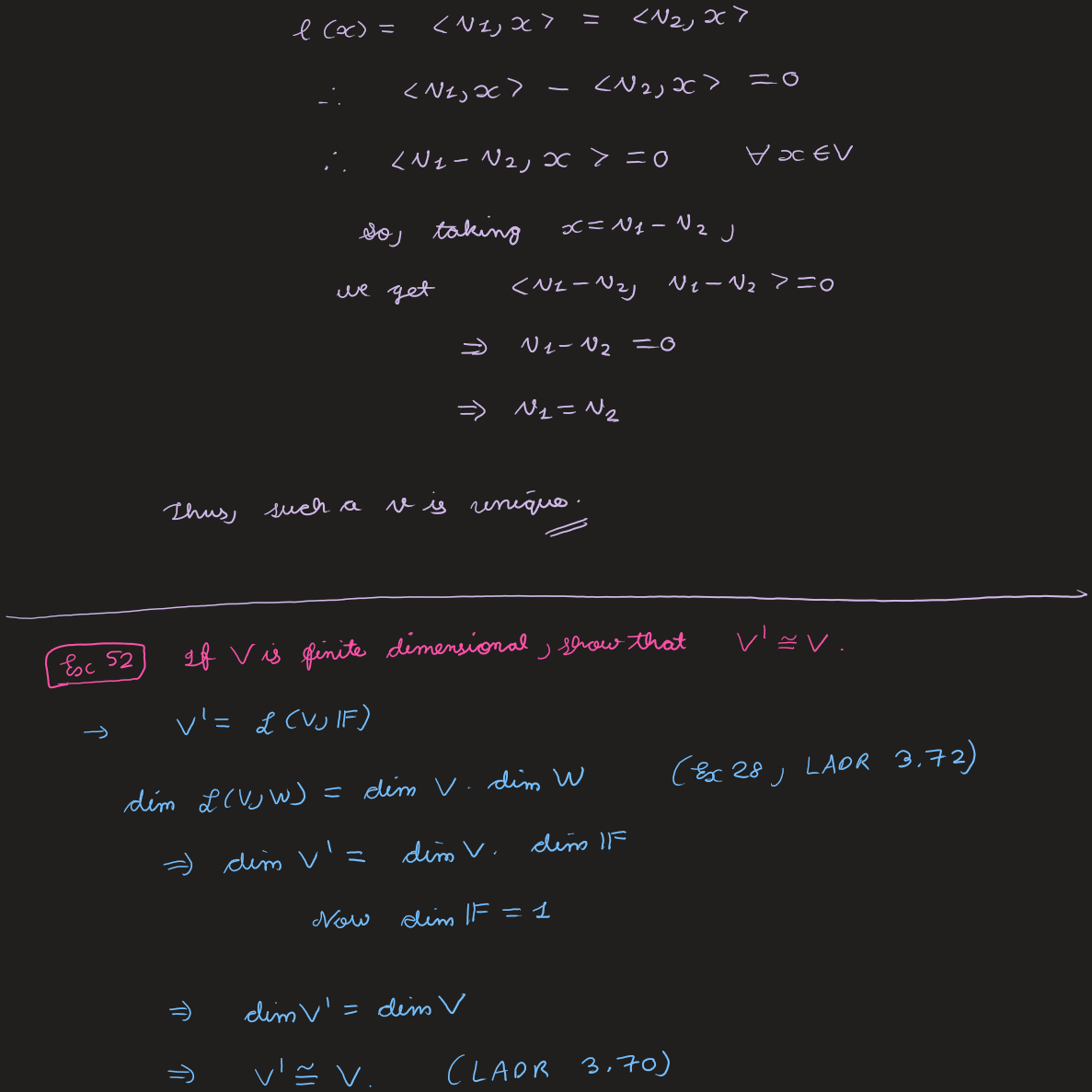
Uniqueness. Suppose \( \exists\, v_1, v_2 \in V \) with \( \ell(x) = \langle v_1, x\rangle = \langle v_2, x\rangle \). Then \( \langle v_1 - v_2, x\rangle = 0 \ \forall\, x \in V \). Taking \( x = v_1 - v_2 \) gives \( \langle v_1 - v_2, v_1 - v_2\rangle = 0 \Rightarrow v_1 - v_2 = 0 \Rightarrow v_1 = v_2 \). Thus \( v \) is unique.
Ex 52
If \( V \) is finite-dimensional, show that \( V' \cong V \).
Solution
\( V' = \Lin(V, \F) \). By Ex 28 (LADR 3.72), \( \dim \Lin(V, W) = \dim V \cdot \dim W \), so \( \dim V' = \dim V \cdot \dim \F \). Since \( \dim \F = 1 \), \( \dim V' = \dim V \), hence \( V' \cong V \) (LADR 3.70).
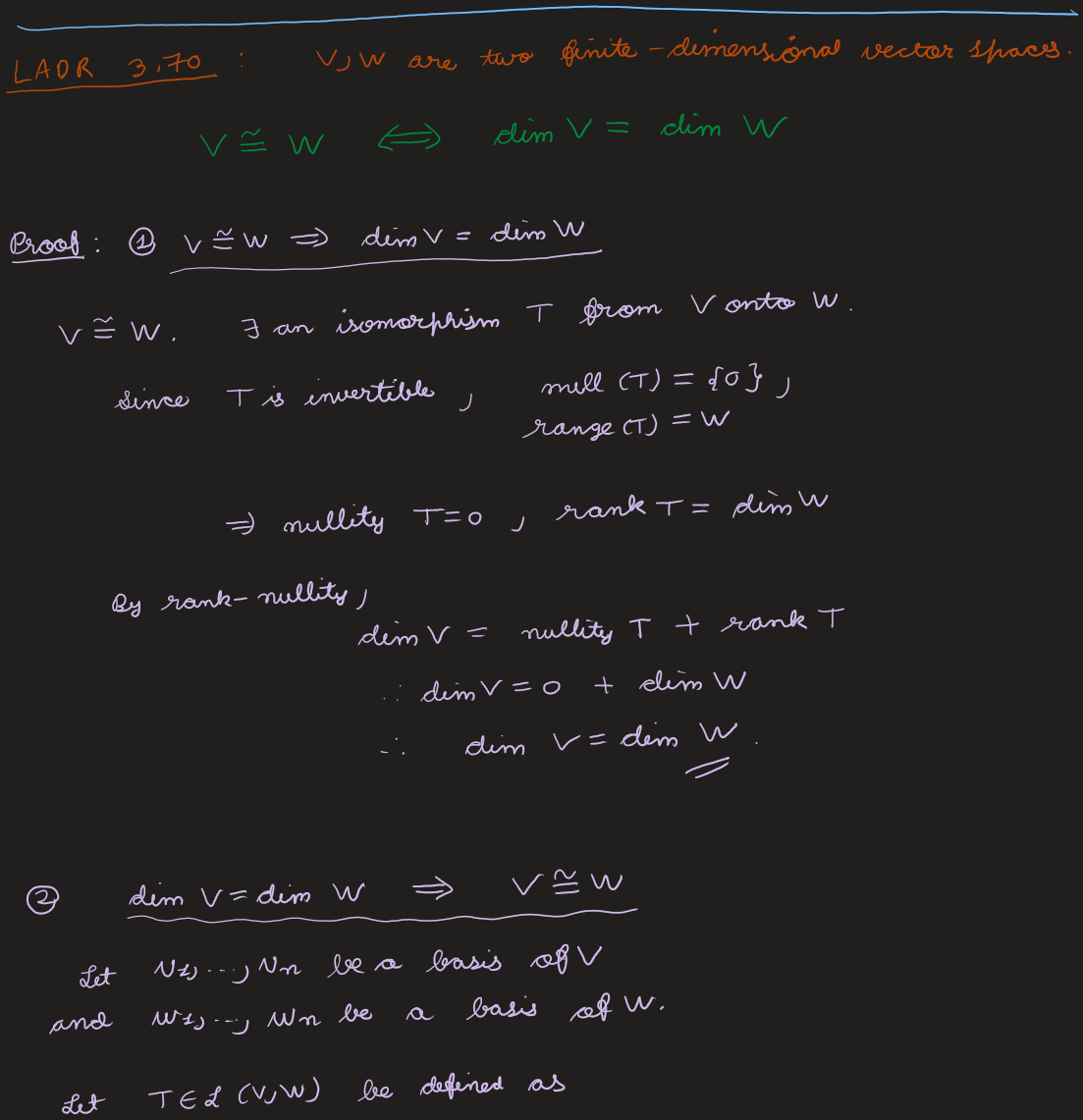
LADR 3.70
Let \( V, W \) be two finite-dimensional vector spaces. Then \( V \cong W \iff \dim V = \dim W \).
Proof
(\( \Rightarrow \)) \( V \cong W \) means there is an isomorphism \( T \) from \( V \) onto \( W \). Since \( T \) is invertible, \( \Null(T) = \{0\} \) and \( \Range(T) = W \), so \( \nullity T = 0 \) and \( \rank T = \dim W \). By rank–nullity, \( \dim V = \nullity T + \rank T = 0 + \dim W \), i.e. \( \dim V = \dim W \).
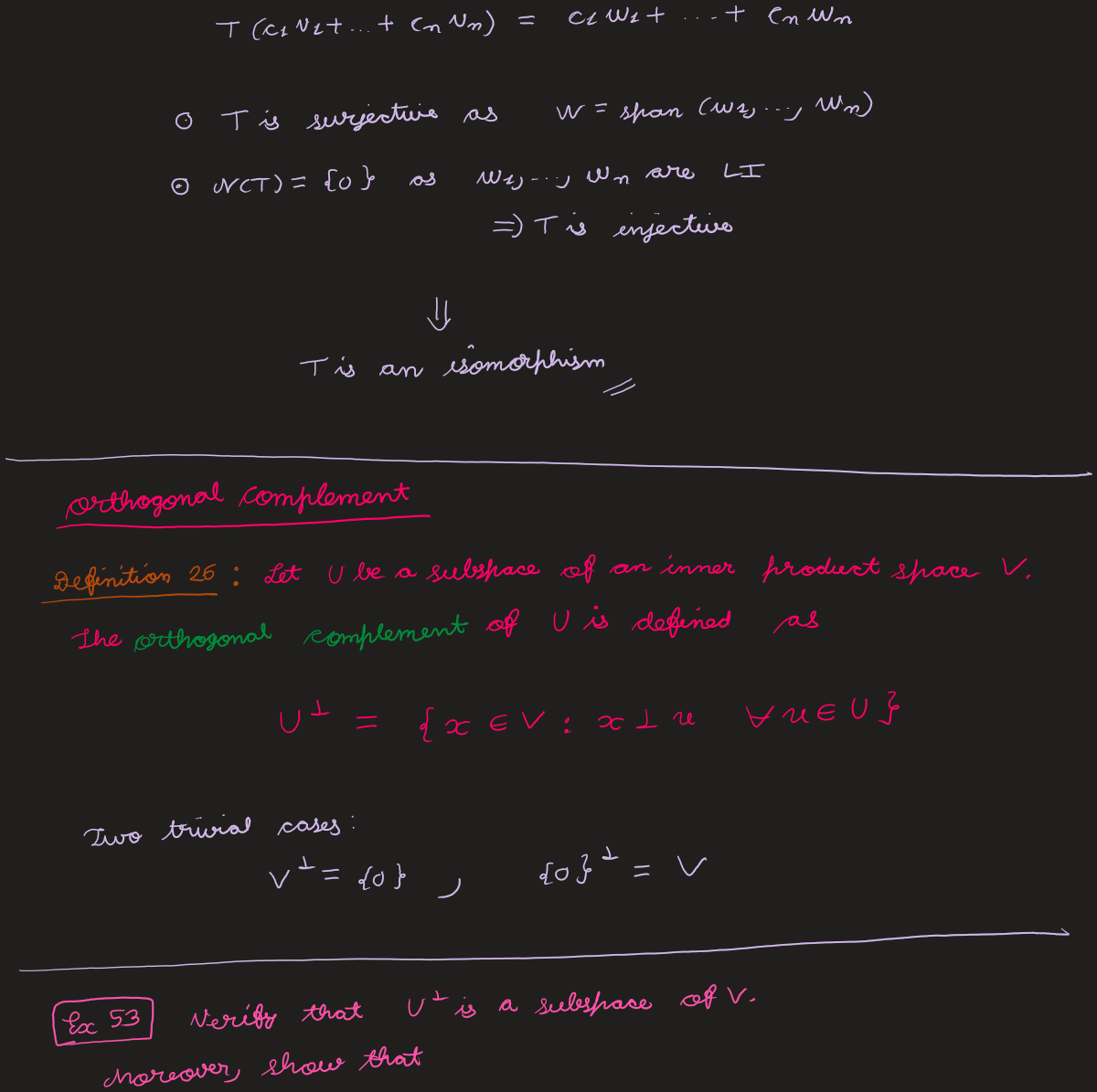
(\( \Leftarrow \)) Suppose \( \dim V = \dim W \). Let \( v_1, \dots, v_n \) be a basis of \( V \) and \( w_1, \dots, w_n \) a basis of \( W \). Define \( T \in \Lin(V, W) \) by \( T(c_1 v_1 + \dots + c_n v_n) = c_1 w_1 + \dots + c_n w_n \). Then \( T \) is surjective (as \( W = \operatorname{span}(w_1, \dots, w_n) \)) and \( \Null(T) = \{0\} \) (as \( w_1, \dots, w_n \) are LI), so \( T \) is injective. Hence \( T \) is an isomorphism.
View original handwritten scans — linear functionals, Riesz (Thm 7), Ex 52 & LADR 3.70 (pages 39–44)
Orthogonal Complement
Definition 26 — Orthogonal complement
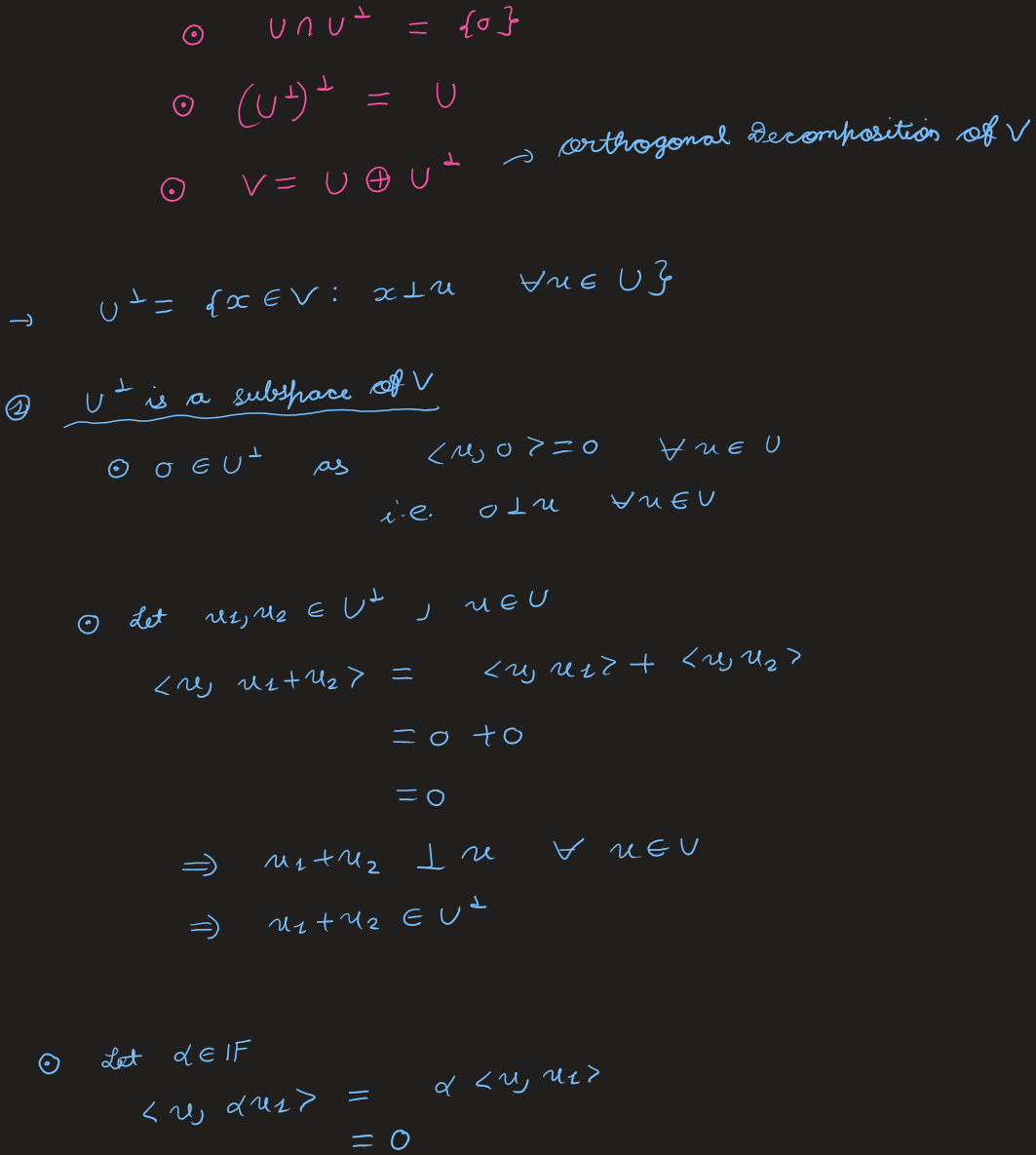
Let \( U \) be a subspace of an inner product space \( V \). The orthogonal complement of \( U \) is \[ U^{\perp} = \{x \in V : x \perp u \ \forall\, u \in U\}. \] Two trivial cases: \( V^{\perp} = \{0\} \) and \( \{0\}^{\perp} = V \).
Ex 53
Verify that \( U^{\perp} \) is a subspace of \( V \). Moreover, show that \( U \cap U^{\perp} = \{0\} \), \( (U^{\perp})^{\perp} = U \), and \( V = U \oplus U^{\perp} \) (the orthogonal decomposition of \( V \)).
Solution
(1) \( U^{\perp} \) is a subspace of \( V \).
- \( 0 \in U^{\perp} \), as \( \langle u, 0\rangle = 0 \ \forall\, u \in U \), i.e. \( 0 \perp u \ \forall\, u \in U \).
- Let \( u_1, u_2 \in U^{\perp} \), \( u \in U \): \( \langle u, u_1 + u_2\rangle = \langle u, u_1\rangle + \langle u, u_2\rangle = 0 + 0 = 0 \Rightarrow u_1 + u_2 \perp u \ \forall\, u \in U \Rightarrow u_1 + u_2 \in U^{\perp} \).
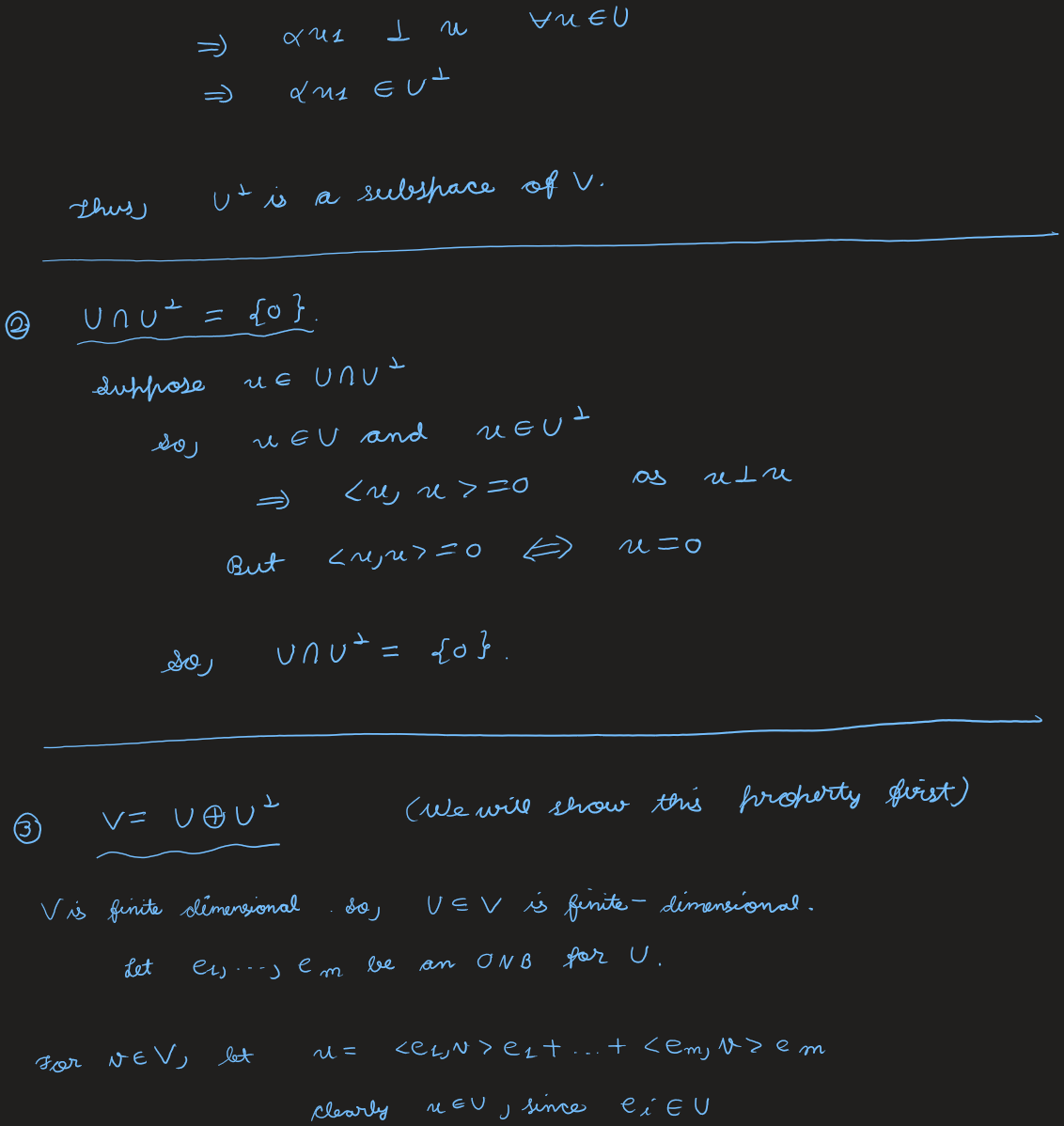
- Let \( \alpha \in \F \): \( \langle u, \alpha u_1\rangle = \alpha\langle u, u_1\rangle = 0 \Rightarrow \alpha u_1 \perp u \ \forall\, u \in U \Rightarrow \alpha u_1 \in U^{\perp} \).
Thus \( U^{\perp} \) is a subspace of \( V \).
(2) \( U \cap U^{\perp} = \{0\} \). Suppose \( u \in U \cap U^{\perp} \). Then \( u \in U \) and \( u \in U^{\perp} \Rightarrow \langle u, u\rangle = 0 \) (as \( u \perp u \)). But \( \langle u, u\rangle = 0 \iff u = 0 \). So \( U \cap U^{\perp} = \{0\} \).
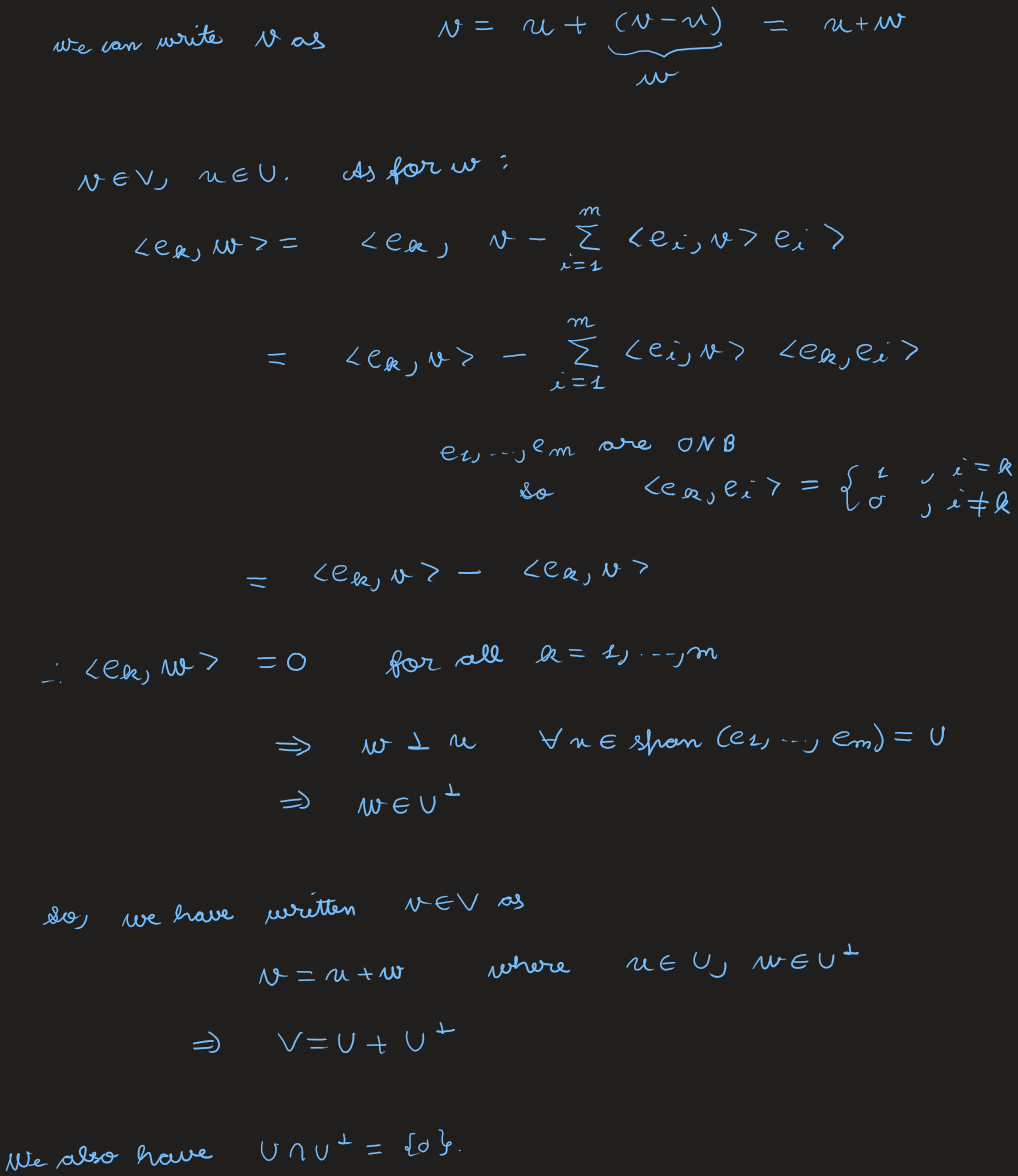
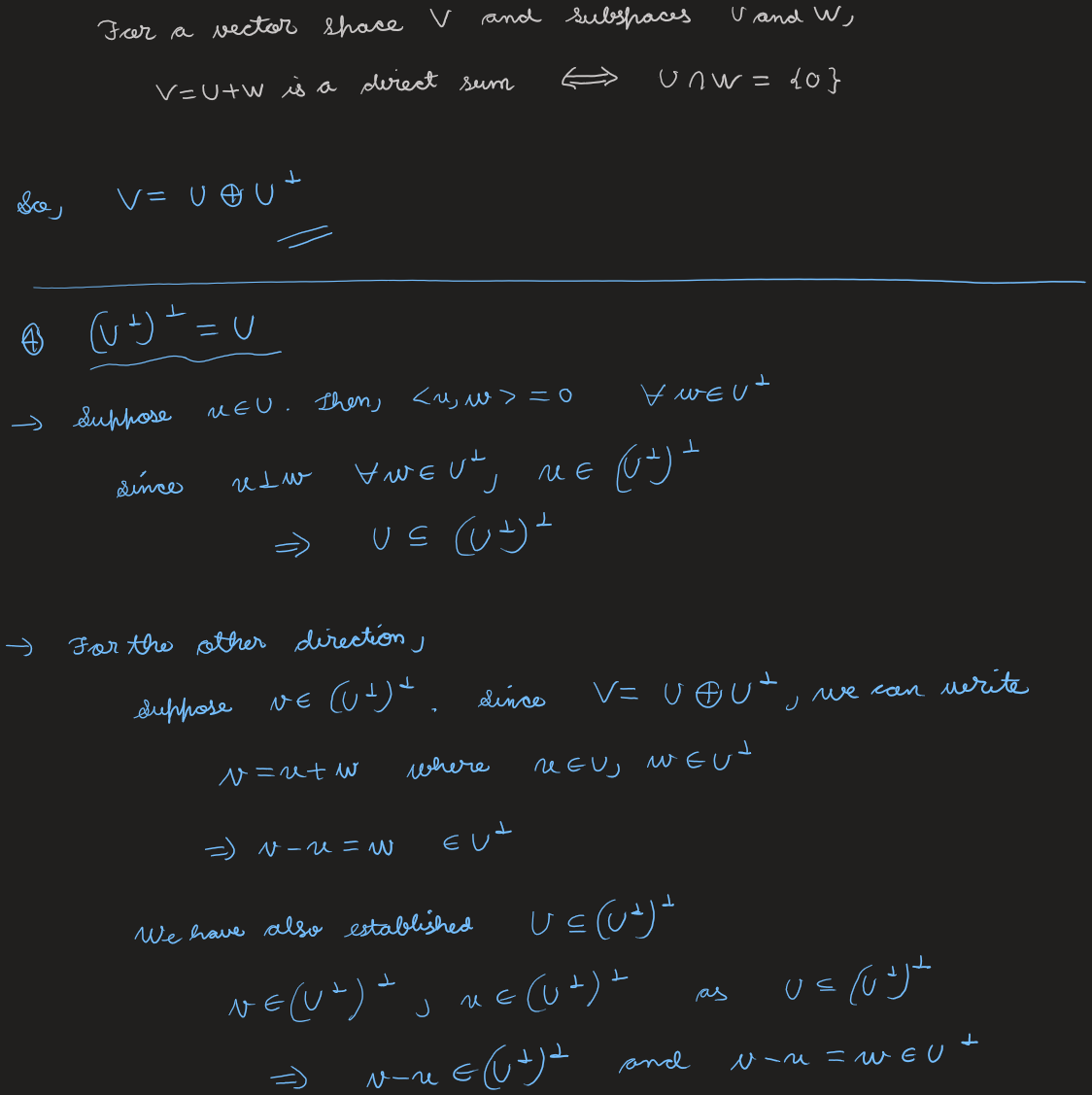
(3) \( V = U \oplus U^{\perp} \) (shown before the next part, since it is used there). \( V \) is finite-dimensional, so \( U \subseteq V \) is finite-dimensional. Let \( e_1, \dots, e_m \) be an ONB for \( U \). For \( v \in V \), let \( u = \langle e_1, v\rangle e_1 + \dots + \langle e_m, v\rangle e_m \). Clearly \( u \in U \) (since \( e_i \in U \)). Write \( v = u + (v - u) = u + w \) with \( w = v - u \). For \( w \), \[ \langle e_k, w\rangle = \Big\langle e_k,\ v - \sum_{i=1}^{m} \langle e_i, v\rangle e_i\Big\rangle = \langle e_k, v\rangle - \sum_{i=1}^{m} \langle e_i, v\rangle\langle e_k, e_i\rangle = \langle e_k, v\rangle - \langle e_k, v\rangle = 0 \] for all \( k = 1, \dots, m \) (using \( \langle e_k, e_i\rangle = \delta_{ik} \)). So \( w \perp u \ \forall\, u \in \operatorname{span}(e_1, \dots, e_m) = U \Rightarrow w \in U^{\perp} \). Thus every \( v \in V \) is \( v = u + w \) with \( u \in U \), \( w \in U^{\perp} \), giving \( V = U + U^{\perp} \). Combined with \( U \cap U^{\perp} = \{0\} \) (and recalling that \( V = U + W \) is a direct sum \( \iff U \cap W = \{0\} \)), we get \( V = U \oplus U^{\perp} \).
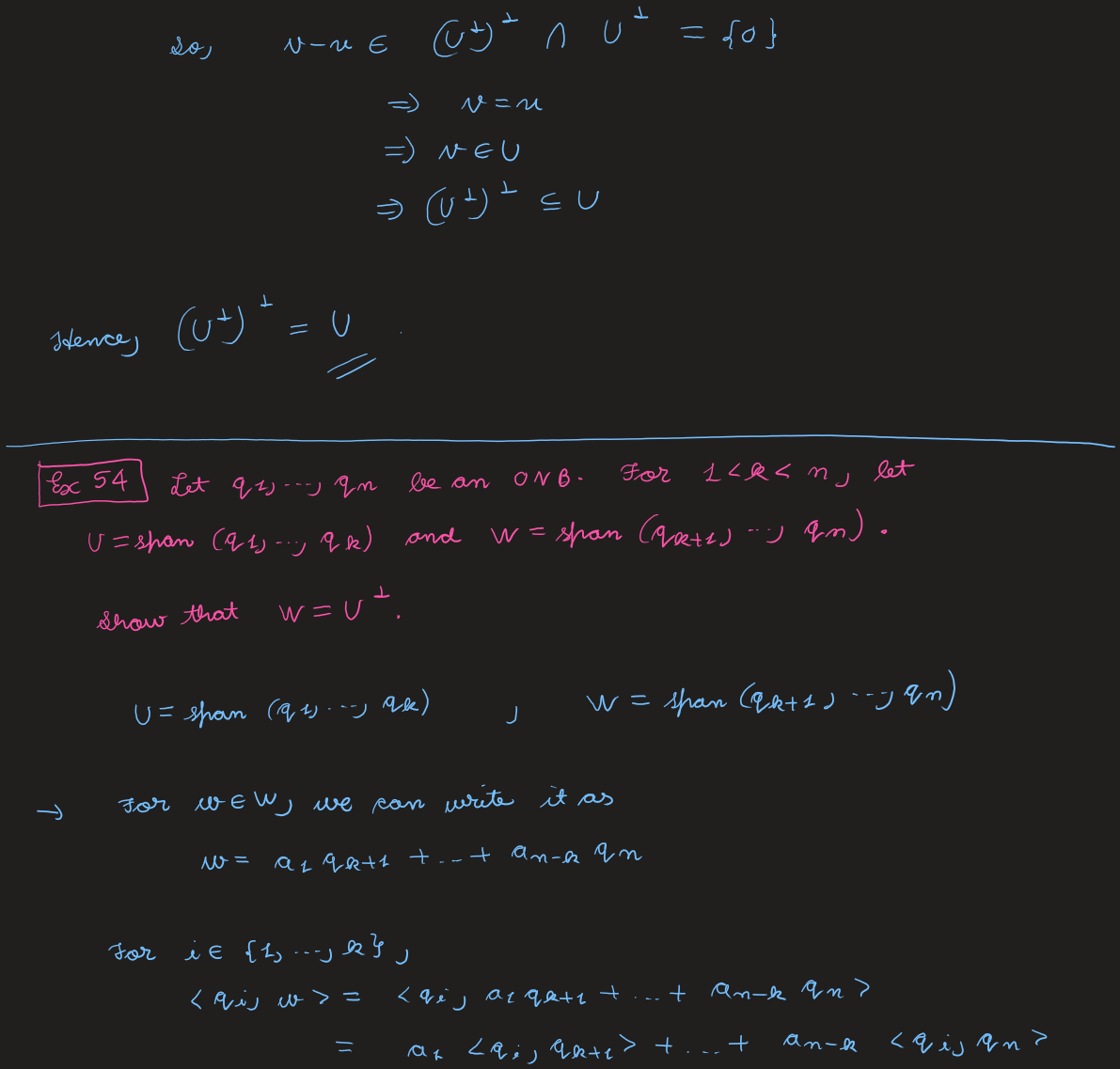
(4) \( (U^{\perp})^{\perp} = U \). Suppose \( u \in U \). Then \( \langle u, w\rangle = 0 \ \forall\, w \in U^{\perp} \), so \( u \perp w \ \forall\, w \in U^{\perp} \), i.e. \( u \in (U^{\perp})^{\perp} \). Hence \( U \subseteq (U^{\perp})^{\perp} \). For the other direction, suppose \( v \in (U^{\perp})^{\perp} \). Since \( V = U \oplus U^{\perp} \), write \( v = u + w \) with \( u \in U \), \( w \in U^{\perp} \), so \( v - u = w \in U^{\perp} \). Also \( v \in (U^{\perp})^{\perp} \) and \( u \in (U^{\perp})^{\perp} \) (as \( U \subseteq (U^{\perp})^{\perp} \)), so \( v - u \in (U^{\perp})^{\perp} \). Hence \( v - u \in (U^{\perp})^{\perp} \cap U^{\perp} = \{0\} \Rightarrow v = u \Rightarrow v \in U \), giving \( (U^{\perp})^{\perp} \subseteq U \). Therefore \( (U^{\perp})^{\perp} = U \).
Ex 54
Let \( q_1, \dots, q_n \) be an ONB. For \( 1 \le k \le n \) (scan: 1 < k < n), let \( U = \operatorname{span}(q_1, \dots, q_k) \) and \( W = \operatorname{span}(q_{k+1}, \dots, q_n) \). Show that \( W = U^{\perp} \).
Solution
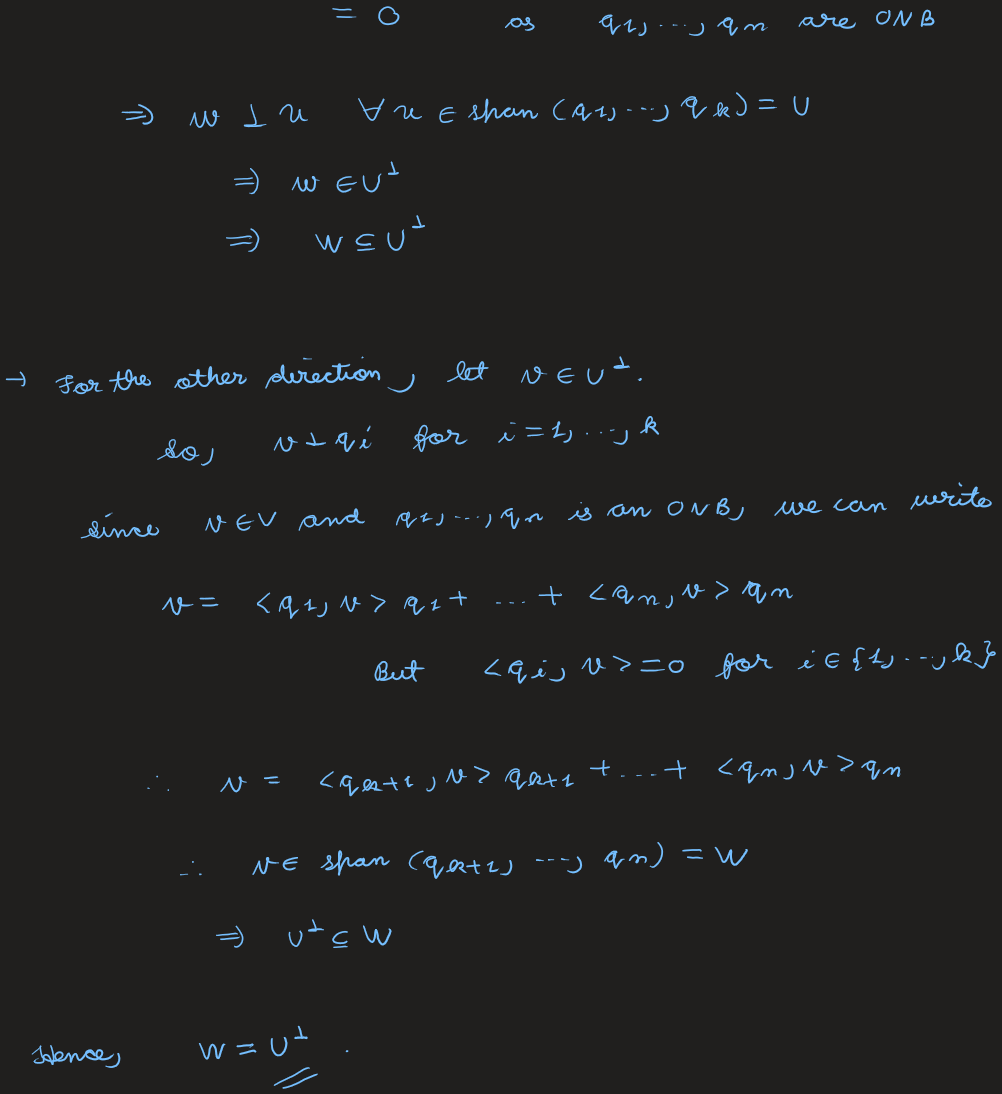
\( W \subseteq U^{\perp} \). For \( w \in W \), write \( w = a_1 q_{k+1} + \dots + a_{n-k} q_n \). For \( i \in \{1, \dots, k\} \), \[ \langle q_i, w\rangle = a_1\langle q_i, q_{k+1}\rangle + \dots + a_{n-k}\langle q_i, q_n\rangle = 0 \] as \( q_1, \dots, q_n \) is an ONB. So \( w \perp u \ \forall\, u \in \operatorname{span}(q_1, \dots, q_k) = U \Rightarrow w \in U^{\perp} \Rightarrow W \subseteq U^{\perp} \).
\( U^{\perp} \subseteq W \). Let \( v \in U^{\perp} \), so \( v \perp q_i \) for \( i = 1, \dots, k \). Since \( v \in V \) and \( q_1, \dots, q_n \) is an ONB, \( v = \langle q_1, v\rangle q_1 + \dots + \langle q_n, v\rangle q_n \). But \( \langle q_i, v\rangle = 0 \) for \( i \in \{1, \dots, k\} \), so \( v = \langle q_{k+1}, v\rangle q_{k+1} + \dots + \langle q_n, v\rangle q_n \), giving \( v \in \operatorname{span}(q_{k+1}, \dots, q_n) = W \). Hence \( U^{\perp} \subseteq W \). Therefore \( W = U^{\perp} \).
View original handwritten scans — orthogonal complement, Def 26, Ex 53–54 (pages 44–50)