Chapter 2 — Vector Spaces
Linear Algebra and its Applications · IISc 2024 · typeset reproduction
Vector Spaces
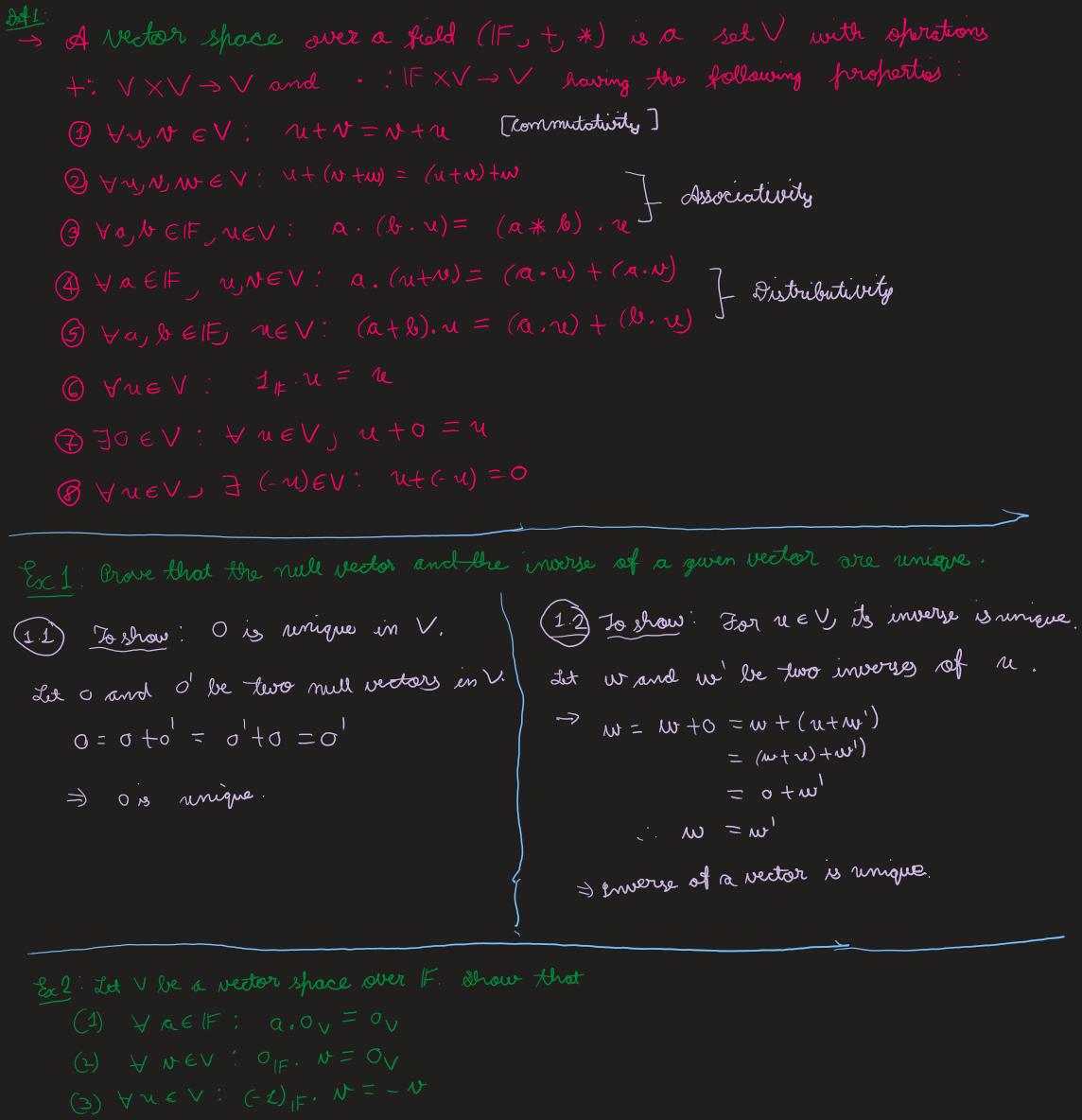
Definition 1 — Vector space
A vector space over a field \( (\F, +, \cdot) \) is a set \(V\) with addition \( + : V\times V \to V \) and scalar multiplication \( \cdot : \F\times V \to V \) satisfying, for all \( u, v, w \in V \) and \( \alpha, \beta \in \F \):
- \( u + v = v + u \) (commutativity);
- \( (u + v) + w = u + (v + w) \) (associativity);
- \( \exists\, 0_V \in V : v + 0_V = v \) (additive identity);
- \( \exists\, -v \in V : v + (-v) = 0_V \) (additive inverse);
- \( \alpha(u + v) = \alpha u + \alpha v \) and \( (\alpha + \beta)v = \alpha v + \beta v \) (distributivity);
- \( \alpha(\beta v) = (\alpha\beta)v \); and \( 1\cdot v = v \).
Ex 1
Show that the null vector and the inverse of a given vector are unique.
Solution
If \( 0 \) and \( 0' \) are both null vectors, \( 0 = 0 + 0' = 0' \). If \(w, w'\) are both inverses of \(v\), \( w = w + 0 = w + (v + w') = (w + v) + w' = 0 + w' = w' \).
Ex 2
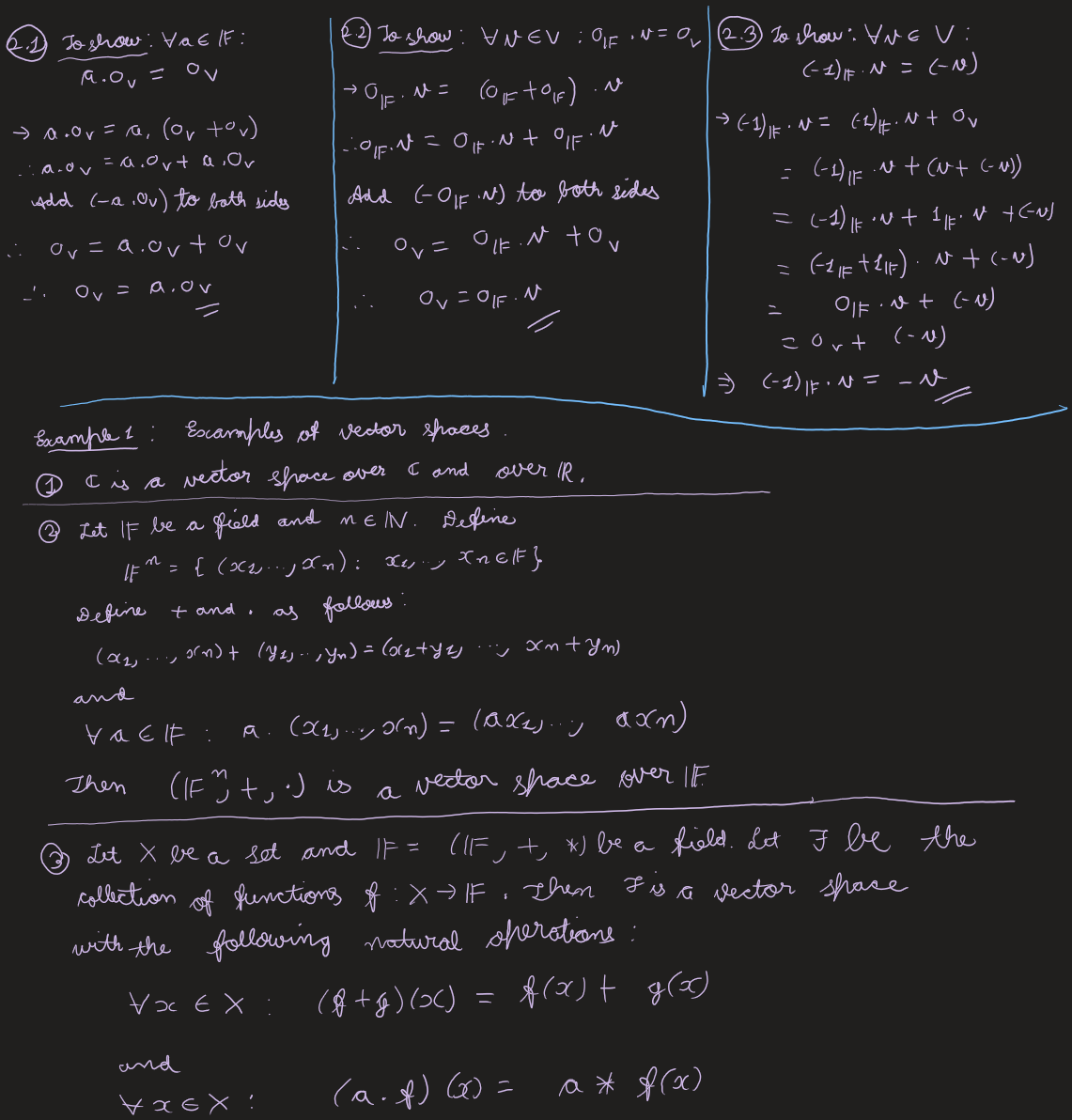
Let \(V\) be a vector space over \( \F \). Show that \( \alpha\,0_V = 0_V \), \( 0_\F\, v = 0_V \), and \( \alpha v = 0_V \Rightarrow \alpha = 0 \) or \( v = 0 \).
Solution
\( \alpha\,0_V = \alpha(0_V + 0_V) = \alpha\,0_V + \alpha\,0_V \), so \( \alpha\,0_V = 0_V \). Similarly \( 0_\F\,v = (0_\F + 0_\F)v = 0_\F v + 0_\F v \Rightarrow 0_\F v = 0_V \). If \( \alpha v = 0_V \) with \( \alpha \neq 0 \), then \( v = 1\cdot v = (\alpha^{-1}\alpha)v = \alpha^{-1}(\alpha v) = \alpha^{-1}0_V = 0_V \).
Solution — Ex 2(3), added in review
The instructor's Exercise 2(3) asks to show \( (-1)_\F\, v = -v \); the solution above instead proves the cancellation law, so we supply this part. Since \( (-1)v + v = (-1)v + 1\cdot v = \big((-1) + 1\big)v = 0_\F\, v = 0_V \) (using part 2), \( (-1)v \) is an additive inverse of \(v\); by uniqueness of inverses (Ex 1), \( (-1)v = -v \).
Examples of vector spaces
- \( \F \) is a vector space over \( \F \); more generally \( \F^n \).
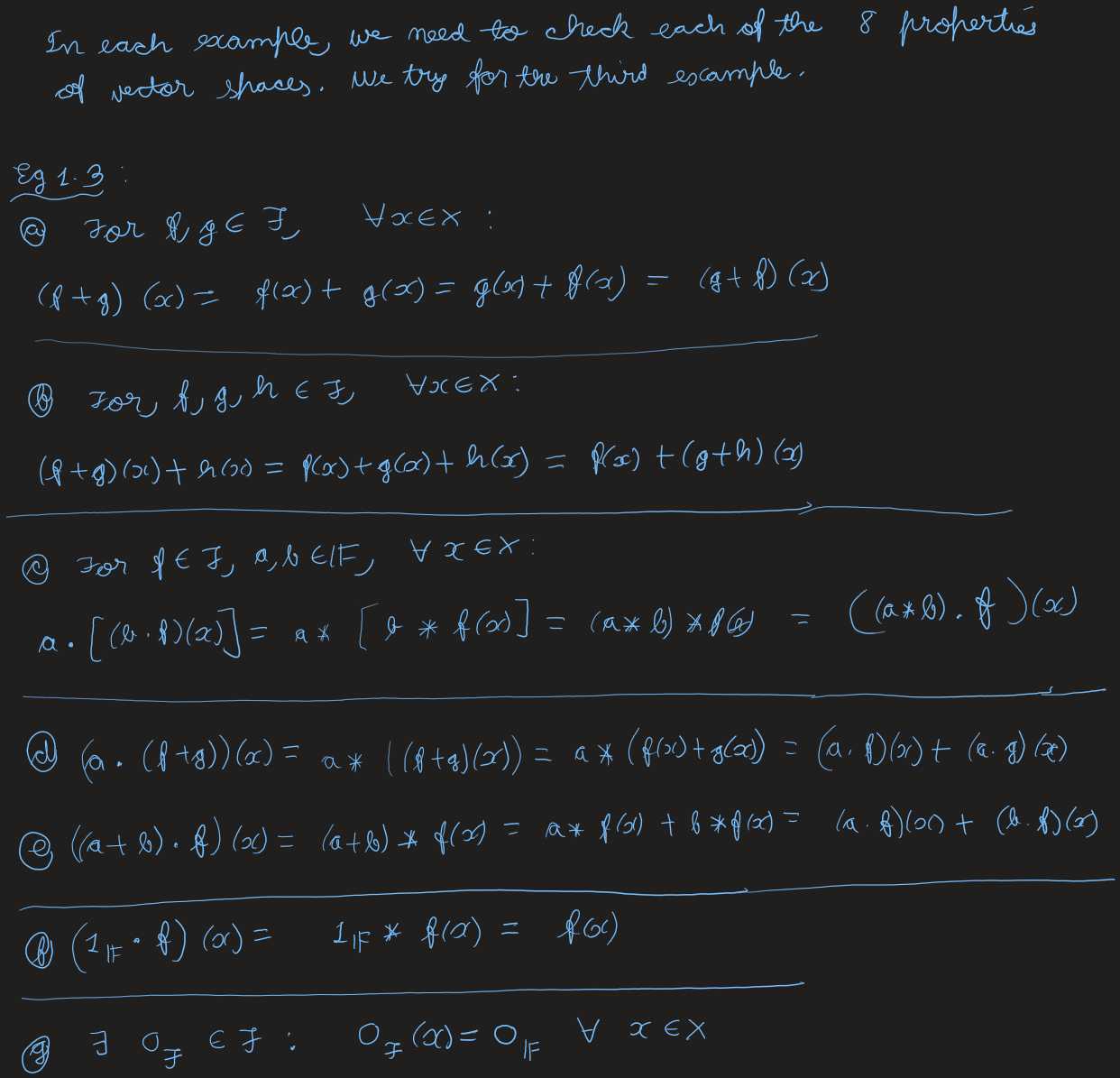
- For a set \(X\) and field-valued functions \( \mathcal{F} = \{ f : X \to \F \} \), with \( (f + g)(x) = f(x) + g(x) \) and \( (\alpha f)(x) = \alpha\,f(x) \), \( \mathcal{F} \) is a vector space (a function space).
Ex 3
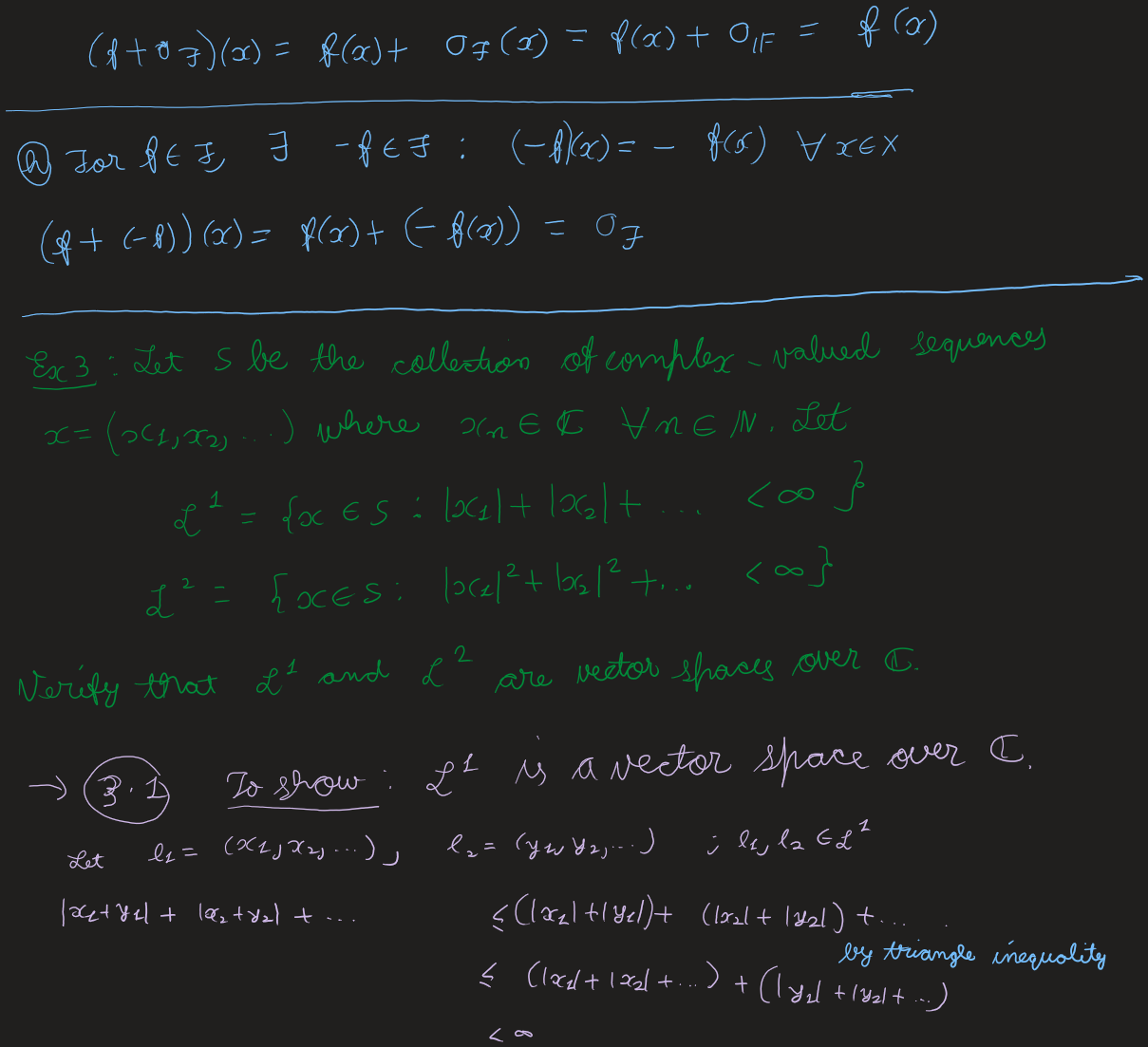
Verify the function space \( \mathcal{F} = \{ f : X \to \F \} \) is a vector space, and that the sequence spaces \( \ell^1 = \{ x \in S : \sum_n |x_n| < \infty \} \) and \( \ell^2 = \{ x \in S : \sum_n |x_n|^2 < \infty \} \) (where \( S \) is all complex sequences) are vector spaces over \( \C \).
Solution
Function space. Each of the eight axioms reduces pointwise to the field axioms; e.g. \( (f + g)(x) = f(x) + g(x) = g(x) + f(x) = (g + f)(x) \), the zero is \( 0_{\mathcal F}(x) = 0_\F \), and the inverse is \( (-f)(x) = -f(x) \).
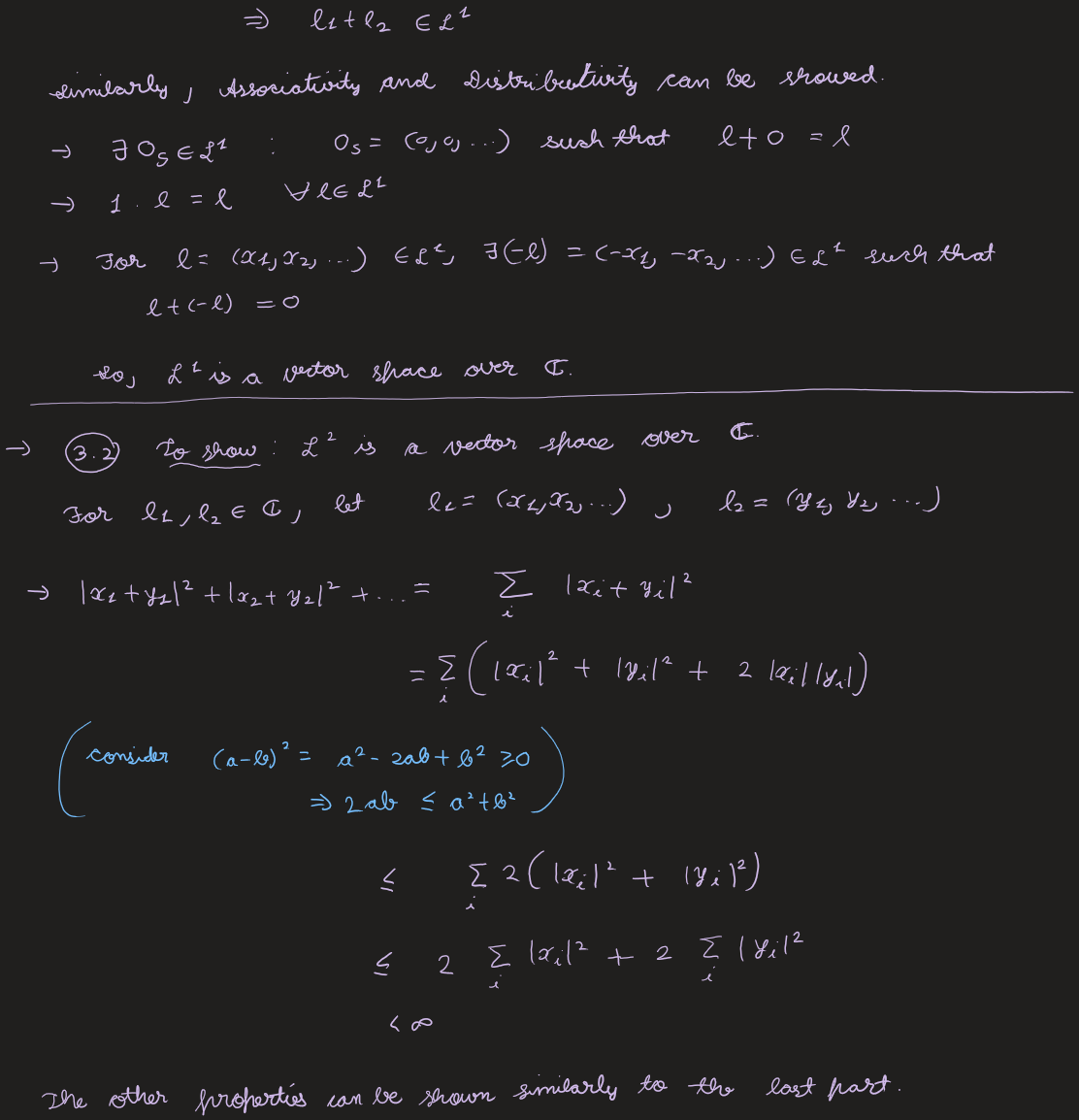
\( \ell^1 \). For \( \ell_1 = (x_n) \), \( \ell_2 = (y_n) \in \ell^1 \), the triangle inequality gives \( \sum_n |x_n + y_n| \le \sum_n |x_n| + \sum_n |y_n| < \infty \), so \( \ell_1 + \ell_2 \in \ell^1 \); the zero sequence and \( -\ell = (-x_n) \) lie in \( \ell^1 \). So \( \ell^1 \) is a vector space.
\( \ell^2 \). Using \( (a - b)^2 \ge 0 \Rightarrow 2ab \le a^2 + b^2 \), \( \sum_n |x_n + y_n|^2 = \sum_n(|x_n|^2 + |y_n|^2 + 2|x_n||y_n|) \le 2\sum_n|x_n|^2 + 2\sum_n|y_n|^2 < \infty \), so \( \ell^2 \) is a vector space.
Ex 4
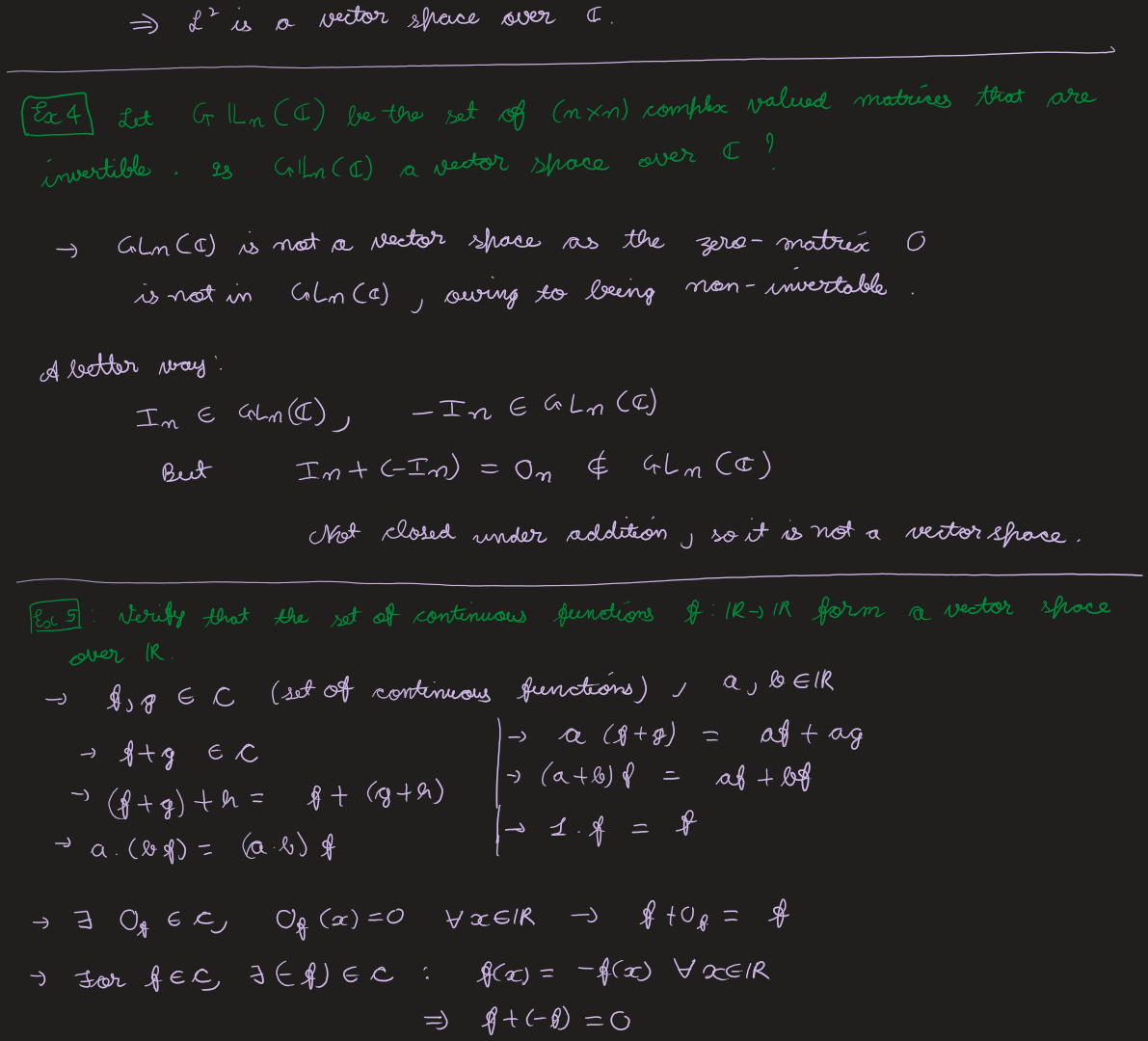
Is \( \mathrm{GL}_n(\C) \) (invertible \( n\times n \) complex matrices) a vector space over \( \C \)?
Solution
No. The zero matrix \(O\) is not in \( \mathrm{GL}_n(\C) \) (not invertible). Also \( I_n, -I_n \in \mathrm{GL}_n(\C) \) but \( I_n + (-I_n) = O \notin \mathrm{GL}_n(\C) \), so it is not closed under addition.
Ex 5
Verify that the set of continuous functions is a vector space over \( \R \).
Solution
Sums and scalar multiples of continuous functions are continuous, so the set is closed under both operations; the axioms hold pointwise, the zero is the zero function, and \( -f \) is the inverse.
View original handwritten scans — Vector spaces, Ex 1–5 (pages 1–6)
Subspaces
Definition 2 — Subspace
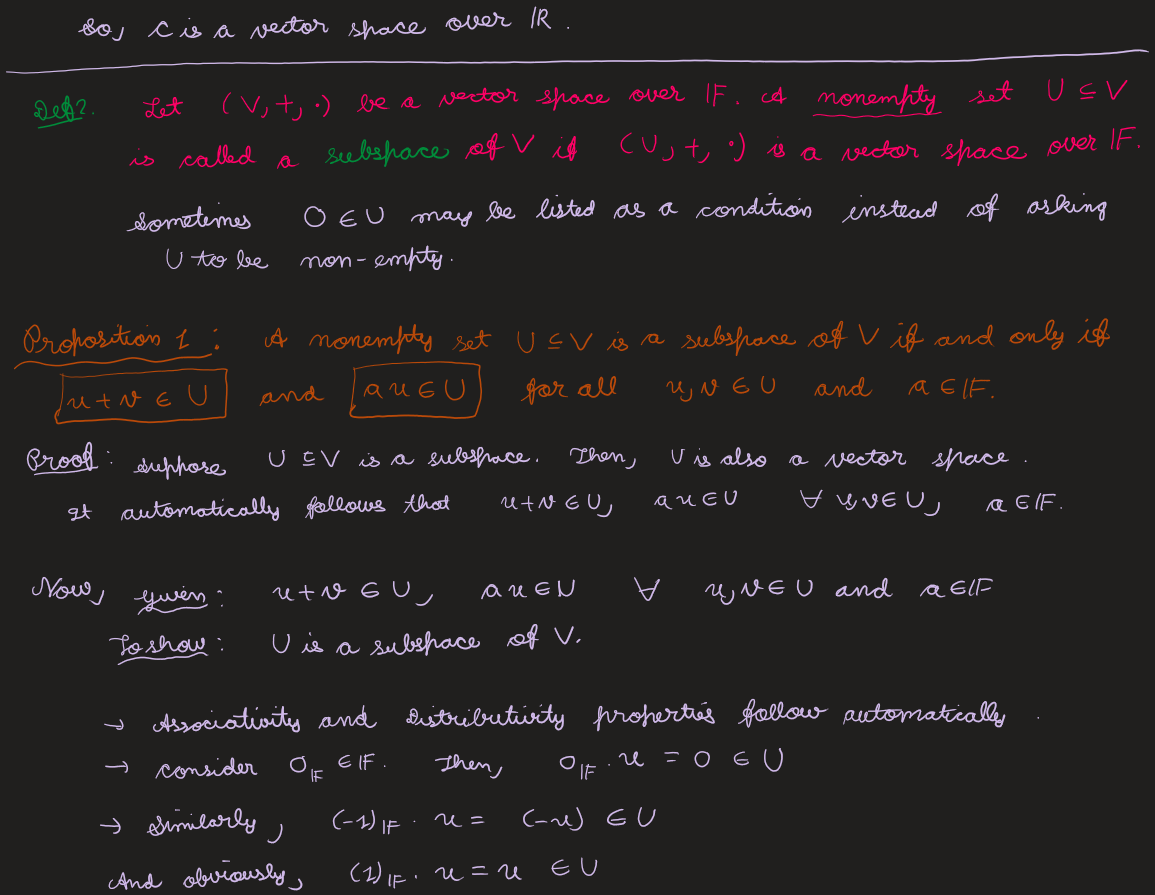
A non-empty set \( U \subseteq V \) is a subspace of \(V\) if \( (U, +, \cdot) \) is itself a vector space over \( \F \).
Proposition 1 — Subspace test
A non-empty \( U \subseteq V \) is a subspace iff \( u + v \in U \) and \( \alpha u \in U \) for all \( u, v \in U \), \( \alpha \in \F \).
Proof
If \(U\) is a subspace it is closed under both operations. Conversely, closure under scalar multiplication gives \( 0_V = 0\cdot u \in U \) and \( -u = (-1)u \in U \), and the remaining axioms are inherited from \(V\). So it suffices to check the two closure conditions rather than all eight axioms.
Examples of subspaces
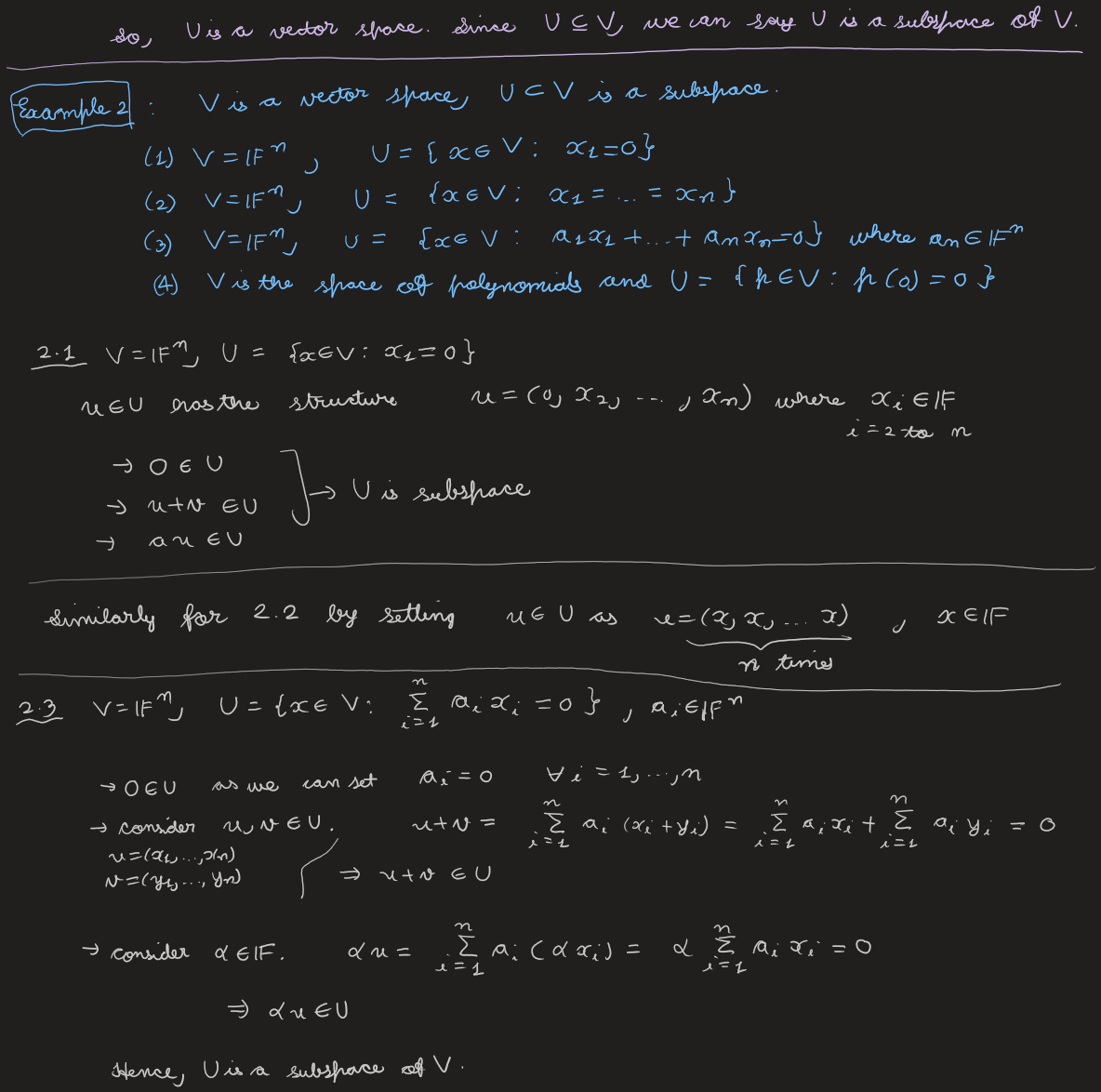
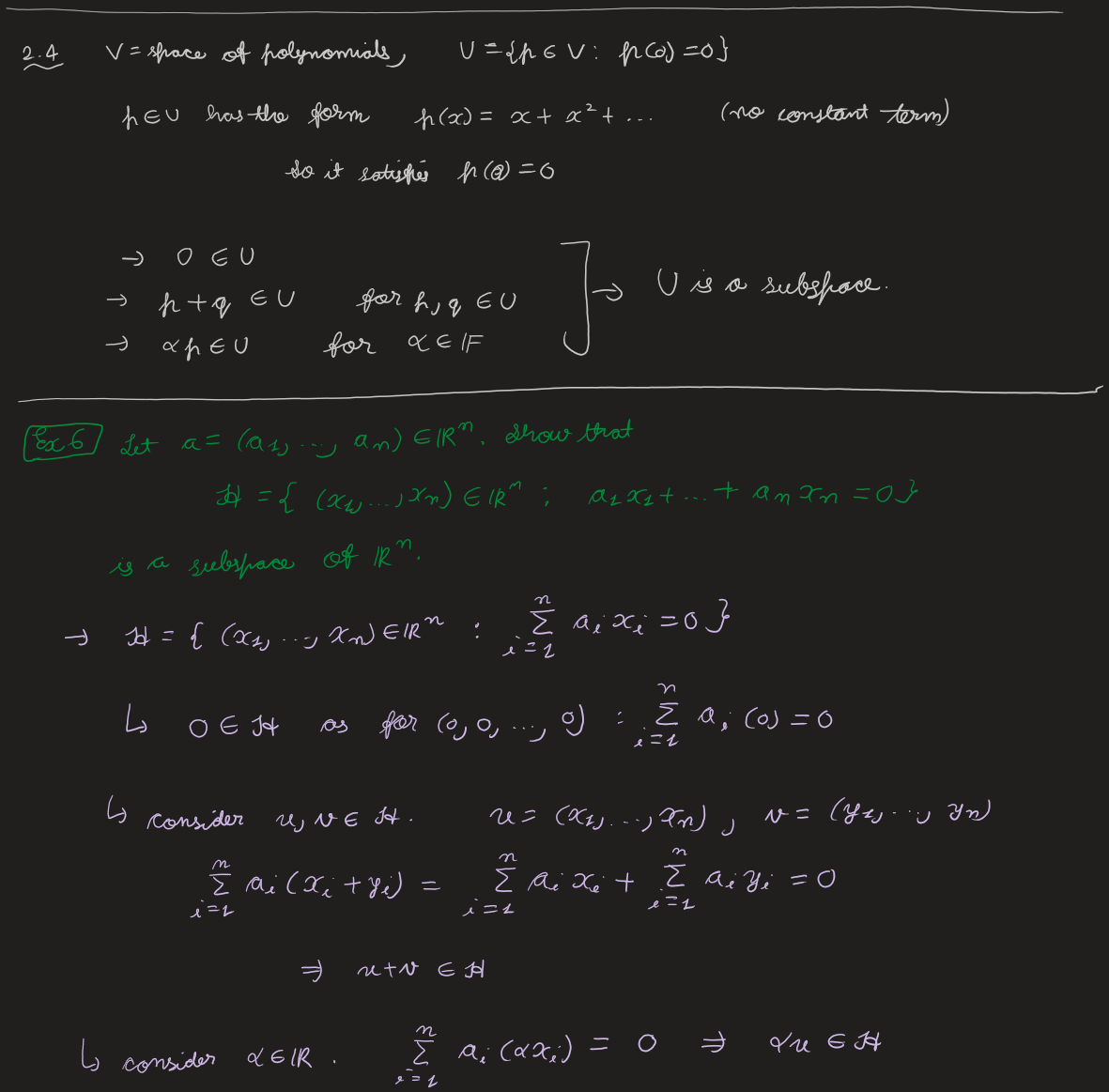
\( V \) itself and \( \{0_V\} \); for \( V = \F^n \), sets like \( \{x : x_1 = x_n\} \); and for \( V \) the space of polynomials, \( U = \{ h : h(0) = 0 \} \) (no constant term), which contains \(0\) and is closed under \(+\) and scalar multiplication.
Ex 6
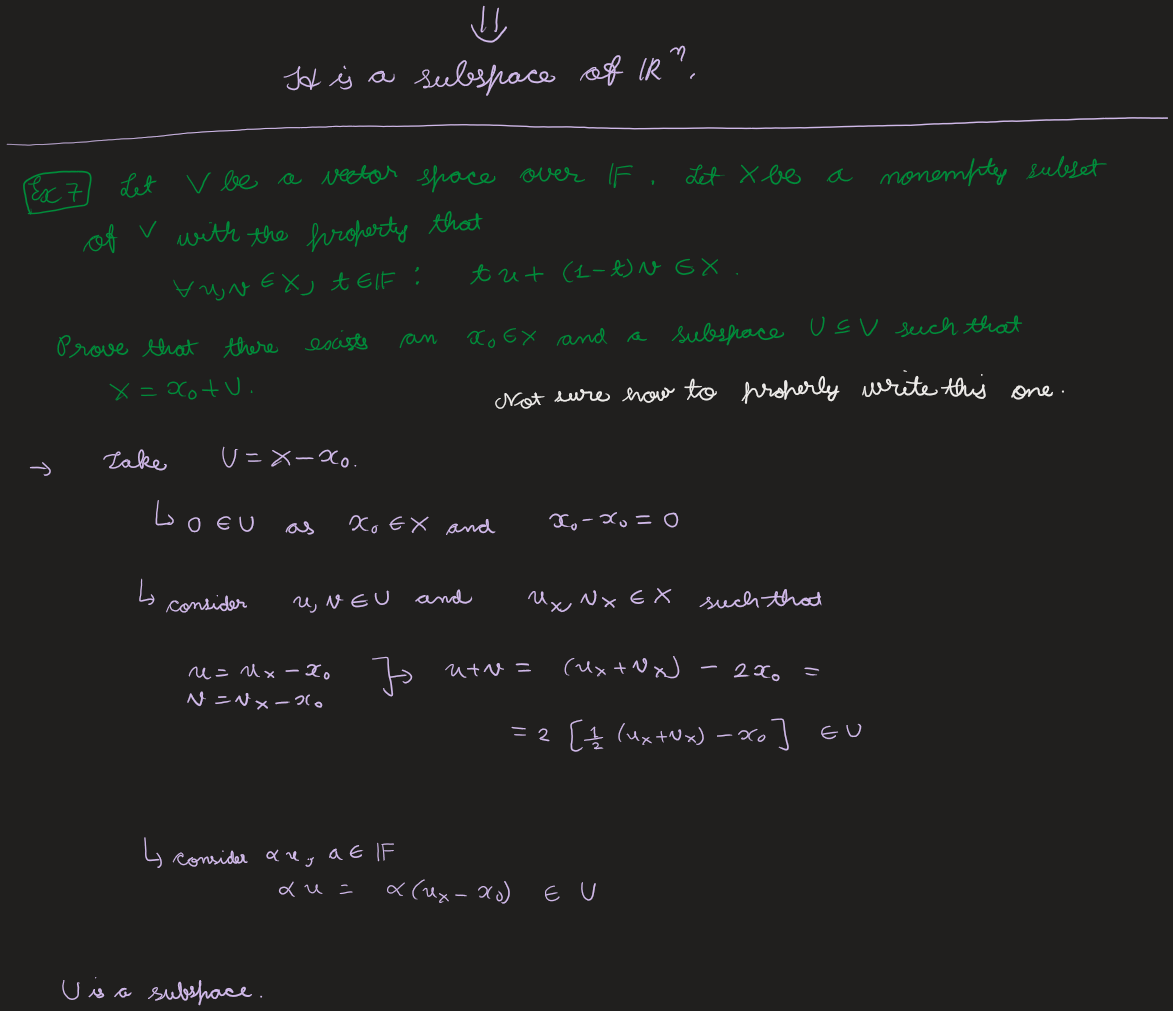
Let \( a = (a_1, \dots, a_n) \in \R^n \). Show that \( H = \{ (x_1, \dots, x_n) \in \R^n : a_1 x_1 + \dots + a_n x_n = 0 \} \) is a subspace of \( \R^n \).
Solution
\( 0 \in H \) since \( \sum_i a_i\cdot 0 = 0 \). For \( u = (x_i), v = (y_i) \in H \), \( \sum_i a_i(x_i + y_i) = \sum_i a_i x_i + \sum_i a_i y_i = 0 \), so \( u + v \in H \); and \( \sum_i a_i(\alpha x_i) = \alpha\sum_i a_i x_i = 0 \), so \( \alpha u \in H \). Hence \(H\) is a subspace.
Ex 7
Let \(V\) be a vector space over \( \F \) and \(X\) a non-empty subset with \( tu + (1 - t)v \in X \) for all \( u, v \in X \), \( t \in \F \). Prove there is an \( x_0 \in X \) and a subspace \( U \subseteq V \) with \( X = x_0 + U \).
Solution
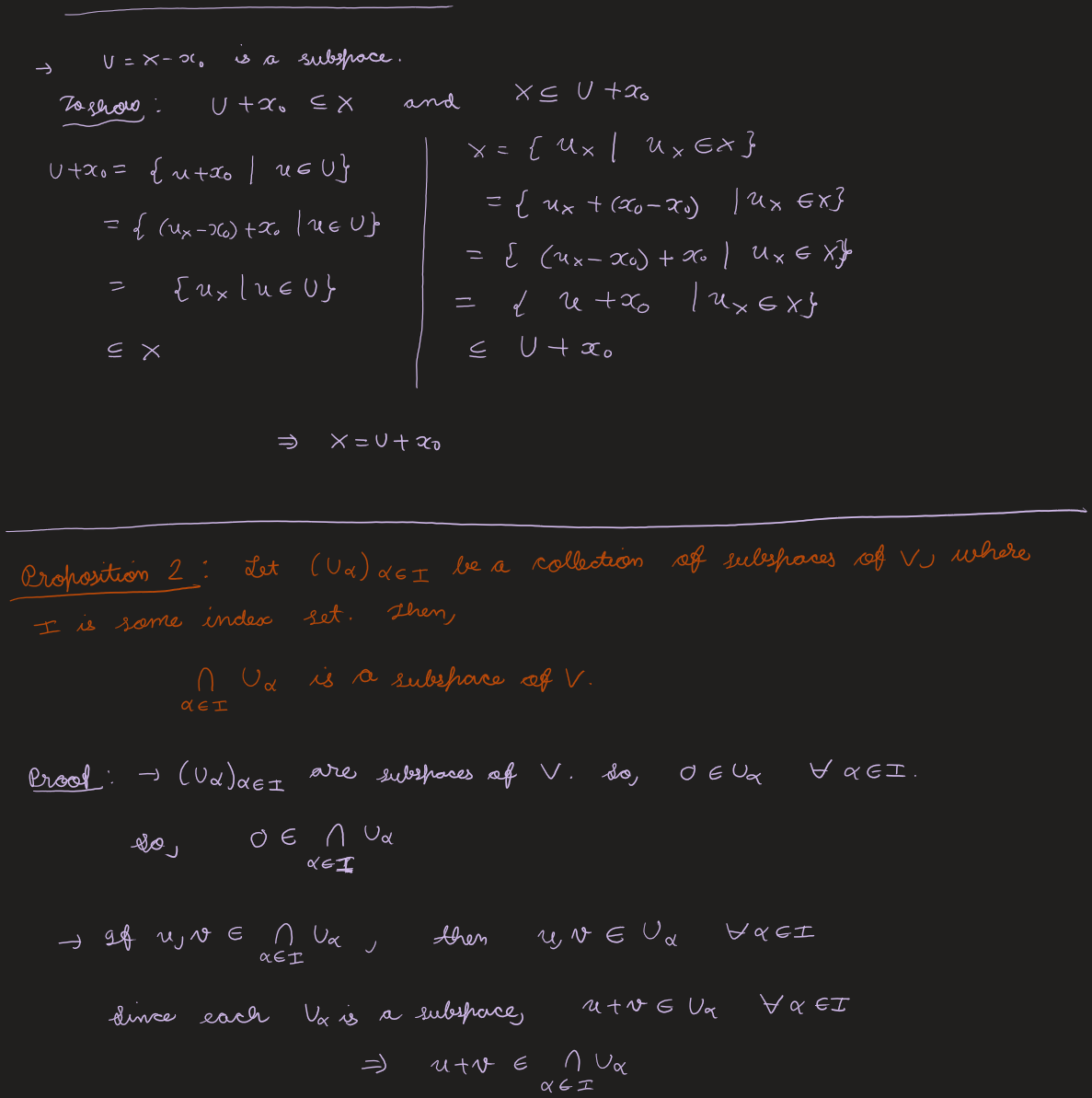
Take \( U = X - x_0 \) (any \( x_0 \in X \)). Then \( 0 = x_0 - x_0 \in U \). For \( u = u_x - x_0, v = v_x - x_0 \in U \), \( u + v = (u_x + v_x) - 2x_0 = 2\big[\tfrac12(u_x + v_x) - x_0\big] \in U \) (using the given closure with \( t = \tfrac12 \)), and \( \alpha u = \alpha(u_x - x_0) \in U \). So \(U\) is a subspace, and \( X = U + x_0 \) follows since \( U + x_0 = \{ u_x : u_x \in X \} = X \).
Proposition 2
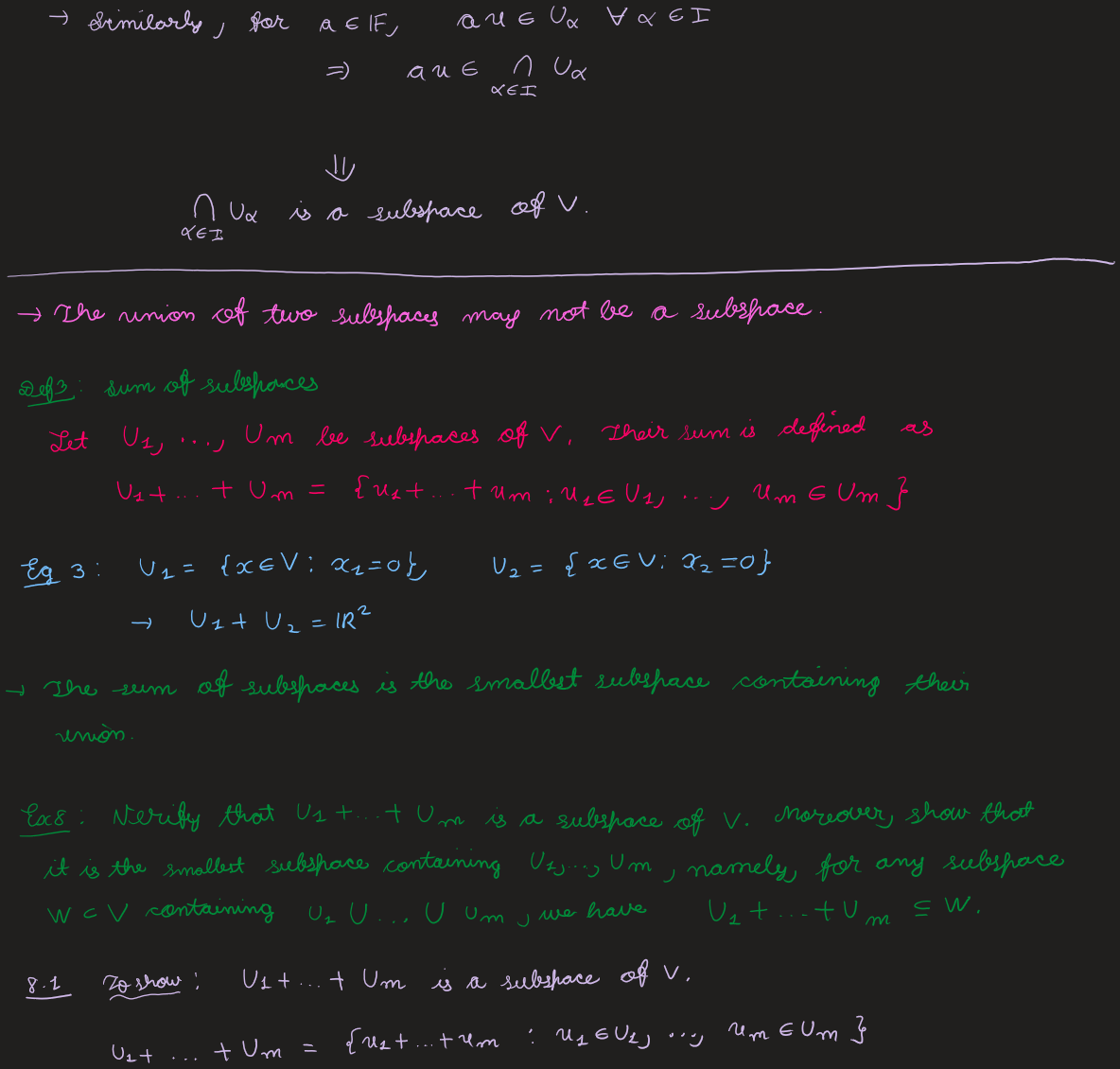
Let \( (U_\alpha)_{\alpha\in I} \) be a collection of subspaces of \(V\). Then \( \bigcap_{\alpha\in I} U_\alpha \) is a subspace of \(V\). (The union of two subspaces need not be a subspace.)
Proof
\( 0 \in U_\alpha \ \forall\,\alpha \), so \( 0 \in \bigcap_\alpha U_\alpha \). If \( u, v \in \bigcap_\alpha U_\alpha \) then \( u, v \in U_\alpha \) for every \( \alpha \), so \( u + v \in U_\alpha \) and \( \alpha' u \in U_\alpha \) for every \( \alpha \); hence both lie in \( \bigcap_\alpha U_\alpha \).
Definition 3 — Sum of subspaces
For subspaces \( U_1, \dots, U_m \) of \(V\), \( U_1 + \dots + U_m = \{ u_1 + \dots + u_m : u_i \in U_i \} \). E.g. with \( U_1 = \{x : x_1 = 0\} \), \( U_2 = \{x : x_2 = 0\} \) in \( \R^2 \), \( U_1 + U_2 = \R^2 \).
Ex 8
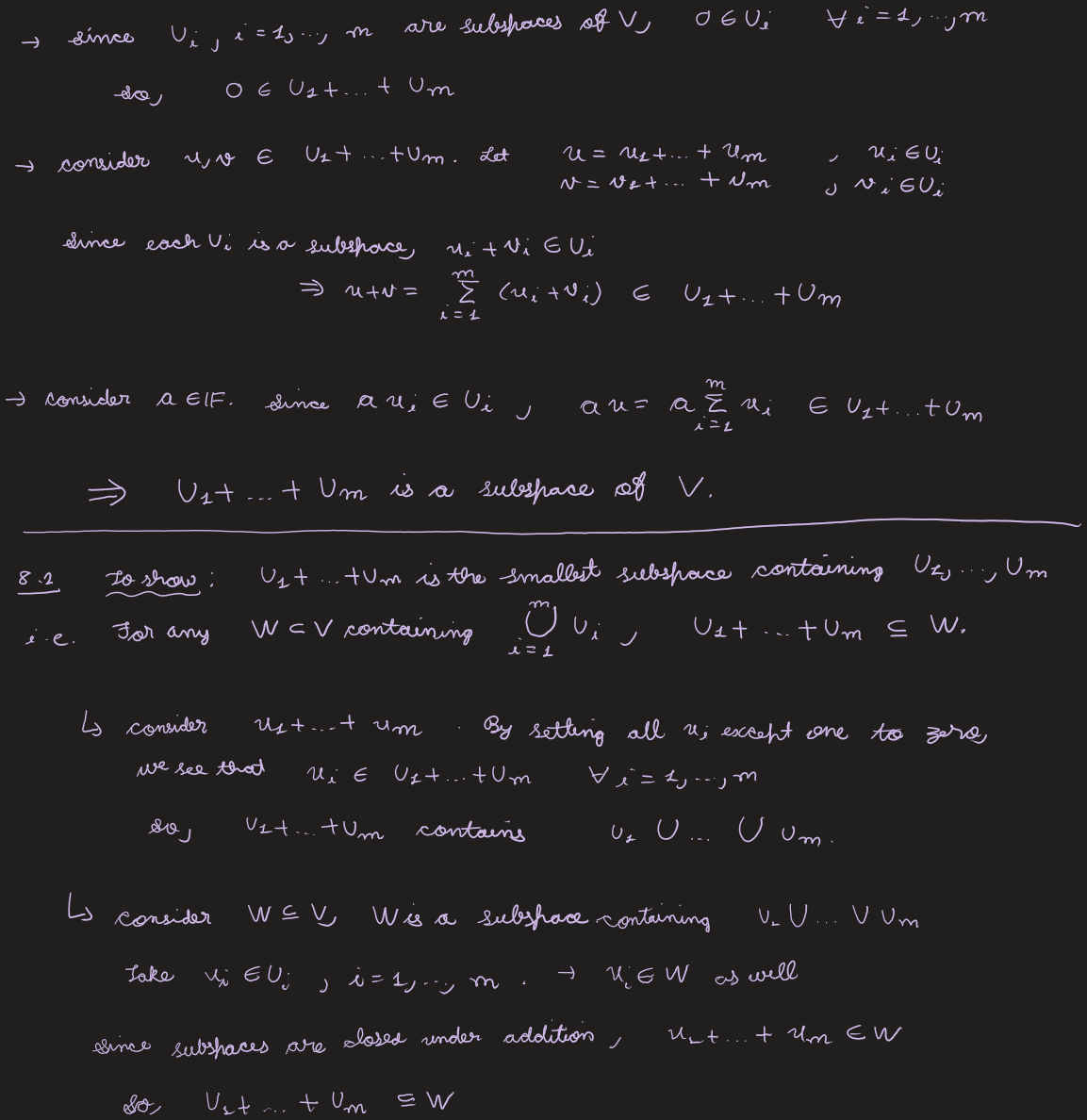
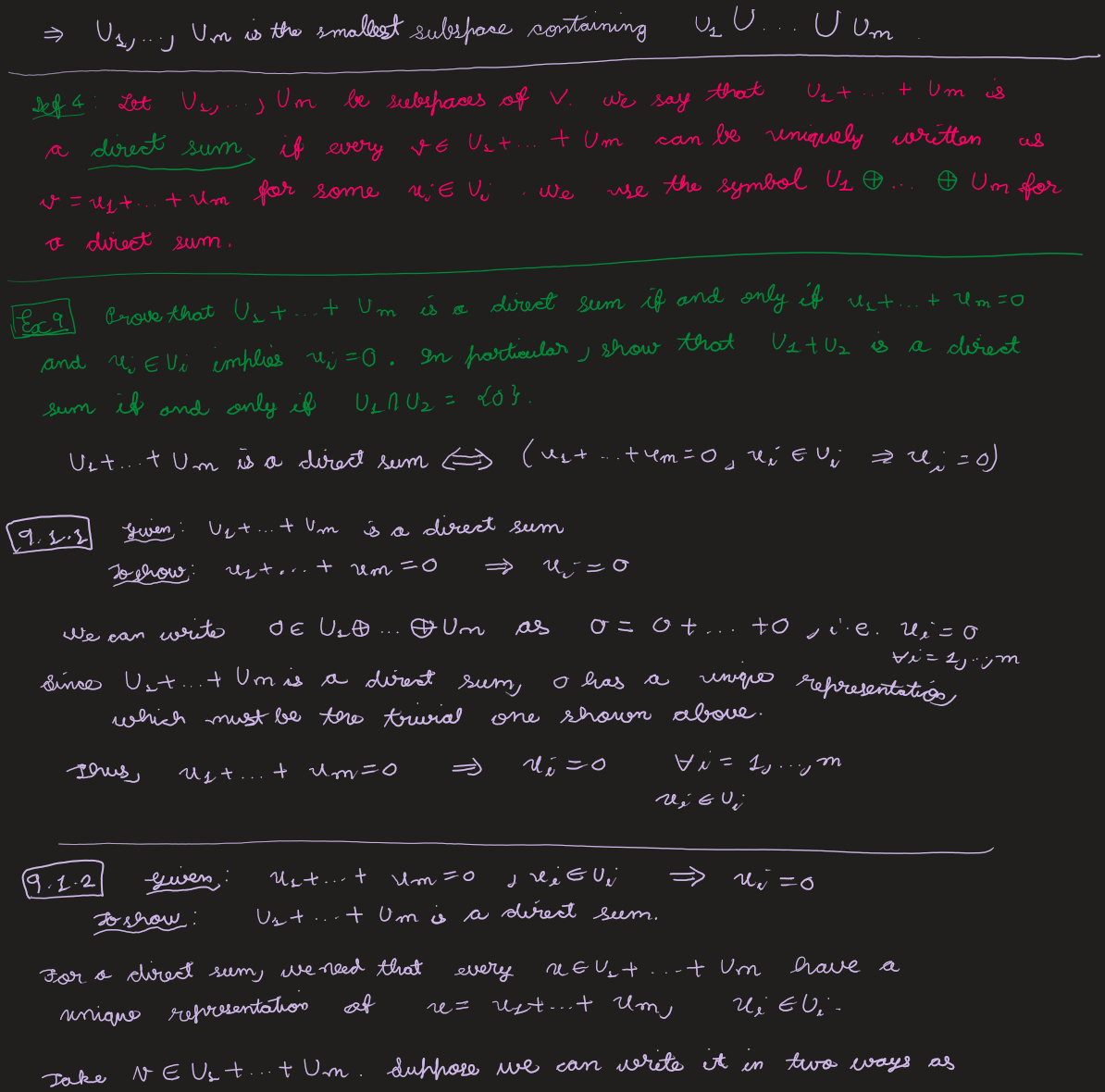
Verify that \( U_1 + \dots + U_m \) is a subspace, and that it is the smallest subspace containing \( U_1 \cup \dots \cup U_m \): for any subspace \( W \) containing the union, \( U_1 + \dots + U_m \subseteq W \).
Solution
It contains \(0\) and is closed under \(+\) and scalar multiplication (componentwise in each \(U_i\)), so it is a subspace. If \(W\) is a subspace containing each \(U_i\), then any \( u_1 + \dots + u_m \) (with \( u_i \in U_i \subseteq W \)) lies in \(W\) by closure; hence \( U_1 + \dots + U_m \subseteq W \).
View original handwritten scans — Subspaces, Ex 6–8 (pages 7–13)
Direct Sums
Definition 4 — Direct sum
\( U_1 + \dots + U_m \) is a direct sum, written \( U_1 \oplus \dots \oplus U_m \), if every element has a unique representation \( v = u_1 + \dots + u_m \) (\( u_i \in U_i \)); equivalently, \( u_1 + \dots + u_m = 0 \Rightarrow u_1 = \dots = u_m = 0 \).
Ex 9
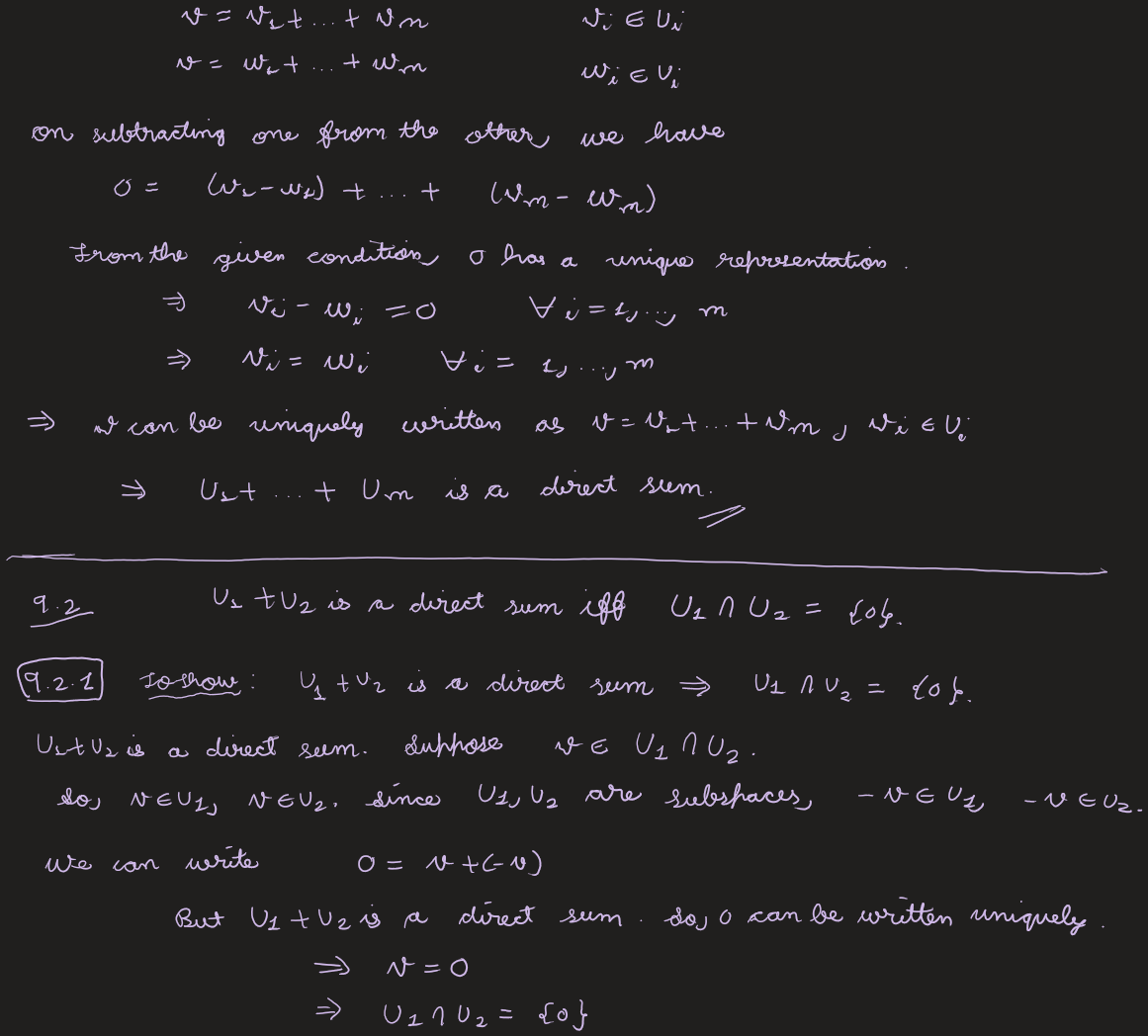
(9.1) Show \( U_1 + \dots + U_m \) is a direct sum iff \( 0 \) has a unique representation \( 0 = u_1 + \dots + u_m \), \( u_i \in U_i \). (9.2) Show \( U_1 + U_2 \) is a direct sum iff \( U_1 \cap U_2 = \{0\} \).
Solution
(9.1) If the sum is direct, \(0\) has the unique representation \( 0 = 0 + \dots + 0 \). Conversely, if \( v = \sum u_i = \sum w_i \) are two representations, subtracting gives \( 0 = \sum(u_i - w_i) \); by uniqueness for \(0\), \( u_i = w_i \), so the representation of every \(v\) is unique.
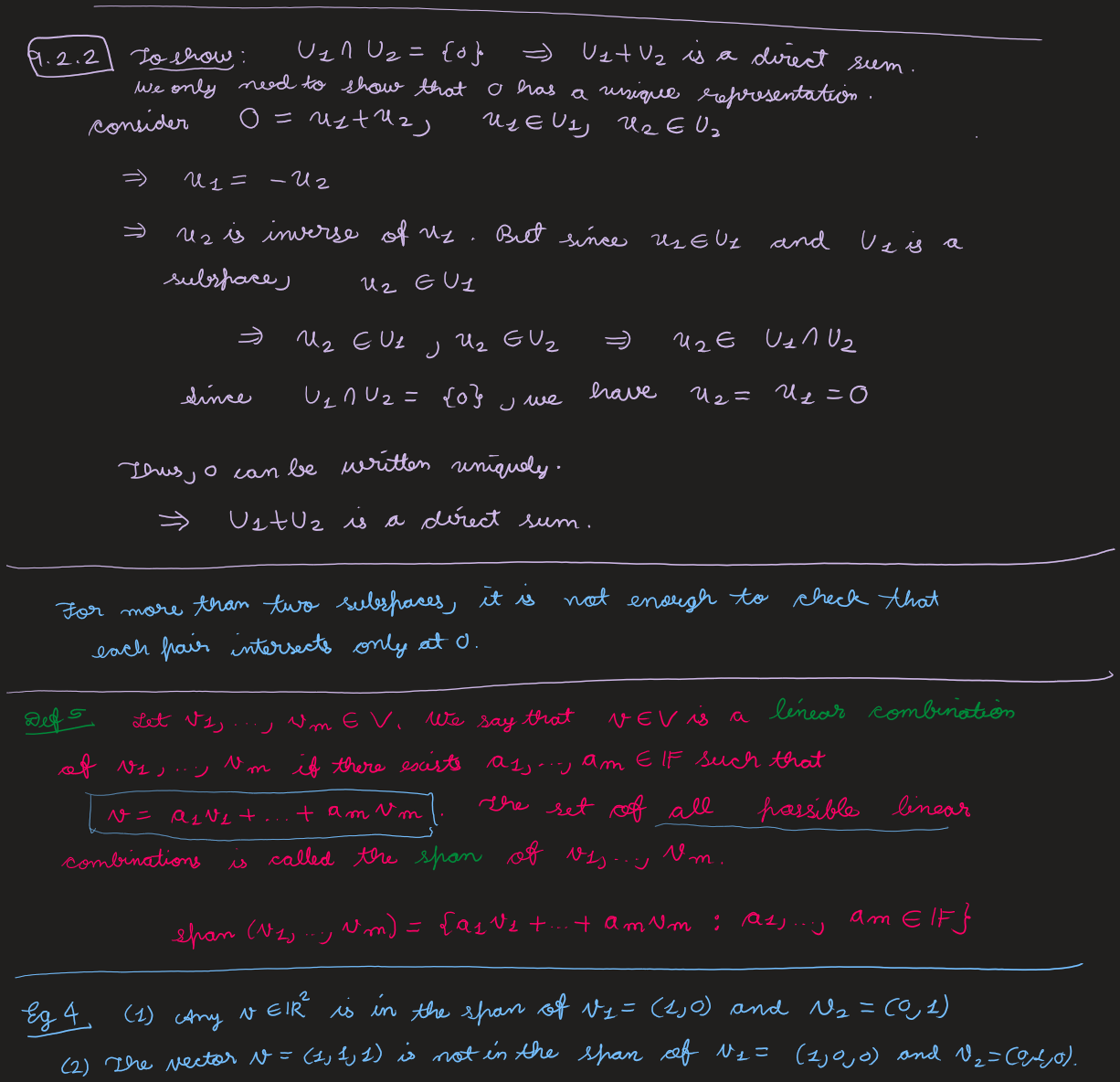
(9.2) If \( U_1 + U_2 \) is direct and \( v \in U_1 \cap U_2 \), then \( v \in U_1 \), \( -v \in U_2 \), and \( 0 = v + (-v) \); uniqueness forces \( v = 0 \), so \( U_1 \cap U_2 = \{0\} \). Conversely, if \( U_1 \cap U_2 = \{0\} \) and \( u_1 + u_2 = 0 \) (\( u_i \in U_i \)), then \( u_1 = -u_2 \in U_1 \cap U_2 = \{0\} \), so \( u_1 = u_2 = 0 \).
View original handwritten scans — Direct sums, Ex 9 (pages 14–16)
Span & Linear Independence
Definition 5 — Span
\( \operatorname{span}(v_1, \dots, v_m) = \{ a_1 v_1 + \dots + a_m v_m : a_i \in \F \} \), the set of all linear combinations.
Ex 10
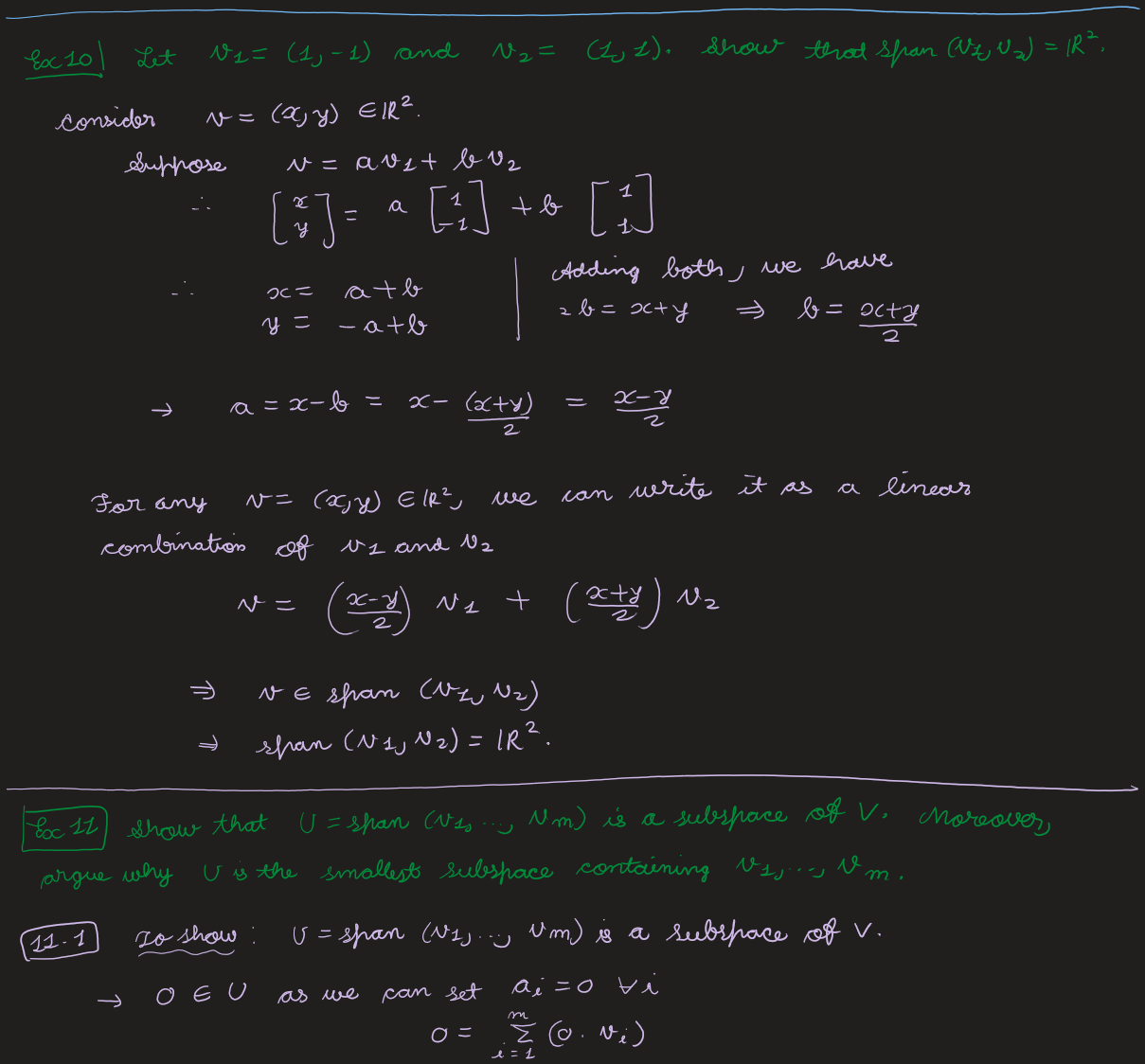
Let \( v_1 = (1, -1) \) and \( v_2 = (1, 1) \). Show \( \operatorname{span}(v_1, v_2) = \R^2 \).
Solution
For \( v = (x, y) \), solving \( v = a v_1 + b v_2 \) gives \( x = a + b \), \( y = -a + b \), so \( b = \tfrac{x + y}{2} \), \( a = \tfrac{x - y}{2} \). Hence any \( (x, y) = \tfrac{x-y}{2}v_1 + \tfrac{x+y}{2}v_2 \in \operatorname{span}(v_1, v_2) \), so \( \operatorname{span}(v_1, v_2) = \R^2 \).
Ex 11
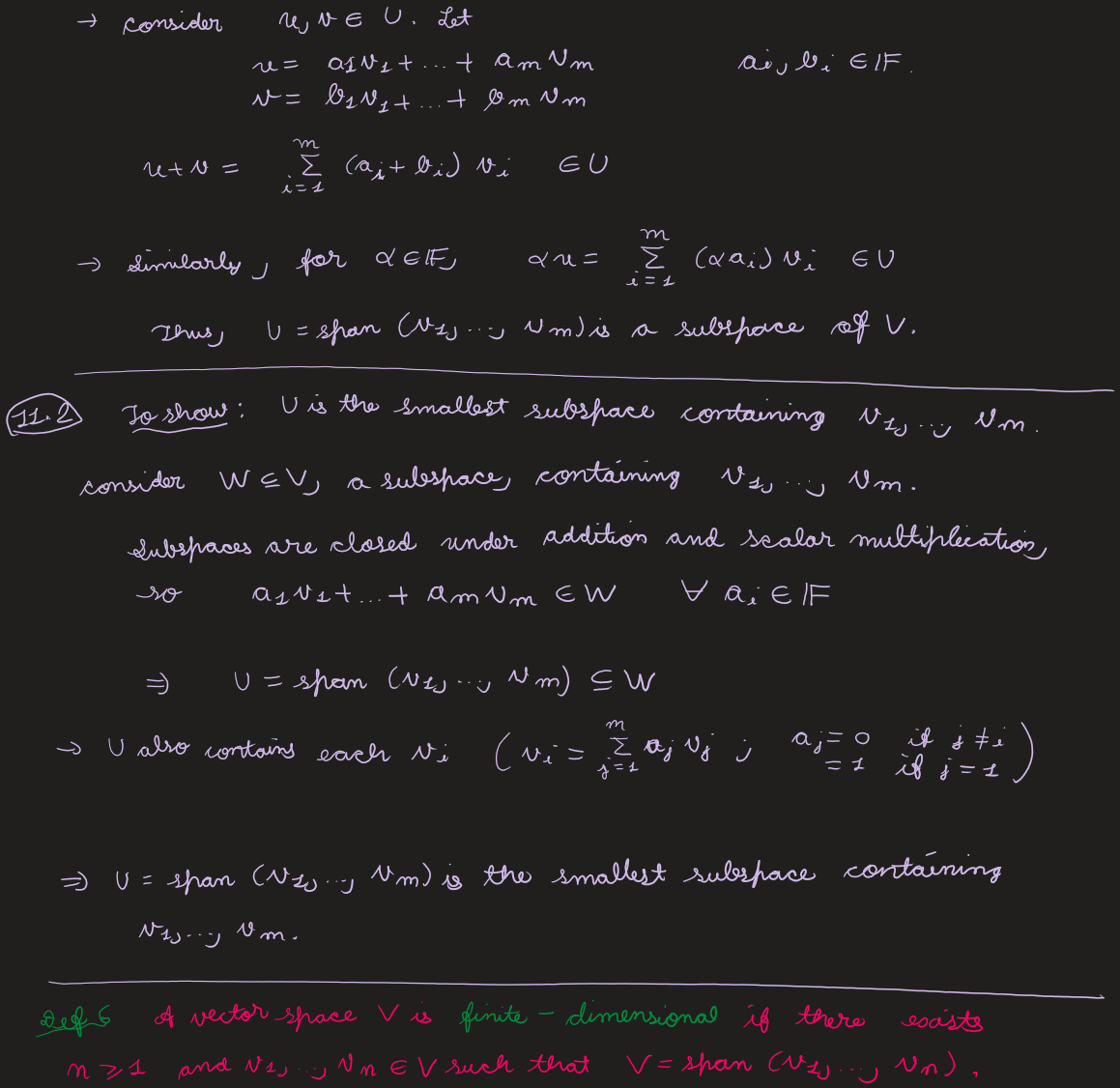
Show \( U = \operatorname{span}(v_1, \dots, v_m) \) is a subspace of \(V\), and is the smallest subspace containing \( v_1, \dots, v_m \).
Solution
\( 0 = \sum_i 0\cdot v_i \in U \); sums and scalar multiples of linear combinations are linear combinations, so \(U\) is a subspace. Any subspace \( W \) containing all \( v_i \) must (by closure) contain every \( \sum a_i v_i \), so \( U \subseteq W \); thus \(U\) is the smallest such subspace.
Definition 6 — Finite-dimensional vector space
A vector space \( V \) is finite-dimensional if there exist \( v_1, \dots, v_n \in V \) with \( V = \operatorname{span}(v_1, \dots, v_n) \). A vector space that is not finite-dimensional is infinite-dimensional.
Example 5 — Finite-dimensional spaces
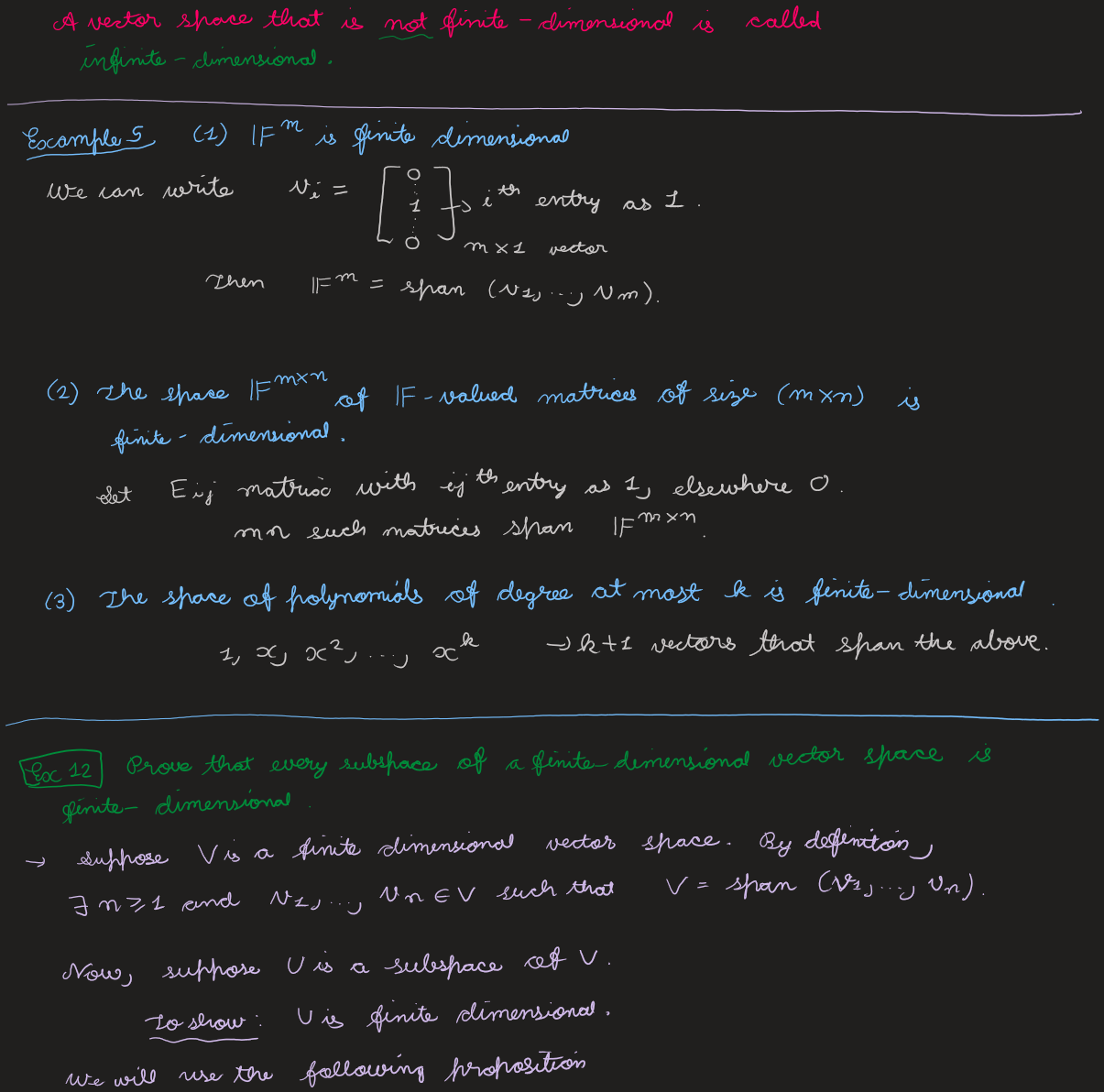
\( \F^n \), the matrix space \( \F^{m\times n} \), and the polynomials of degree at most \(k\) are all finite-dimensional.
Ex 12
Prove that every subspace of a finite-dimensional vector space is finite-dimensional.
Solution — added in review
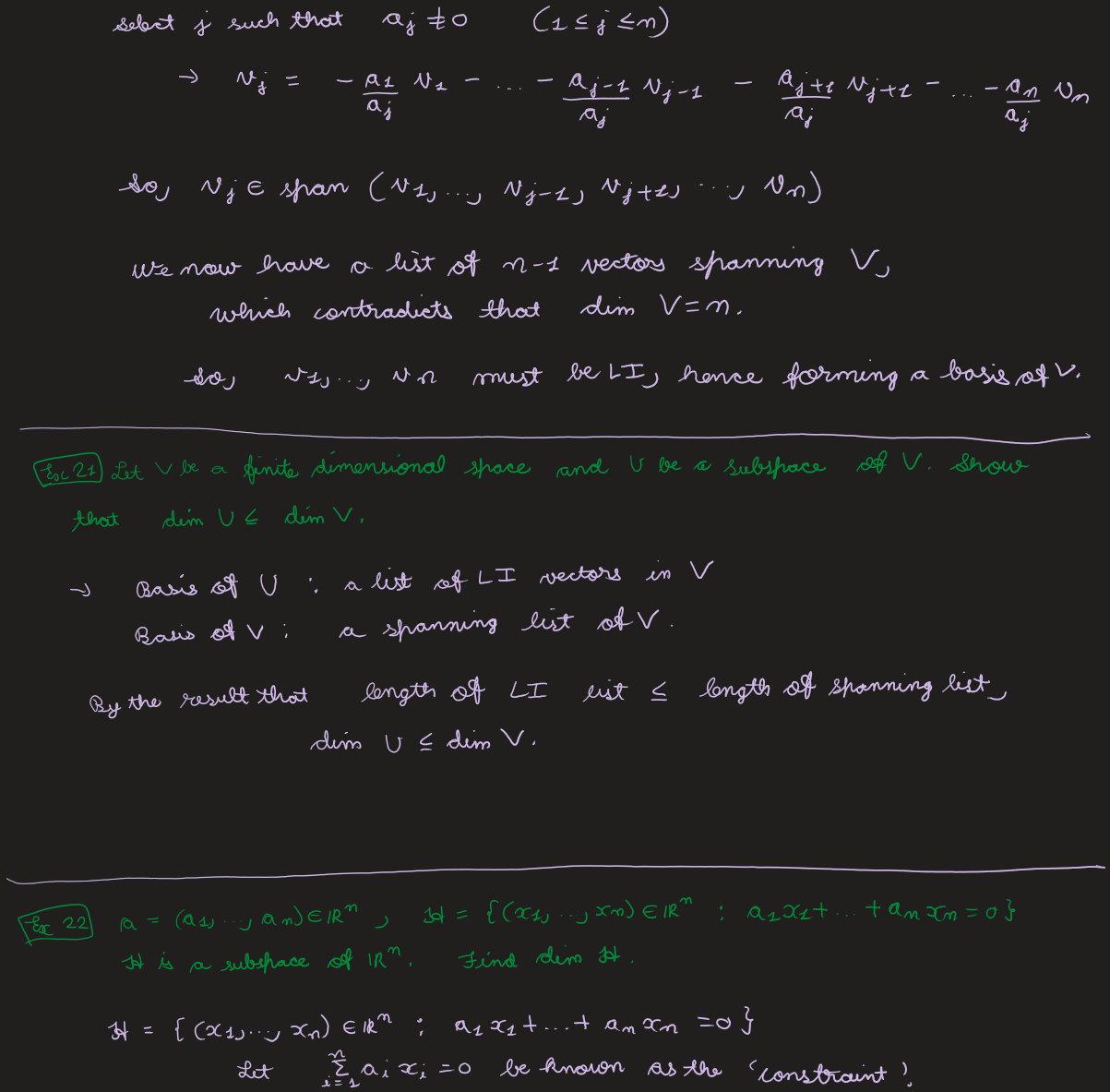
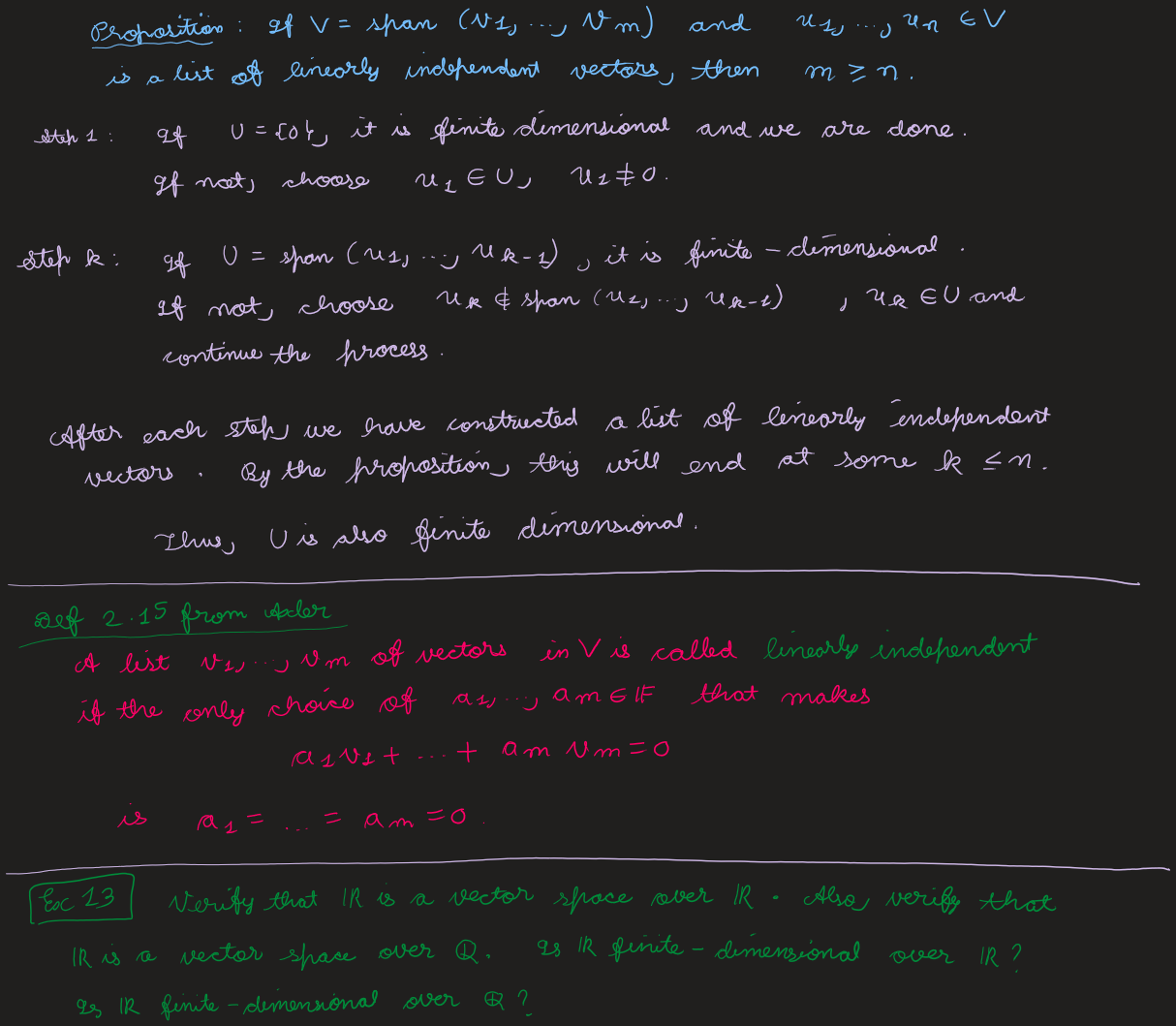
Let \(V\) be finite-dimensional and \( U \subseteq V \) a subspace. If \( U = \{0\} \) it is finite-dimensional. Otherwise pick \( u_1 \in U\setminus\{0\} \); inductively, while \( \operatorname{span}(u_1, \dots, u_j) \neq U \), choose \( u_{j+1} \in U \setminus \operatorname{span}(u_1, \dots, u_j) \). Adjoining a vector outside the current span keeps the list linearly independent. A linearly independent list in \(V\) can be no longer than a spanning list of \(V\) (Proposition 3 below), and \(V\) has a finite spanning list, so the process must stop after \( r \le \dim V \) steps with \( \operatorname{span}(u_1, \dots, u_r) = U \). Hence \(U\) is finite-dimensional.
Ex 13
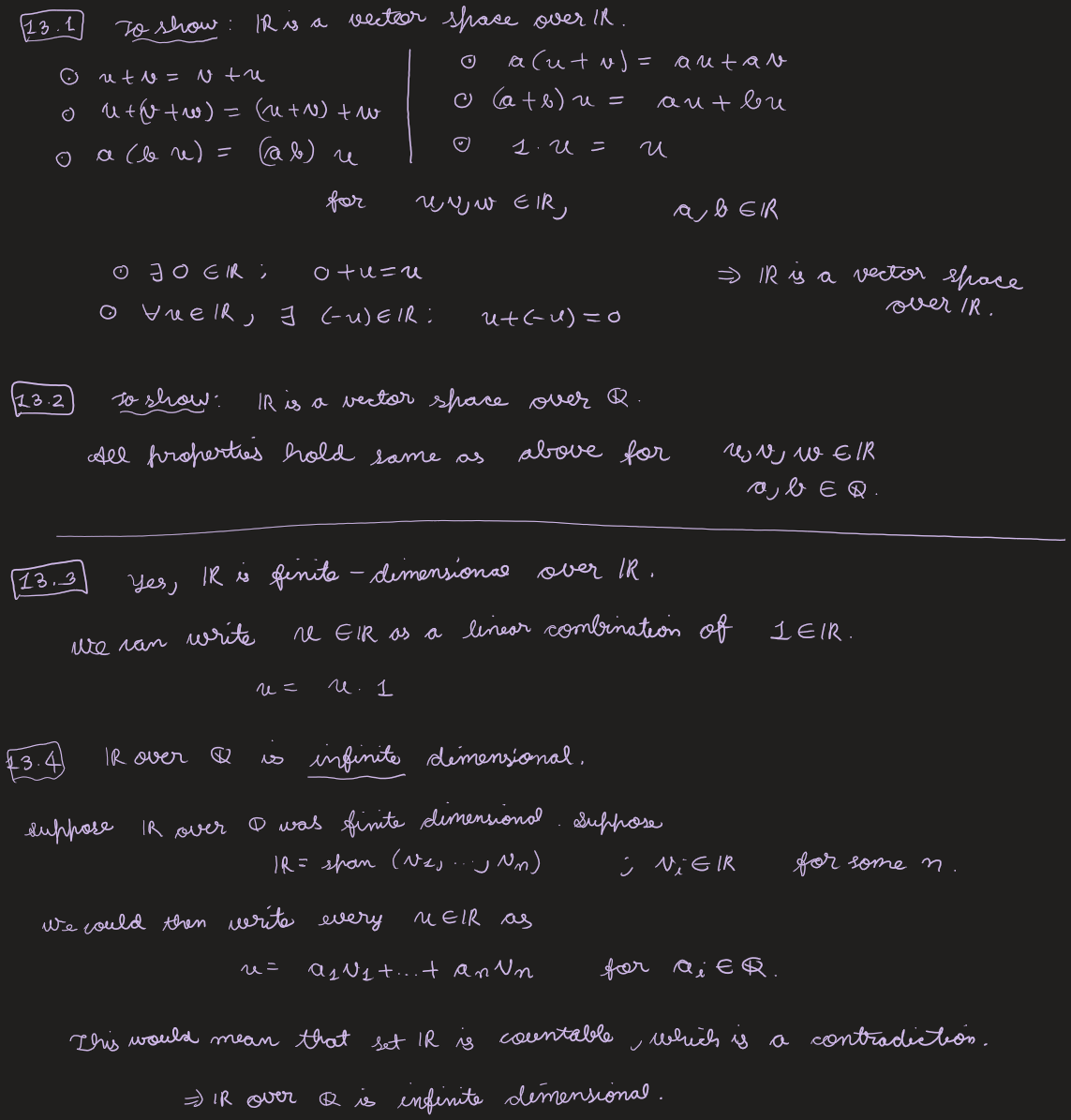
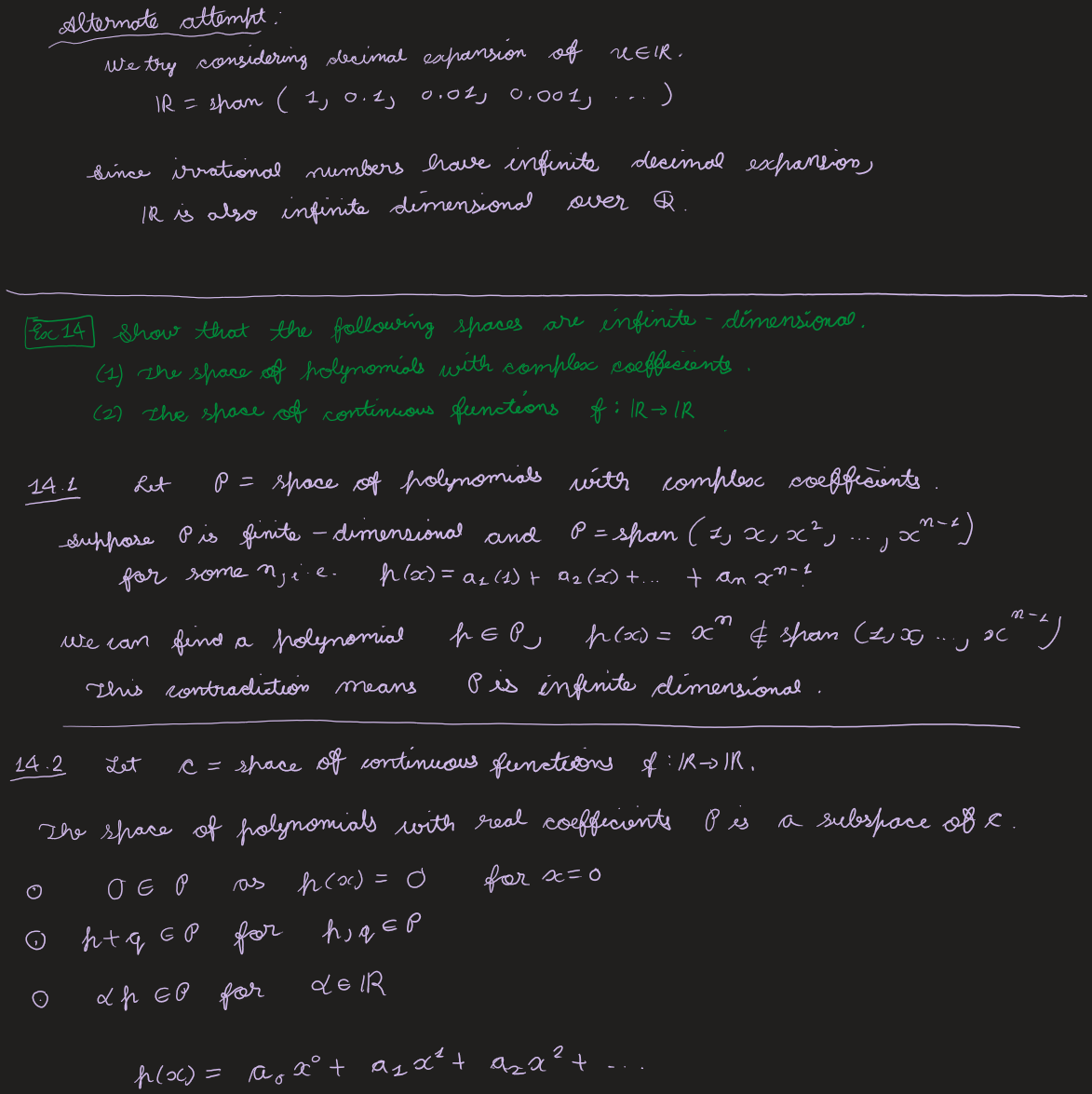
Verify that \( \R \) is a vector space over \( \R \) and over \( \Q \). Is \( \R \) finite-dimensional over \( \R \)? Over \( \Q \)?
Solution — added in review
With ordinary addition and multiplication, \( \R \) satisfies the eight axioms with scalars drawn from \( \R \), and equally with scalars restricted to \( \Q \) — so it is a vector space over each. Over \( \R \) it is finite-dimensional: \( \{1\} \) spans (every \( x = x\cdot 1 \)), so \( \dim_\R \R = 1 \). Over \( \Q \) it is infinite-dimensional: if \( \{b_1, \dots, b_n\} \) were a basis, every real would be a rational combination \( \sum_i q_i b_i \), giving a surjection \( \Q^n \to \R \); but \( \Q^n \) is countable and \( \R \) is uncountable — a contradiction.
Ex 14
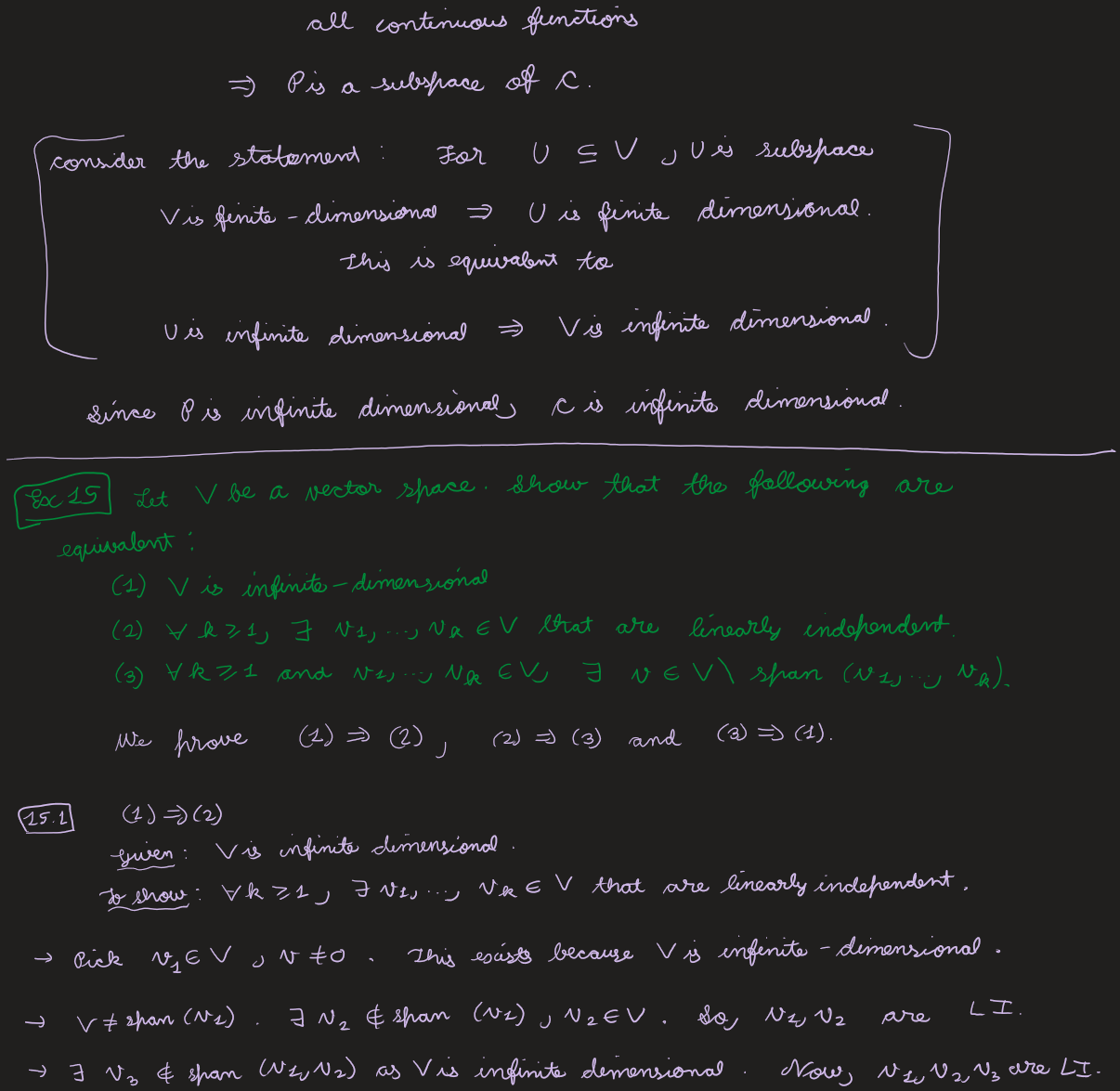
Show that (1) the polynomials with complex coefficients and (2) the continuous functions \( f : \R \to \R \) are infinite-dimensional.
Solution — added in review
In both spaces the monomials \( 1, x, x^2, \dots \) are linearly independent: \( a_0 + a_1 x + \dots + a_k x^k = 0 \) as a function forces every \( a_i = 0 \). So for each \(k\) there is a linearly independent list of length \( k+1 \). A finite-dimensional space of dimension \(d\) admits no linearly independent list longer than \(d\) (Proposition 3 below), so neither space is finite-dimensional.
Ex 15
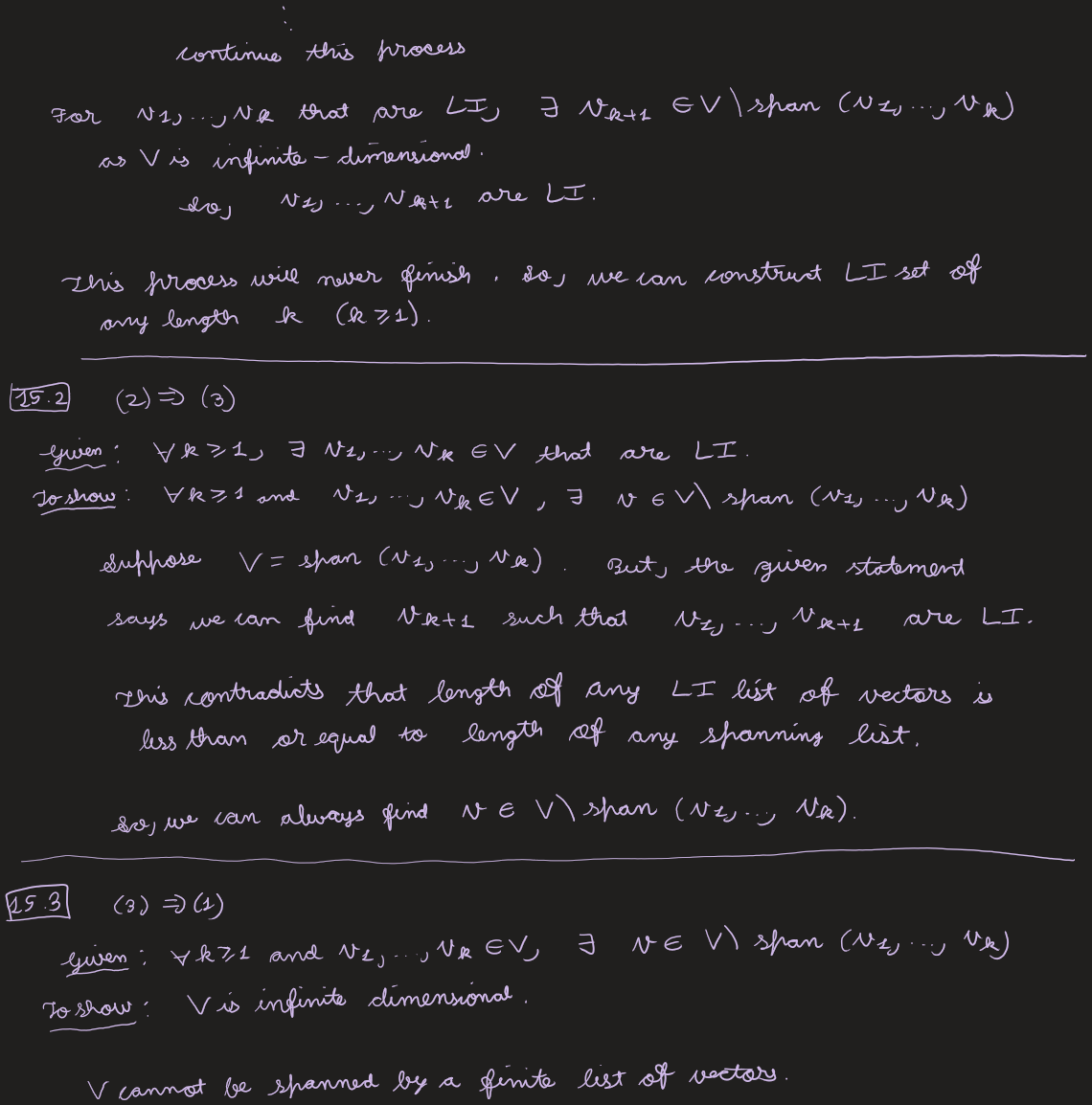
Let \(V\) be a vector space. Show the following are equivalent: (1) \(V\) is infinite-dimensional; (2) for every \( k \ge 1 \) there exist \(k\) linearly independent vectors; (3) for every \( k \ge 1 \) and \( v_1, \dots, v_k \in V \) there exists \( v \in V \setminus \operatorname{span}(v_1, \dots, v_k) \).
Solution — added in review
(1) \( \Rightarrow \) (3). If some \( v_1, \dots, v_k \) had \( \operatorname{span}(v_1, \dots, v_k) = V \), then \(V\) would be finite-dimensional; so for every list there is a \(v\) outside its span. (3) \( \Rightarrow \) (2). Build the list inductively: given linearly independent \( v_1, \dots, v_j \), (3) supplies \( v_{j+1} \notin \operatorname{span}(v_1, \dots, v_j) \), and a vector outside the span preserves independence; so lists of every length exist. (2) \( \Rightarrow \) (1). If \(V\) were finite-dimensional with \( \dim V = d \), no linearly independent list could exceed length \(d\) (Proposition 3 below), contradicting (2) at \( k = d+1 \).
Definition 7 — Linear independence
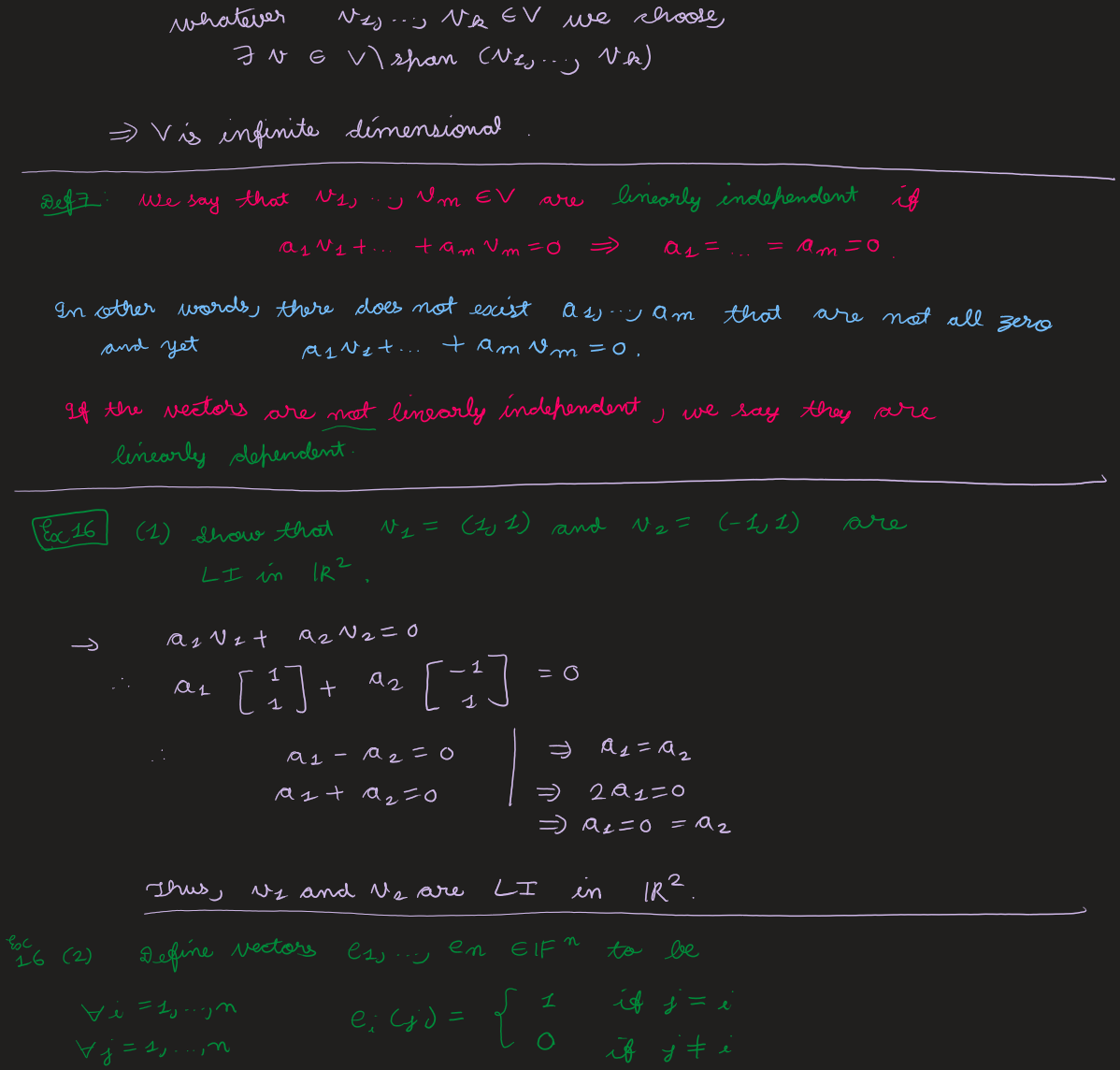
\( v_1, \dots, v_m \in V \) are linearly independent (LI) if \( a_1 v_1 + \dots + a_m v_m = 0 \Rightarrow a_1 = \dots = a_m = 0 \); otherwise they are linearly dependent (LD).
Ex 16
- Show \( v_1 = (1, 1) \), \( v_2 = (-1, 1) \) are LI in \( \R^2 \). From \( a_1 v_1 + a_2 v_2 = 0 \): \( a_1 - a_2 = 0 \), \( a_1 + a_2 = 0 \Rightarrow 2a_1 = 0 \Rightarrow a_1 = a_2 = 0 \).
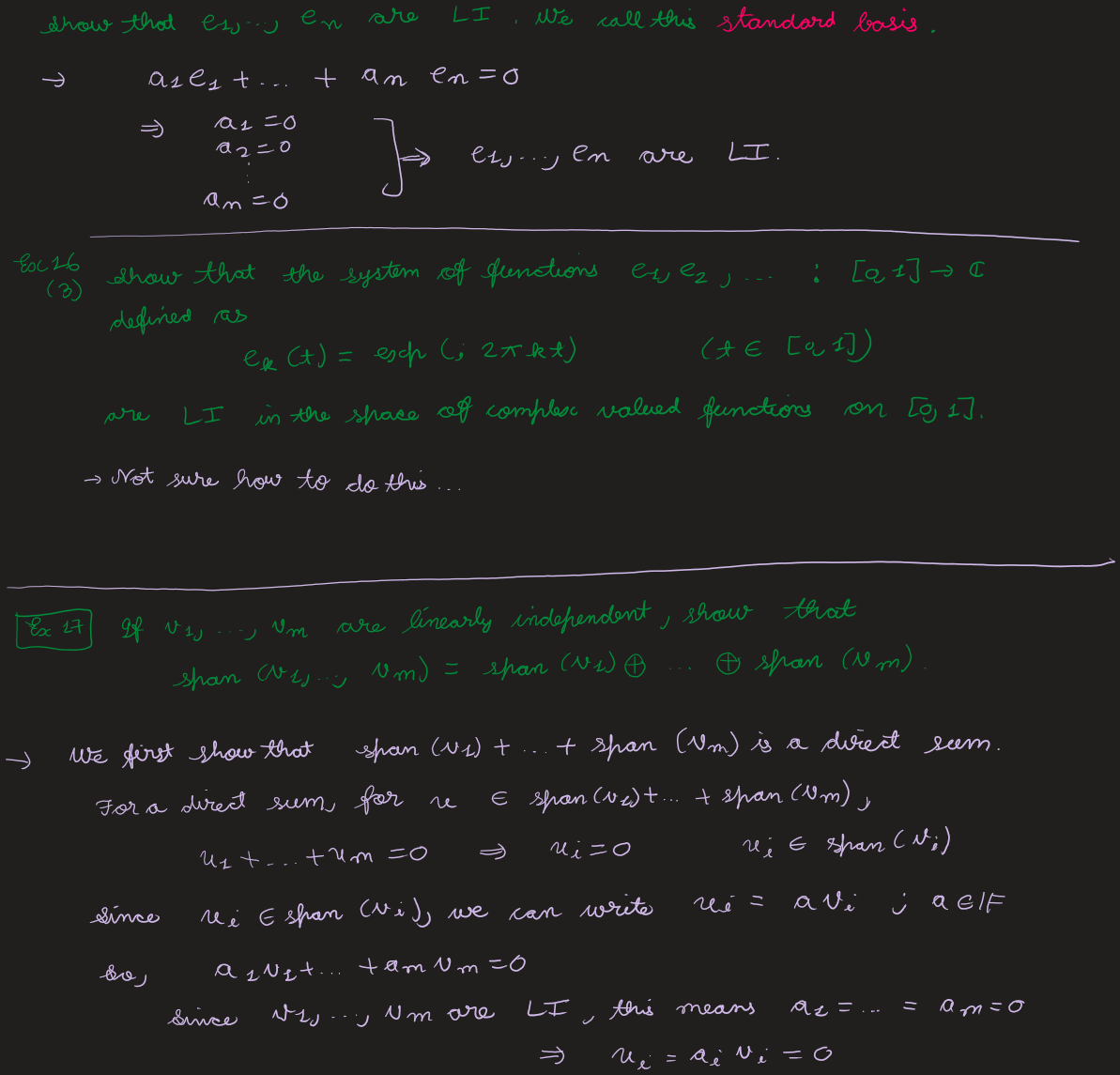
- The standard basis \( e_1, \dots, e_n \in \F^n \) (\( (e_i)_j = \delta_{ij} \)) is LI: \( \sum_i a_i e_i = 0 \) gives \( a_1 = \dots = a_n = 0 \) componentwise.
- The functions \( e_k(t) = \exp(i\,2\pi k t) \), \( t \in [0, 1] \), are LI in the space of complex-valued functions. (worked below)
Solution — Ex 16(3), added in review
The \( e_k \) are pairwise orthogonal on \( [0,1] \): for integers \( k, l \), \[ \int_0^1 e_k(t)\,\overline{e_l(t)}\,dt = \int_0^1 \exp\!\big(i\,2\pi (k - l) t\big)\,dt = \begin{cases} 1, & k = l,\\ 0, & k \neq l,\end{cases} \] since a full-period complex exponential integrates to \(0\). So if \( \sum_j a_j e_{k_j} = 0 \) as a function (distinct integers \( k_j \)), multiplying by \( \overline{e_{k_i}} \) and integrating gives \( a_i = 0 \) for each \(i\). Hence the \( e_k \) are linearly independent.
Ex 17
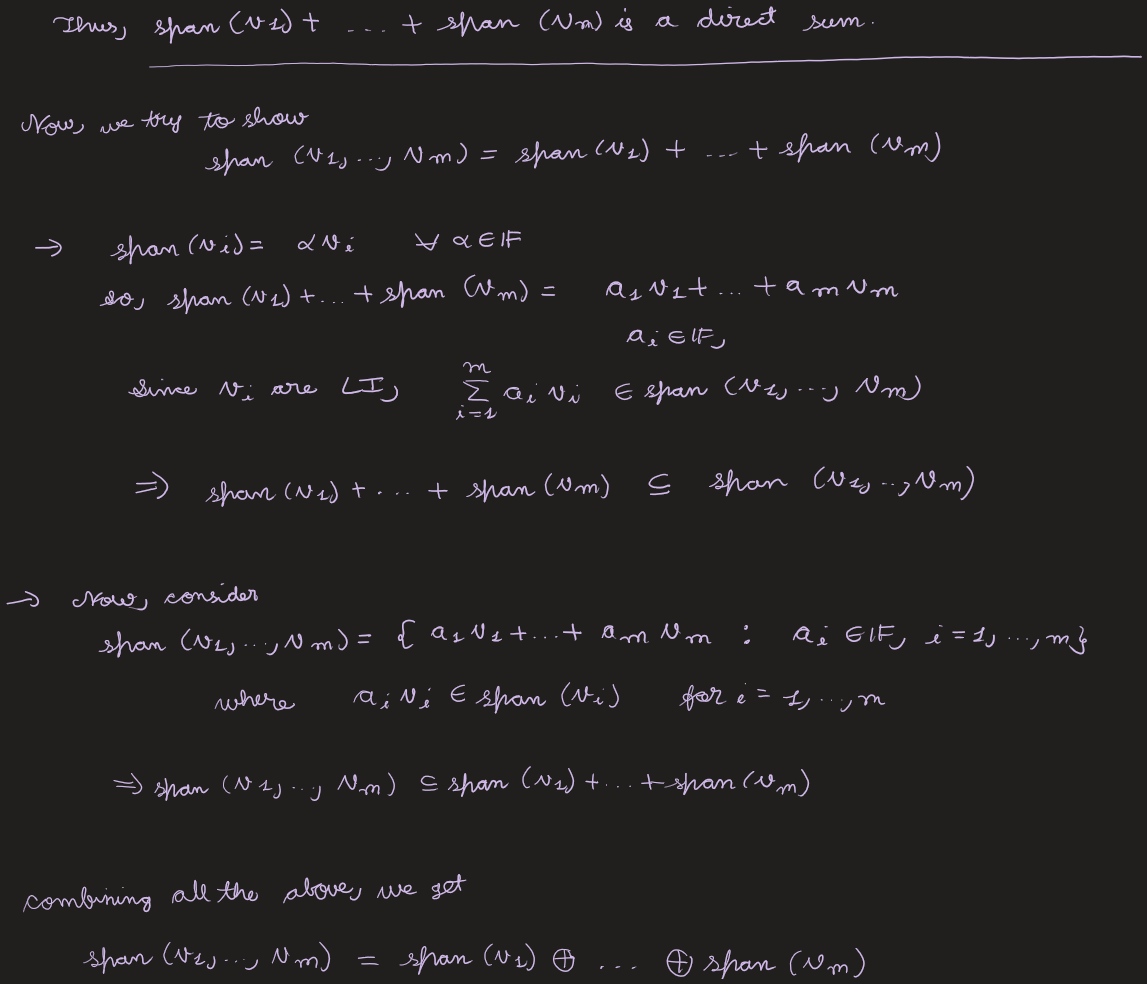
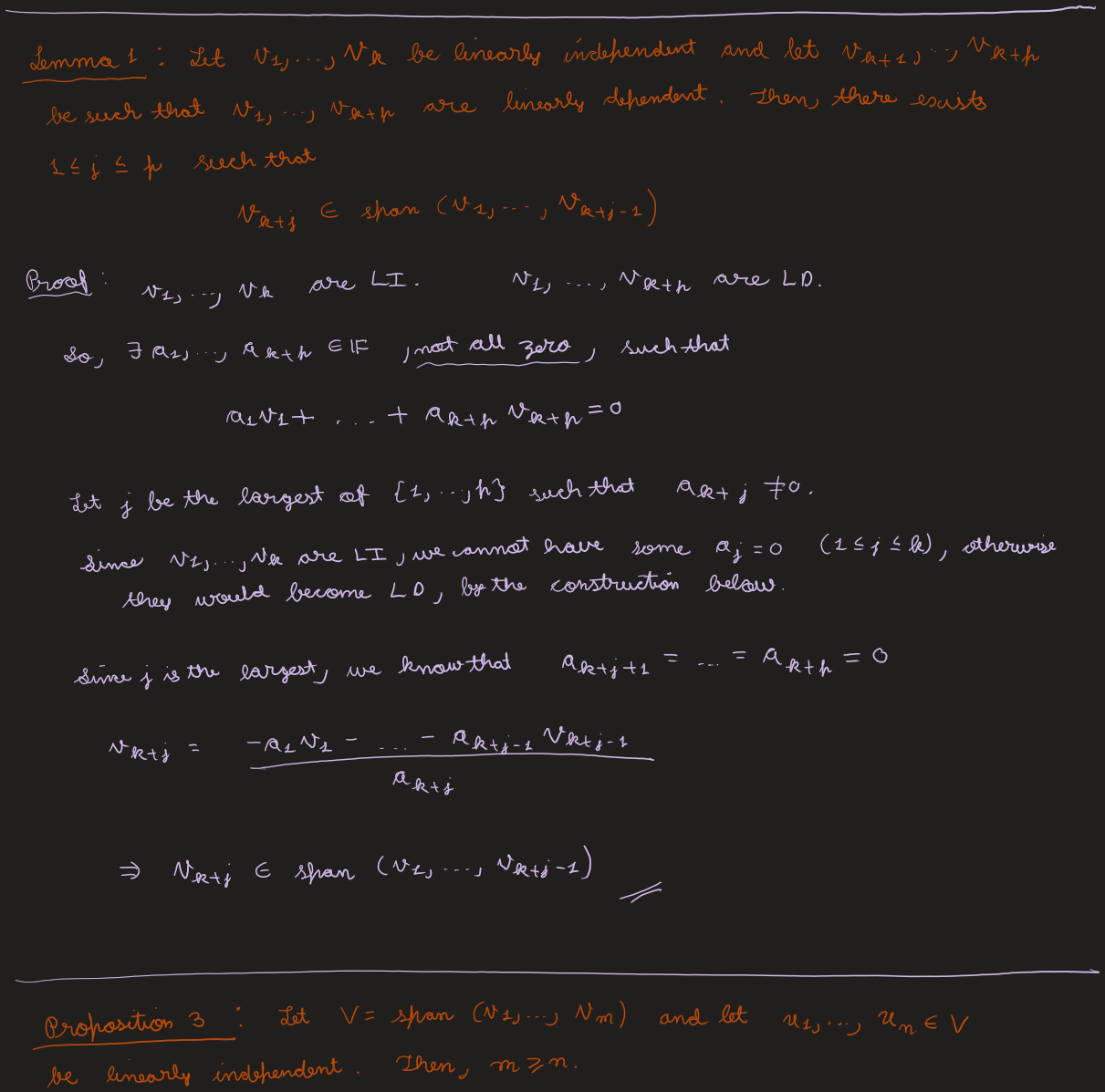
If \( v_1, \dots, v_m \) are linearly independent, show \( \operatorname{span}(v_1, \dots, v_m) = \operatorname{span}(v_1) \oplus \dots \oplus \operatorname{span}(v_m) \).
Solution
For a direct sum we need \( u_1 + \dots + u_m = 0 \Rightarrow u_i = 0 \) with \( u_i \in \operatorname{span}(v_i) \), i.e. \( u_i = a_i v_i \). Then \( \sum a_i v_i = 0 \) and LI of the \( v_i \) give \( a_i = 0 \), so each \( u_i = 0 \); the sum is direct. Both inclusions \( \operatorname{span}(v_1, \dots, v_m) = \sum_i \operatorname{span}(v_i) \) are immediate, so \( \operatorname{span}(v_1, \dots, v_m) = \bigoplus_i \operatorname{span}(v_i) \).
View original handwritten scans — Span, linear independence & finite-dimensionality, Ex 10–17 (pages 16–28)
Basis & Dimension
Lemma 1 — Linear dependence lemma
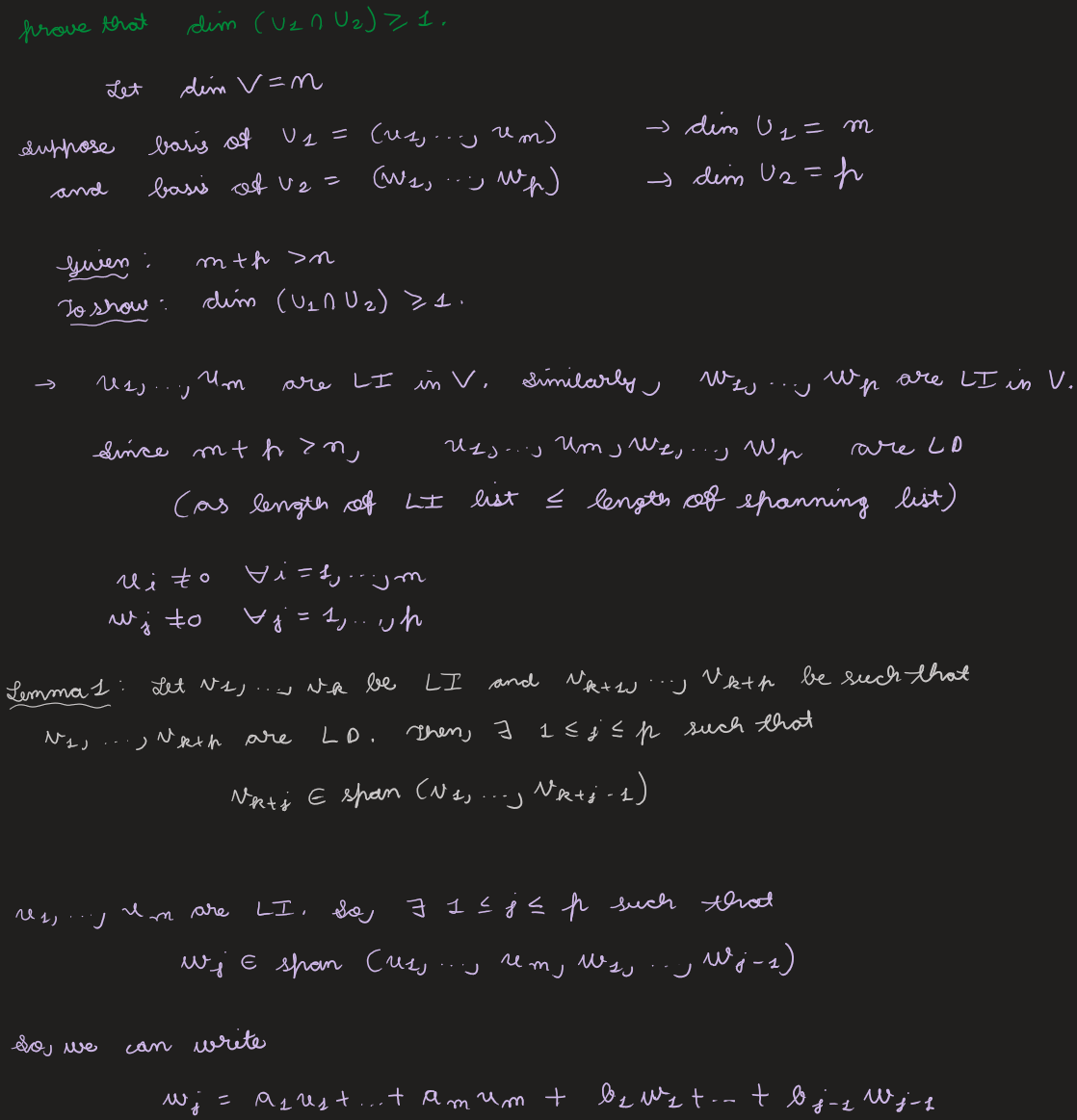
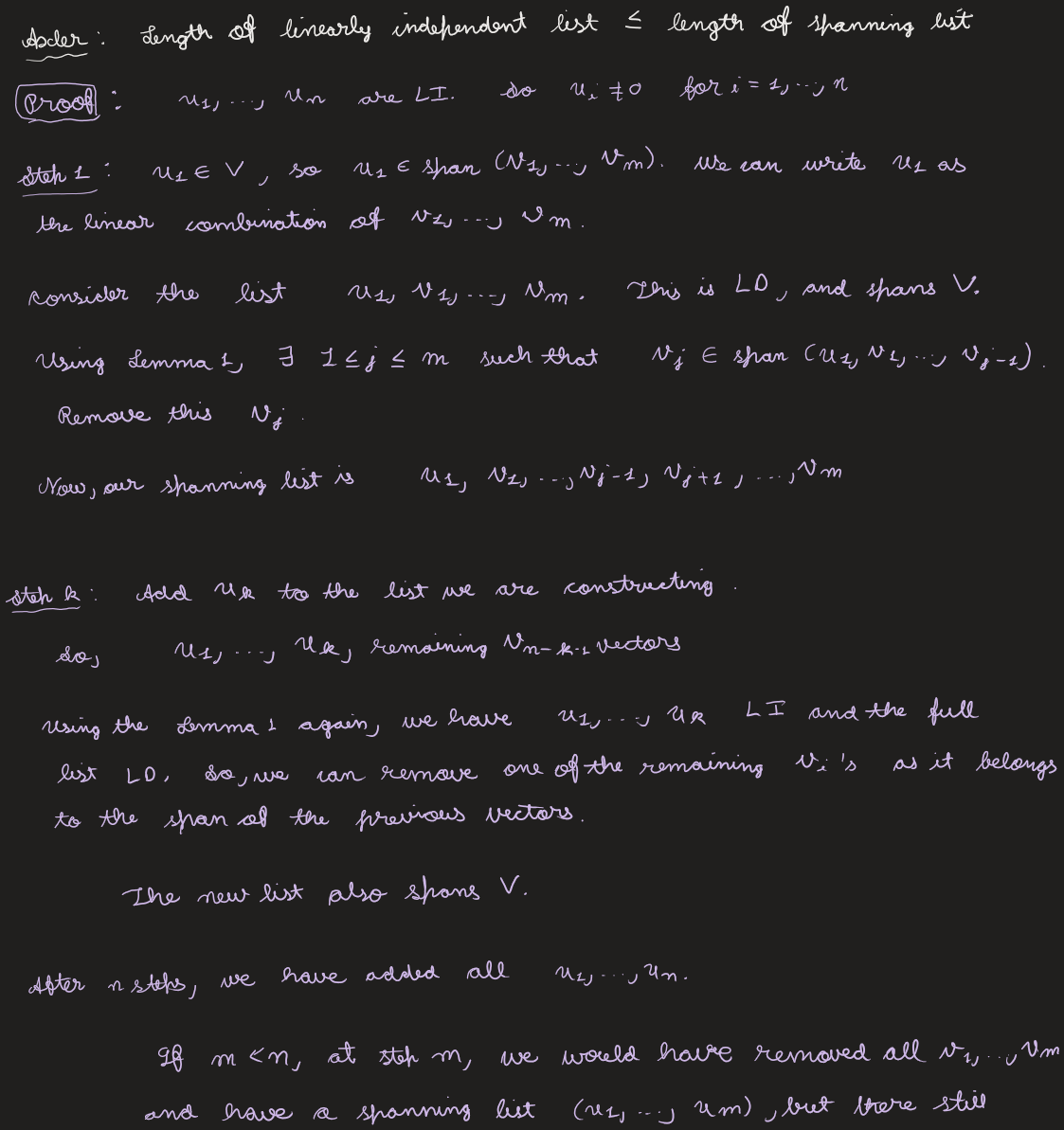
Let \( v_1, \dots, v_k \) be LI and \( v_1, \dots, v_{k+p} \) be LD. Then there exists \( 1 \le j \le p \) with \( v_{k+j} \in \operatorname{span}(v_1, \dots, v_{k+j-1}) \).
Proof
Since \( v_1, \dots, v_{k+p} \) are LD, \( a_1 v_1 + \dots + a_{k+p}v_{k+p} = 0 \) with not all \( a_i = 0 \). Let \(j\) be the largest index with \( a_{k+j} \neq 0 \) (some \( a_{k+i} \) with \( i > 0 \) is non-zero, else the LI \( v_1, \dots, v_k \) would be dependent). Then \( v_{k+j} = -\tfrac{1}{a_{k+j}}\big(a_1 v_1 + \dots + a_{k+j-1}v_{k+j-1}\big) \in \operatorname{span}(v_1, \dots, v_{k+j-1}) \).
Proposition 3
If \( V = \operatorname{span}(v_1, \dots, v_m) \) and \( u_1, \dots, u_n \in V \) are LI, then \( n \le m \) (the length of a LI list is at most the length of a spanning list).
Proof (sketch)
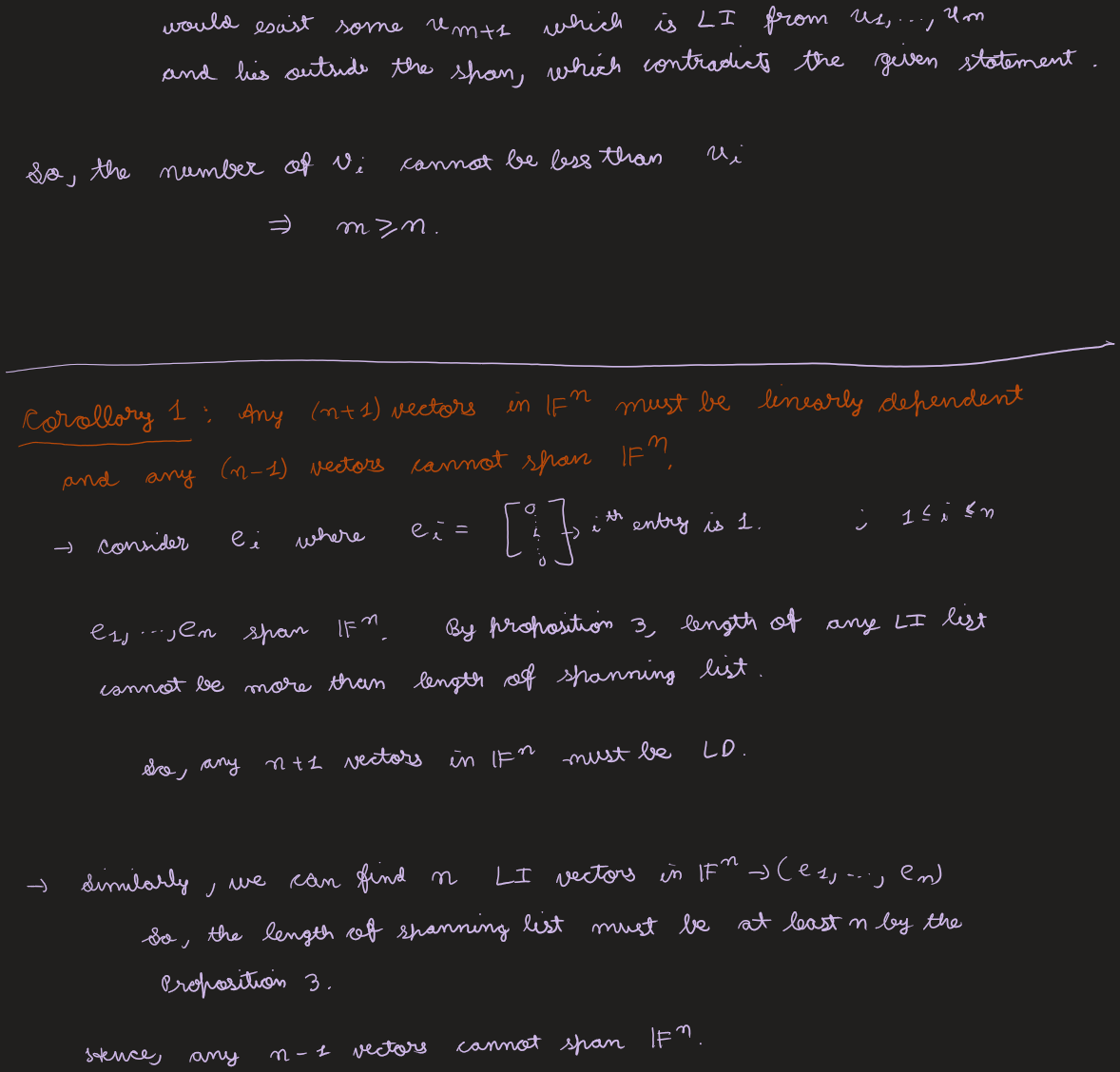
Repeatedly swap a \(u\) into the spanning list and remove a \(v\): at each step the list still spans \(V\), and the linear-dependence lemma guarantees a \(v\) can be removed. If \( n > m \) we would run out of \(v\)'s while some \(u_{m+1}\) is still LI and in the span — a contradiction. Hence \( n \le m \).
Corollary 1
Any \( n + 1 \) vectors in \( \F^n \) are linearly dependent, and any \( n - 1 \) vectors cannot span \( \F^n \).
Proof
\( e_1, \dots, e_n \) span \( \F^n \); by Proposition 3 a LI list has length \( \le n \), so \( n + 1 \) vectors are LD. Likewise \( e_1, \dots, e_n \) are LI, so a spanning list has length \( \ge n \), so \( n - 1 \) vectors cannot span.
Definition 8 — Basis
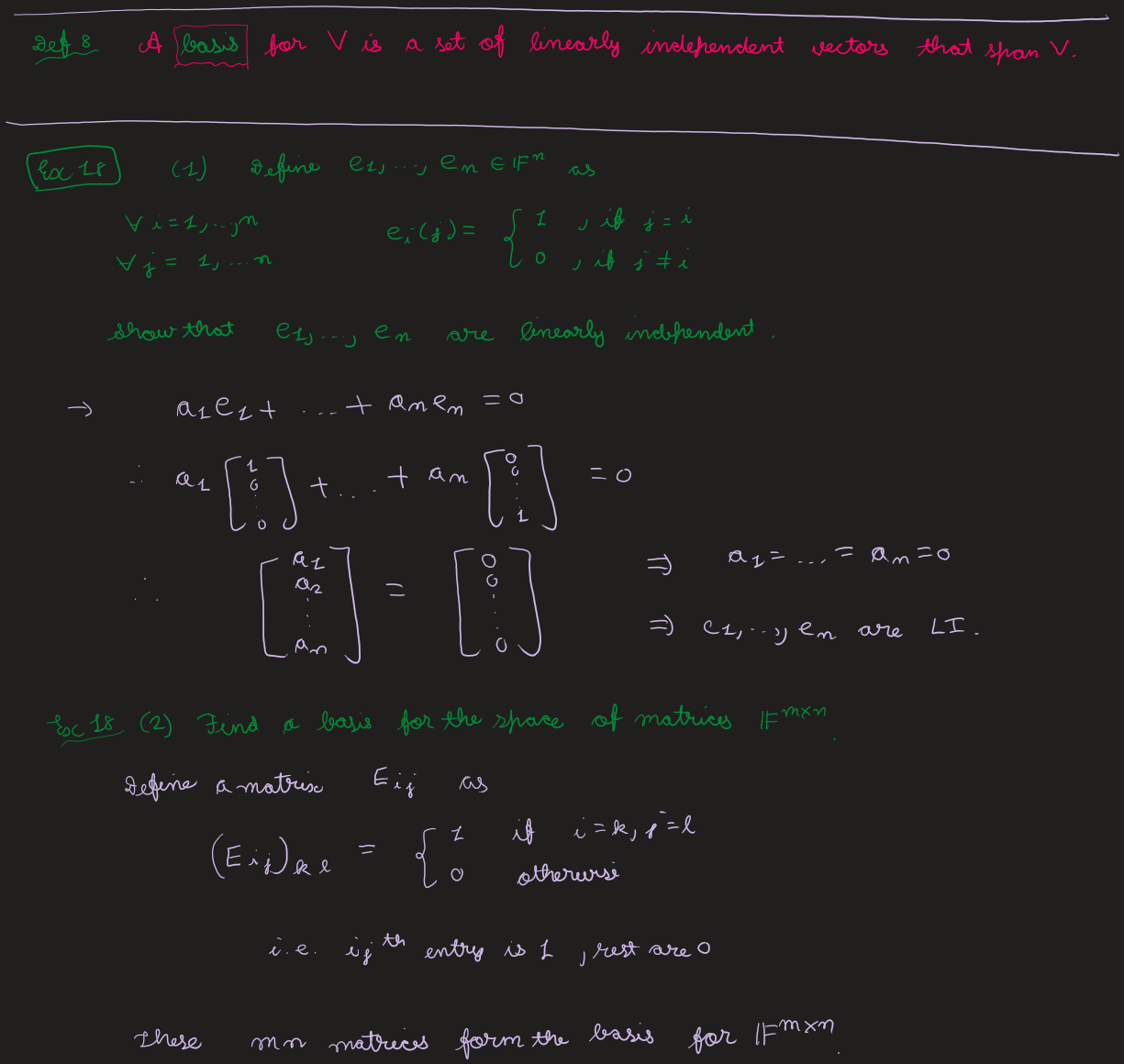
A basis for \(V\) is a set of linearly independent vectors that span \(V\).
Ex 18
- The standard basis \( e_1, \dots, e_n \in \F^n \) is LI (as in Ex 16) and spans \( \F^n \), so it is a basis.
- A basis for \( \F^{m\times n} \): the matrices \( E_{kl} \) with a \(1\) in entry \( (k, l) \) and \(0\) elsewhere — the \(mn\) such matrices form a basis.
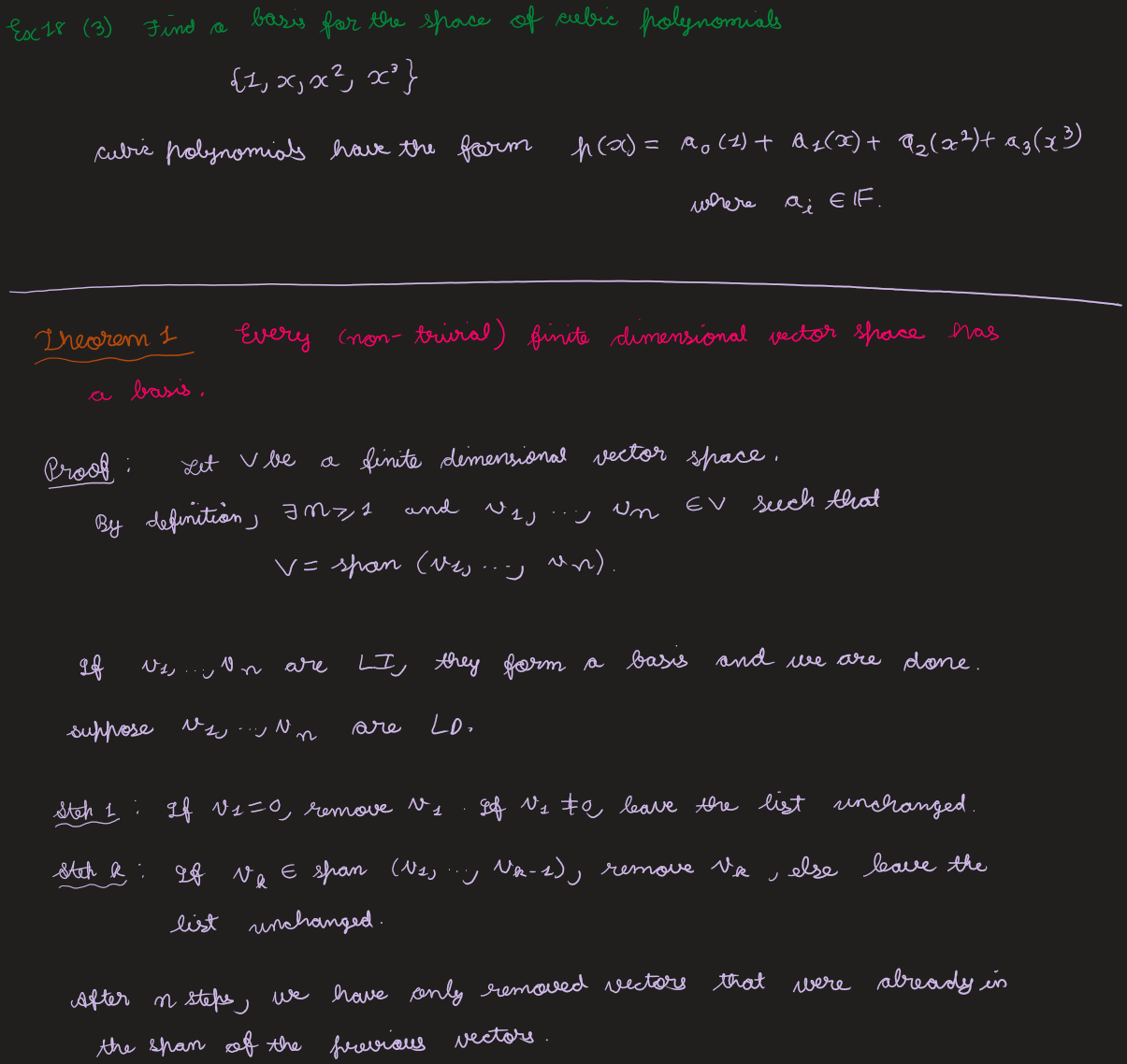
- A basis for the cubic polynomials is \( \{1, x, x^2, x^3\} \), since any cubic is \( p(x) = a_0 + a_1 x + a_2 x^2 + a_3 x^3 \).
Theorem 1
Every (non-trivial) finite-dimensional vector space has a basis.
Proof
\( V = \operatorname{span}(v_1, \dots, v_n) \). If the \( v_i \) are LI they form a basis. Otherwise, repeatedly: if some \( v_i = 0 \) or \( v_i \in \operatorname{span}(v_1, \dots, v_{i-1}) \), remove it. After at most \(n\) steps only vectors that were already in the span of earlier ones have been removed, so the remaining list still spans \(V\) and is now LI — a basis.
Ex 19
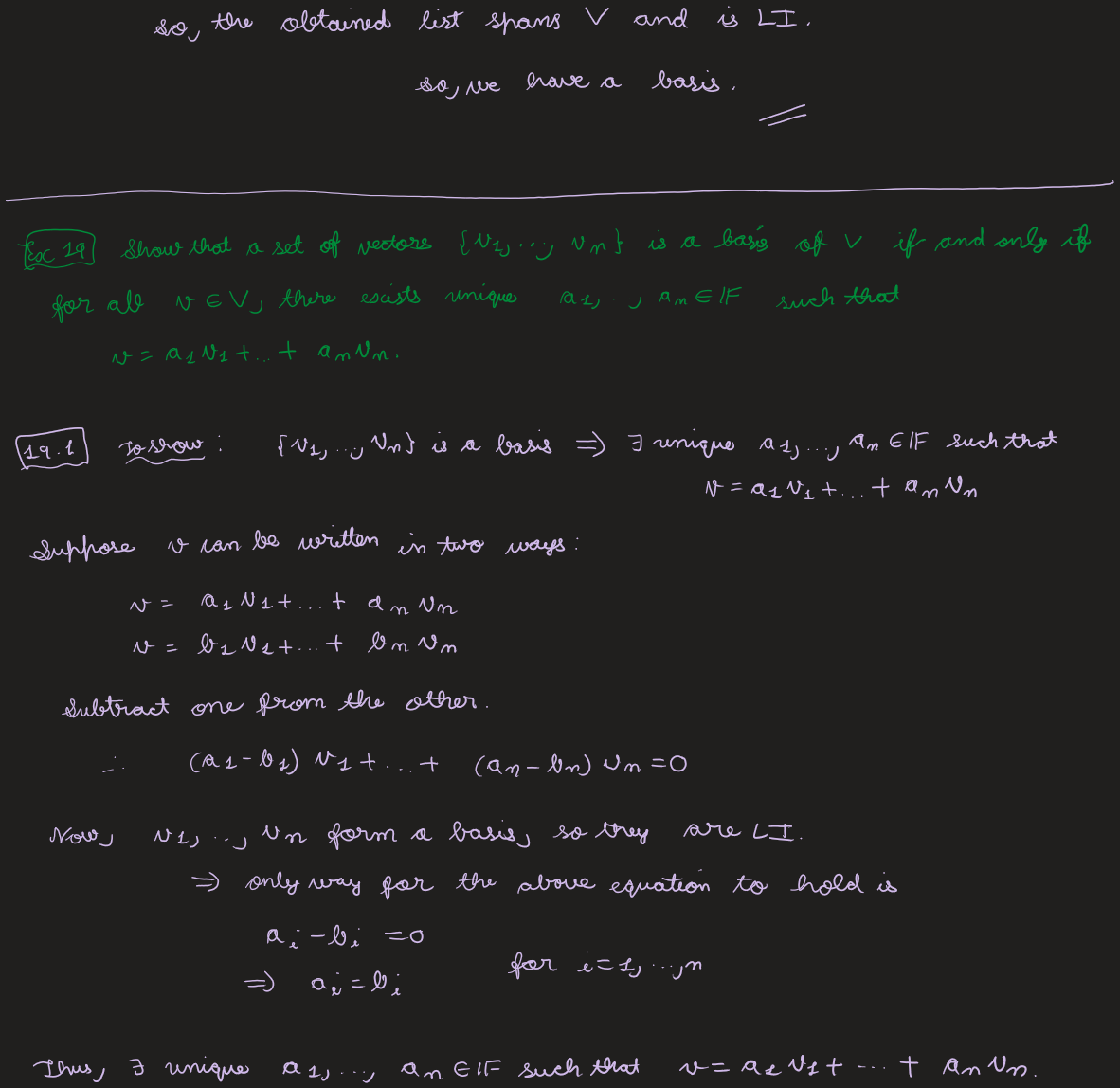
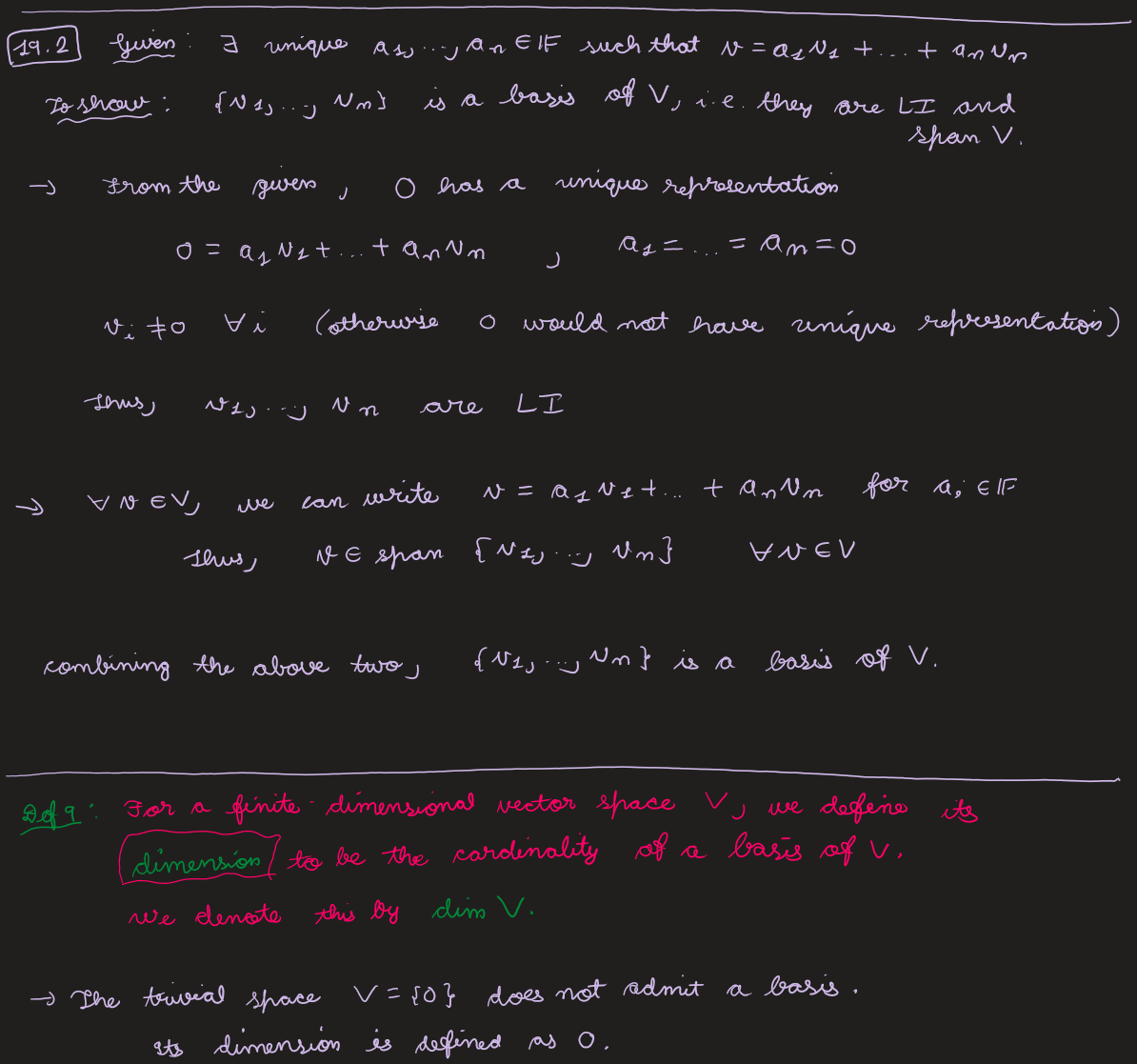
Show \( \{v_1, \dots, v_n\} \) is a basis of \(V\) iff every \( v \in V \) has a unique representation \( v = a_1 v_1 + \dots + a_n v_n \).
Solution
If it is a basis and \( v = \sum a_i v_i = \sum b_i v_i \), subtracting gives \( \sum(a_i - b_i)v_i = 0 \); LI forces \( a_i = b_i \), so the representation is unique. Conversely, unique representations make the \( v_i \) span (existence) and LI (the representation of \(0\) is unique, namely all-zero), so they form a basis.
Definition 9 — Dimension
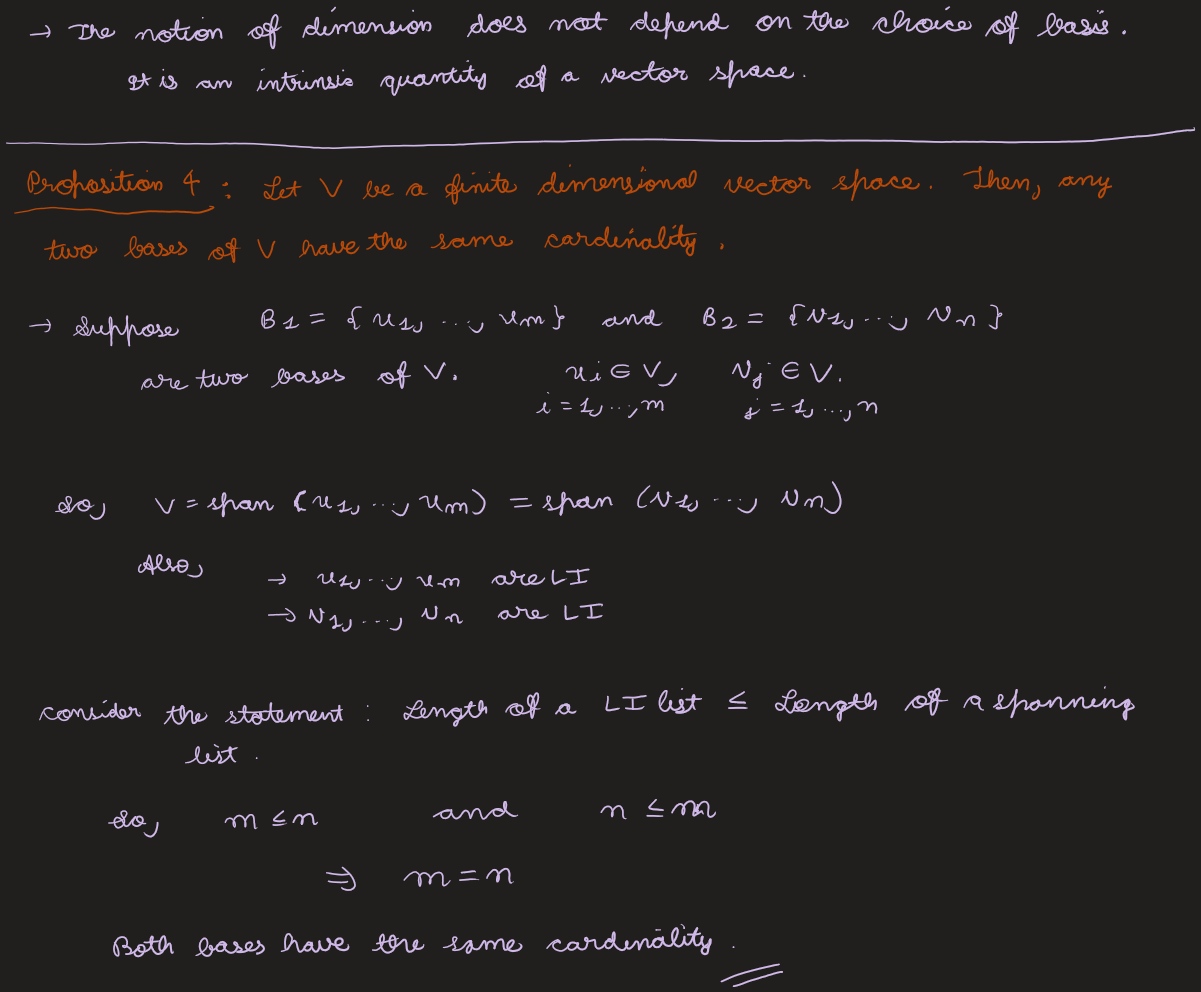
For a finite-dimensional space \(V\), the dimension is the cardinality of a basis (the trivial space \( V = \{0\} \) has dimension \(0\)). Dimension does not depend on the choice of basis — it is an intrinsic quantity.
Proposition 4
Any two bases of a finite-dimensional space \(V\) have the same cardinality.
Proof
Let \( B_1 = \{u_1, \dots, u_m\} \), \( B_2 = \{v_1, \dots, v_n\} \) be bases. Since \( B_1 \) is LI and \( B_2 \) spans, Proposition 3 gives \( m \le n \); swapping roles gives \( n \le m \). Hence \( m = n \).
View original handwritten scans — Basis & dimension, Lemma 1, Prop 3–4, Ex 18–19 (pages 28–36)
Dimension Results
Correction — exercise numbering
The instructor's Exercise 20 is a single exercise with two parts; these notes had split it into "Ex 20" and "Ex 21", which shifted the following exercises. Numbering is corrected here to match the instructor: Ex 20 (two parts), Ex 21 \( \dim U \le \dim V \), Ex 22 \( \dim H \), Ex 23 \( \dim U_1 + \dim U_2 > \dim V \Rightarrow \dim(U_1\cap U_2)\ge 1 \), Ex 24 \( \dim V = \dim U + \dim W \), Ex 25 complementary subspaces.
Ex 20
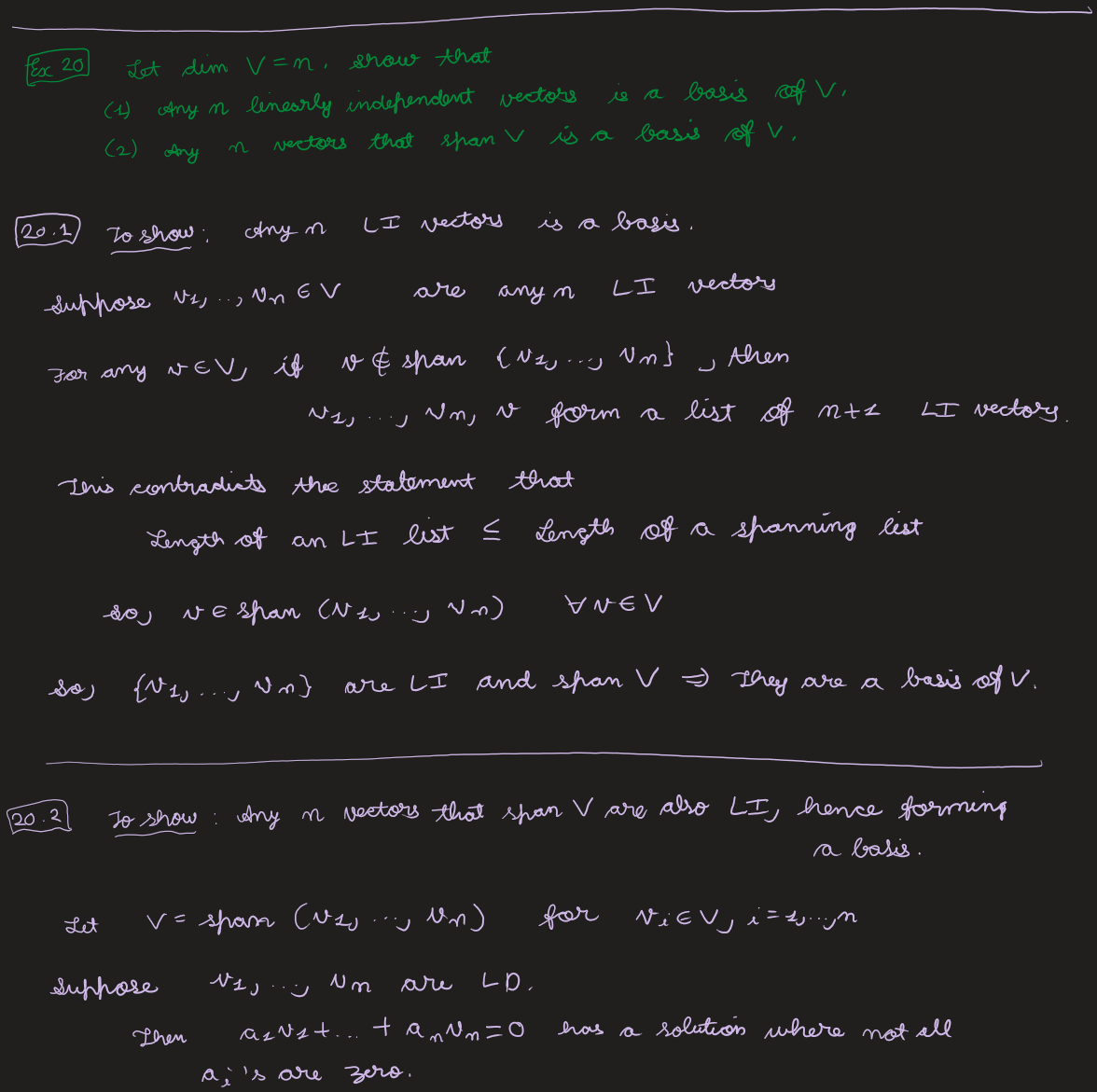
Let \( \dim V = n \). Show that (1) any \(n\) linearly independent vectors form a basis of \(V\); (2) any \(n\) vectors that span \(V\) form a basis.
Solution
(1) If \(n\) LI vectors did not span, some \( v \in V \setminus \operatorname{span} \) would extend them to \( n+1 \) LI vectors, exceeding the spanning length \(n\) — contradiction. (2) If \(n\) spanning vectors were LD, the linear dependence lemma lets us remove one, leaving \( n-1 \) vectors spanning \(V\), contradicting that any basis has length \(n\).
Ex 21
If \(V\) is finite-dimensional and \( U \subseteq V \) a subspace, then \( \dim U \le \dim V \).
Solution
A basis of \(U\) is a LI list in \(V\); by Proposition 3 its length is at most that of a spanning list of \(V\), so \( \dim U \le \dim V \).
Ex 22
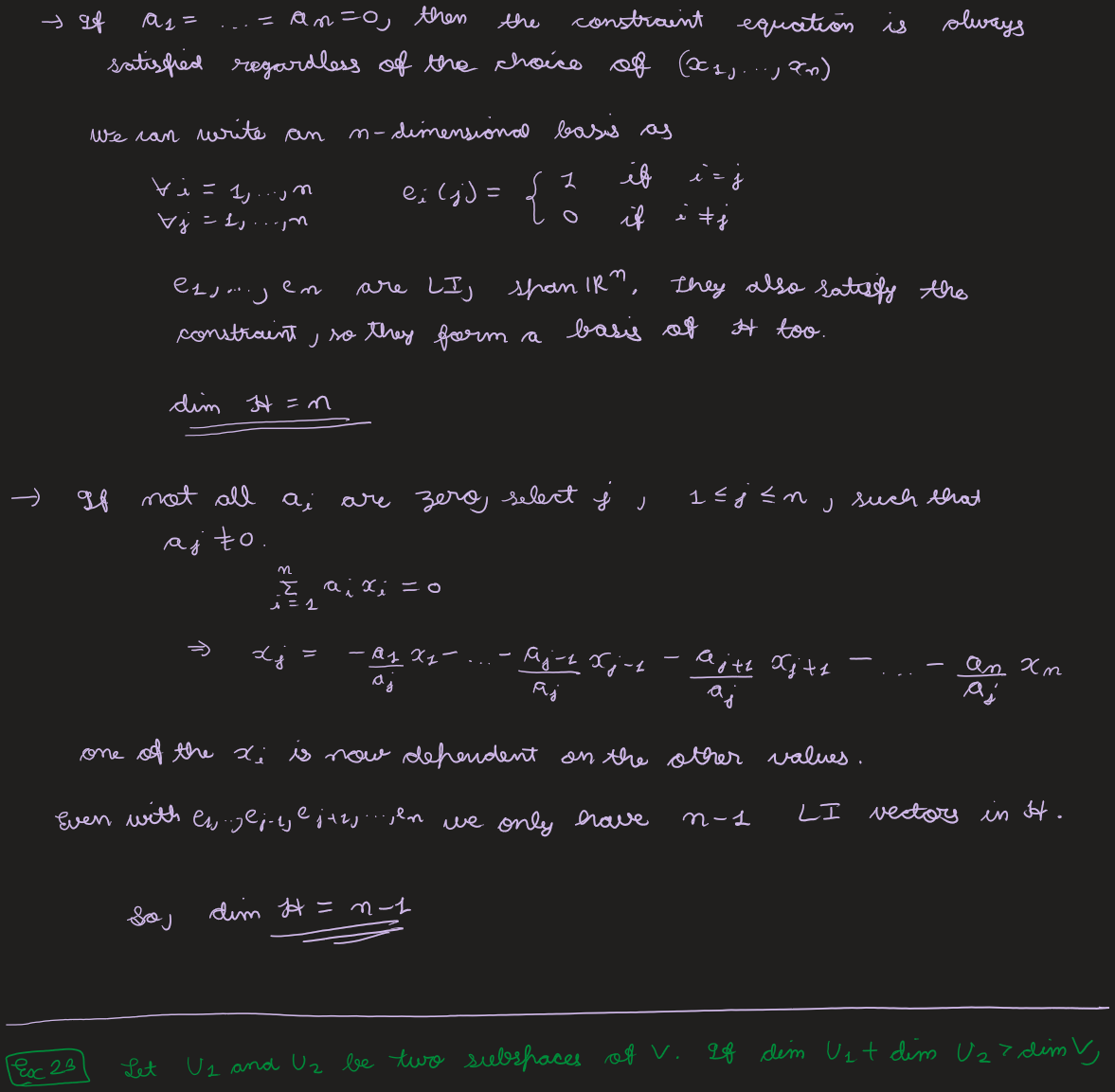
For \( H = \{ x \in \R^n : \sum_i a_i x_i = 0 \} \), find \( \dim H \).
Solution
If all \( a_i = 0 \), the constraint is vacuous and \( H = \R^n \), so \( \dim H = n \). Otherwise pick \(j\) with \( a_j \neq 0 \); then \( x_j = -\tfrac{1}{a_j}\sum_{i\neq j}a_i x_i \) is determined by the other \( n - 1 \) coordinates. Concretely, the vectors \( f_i = e_i - \tfrac{a_i}{a_j}e_j \) for \( i \neq j \) are \( n - 1 \) linearly independent elements of \(H\) that span it, so \( \dim H = n - 1 \).
Ex 23
Let \( U_1, U_2 \) be subspaces of \(V\) with \( \dim U_1 + \dim U_2 > \dim V \). Prove \( \dim(U_1 \cap U_2) \ge 1 \).
Solution
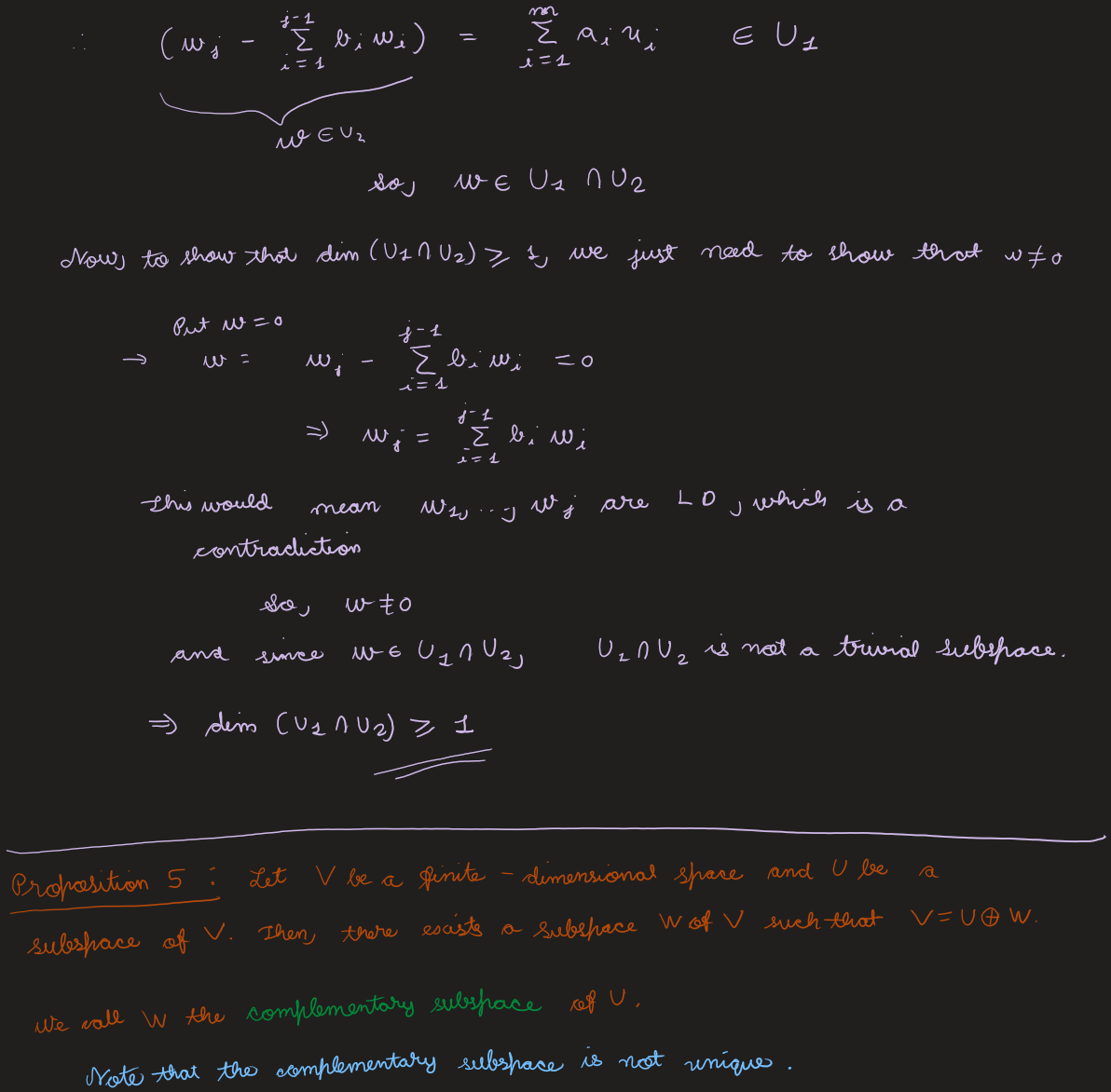
Let \( \dim V = n \), bases \( u_1, \dots, u_m \) of \( U_1 \) and \( w_1, \dots, w_p \) of \( U_2 \) with \( m + p > n \). The combined \( m + p \) vectors lie in \(V\), so (exceeding \(n\)) they are LD. By the linear dependence lemma some \( w_j = a_1 u_1 + \dots + a_m u_m + b_1 w_1 + \dots + b_{j-1}w_{j-1} \), giving a non-zero \( w = w_j - \sum_{i<j} b_i w_i \in U_2 \) that also equals \( \sum_i a_i u_i \in U_1 \). So \( 0 \neq w \in U_1 \cap U_2 \), hence \( \dim(U_1 \cap U_2) \ge 1 \).
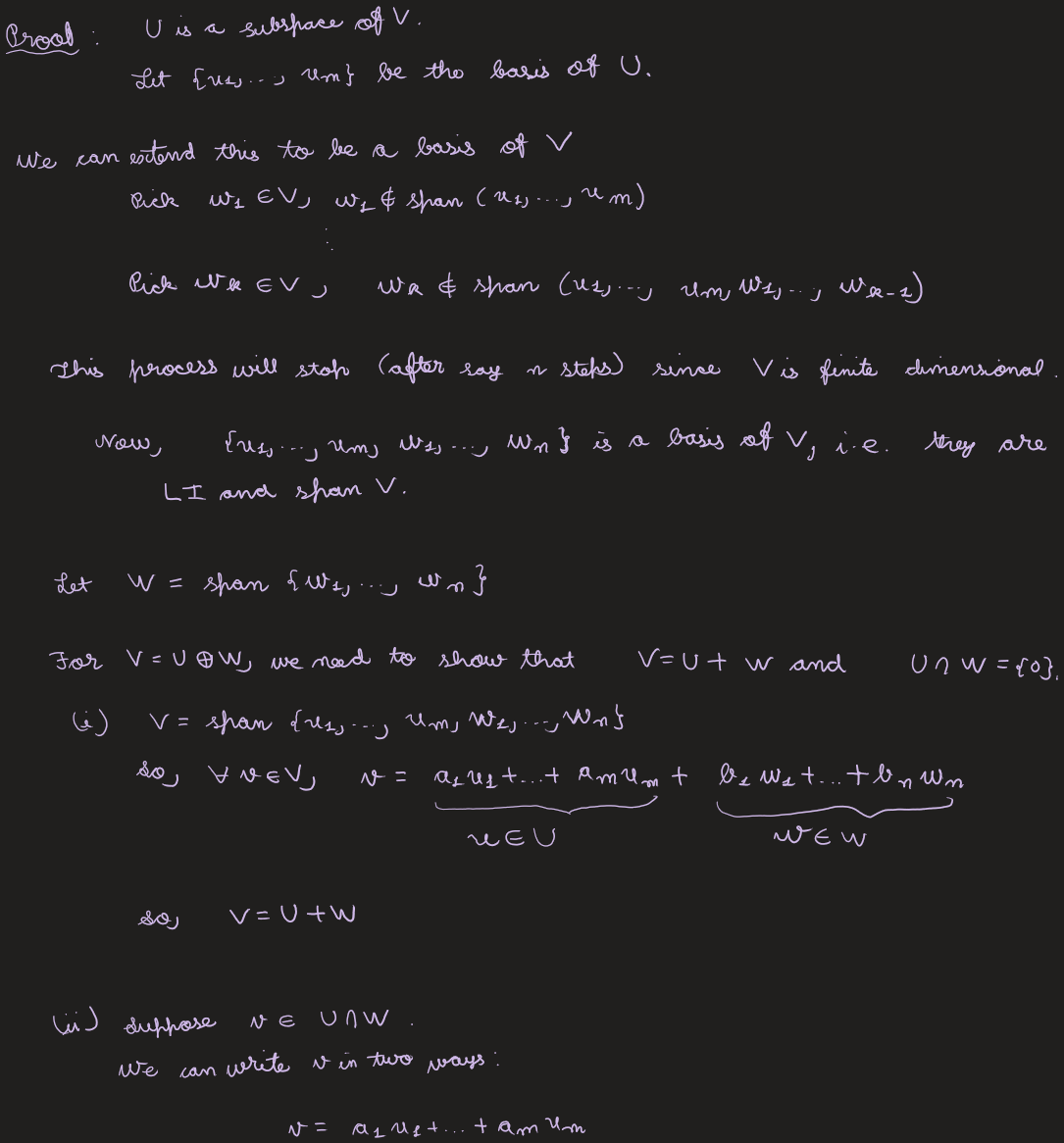
Proposition 5 — Complementary subspace
Let \(V\) be finite-dimensional and \( U \subseteq V \) a subspace. There exists a subspace \( W \subseteq V \) with \( V = U \oplus W \). We call \(W\) a complementary subspace of \(U\) (it is not unique).
Proof
Take a basis \( u_1, \dots, u_m \) of \(U\) and extend it to a basis \( u_1, \dots, u_m, w_1, \dots, w_{n-m} \) of \(V\) (possible since \(V\) is finite-dimensional). Set \( W = \operatorname{span}(w_1, \dots, w_{n-m}) \). Then \( V = U + W \) (the combined list spans), and \( U \cap W = \{0\} \): if \( v \in U \cap W \), writing it in both bases and subtracting uses LI of the full basis to force all coefficients \(0\). So \( V = U \oplus W \). Moreover \( \dim V = m + (n - m) = \dim U + \dim W \) (Ex 24 below).
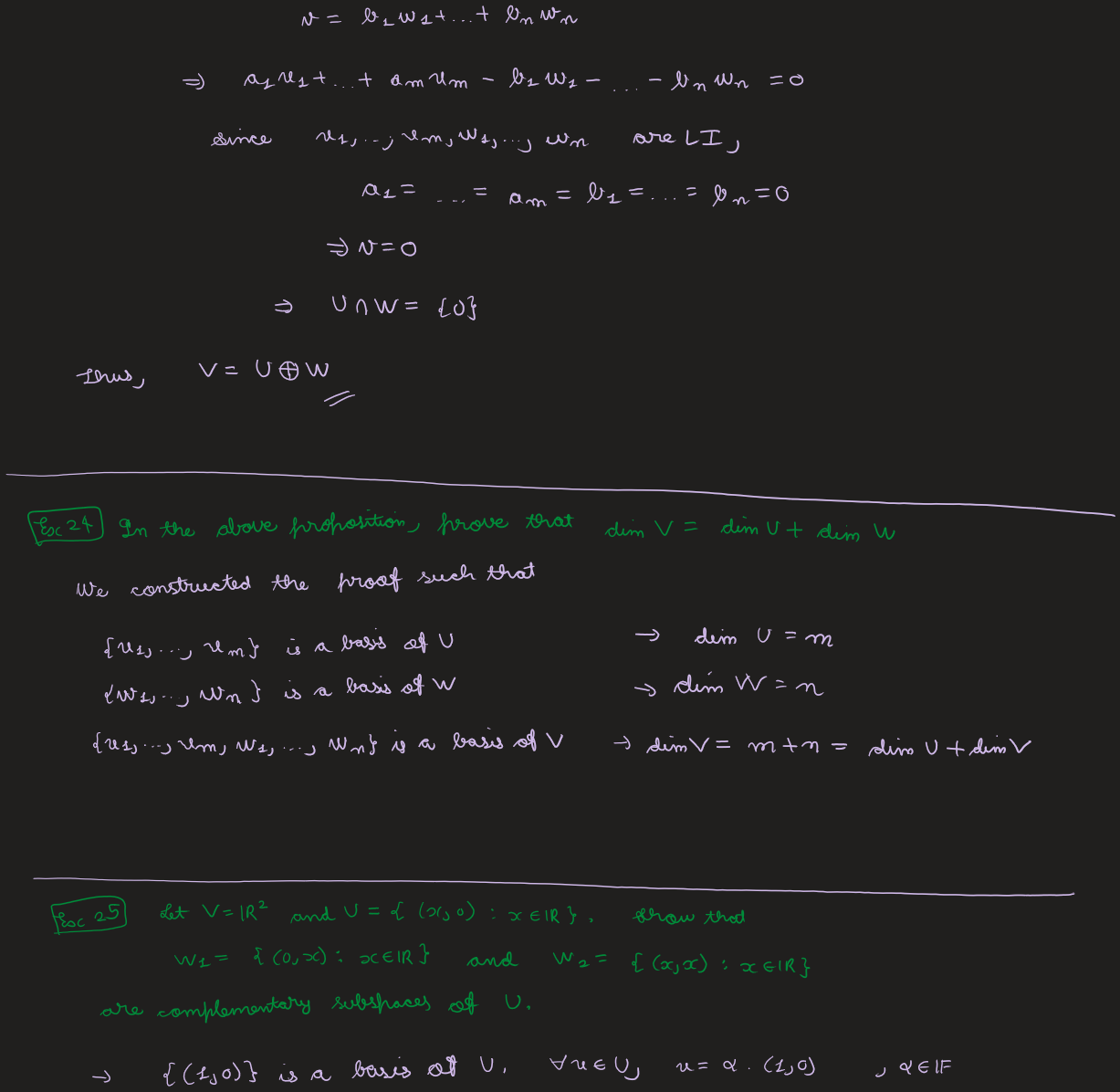
Ex 24
In Proposition 5, prove that \( \dim V = \dim U + \dim W \).
Solution — added in review
From the proof of Proposition 5, a basis \( u_1, \dots, u_m \) of \(U\) extends to a basis \( u_1, \dots, u_m, w_1, \dots, w_{n-m} \) of \(V\), and the \( w_j \) are a basis of \( W = \operatorname{span}(w_1, \dots, w_{n-m}) \). Hence \( \dim U + \dim W = m + (n-m) = n = \dim V \).
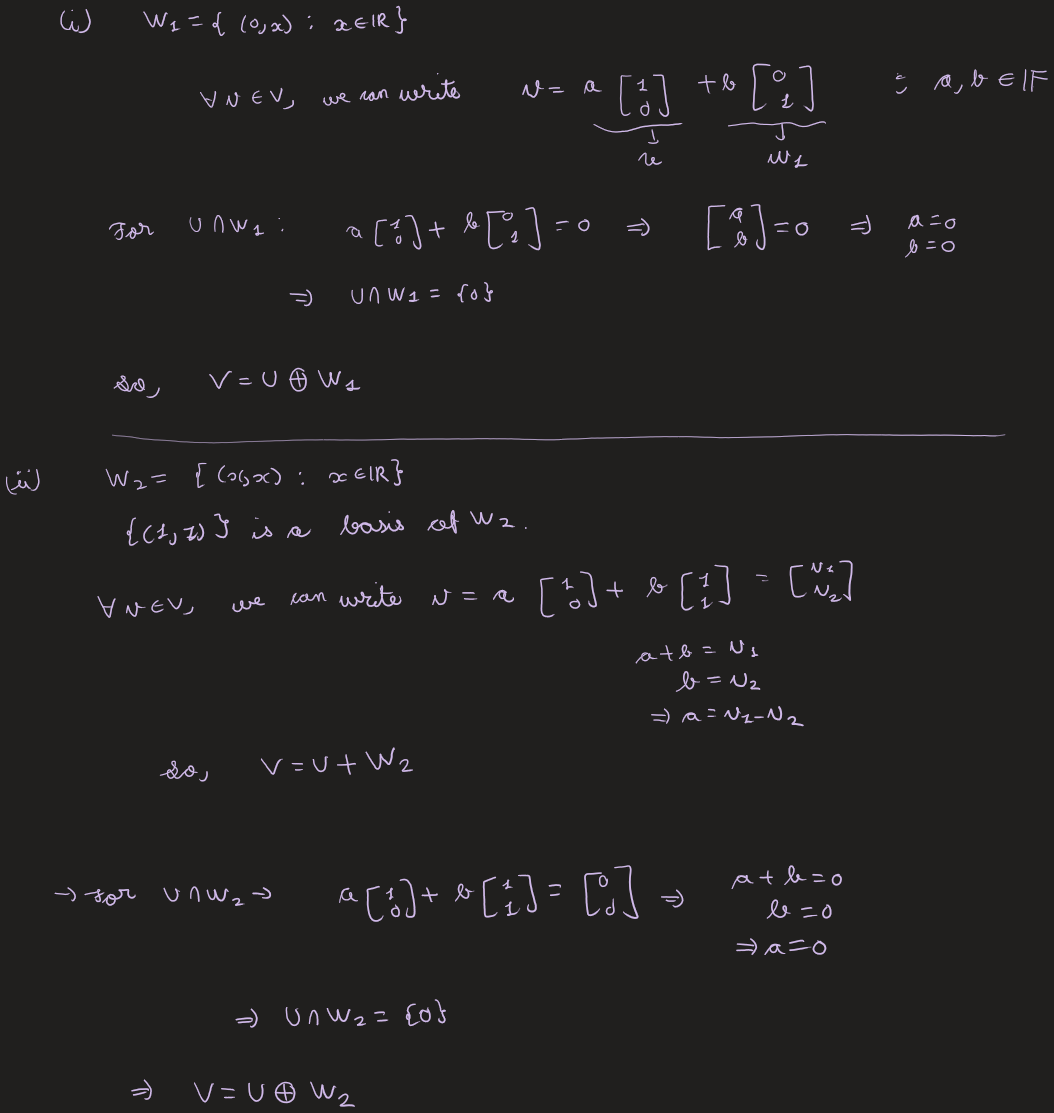
Ex 25
Let \( V = \R^2 \), \( U = \{ (x, 0) : x \in \R \} \). Show \( W_1 = \{ (0, x) : x \in \R \} \) and \( W_2 = \{ (x, x) : x \in \R \} \) are both complementary subspaces of \(U\).
Solution
\( \{(1,0)\} \) is a basis of \(U\). For \( W_1 \): any \( v = a(1,0) + b(0,1) \), so \( V = U + W_1 \); and \( a(1,0) + b(0,1) = 0 \Rightarrow a = b = 0 \), so \( U \cap W_1 = \{0\} \) and \( V = U \oplus W_1 \). For \( W_2 \) (basis \( (1,1) \)): \( v = a(1,0) + b(1,1) = (a+b,\ b) \) is solvable (\( b = v_2 \), \( a = v_1 - v_2 \)), so \( V = U + W_2 \); and \( a(1,0) + b(1,1) = 0 \Rightarrow b = 0, a = 0 \), so \( U \cap W_2 = \{0\} \) and \( V = U \oplus W_2 \). Thus \( W_1 \) and \( W_2 \) are both complementary to \(U\).
View original handwritten scans — Dimension results, Ex 20–25 & Prop 5 (pages 36–44)