Chapter 10 — Singular Value Decomposition
Linear Algebra and its Applications · IISc 2024 · typeset reproduction
Truncated SVD
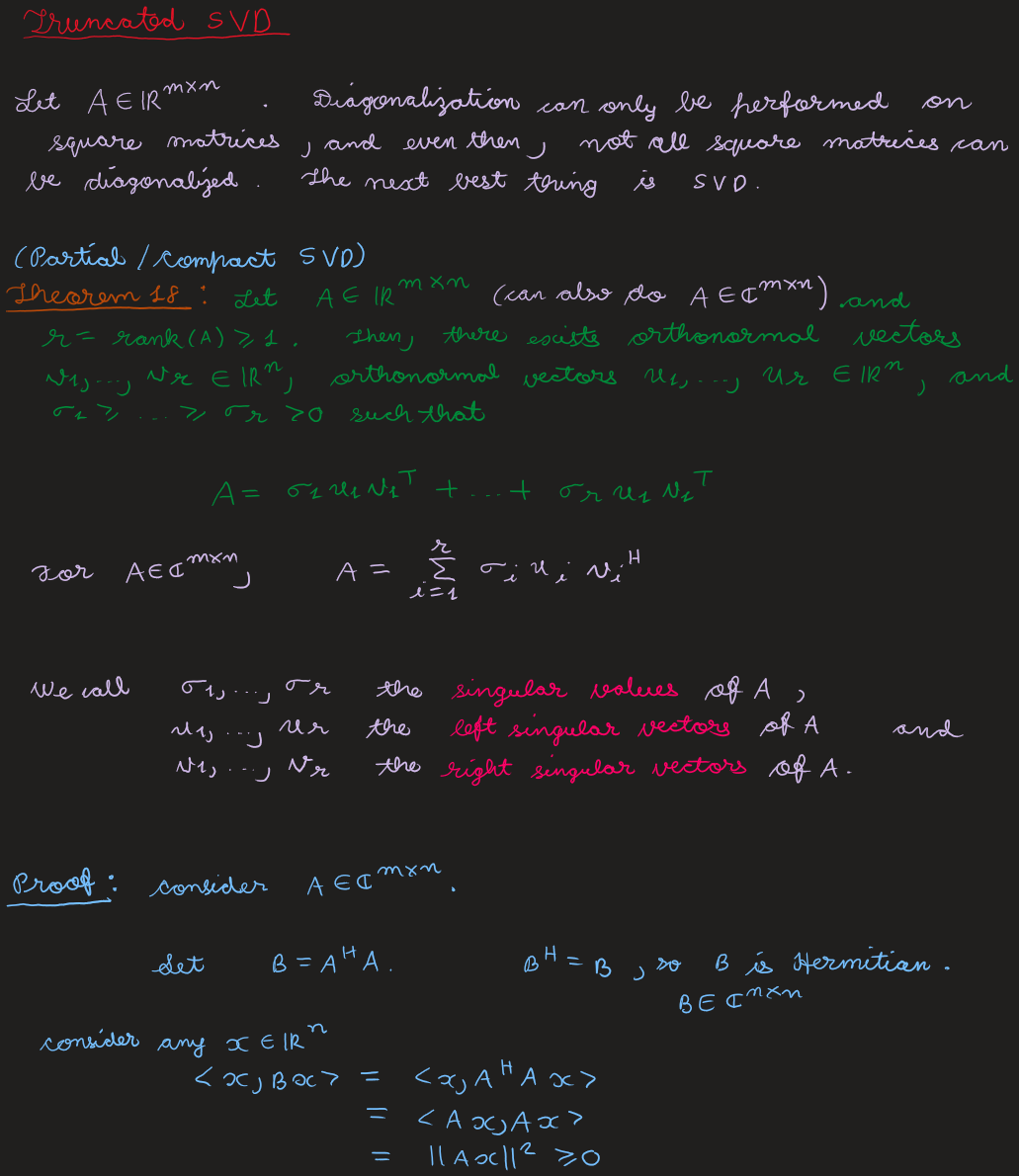
Let \( A \in \R^{m\times n} \). Diagonalization can only be performed on square matrices, and even then not all square matrices can be diagonalized. The next best thing is the SVD.
Theorem 18 — Partial / compact SVD
Let \( A \in \R^{m\times n} \) (this also works for \( A \in \C^{m\times n} \)) and \( r = \rank(A) \ge 1 \). Then there exist orthonormal vectors \( v_1, \dots, v_r \in \R^n \), orthonormal vectors \( u_1, \dots, u_r \in \R^m \), and \( \sigma_1 \ge \dots \ge \sigma_r > 0 \) such that \[ A = \sigma_1 u_1 v_1\T + \dots + \sigma_r u_r v_r\T, \] and for \( A \in \C^{m\times n} \), \[ A = \sum_{i=1}^{r} \sigma_i u_i v_i\herm. \]
We call \( \sigma_1, \dots, \sigma_r \) the singular values of \(A\); \( u_1, \dots, u_r \) the left singular vectors of \(A\); and \( v_1, \dots, v_r \) the right singular vectors of \(A\).
Proof
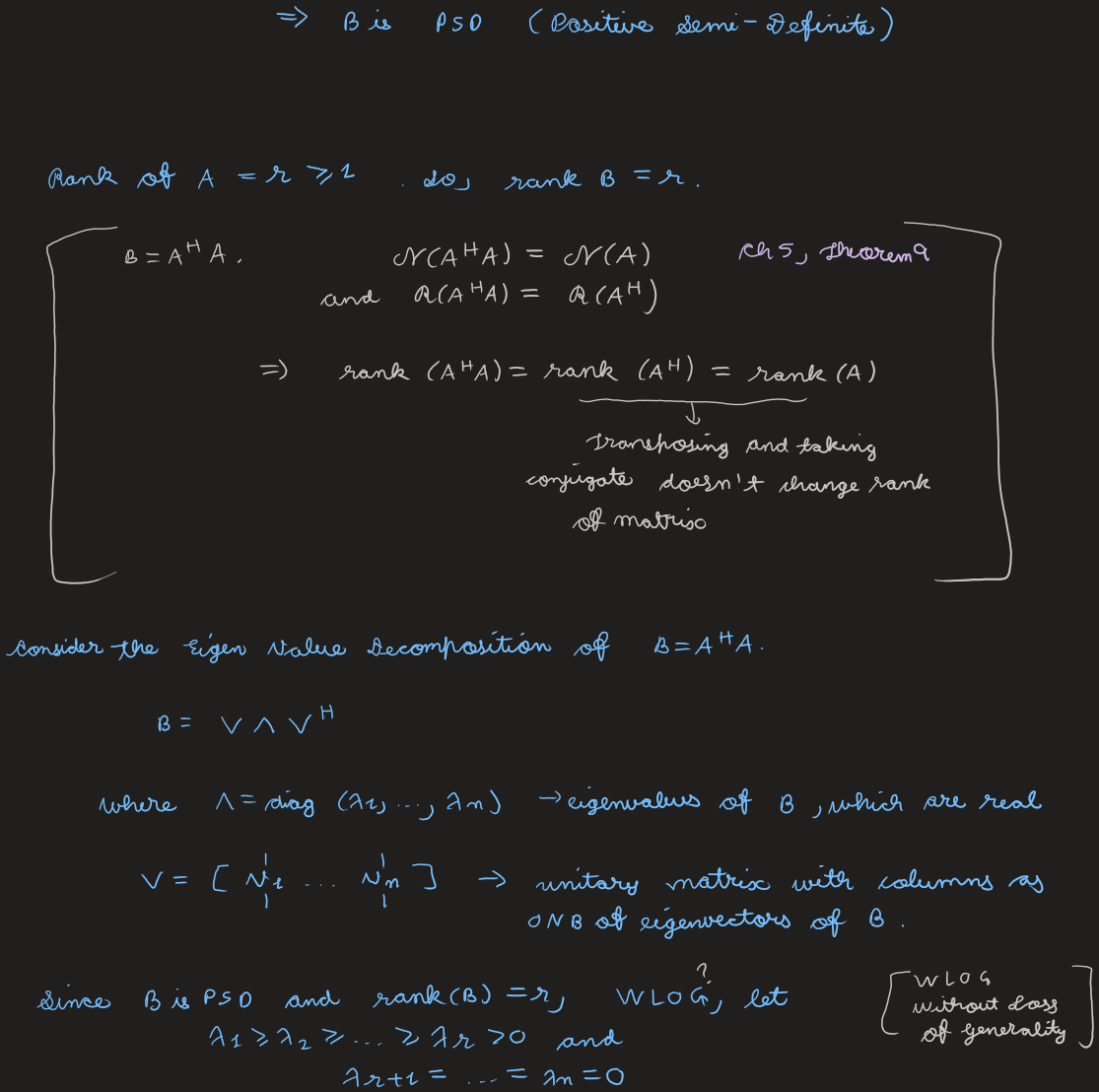
Consider \( A \in \C^{m\times n} \). Let \( B = A\herm A \). Then \( B\herm = B \), so \( B \) is Hermitian, with \( B \in \C^{n\times n} \). For any \( x \in \C^n \) (scan: ℝⁿ), \[ \langle x, Bx \rangle = \langle x, A\herm A x \rangle = \langle Ax, Ax \rangle = \|Ax\|^2 \ge 0, \] so \( B \) is PSD (positive semi-definite).
Since \( \rank(A) = r \ge 1 \), we have \( \rank(B) = r \): with \( B = A\herm A \), \( \Null(A\herm A) = \Null(A) \) and \( \Range(A\herm A) = \Range(A\herm) \) (Ch. 5, Theorem 9), so \[ \rank(A\herm A) = \rank(A\herm) = \rank(A) \] (transposing and conjugating does not change the rank of a matrix).
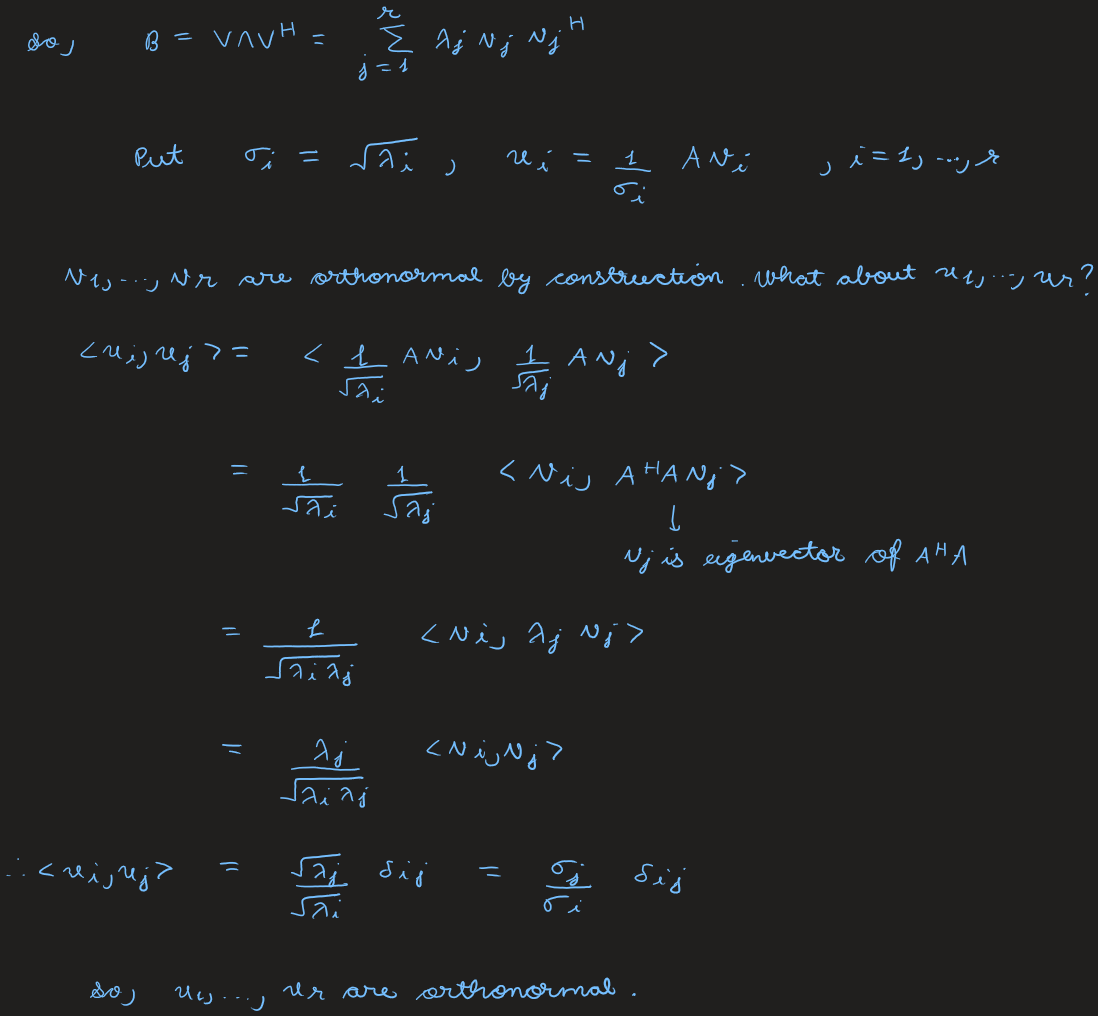
Consider the eigenvalue decomposition of \( B = A\herm A \): \[ B = V \Lambda V\herm, \] where \( \Lambda = \diag(\lambda_1, \dots, \lambda_n) \) holds the eigenvalues of \(B\) (which are real) and \( V = [\,v_1 \ \cdots \ v_n\,] \) is unitary with columns an ONB of eigenvectors of \(B\). Since \(B\) is PSD with \( \rank(B) = r \), WLOG \[ \lambda_1 \ge \lambda_2 \ge \dots \ge \lambda_r > 0, \qquad \lambda_{r+1} = \dots = \lambda_n = 0. \] So \[ B = V \Lambda V\herm = \sum_{j=1}^{r} \lambda_j v_j v_j\herm. \]
Put \( \sigma_i = \sqrt{\lambda_i} \) and \( u_i = \dfrac{1}{\sigma_i} A v_i \), \( i = 1, \dots, r \). The \( v_1, \dots, v_r \) are orthonormal by construction. For the \( u_i \): \[\begin{aligned} \langle u_i, u_j \rangle &= \Big\langle \tfrac{1}{\sqrt{\lambda_i}} A v_i,\ \tfrac{1}{\sqrt{\lambda_j}} A v_j \Big\rangle \\ &= \tfrac{1}{\sqrt{\lambda_i}\sqrt{\lambda_j}} \langle v_i, A\herm A v_j \rangle \\ &= \tfrac{1}{\sqrt{\lambda_i \lambda_j}} \langle v_i, \lambda_j v_j \rangle = \tfrac{\lambda_j}{\sqrt{\lambda_i \lambda_j}} \langle v_i, v_j \rangle, \end{aligned}\] so \( \langle u_i, u_j \rangle = \dfrac{\sqrt{\lambda_j}}{\sqrt{\lambda_i}}\, \delta_{ij} = \dfrac{\sigma_j}{\sigma_i}\, \delta_{ij} \). Hence \( u_1, \dots, u_r \) are orthonormal.
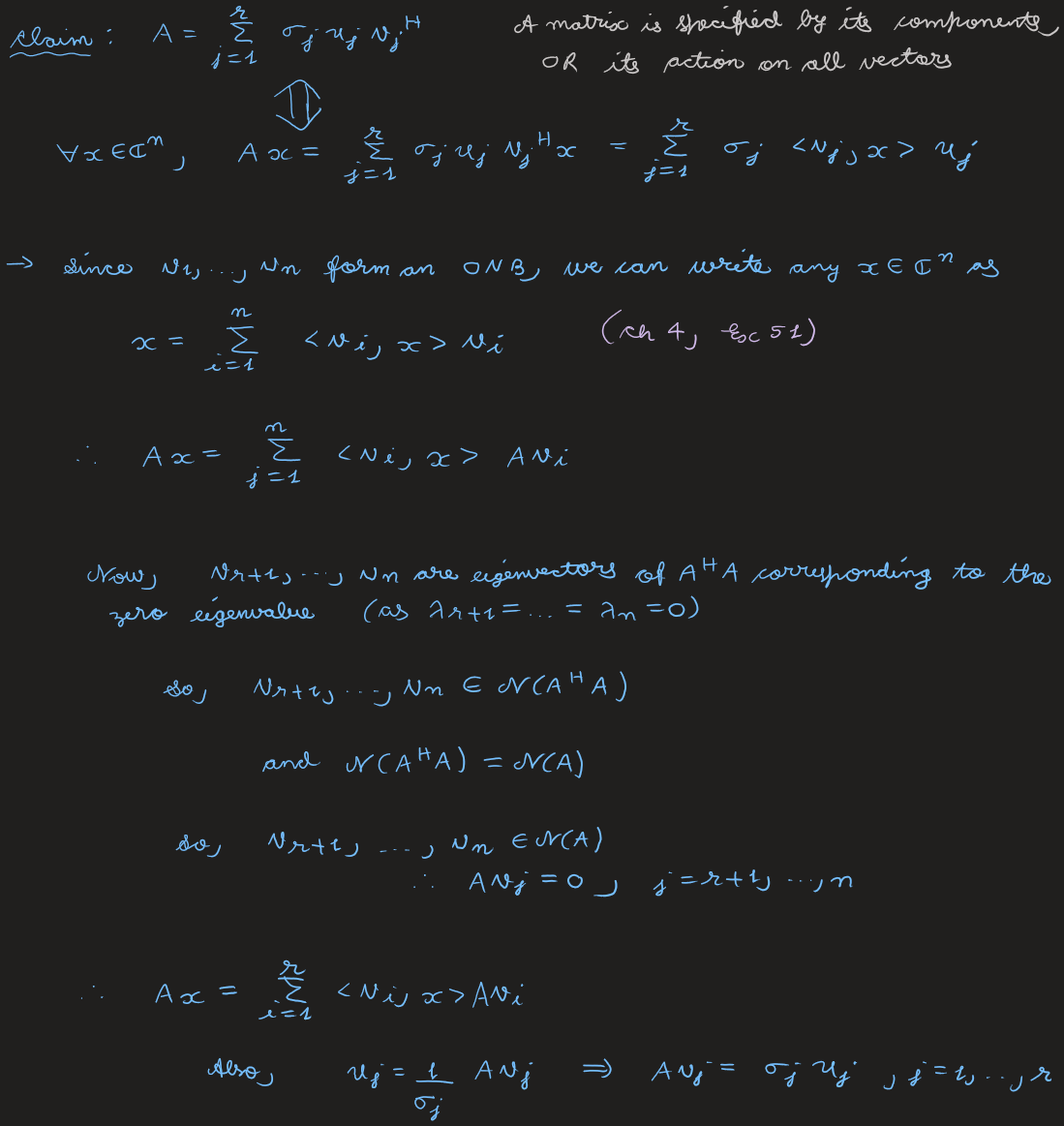
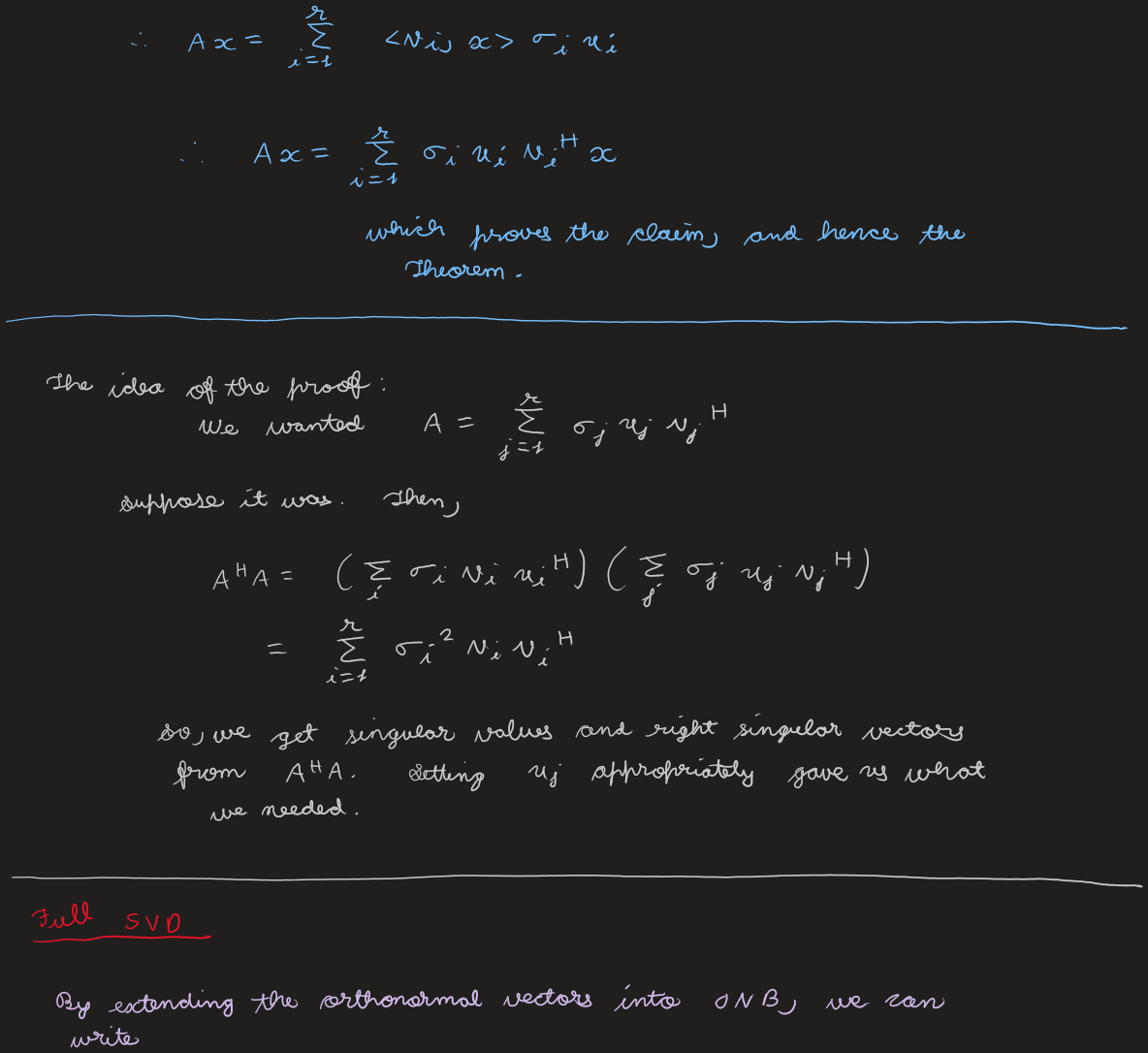
Claim: \( A = \displaystyle\sum_{j=1}^{r} \sigma_j u_j v_j\herm \). (A matrix is specified by its action on all vectors.) For \( x \in \C^n \), the claim gives \[ Ax = \sum_{j=1}^{r} \sigma_j u_j v_j\herm x = \sum_{j=1}^{r} \sigma_j \langle v_j, x \rangle u_j. \] Since \( v_1, \dots, v_n \) form an ONB, any \( x \in \C^n \) can be written as \( x = \sum_{i=1}^{n} \langle v_i, x \rangle v_i \) (Ch. 4, Ex 51). Therefore \[ Ax = \sum_{i=1}^{n} \langle v_i, x \rangle A v_i. \] Now \( v_{r+1}, \dots, v_n \) are eigenvectors of \( A\herm A \) for the zero eigenvalue, so \( v_{r+1}, \dots, v_n \in \Null(A\herm A) = \Null(A) \), giving \( A v_j = 0 \) for \( j = r+1, \dots, n \). Thus \[ Ax = \sum_{i=1}^{r} \langle v_i, x \rangle A v_i, \quad\text{and since } u_i = \tfrac{1}{\sigma_i} A v_i \implies A v_i = \sigma_i u_i, \] \[ Ax = \sum_{i=1}^{r} \langle v_i, x \rangle \sigma_i u_i = \sum_{i=1}^{r} \sigma_i u_i v_i\herm x, \] which proves the claim, and hence the theorem.
The idea of the proof. We wanted \( A = \sum_{j=1}^{r} \sigma_j u_j v_j\herm \). Suppose it were so. Then \[ A\herm A = \Big(\sum_i \sigma_i v_i u_i\herm\Big)\Big(\sum_j \sigma_j u_j v_j\herm\Big) = \sum_{i=1}^{r} \sigma_i^2 v_i v_i\herm. \] So we get the singular values and right singular vectors from \( A\herm A \); setting \( u_j \) appropriately gave us what we needed.
View original handwritten scans — Truncated SVD & proof (pages 1–5)
Full SVD
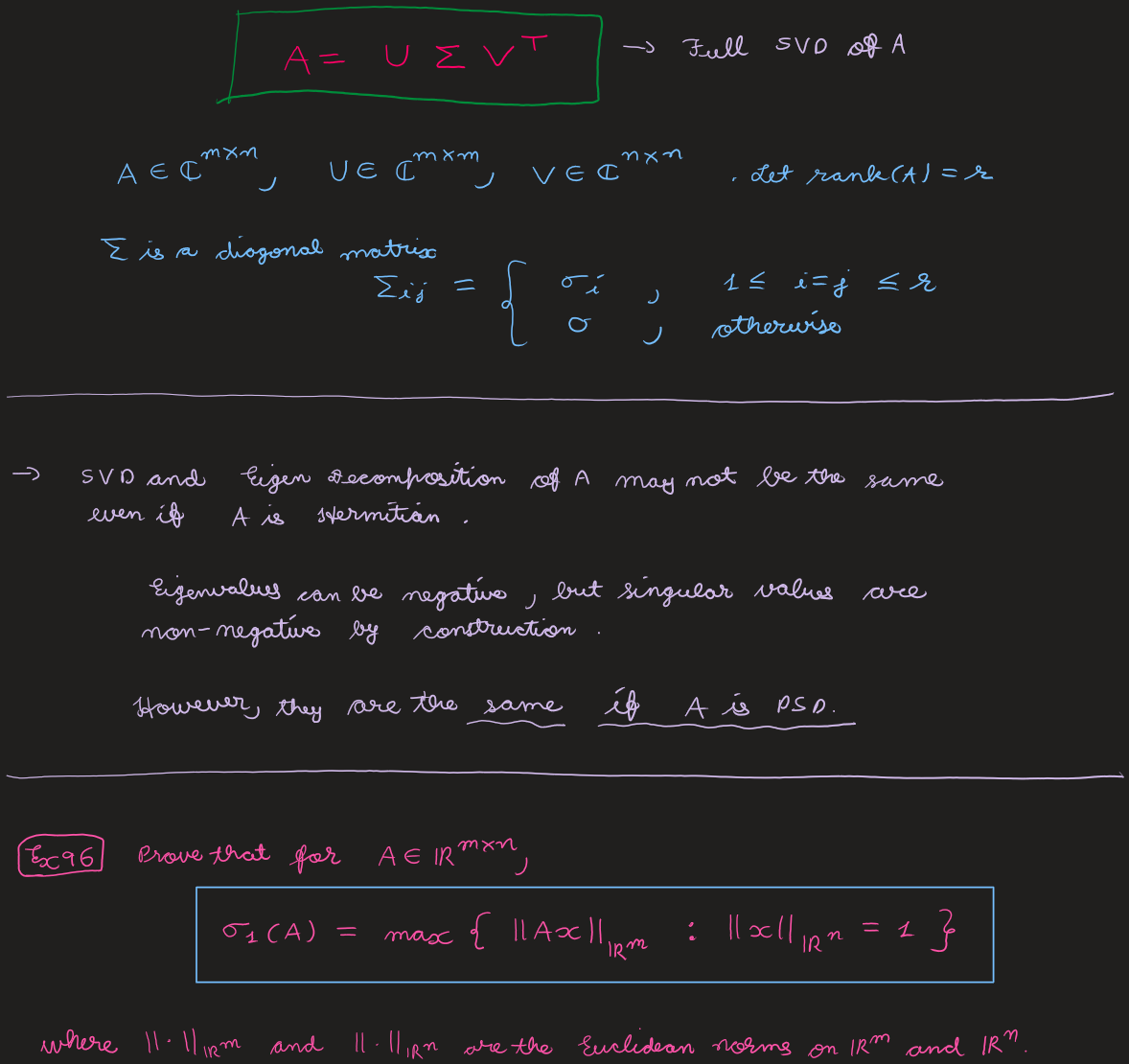
By extending the orthonormal vectors into an ONB, we can write \[ A = U \Sigma V\T \qquad (\text{Full SVD of } A). \] Here \( A \in \C^{m\times n} \), \( U \in \C^{m\times m} \), \( V \in \C^{n\times n} \), and \( \rank(A) = r \). \( \Sigma \) is a diagonal matrix with \[ \Sigma_{ij} = \begin{cases} \sigma_i & 1 \le i = j \le r \\ 0 & \text{otherwise} \end{cases} \]
Remark
SVD and the eigen-decomposition of \(A\) may not be the same, even if \(A\) is Hermitian: eigenvalues can be negative, but singular values are non-negative by construction. However, they are the same if \(A\) is PSD.
Ex 96
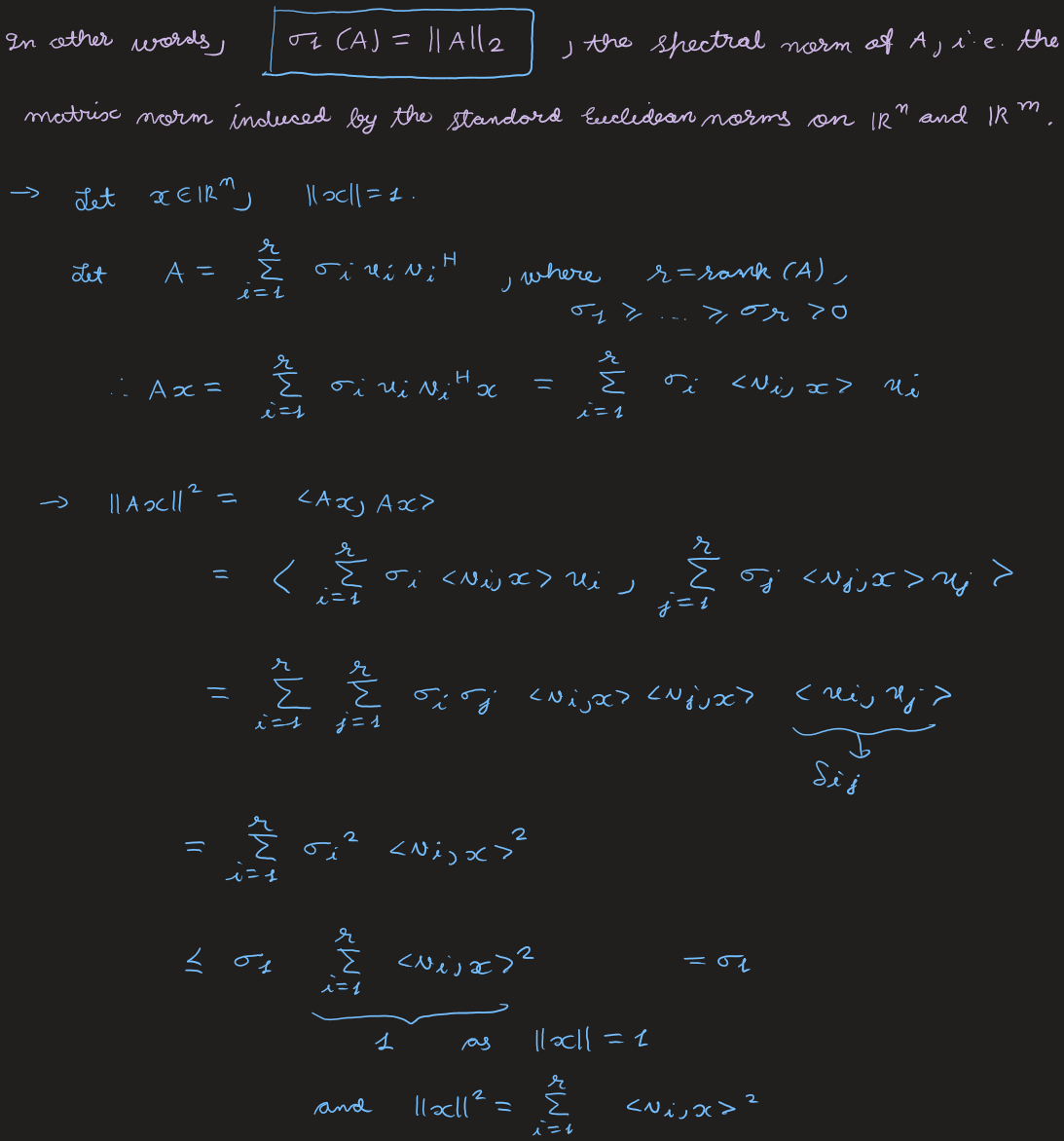
Prove that for \( A \in \R^{m\times n} \), \[ \sigma_1(A) = \max\big\{ \|Ax\|_{\R^m} : \|x\|_{\R^n} = 1 \big\}, \] where \( \|\cdot\|_{\R^m} \) and \( \|\cdot\|_{\R^n} \) are the Euclidean norms on \( \R^m \) and \( \R^n \). In other words, \( \sigma_1(A) = \|A\|_2 \), the spectral norm of \(A\) — the matrix norm induced by the standard Euclidean norms.
Solution
Let \( x \in \R^n \), \( \|x\| = 1 \), and \( A = \sum_{i=1}^{r} \sigma_i u_i v_i\herm \) where \( r = \rank(A) \), \( \sigma_1 \ge \dots \ge \sigma_r > 0 \). Then \[ Ax = \sum_{i=1}^{r} \sigma_i u_i v_i\herm x = \sum_{i=1}^{r} \sigma_i \langle v_i, x \rangle u_i. \]
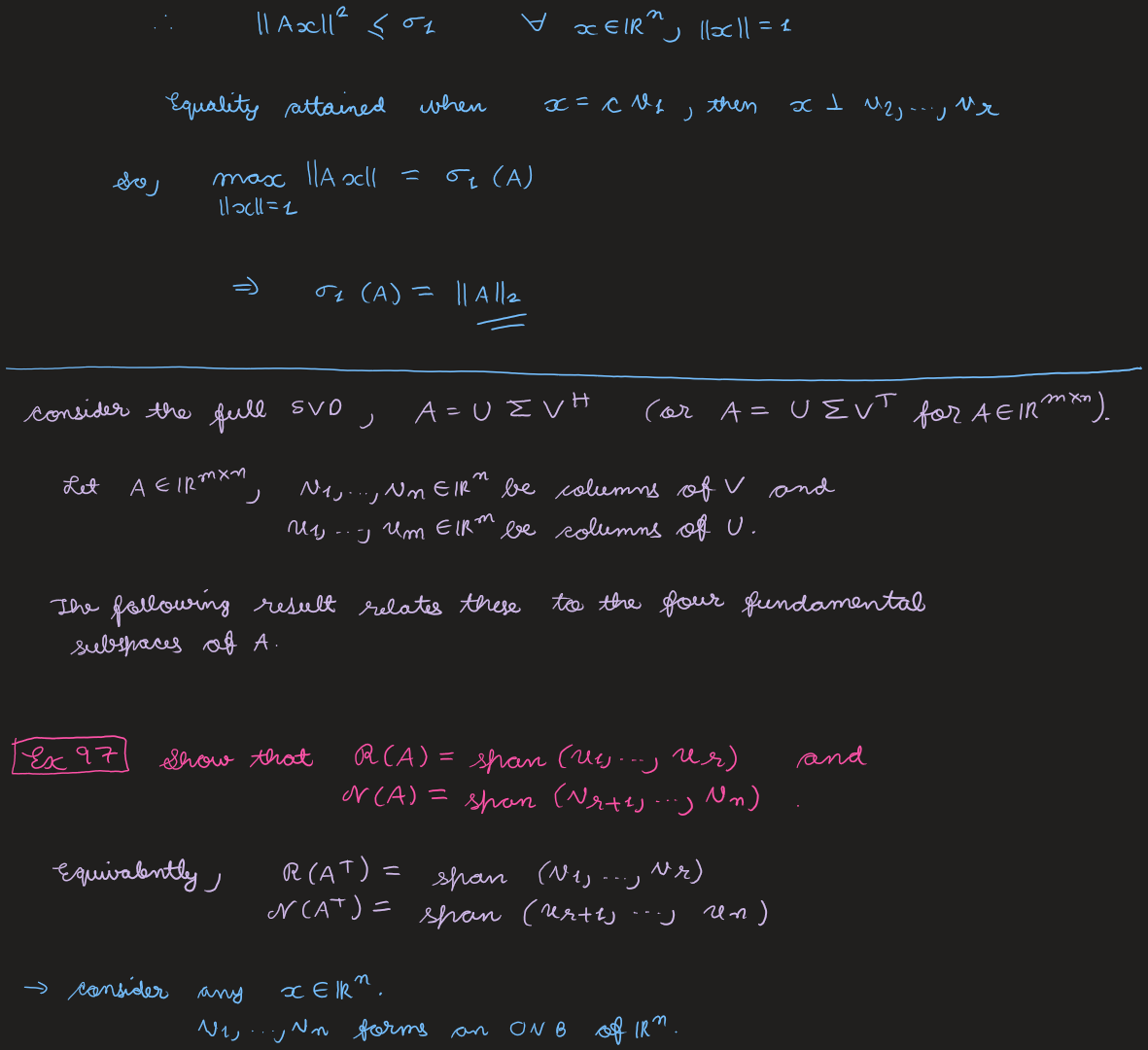
So \[\begin{aligned} \|Ax\|^2 &= \langle Ax, Ax \rangle \\ &= \Big\langle \sum_{i=1}^{r} \sigma_i \langle v_i,x\rangle u_i,\ \sum_{j=1}^{r} \sigma_j \langle v_j,x\rangle u_j \Big\rangle \\ &= \sum_{i=1}^{r}\sum_{j=1}^{r} \sigma_i \sigma_j \langle v_i,x\rangle \langle v_j,x\rangle \underbrace{\langle u_i,u_j\rangle}_{\delta_{ij}} \\ &= \sum_{i=1}^{r} \sigma_i^2 \langle v_i,x\rangle^2 \\ &\le \sigma_1^2 \sum_{i=1}^{r} \langle v_i,x\rangle^2 \\ &\le \sigma_1^2 \underbrace{\sum_{i=1}^{n} \langle v_i,x\rangle^2}_{=\,\|x\|^2 =\, 1} = \sigma_1^2, \end{aligned}\] using \( \sum_{i=1}^{r} \langle v_i,x\rangle^2 \le \sum_{i=1}^{n} \langle v_i,x\rangle^2 = \|x\|^2 = 1 \) (the \( v_1, \dots, v_n \) are a full ONB of \( \R^n \)). Thus \( \|Ax\|^2 \le \sigma_1^2 \ \forall\, x \in \R^n,\ \|x\|=1 \), with equality at \( x = \pm v_1 \) (then \( \langle v_1,x\rangle^2 = 1 \) and \( \langle v_i,x\rangle = 0,\ i \ge 2 \)). So \[ \max_{\|x\|=1} \|Ax\| = \sigma_1(A) \implies \sigma_1(A) = \|A\|_2. \]
Correction
The scan (pages 7–8) writes the bound without the square — \( \|Ax\|^2 \le \sigma_1 \) — but pulling the largest singular value out of \( \sum_{i=1}^{r} \sigma_i^2 \langle v_i,x\rangle^2 \) leaves \( \le \sigma_1^2 \sum_{i=1}^{r}\langle v_i,x\rangle^2 = \sigma_1^2 \). Taking square roots recovers \( \|Ax\| \le \sigma_1 \), so the conclusion \( \sigma_1 = \|A\|_2 \) is unaffected.
Consider the full SVD, \( A = U\Sigma V\herm \) (or \( A = U\Sigma V\T \) for \( A \in \R^{m\times n} \)). Let \( A \in \R^{m\times n} \), let \( v_1, \dots, v_n \in \R^n \) be the columns of \(V\) and \( u_1, \dots, u_m \in \R^m \) the columns of \(U\). The following result relates these to the four fundamental subspaces of \(A\).
Ex 97
Show that \( \Range(A) = \operatorname{span}(u_1, \dots, u_r) \) and \( \Null(A) = \operatorname{span}(v_{r+1}, \dots, v_n) \). Equivalently, \( \Range(A\T) = \operatorname{span}(v_1, \dots, v_r) \) and \( \Null(A\T) = \operatorname{span}(u_{r+1}, \dots, u_m) \).
Solution
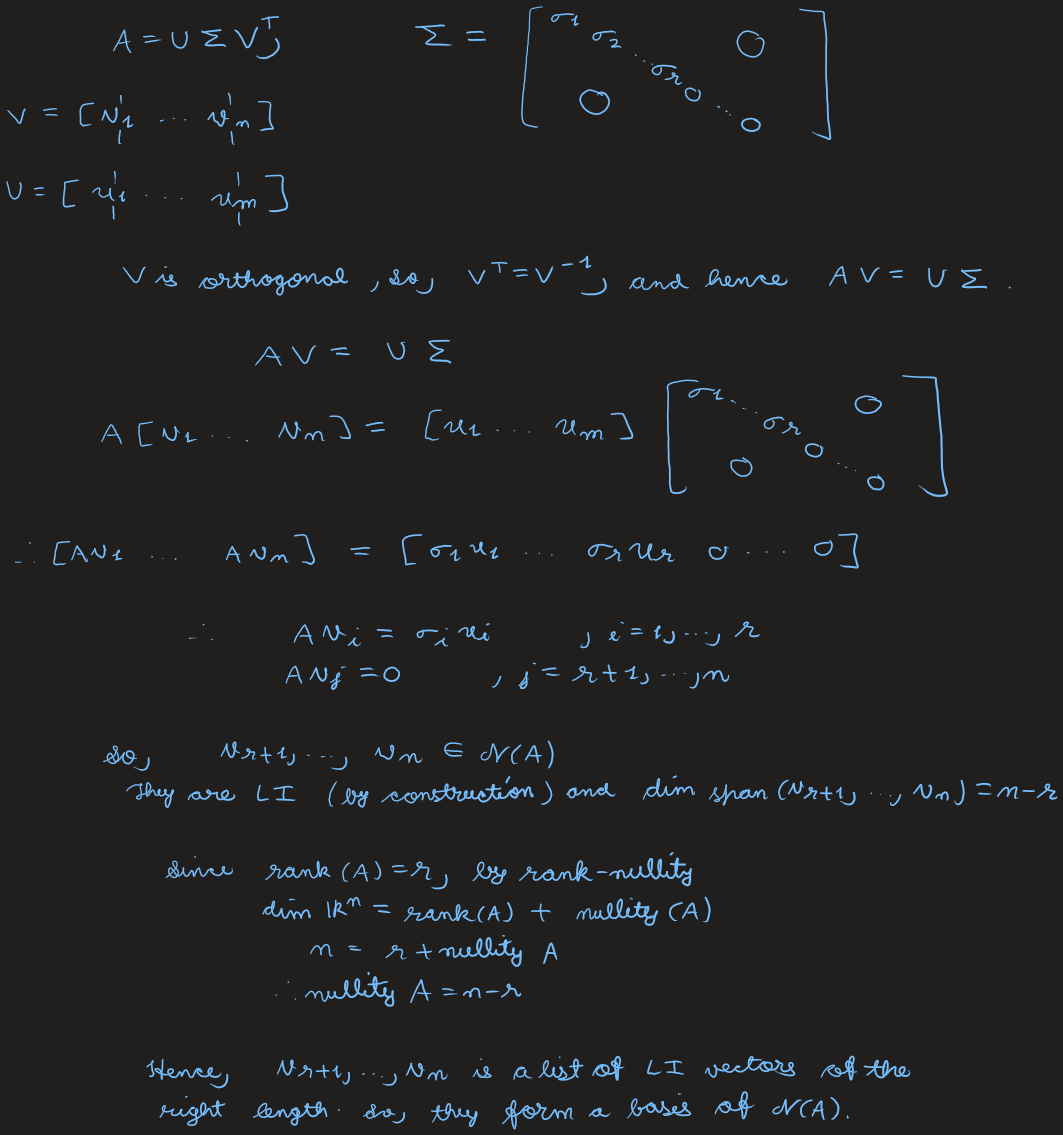
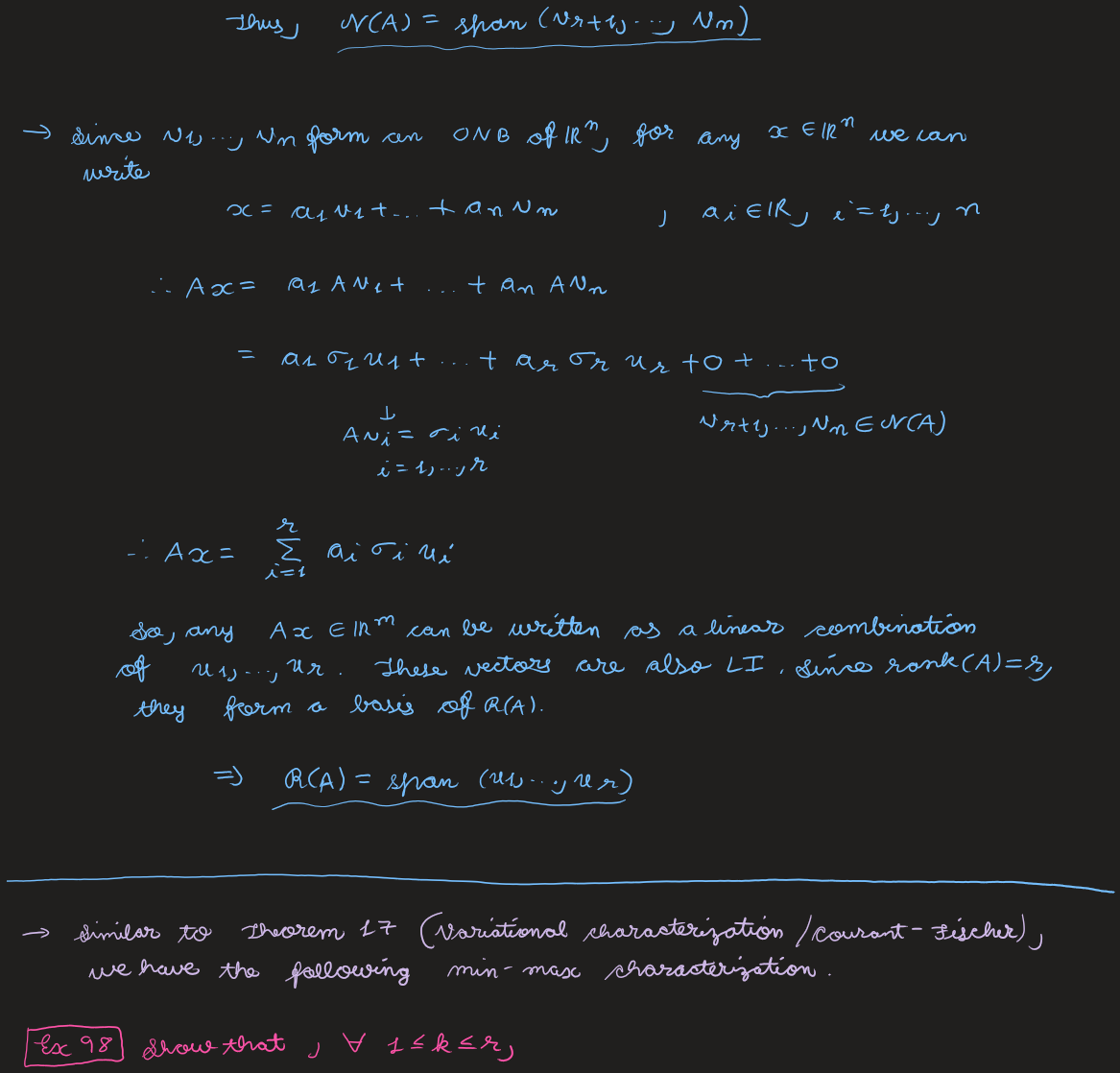
Consider any \( x \in \R^n \); \( v_1, \dots, v_n \) forms an ONB of \( \R^n \). With \( A = U\Sigma V\T \) and \(V\) orthogonal, \( V\T = V^{-1} \), hence \( AV = U\Sigma \). So \[ A[\,v_1 \ \cdots \ v_n\,] = [\,u_1 \ \cdots \ u_m\,]\,\Sigma \implies [\,Av_1 \ \cdots \ Av_n\,] = [\,\sigma_1 u_1 \ \cdots \ \sigma_r u_r \ 0 \ \cdots \ 0\,], \] giving \( A v_i = \sigma_i u_i \) (\( i = 1, \dots, r \)) and \( A v_j = 0 \) (\( j = r+1, \dots, n \)).
So \( v_{r+1}, \dots, v_n \in \Null(A) \); they are LI (by construction) with \( \dim \operatorname{span}(v_{r+1}, \dots, v_n) = n - r \). Since \( \rank(A) = r \), by rank–nullity \( \dim \R^n = \rank(A) + \nullity(A) \), so \( n = r + \nullity(A) \), i.e. \( \nullity(A) = n - r \). Hence \( v_{r+1}, \dots, v_n \) is a list of LI vectors of the right length, so they form a basis of \( \Null(A) \): \[ \Null(A) = \operatorname{span}(v_{r+1}, \dots, v_n). \]
Since \( v_1, \dots, v_n \) form an ONB of \( \R^n \), any \( x \in \R^n \) is \( x = a_1 v_1 + \dots + a_n v_n \), \( a_i \in \R \). Then \[ Ax = a_1 A v_1 + \dots + a_n A v_n = a_1 \sigma_1 u_1 + \dots + a_r \sigma_r u_r + 0 + \dots + 0 = \sum_{i=1}^{r} a_i \sigma_i u_i. \] So any \( Ax \in \R^m \) is a linear combination of \( u_1, \dots, u_r \); these are LI and, since \( \rank(A) = r \), they form a basis of \( \Range(A) \): \[ \Range(A) = \operatorname{span}(u_1, \dots, u_r). \]
Remark
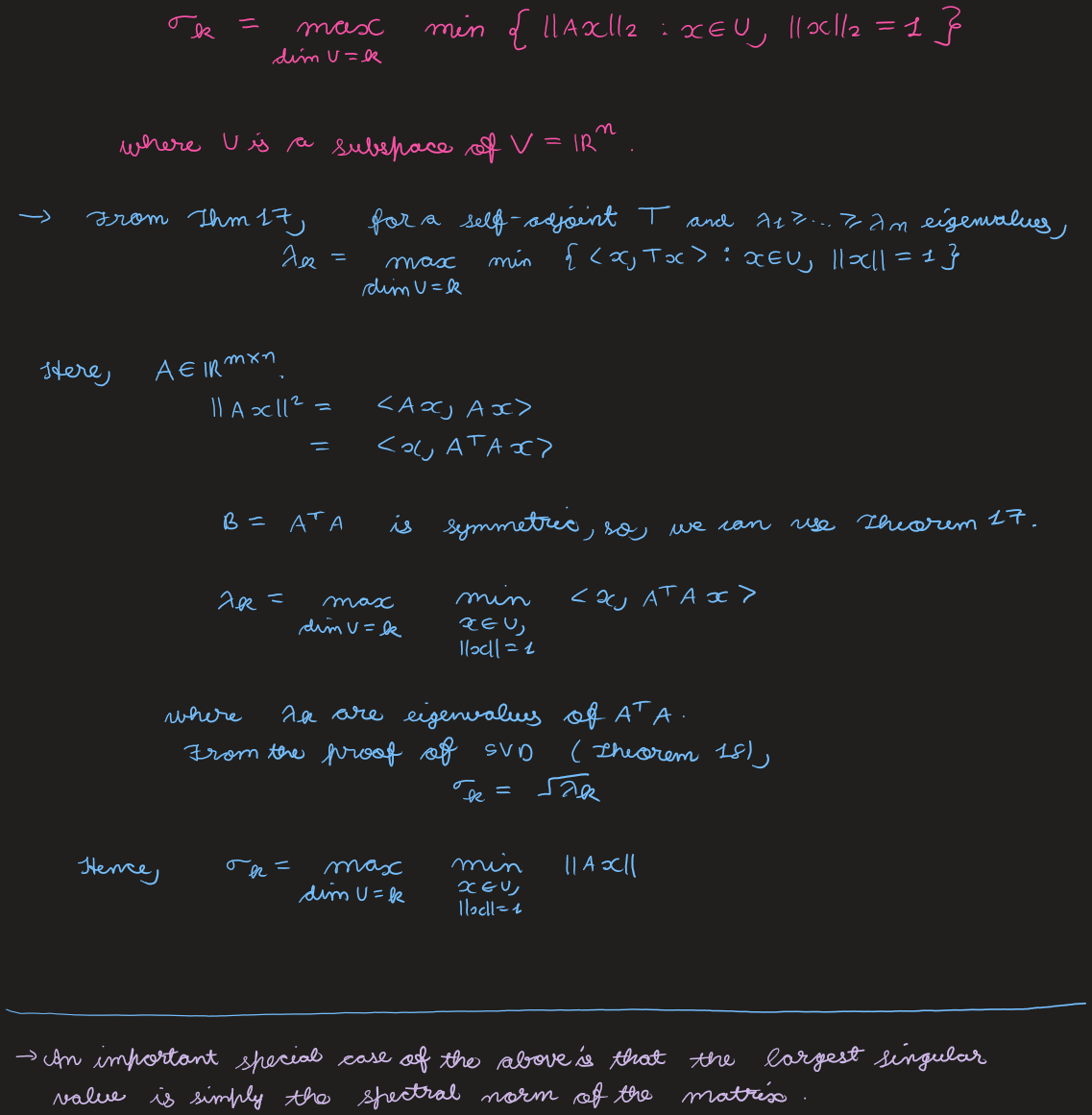
Similar to Theorem 17 (variational characterization / Courant–Fischer), we have the following min–max characterization.
Ex 98
Show that, for all \( 1 \le k \le r \), \[ \sigma_k = \max_{\dim U = k} \ \min\big\{ \|Ax\|_2 : x \in U,\ \|x\|_2 = 1 \big\}, \] where \(U\) is a subspace of \( V = \R^n \).
Solution
From Theorem 17, for a self-adjoint \(T\) with eigenvalues \( \lambda_1 \ge \dots \ge \lambda_n \), \[ \lambda_k = \max_{\dim U = k} \ \min\big\{ \langle x, Tx \rangle : x \in U,\ \|x\| = 1 \big\}. \] Here \( A \in \R^{m\times n} \) and \( \|Ax\|^2 = \langle Ax, Ax \rangle = \langle x, A\T A x \rangle \). Since \( B = A\T A \) is symmetric, we can use Theorem 17: \[ \lambda_k = \max_{\dim U = k} \ \min_{\substack{x \in U \\ \|x\|=1}} \langle x, A\T A x \rangle, \] where the \( \lambda_k \) are eigenvalues of \( A\T A \). From the proof of the SVD (Theorem 18), \( \sigma_k = \sqrt{\lambda_k} \). Hence \[ \sigma_k = \max_{\dim U = k} \ \min_{\substack{x \in U \\ \|x\|=1}} \|Ax\|. \]
Remark
An important special case is that the largest singular value is simply the spectral norm of the matrix: \( \sigma_1(A) = \|A\|_2 \).
Ex 99
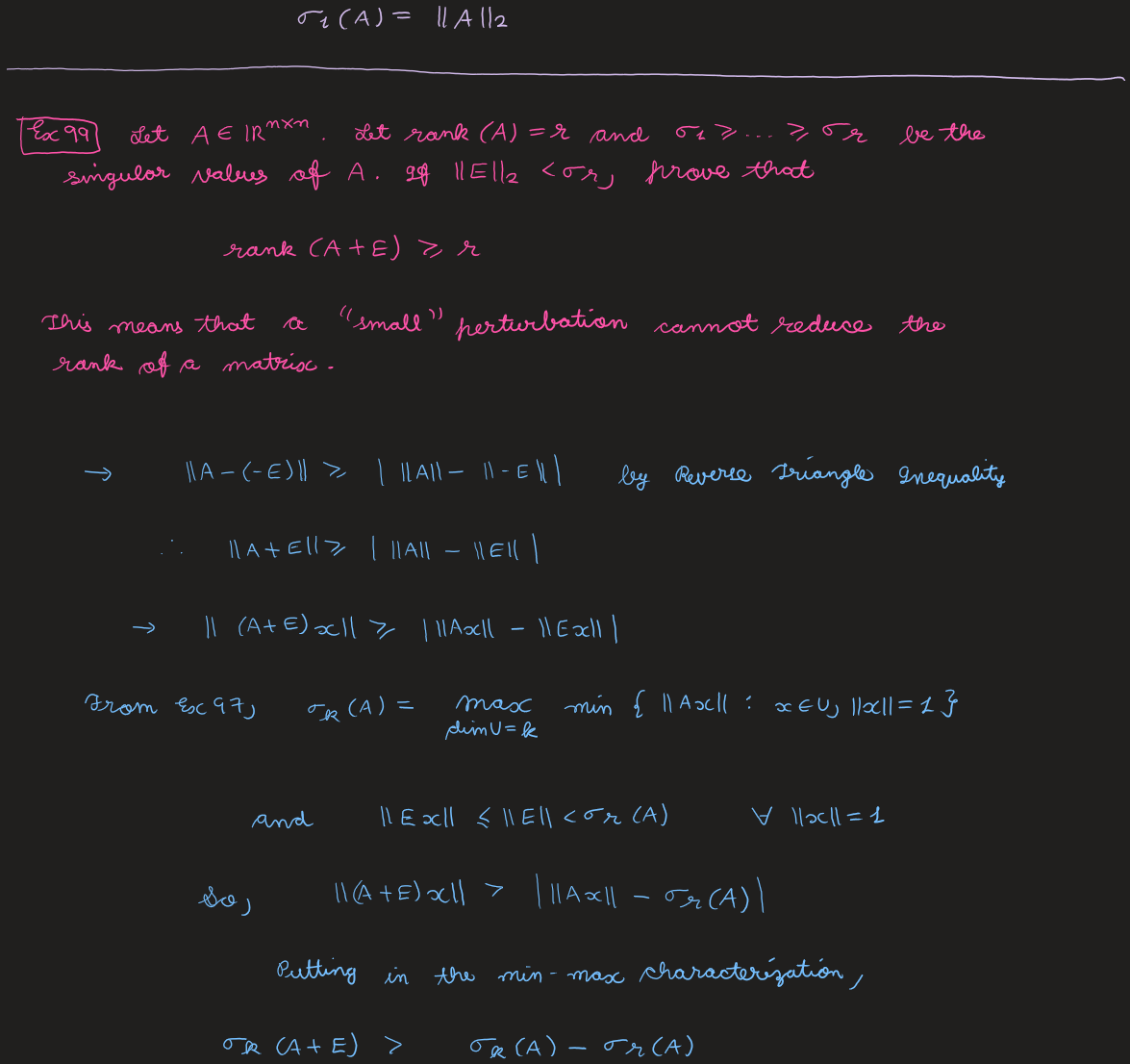
Let \( A \in \R^{m\times n} \) with \( \rank(A) = r \) and singular values \( \sigma_1 \ge \dots \ge \sigma_r \). If \( \|E\|_2 < \sigma_r \), prove that \( \rank(A + E) \ge r \). (A "small" perturbation cannot reduce the rank of a matrix.)
Solution
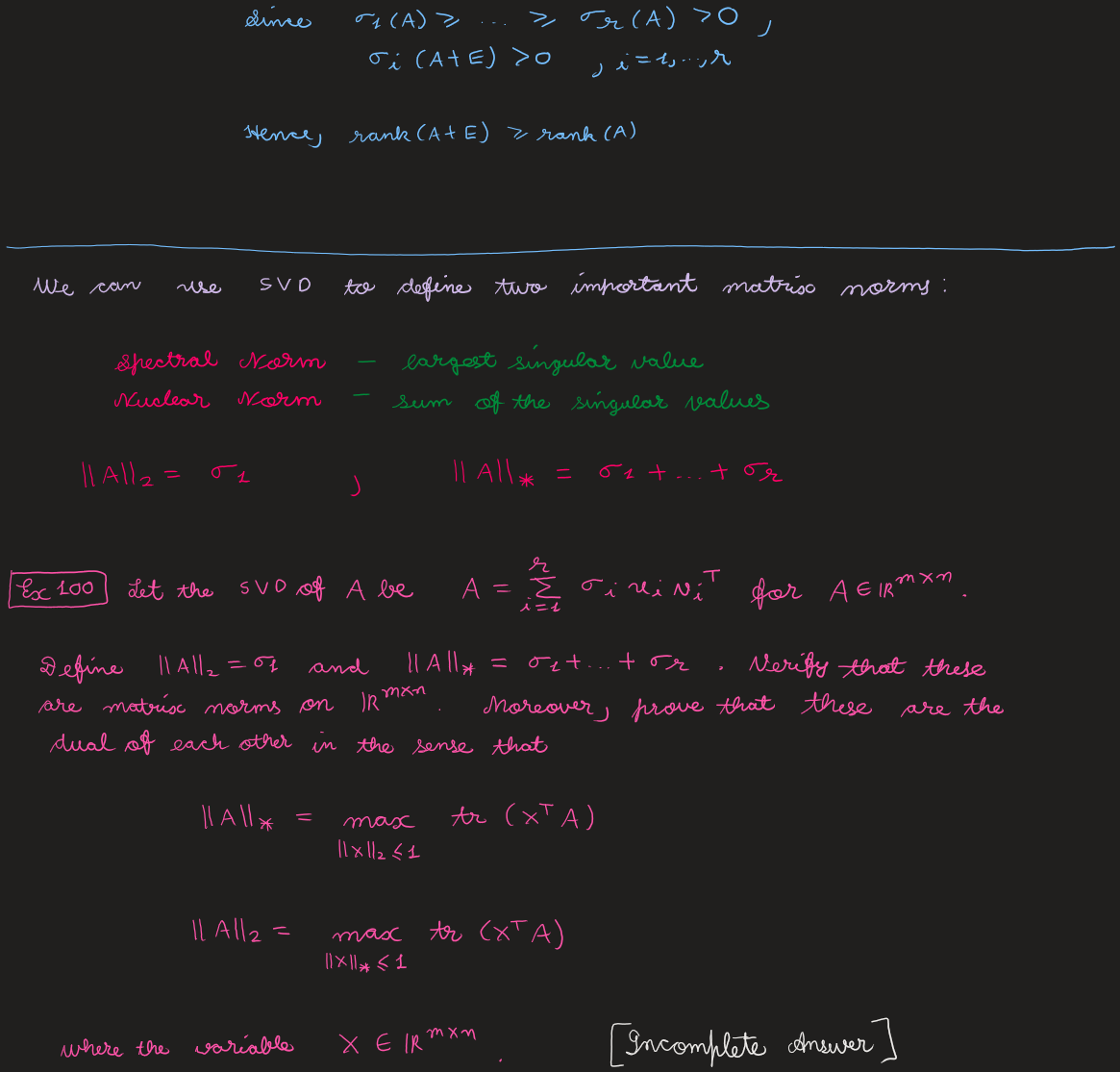
For any \( x \) with \( \|x\| = 1 \), the triangle inequality gives \( \|(A+E)x\| \ge \|Ax\| - \|Ex\| \ge \|Ax\| - \|E\|_2 \) (since \( \|Ex\| \le \|E\|_2 \)). Taking the \( \min \) over a \(k\)-dimensional subspace and then the \( \max \) over such subspaces, the min–max characterization (Ex 98 (scan: Ex 97)) yields the Weyl bound \[ \sigma_k(A+E) \ \ge\ \sigma_k(A) - \|E\|_2 \qquad (1 \le k \le r). \] For each \( k = 1, \dots, r \), \( \sigma_k(A) \ge \sigma_r(A) > \|E\|_2 \) (given), so \( \sigma_k(A+E) \ge \sigma_k(A) - \|E\|_2 > 0 \). Thus \( A+E \) has at least \(r\) strictly positive singular values, i.e. \( \rank(A+E) \ge r \).
Correction — Ex 99 bound
The original bounded \( \|Ex\| \) by \( \sigma_r(A) \) (the limit in the hypothesis) rather than by the actual perturbation size \( \|E\|_2 \), arriving at \( \sigma_k(A+E) \ge \sigma_k(A) - \sigma_r(A) \). For \( k = r \) that only gives \( \sigma_r(A+E) \ge 0 \), which does not force the rank to stay \( \ge r \). Using \( \|E\|_2 \) gives \( \sigma_k(A+E) \ge \sigma_k(A) - \|E\|_2 > 0 \) for all \( k \le r \) (as \( \sigma_k(A) \ge \sigma_r(A) > \|E\|_2 \)) — the strict positivity the conclusion needs.
We can use the SVD to define two important matrix norms:
- Spectral norm — the largest singular value: \( \|A\|_2 = \sigma_1 \).
- Nuclear norm — the sum of the singular values: \( \|A\|_* = \sigma_1 + \dots + \sigma_r \).
Ex 100
Let the SVD of \(A\) be \( A = \sum_{i=1}^{r} \sigma_i u_i v_i\T \) for \( A \in \R^{m\times n} \). Define \( \|A\|_2 = \sigma_1 \) and \( \|A\|_* = \sigma_1 + \dots + \sigma_r \). Verify that these are matrix norms on \( \R^{m\times n} \). Moreover, prove that they are dual to each other, in the sense that \[ \|A\|_* = \max_{\|X\|_2 \le 1} \tr(X\T A), \qquad \|A\|_2 = \max_{\|X\|_* \le 1} \tr(X\T A), \] where the variable \( X \in \R^{m\times n} \). [The original left the two duals and nuclear-norm submultiplicativity incomplete, and its triangle-inequality argument was flawed; both are corrected/completed in review below.]
Solution
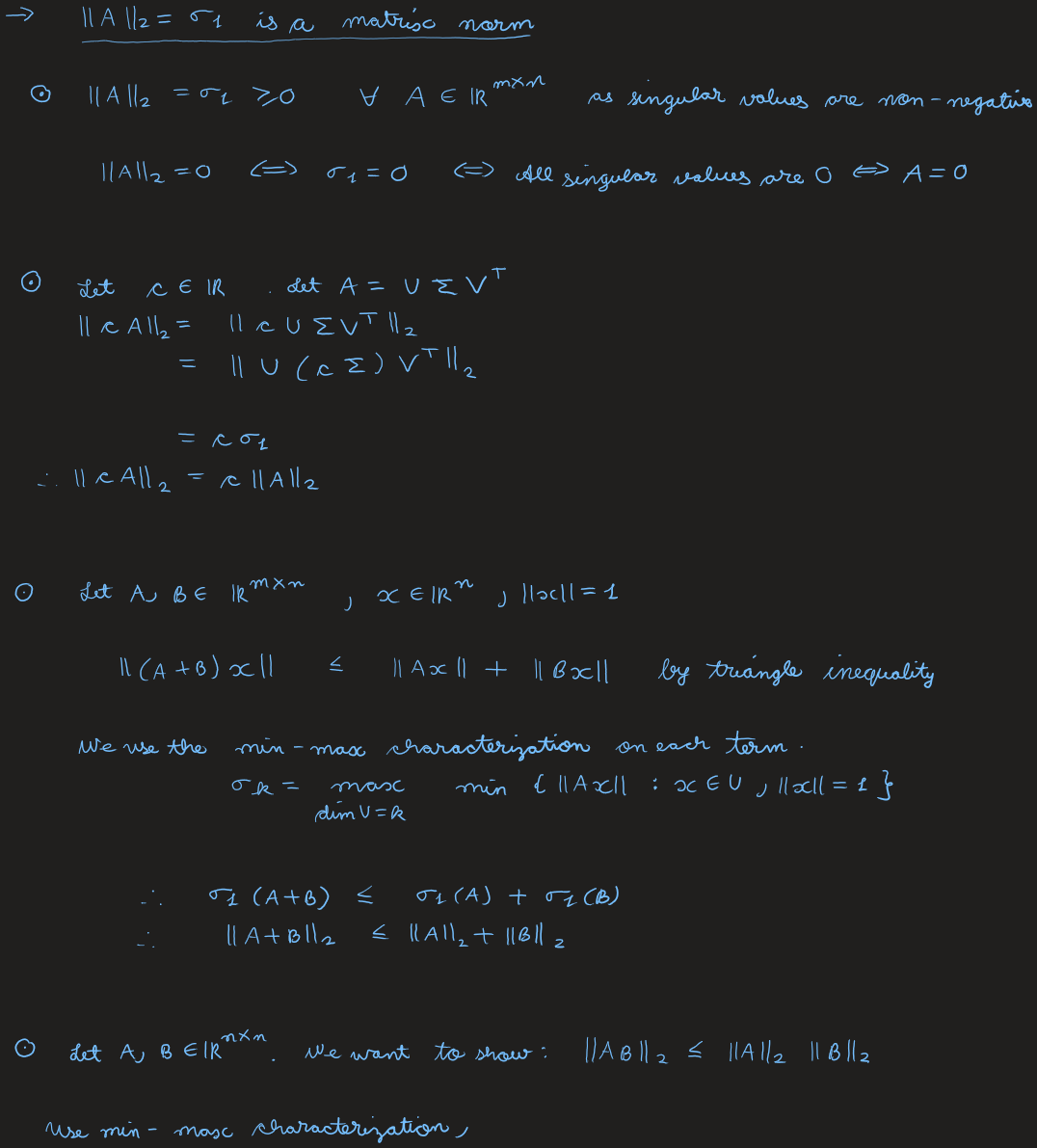
\( \|A\|_2 = \sigma_1 \) is a matrix norm.
- \( \|A\|_2 = \sigma_1 \ge 0 \ \forall\, A \in \R^{m\times n} \) (singular values are non-negative); \( \|A\|_2 = 0 \iff \sigma_1 = 0 \iff \) all singular values are \(0\) \( \iff A = 0 \).
- Let \( c \in \R \), \( A = U\Sigma V\T \). Then \( \|cA\|_2 = \|c\,U\Sigma V\T\|_2 = \|U(c\Sigma)V\T\|_2 = |c|\,\sigma_1 \), so \( \|cA\|_2 = |c|\,\|A\|_2 \) (scan: c, no bars).
- Let \( A, B \in \R^{m\times n} \), \( x \in \R^n \), \( \|x\| = 1 \). Then \( \|(A+B)x\| \le \|Ax\| + \|Bx\| \) (triangle inequality). Using the min–max characterization on each term, \( \sigma_1(A+B) \le \sigma_1(A) + \sigma_1(B) \), i.e. \( \|A+B\|_2 \le \|A\|_2 + \|B\|_2 \).
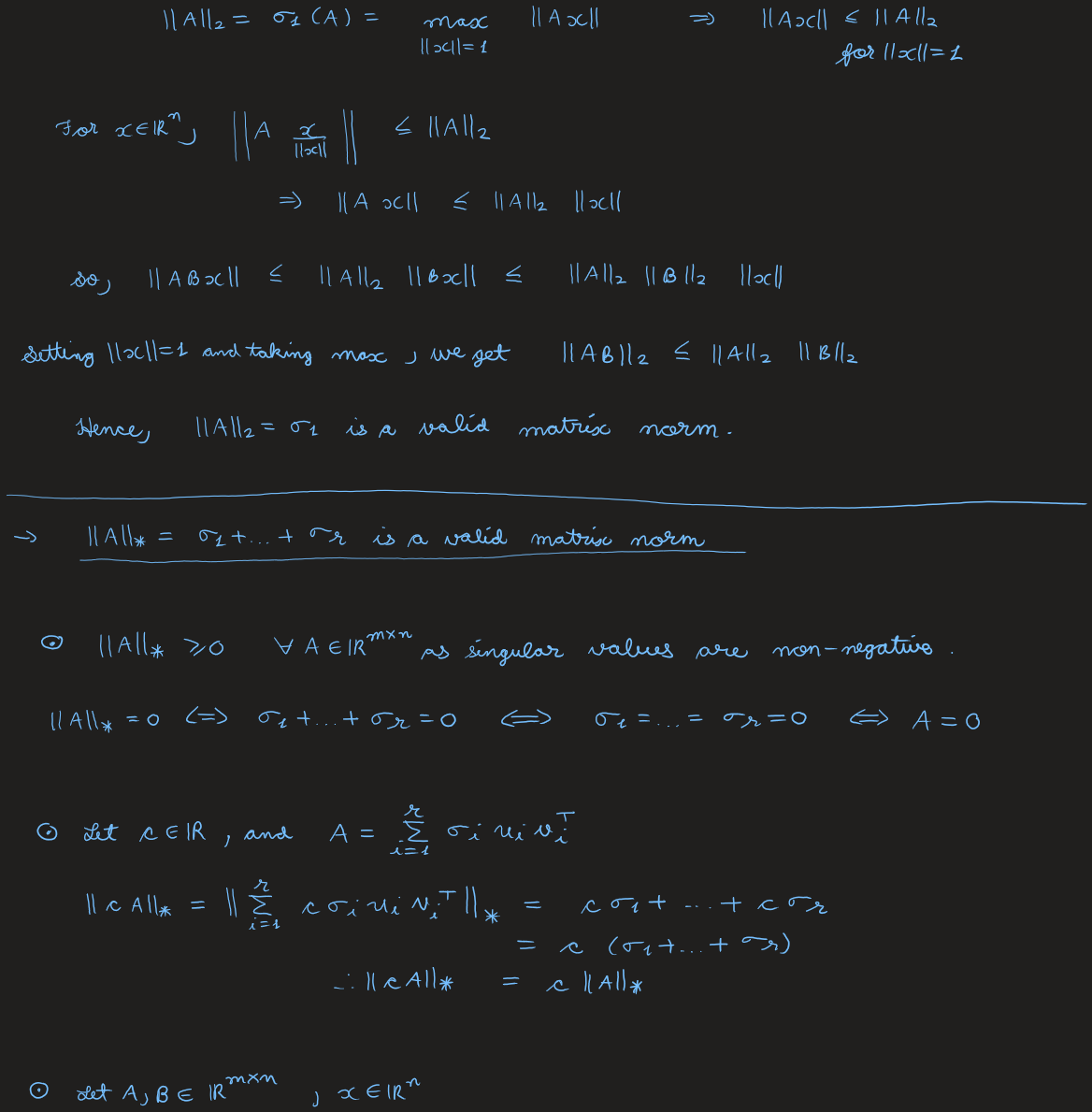
- Let \( A, B \in \R^{n\times n} \). From \( \|A\|_2 = \sigma_1(A) = \max_{\|x\|=1}\|Ax\| \) we get \( \|Ax\| \le \|A\|_2 \) for \( \|x\| = 1 \), so for \( x \in \R^n \), \( \big\|A \tfrac{x}{\|x\|}\big\| \le \|A\|_2 \implies \|Ax\| \le \|A\|_2\|x\| \). Then \( \|ABx\| \le \|A\|_2\|Bx\| \le \|A\|_2\|B\|_2\|x\| \); setting \( \|x\|=1 \) and taking the max, \( \|AB\|_2 \le \|A\|_2\|B\|_2 \). Hence \( \|A\|_2 = \sigma_1 \) is a valid matrix norm.
\( \|A\|_* = \sigma_1 + \dots + \sigma_r \) is a matrix norm.
- \( \|A\|_* \ge 0 \ \forall\, A \in \R^{m\times n} \); \( \|A\|_* = 0 \iff \sigma_1 + \dots + \sigma_r = 0 \iff \sigma_1 = \dots = \sigma_r = 0 \iff A = 0 \).
- Let \( c \in \R \), \( A = \sum_{i=1}^{r} \sigma_i u_i v_i\T \). Then \( \|cA\|_* = \big\|\sum_{i=1}^{r} c\,\sigma_i u_i v_i\T\big\|_* = |c|\sigma_1 + \dots + |c|\sigma_r = |c|(\sigma_1 + \dots + \sigma_r) \), so \( \|cA\|_* = |c|\,\|A\|_* \) (scan: c, no bars).
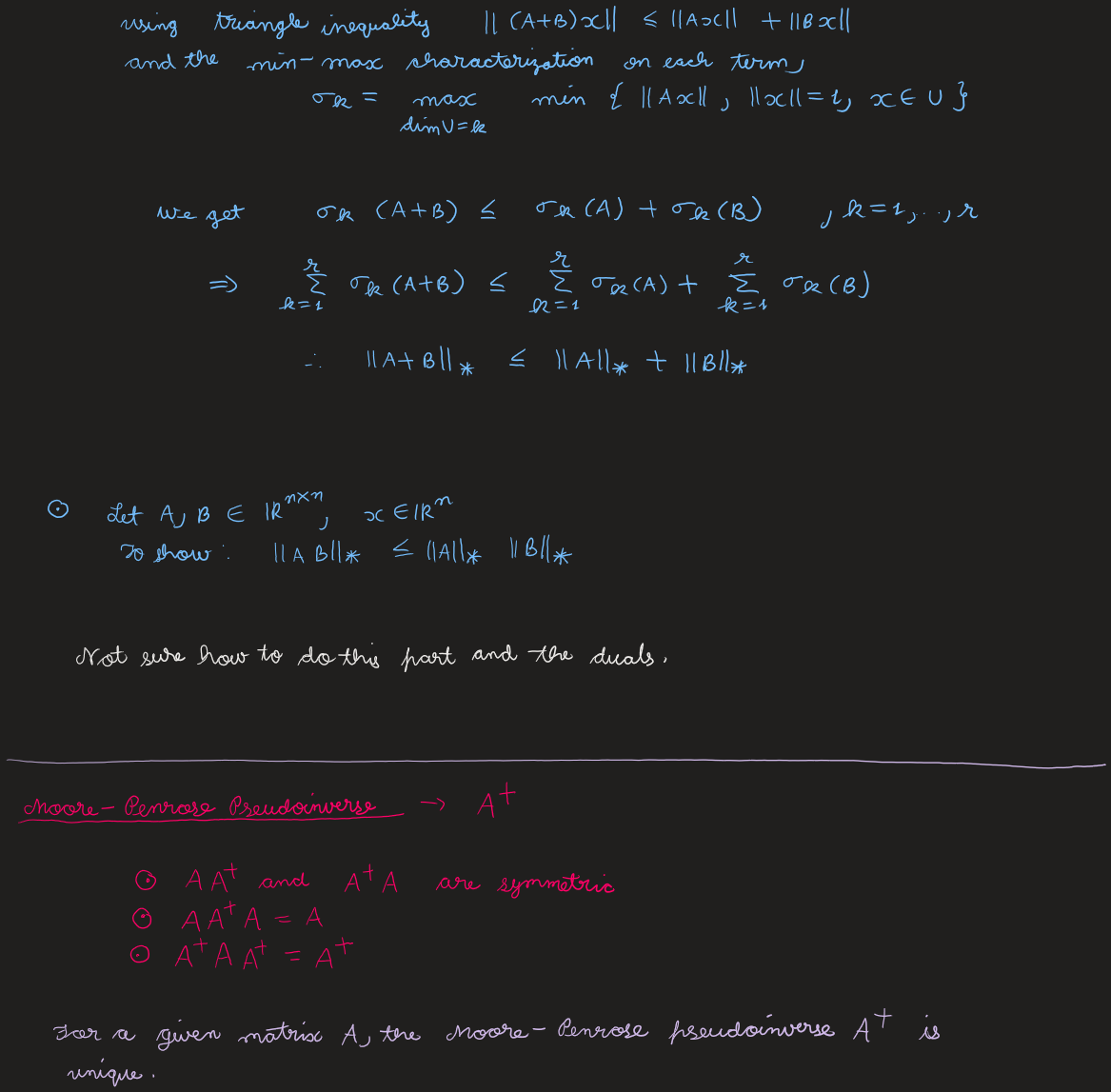
- Triangle inequality \( \|A+B\|_* \le \|A\|_* + \|B\|_* \): follows directly from the dual characterization \( \|A\|_* = \max_{\|X\|_2\le1}\tr(X\T A) \) proved in the box below. (The per-singular-value bound \( \sigma_k(A+B)\le\sigma_k(A)+\sigma_k(B) \) used originally is false — see the Correction.)
- Submultiplicativity \( \|AB\|_* \le \|A\|_*\|B\|_* \): proved in the box below (via \( \sigma_k(AB)\le\|A\|_2\,\sigma_k(B) \) and \( \|A\|_2\le\|A\|_* \)).
Correction — Ex 100 nuclear-norm triangle inequality
The original proof of \( \|A+B\|_*\le\|A\|_*+\|B\|_* \) summed a per-singular-value bound \( \sigma_k(A+B)\le\sigma_k(A)+\sigma_k(B) \). That bound is false: with \( A=\diag(1,0) \), \( B=\diag(0,1) \), \( \sigma_2(A+B)=1 \) but \( \sigma_2(A)+\sigma_2(B)=0 \). The nuclear-norm triangle inequality is nevertheless true; it follows from the dual characterization (below).
Solution — Ex 100 duals & remaining parts, added in review
Write \( A=\sum_{i=1}^r\sigma_i u_i v_i\T \) (SVD); the trace pairing is \( \tr(X\T A)=\sum_{i,j}X_{ij}A_{ij} \).
Dual of the nuclear norm: \( \|A\|_* = \displaystyle\max_{\|X\|_2\le1}\tr(X\T A) \). (\(\le\)) \( \tr(X\T A)=\sum_i\sigma_i\,(u_i\T X v_i) \), and \( |u_i\T X v_i|\le\|u_i\|\,\|Xv_i\|\le\|X\|_2\le1 \), so \( \tr(X\T A)\le\sum_i\sigma_i=\|A\|_* \). (\(\ge\)) Take \( X_0=\sum_i u_i v_i\T \); its singular values are all \(1\), so \( \|X_0\|_2=1 \), and \( \tr(X_0\T A)=\sum_{i,j}\sigma_j(u_i\T u_j)(v_j\T v_i)=\sum_i\sigma_i=\|A\|_* \). Hence the maximum is \( \|A\|_* \).
Triangle inequality. \( \|A+B\|_*=\displaystyle\max_{\|X\|_2\le1}\tr\big(X\T(A+B)\big)\le\max_{\|X\|_2\le1}\tr(X\T A)+\max_{\|X\|_2\le1}\tr(X\T B)=\|A\|_*+\|B\|_* \).
Dual of the spectral norm: \( \|A\|_2 = \displaystyle\max_{\|X\|_*\le1}\tr(X\T A) \). (\(\le\)) With \( X=\sum_k\tau_k a_k b_k\T \) (SVD of \(X\), \( \sum_k\tau_k=\|X\|_* \)), \( \tr(X\T A)=\sum_k\tau_k\,(a_k\T A b_k)\le\sum_k\tau_k\|A\|_2=\|X\|_*\|A\|_2\le\|A\|_2 \). (\(\ge\)) Take \( X=u_1 v_1\T \), so \( \|X\|_*=1 \) and \( \tr(X\T A)=u_1\T A v_1=\sigma_1=\|A\|_2 \).
Submultiplicativity of \( \|\cdot\|_* \). By the min–max form (Ex 98), \( \sigma_k(AB)=\max_{\dim U=k}\min_{x\in U,\,\|x\|=1}\|ABx\|\le\|A\|_2\,\sigma_k(B) \) (as \( \|ABx\|\le\|A\|_2\|Bx\| \)). Summing over \(k\), \( \|AB\|_*=\sum_k\sigma_k(AB)\le\|A\|_2\sum_k\sigma_k(B)=\|A\|_2\,\|B\|_*\le\|A\|_*\,\|B\|_* \), using \( \|A\|_2=\sigma_1(A)\le\sum_i\sigma_i(A)=\|A\|_* \).
View original handwritten scans — Full SVD, spectral & nuclear norms (pages 6–16)
Moore–Penrose Pseudoinverse
The Moore–Penrose pseudoinverse \( A^{+} \) is characterized by four properties:
- \( AA^{+} \) and \( A^{+}A \) are symmetric;
- \( AA^{+}A = A \);
- \( A^{+}AA^{+} = A^{+} \).
For a given matrix \(A\), the Moore–Penrose pseudoinverse \( A^{+} \) is unique.
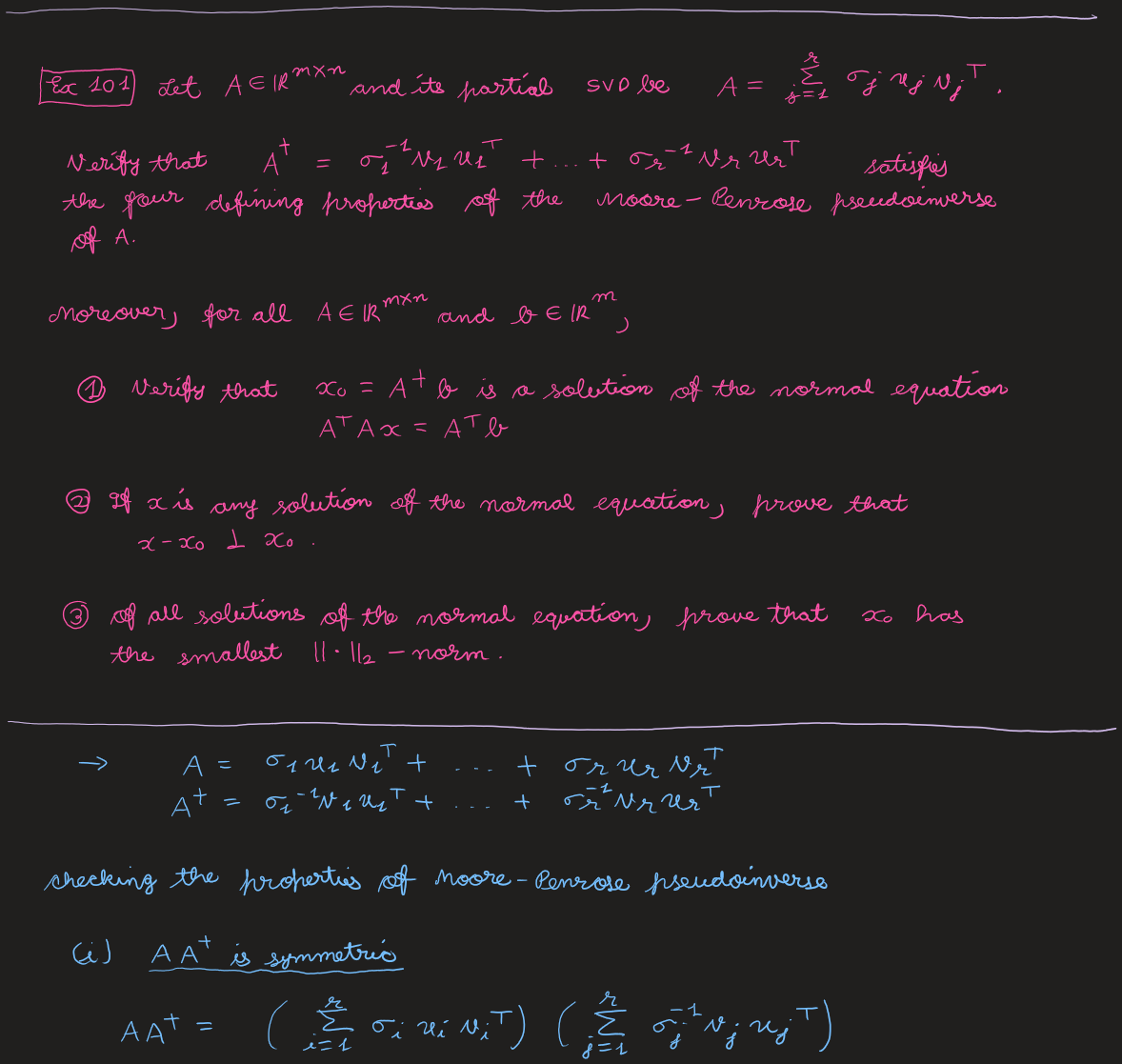
Ex 101
Let \( A \in \R^{m\times n} \) with partial SVD \( A = \sum_{j=1}^{r} \sigma_j u_j v_j\T \). Verify that \[ A^{+} = \sigma_1^{-1} v_1 u_1\T + \dots + \sigma_r^{-1} v_r u_r\T \] satisfies the four defining properties of the Moore–Penrose pseudoinverse of \(A\). Moreover, for all \( A \in \R^{m\times n} \) and \( b \in \R^m \):
- Verify that \( x_0 = A^{+}b \) is a solution of the normal equation \( A\T A x = A\T b \).
- If \(x\) is any solution of the normal equation, prove that \( x - x_0 \perp x_0 \).
- Of all solutions of the normal equation, prove that \( x_0 \) has the smallest \( \|\cdot\|_2 \)-norm.
Solution — verifying the four properties
With \( A = \sigma_1 u_1 v_1\T + \dots + \sigma_r u_r v_r\T \) and \( A^{+} = \sigma_1^{-1} v_1 u_1\T + \dots + \sigma_r^{-1} v_r u_r\T \):
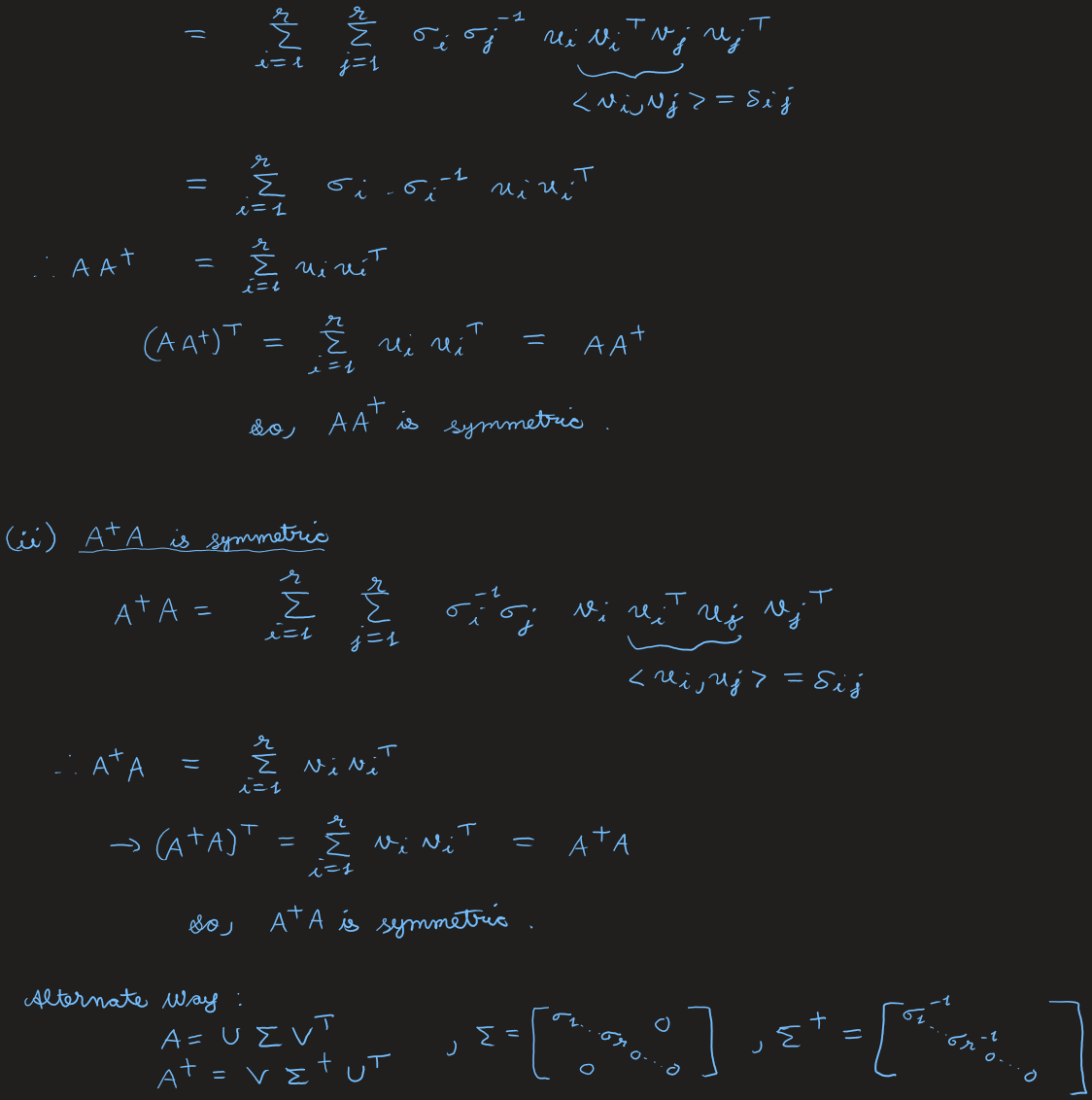
(i) \( AA^{+} \) is symmetric. \[\begin{aligned} AA^{+} &= \Big(\sum_{i=1}^{r}\sigma_i u_i v_i\T\Big)\Big(\sum_{j=1}^{r}\sigma_j^{-1} v_j u_j\T\Big) \\ &= \sum_{i=1}^{r}\sum_{j=1}^{r} \sigma_i \sigma_j^{-1} u_i \underbrace{v_i\T v_j}_{\delta_{ij}} u_j\T \\ &= \sum_{i=1}^{r} \sigma_i \sigma_i^{-1} u_i u_i\T, \end{aligned}\] so \( AA^{+} = \sum_{i=1}^{r} u_i u_i\T \) and \( (AA^{+})\T = \sum_{i=1}^{r} u_i u_i\T = AA^{+} \). Hence \( AA^{+} \) is symmetric.
(ii) \( A^{+}A \) is symmetric. \[ A^{+}A = \sum_{i=1}^{r}\sum_{j=1}^{r} \sigma_i^{-1}\sigma_j v_i \underbrace{u_i\T u_j}_{\delta_{ij}} v_j\T = \sum_{i=1}^{r} v_i v_i\T, \] and \( (A^{+}A)\T = \sum_{i=1}^{r} v_i v_i\T = A^{+}A \). Hence \( A^{+}A \) is symmetric.
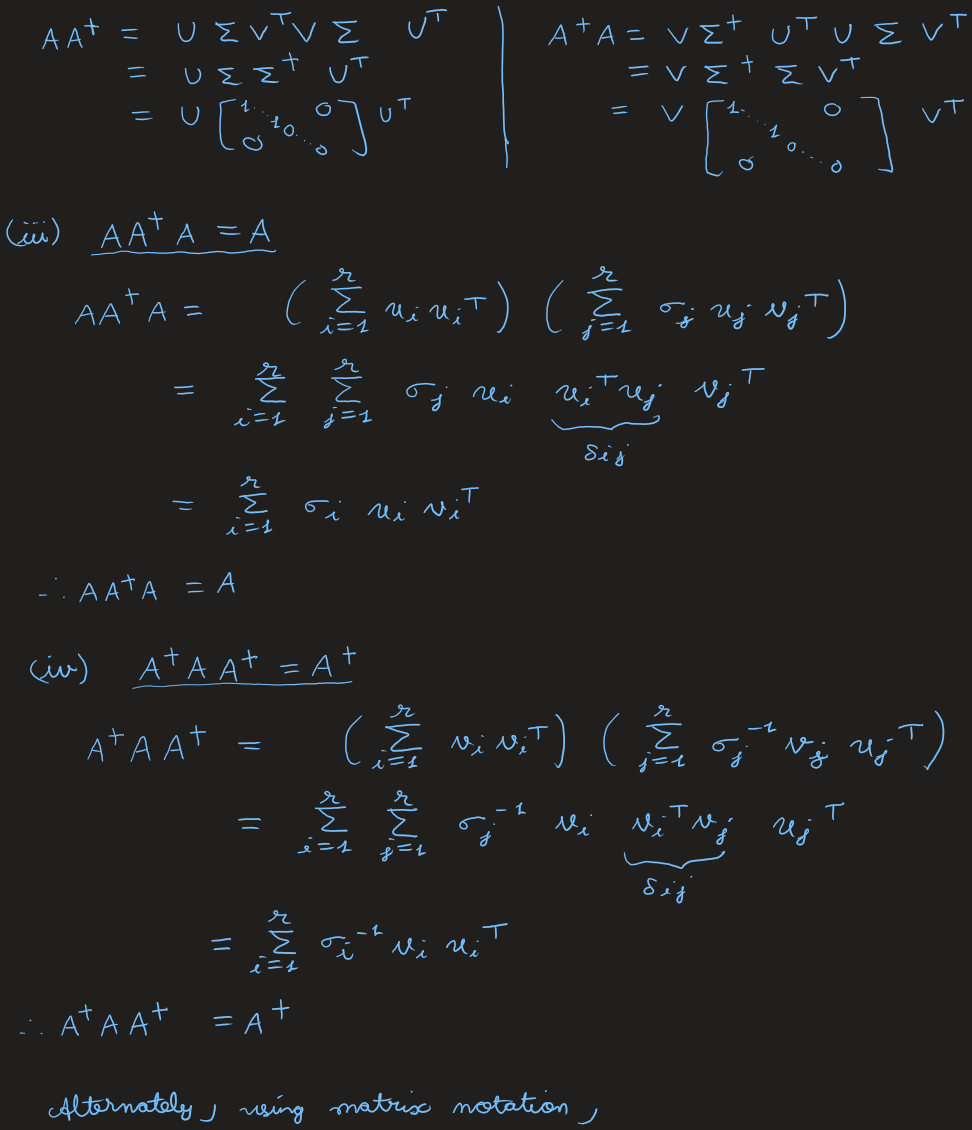
Alternate way. With \( A = U\Sigma V\T \), \( A^{+} = V\Sigma^{+}U\T \), \( \Sigma = \diag(\sigma_1, \dots, \sigma_r, 0, \dots) \), \( \Sigma^{+} = \diag(\sigma_1^{-1}, \dots, \sigma_r^{-1}, 0, \dots) \): \[ AA^{+} = U\Sigma V\T V\Sigma^{+}U\T = U\Sigma\Sigma^{+}U\T = U\begin{bmatrix}1 & & & \\ & \ddots & & \\ & & 1 & \\ & & & 0\end{bmatrix}U\T, \qquad A^{+}A = V\Sigma^{+}\Sigma V\T = V\begin{bmatrix}1 & & & \\ & \ddots & & \\ & & 1 & \\ & & & 0\end{bmatrix}V\T. \]
(iii) \( AA^{+}A = A \). \[\begin{aligned} AA^{+}A &= \Big(\sum_{i=1}^{r} u_i u_i\T\Big)\Big(\sum_{j=1}^{r}\sigma_j u_j v_j\T\Big) \\ &= \sum_{i=1}^{r}\sum_{j=1}^{r} \sigma_j u_i \underbrace{u_i\T u_j}_{\delta_{ij}} v_j\T \\ &= \sum_{i=1}^{r}\sigma_i u_i v_i\T = A. \end{aligned}\]
(iv) \( A^{+}AA^{+} = A^{+} \). \[\begin{aligned} A^{+}AA^{+} &= \Big(\sum_{i=1}^{r} v_i v_i\T\Big)\Big(\sum_{j=1}^{r}\sigma_j^{-1} v_j u_j\T\Big) \\ &= \sum_{i=1}^{r}\sum_{j=1}^{r} \sigma_j^{-1} v_i \underbrace{v_i\T v_j}_{\delta_{ij}} u_j\T \\ &= \sum_{i=1}^{r}\sigma_i^{-1} v_i u_i\T = A^{+}. \end{aligned}\]
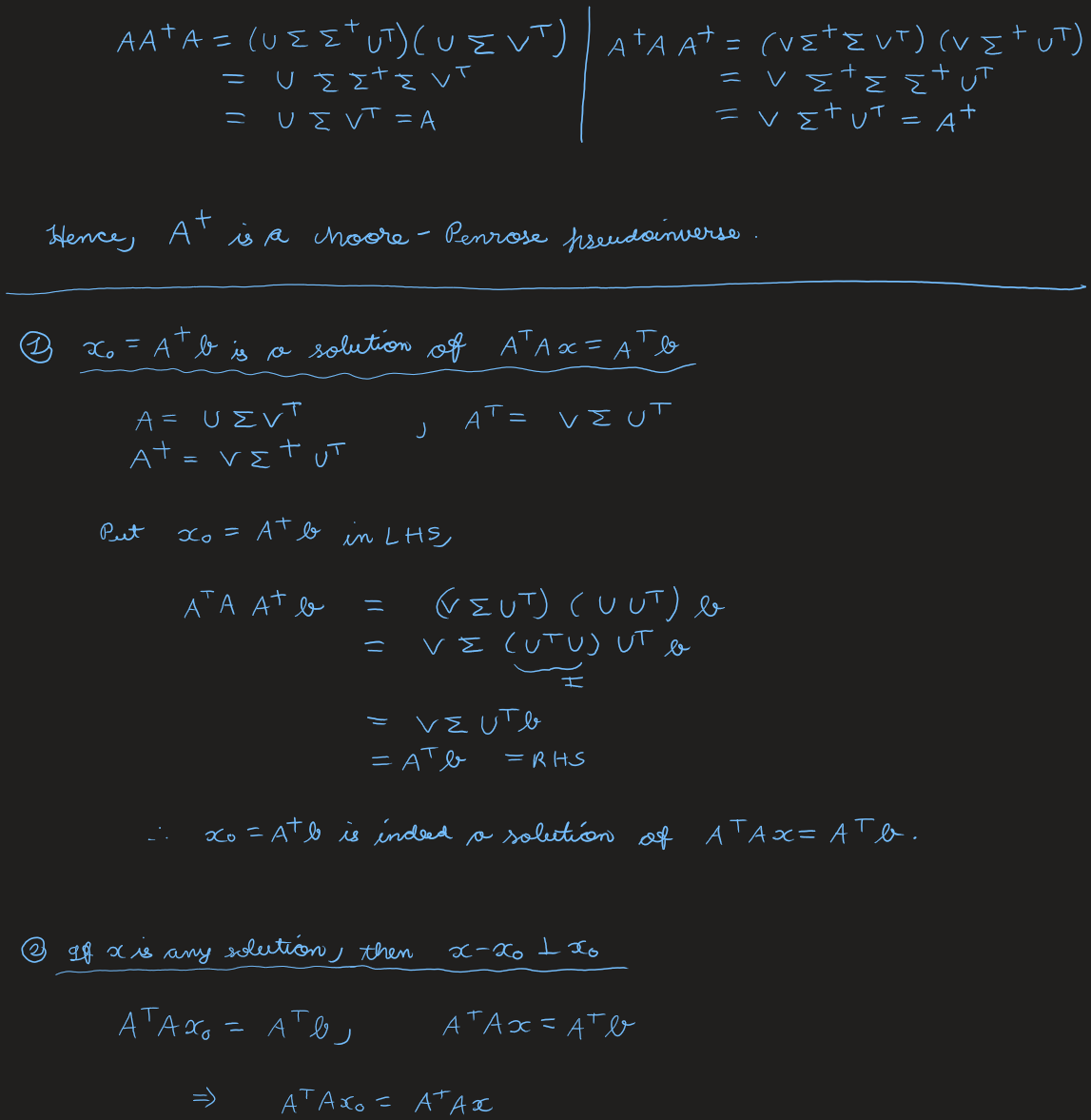
Alternately, in matrix notation: \[\begin{aligned} AA^{+}A &= (U\Sigma\Sigma^{+}U\T)(U\Sigma V\T) = U\Sigma\Sigma^{+}\Sigma V\T = U\Sigma V\T = A, \\ A^{+}AA^{+} &= (V\Sigma^{+}\Sigma V\T)(V\Sigma^{+}U\T) = V\Sigma^{+}\Sigma\Sigma^{+}U\T = V\Sigma^{+}U\T = A^{+}. \end{aligned}\] Hence \( A^{+} \) is a Moore–Penrose pseudoinverse.
Solution — (1) \( x_0 = A^{+}b \) solves \( A\T A x = A\T b \)
With \( A = U\Sigma V\T \), \( A^{+} = V\Sigma^{+}U\T \), put \( x_0 = A^{+}b \) into the LHS: \[ A\T A A^{+}b = (V\Sigma U\T)(UU\T)b = V\Sigma\,\underbrace{(U\T U)}_{I}\,U\T b = V\Sigma U\T b = A\T b = \text{RHS}. \] Therefore \( x_0 = A^{+}b \) is indeed a solution of \( A\T A x = A\T b \).
Solution — (2) \( x - x_0 \perp x_0 \)
If \(x\) is any solution, \( A\T A x_0 = A\T b \) and \( A\T A x = A\T b \), so \( A\T A x_0 = A\T A x \), giving \( A\T A (x - x_0) = 0 \), i.e. \( x - x_0 \in \Null(A) \).
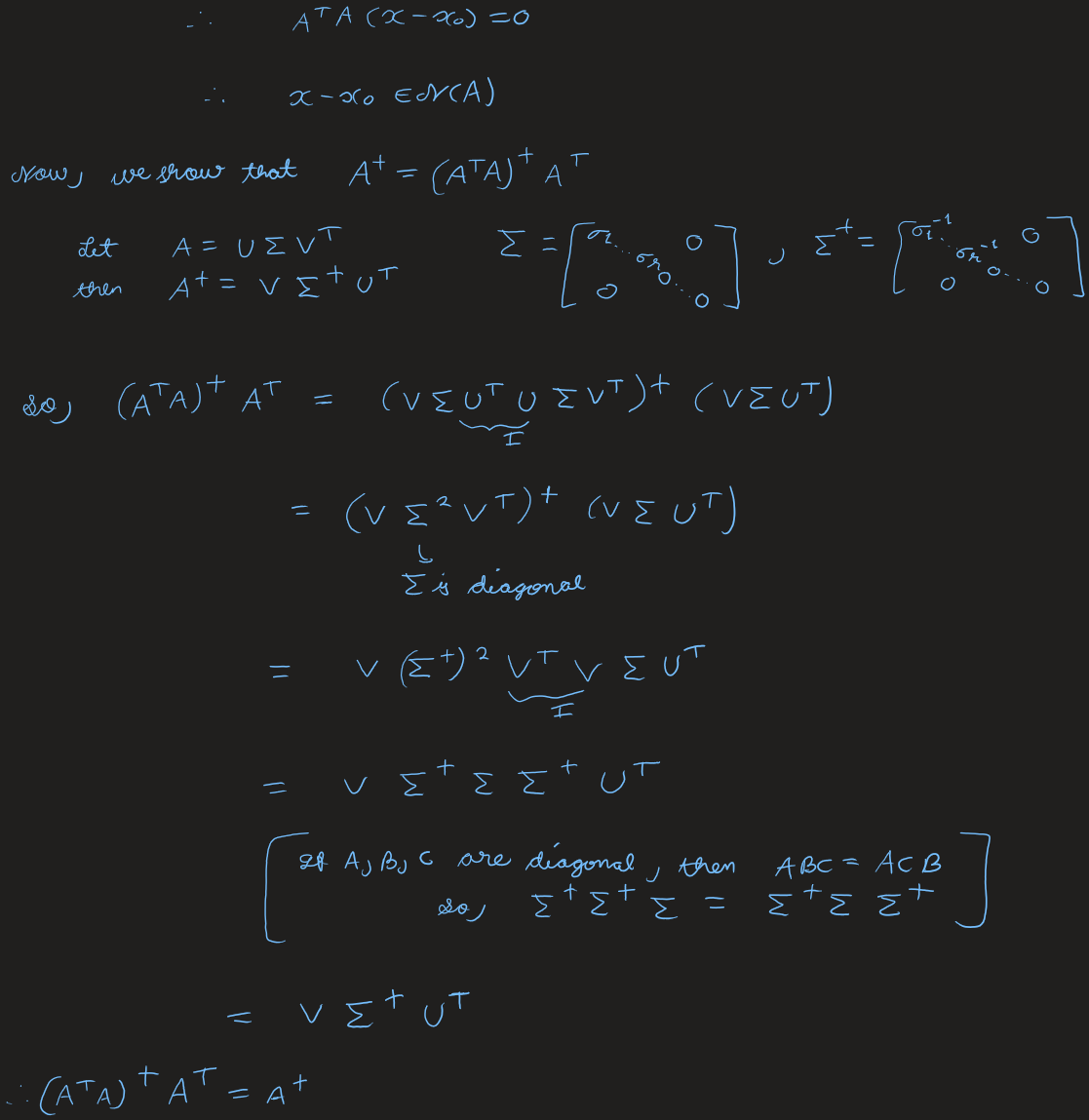
Now we show \( A^{+} = (A\T A)^{+} A\T \). With \( A = U\Sigma V\T \), \( A^{+} = V\Sigma^{+}U\T \): \[\begin{aligned} (A\T A)^{+} A\T &= (V\Sigma U\T U\Sigma V\T)^{+}(V\Sigma U\T) \\ &= (V\Sigma^2 V\T)^{+}(V\Sigma U\T) \\ &= V(\Sigma^{+})^2 V\T V\Sigma U\T \\ &= V\Sigma^{+}\Sigma\Sigma^{+}U\T = V\Sigma^{+}U\T = A^{+}, \end{aligned}\] using that for diagonal \( A, B, C \), \( ABC = ACB \), so \( \Sigma^{+}\Sigma^{+}\Sigma = \Sigma^{+}\Sigma\Sigma^{+} \).
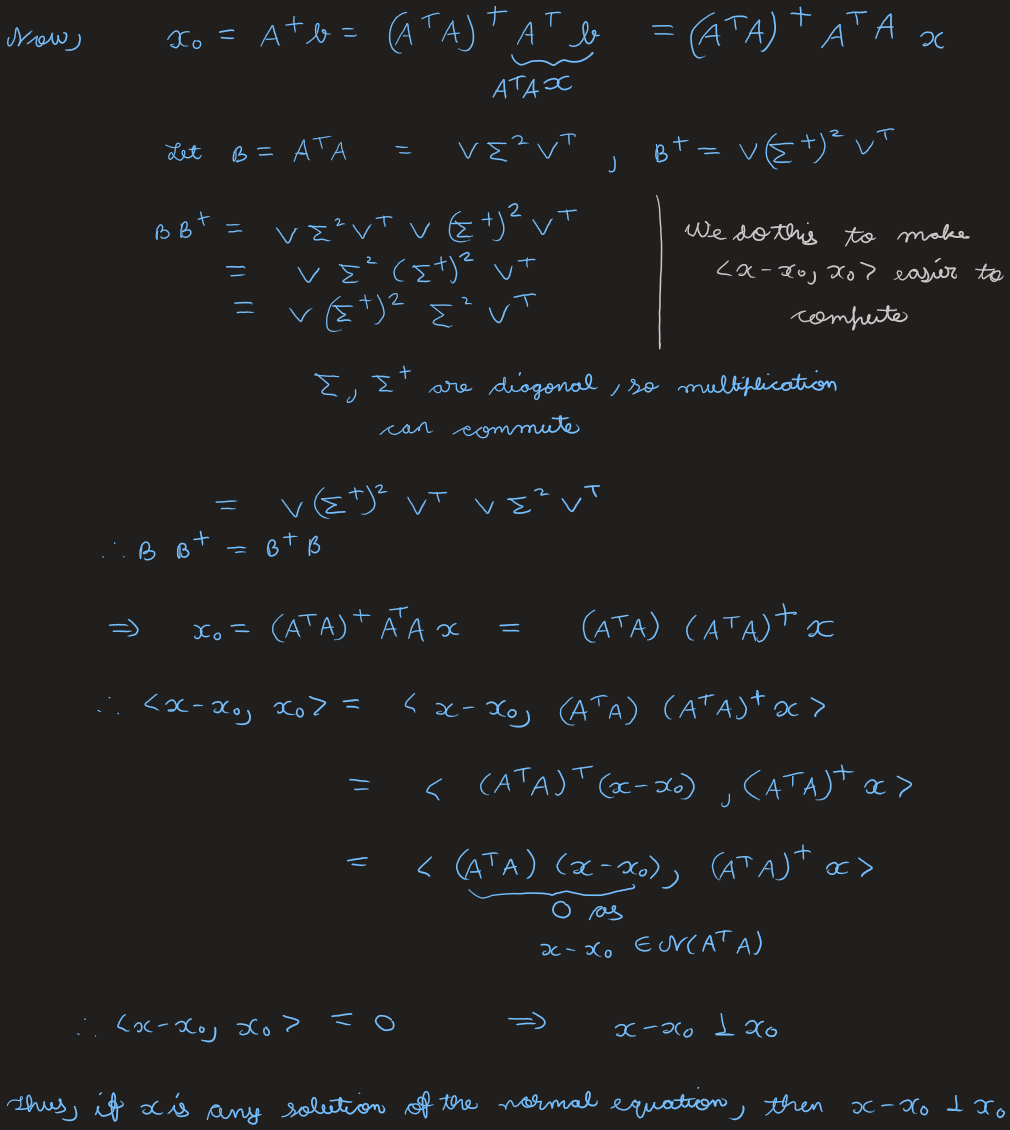
Then \[ x_0 = A^{+}b = (A\T A)^{+} A\T b = (A\T A)^{+} A\T A x. \] Let \( B = A\T A = V\Sigma^2 V\T \), \( B^{+} = V(\Sigma^{+})^2 V\T \). Since \( \Sigma, \Sigma^{+} \) are diagonal (so their products commute), \[\begin{aligned} BB^{+} &= V\Sigma^2 V\T V(\Sigma^{+})^2 V\T \\ &= V\Sigma^2(\Sigma^{+})^2 V\T = V(\Sigma^{+})^2\Sigma^2 V\T = B^{+}B, \end{aligned}\] hence \( x_0 = (A\T A)^{+} A\T A x = (A\T A)(A\T A)^{+} x \). Therefore \[\begin{aligned} \langle x - x_0, x_0 \rangle &= \langle x - x_0, (A\T A)(A\T A)^{+}x \rangle \\ &= \langle (A\T A)\T(x - x_0), (A\T A)^{+}x \rangle \\ &= \big\langle \underbrace{(A\T A)(x - x_0)}_{=\,0\ \text{as } x - x_0 \in \Null(A\T A)}, (A\T A)^{+}x \big\rangle = 0. \end{aligned}\] So \( \langle x - x_0, x_0 \rangle = 0 \implies x - x_0 \perp x_0 \). Thus if \(x\) is any solution of the normal equation, \( x - x_0 \perp x_0 \).
Solution — (3) \( x_0 \) has the smallest norm
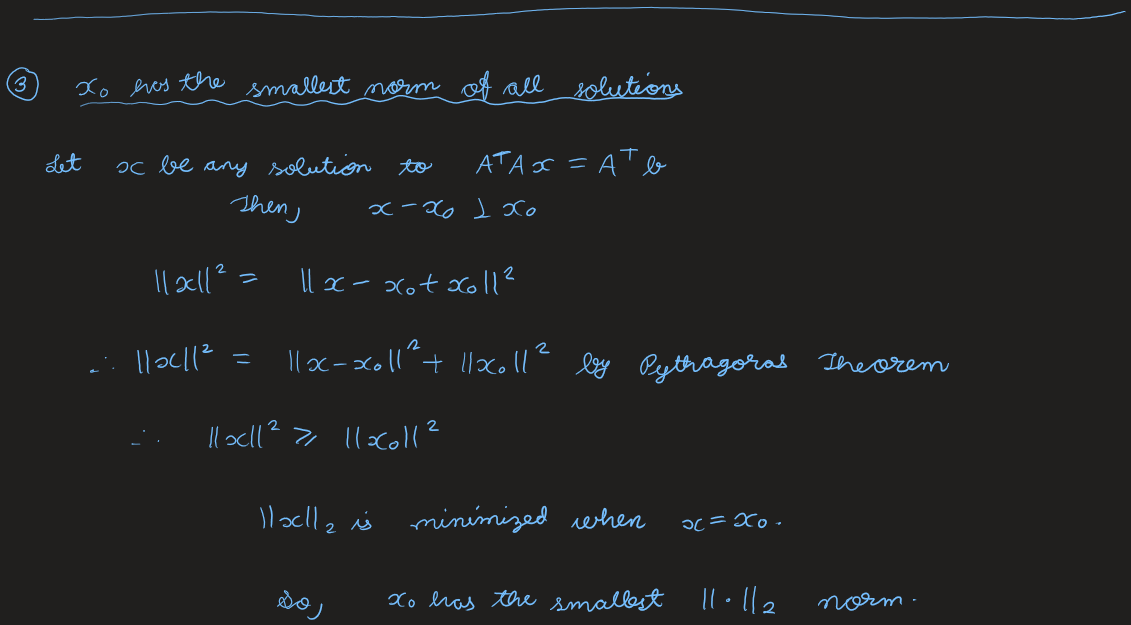
Let \(x\) be any solution to \( A\T A x = A\T b \). Then \( x - x_0 \perp x_0 \), so \[ \|x\|^2 = \|x - x_0 + x_0\|^2 = \|x - x_0\|^2 + \|x_0\|^2 \quad\text{(by the Pythagoras theorem)}, \] hence \( \|x\|^2 \ge \|x_0\|^2 \). So \( \|x\|_2 \) is minimized when \( x = x_0 \); that is, \( x_0 \) has the smallest \( \|\cdot\|_2 \)-norm.
View original handwritten scans — Moore–Penrose pseudoinverse (pages 17–23)